zenpundit.com » 2013

Archive for 2013

NatSec Lit

Wednesday, August 7th, 2013

[ by Charles Cameron — books, Gitmo and Snowden — signing off with a great clip from Three Days of the Condor exhibiting the benefits of reading ]
.

I’m not entirely sure that Fifty Shades of Grey qualifies as Literature, but I think it can squeeze by as Lit — just as I’m not sure the topic of this post has much to do with National Security, but NatSec seems to fit.
.


.

Seriously, though — Carole Rosenberg at the Miami Herald is the go to person for all news Gitmo, and her recent piece, Congressman: ‘Fifty Shades’ popularity shows Guantánamo prisoners are ‘phonies’, is well worth your attention. I’ve selected the choicest cuts for your reading pleasure — and will also recommend John Schwartz‘ NYT piece, Russia for Beginners: A Literary Course for Edward Snowden, further down. Together, they make a feast.

And hang in there — there’s a clip from Condor at the very end…
**

From Gitmo, then:

A member of Congress said Tuesday he disclosed the popularity of the erotic sometimes sadomasochistic series Fifty Shades of Grey among Guantánamo’s most prized prisoners not to titillate but to set straight for their global followers that they were not devout holy warriors passing their Ramadan reading the Quran.

“It demystifies them. It exposes them for who they actually are,” said Rep. Jim Moran, D-Va., in a telephone interview that sought to set straight that the captives in the secretive Camp 7 complex are “not exactly holy warriors. Just the opposite. These people are phonies.” [ … ]

What made the disclosure so odd is that, during media visits to the trailers that house the prison camp’s collection of about 18,000 books, many of them religious, the Defense Department contractor in charge, Milton, says he systematically forbids the circulation of books and videos that are either lascivious or exceptionally violent..

The Herald contacted Moran on vacation after a prison camps spokeswoman, Army Capt. Andi Hahn, checked with the Army officer in charge of the detention center library and replied that the Fifty Shades of Grey series is a “prohibited” book. [ … ]

Moran said he has long favored exposing the Pentagon prisoners to great works of Western literature, and had asked the same questions in the less secretive prisons containing the 150 or so other prisoners, 84 of them approved for release or transfer in 2010. In those prison, the troops responded more generically that detainees who broke the rules get to keep just two library books in their cells while cooperative, communal captives get to borrow eight at a time.  [ … ]

In February, military spokesman said they were forbidden to elaborate on war court testimony that showed Camp 7’s troops seized as banned a previously approved book by ex-FBI Agent Ali Soufan called Black Banners. [ … ]

Another attorney, Carlos Warner, said while his Camp 7 client, Muhammed Rahim, was interested in American popular culture he couldn’t imagine him reading the Fifty Shades of Grey series sometimes referred to as “mommy porn.”

In March, Warner said, he handed Rahim the bestseller fantasy novel American Gods, about a freed prisoner, now being serialized for HBO — and was fully engaged in it.

Because of his enthusiasm, Warner got a card for Rahim from the book’s author, Neil Gaiman. “I hope you enjoy American Gods. It was written before Guantánamo and all this current madness,” the British novelist wrote Rahim in June at Warner’s behest. The lawyer said he plans to show it to Rahim at their next meeting.

American Gods is not an approved book at the detention center library, the prison spokeswoman, Hahn, said in response to a question Tuesday.

**

Meanwhile, regarding Edward Snowden

Edward J. Snowden has the time, and now he has the classics. [ … ]

His Russian lawyer earlier this week left him a shopping bag with books by Dostoyevsky, Chekhov and Nikolai Karamzin to help him learn about Russian reality.

According to news accounts, the lawyer, Anatoly Kucherena, gave his client Dostoyevsky’s “Crime and Punishment,” the tale of law, order and redemption, telling him, “You should know who Raskolnikov was.” He added that the Chekhov was “for dessert,” and also provided him with the writings of Karamzin, a historian, for background on the nation’s development.

One has to ask: Is Dostoevsky really the best choice? Raskolnikov could hardly be expected to cheer up Mr. Snowden. Sonia, the girl whose love saves Raskolnikov’s soul, may remind him of Lindsay Mills, the pole-dancing, exhibitionist girlfriend he left behind. [ … ]

Are there better Russian books to help Mr. Snowden get to know the Russian soul? One could do worse than to read Gogol, whose absurdist short story “The Nose” could help Mr. Snowden understand that living in Russia might not make any more sense than living in the United States. And Tolstoy – well, no matter how much time Mr. Snowden has, he may not have enough time for Tolstoy. [ … ]

Why should Mr. Snowden confine himself to the literature of Russia? After all, Edward Everett Hale wrote a book that must absolutely resonate with Mr. Snowden and his plight: “The Man Without a Country,” whose main figure is tried for treason and cries out before the judge, “I wish I may never hear of the United States again!” Walter Kirn’s “Up in the Air” would continue the travel theme. John le Carré’s George Smiley offers glimpses into Russian life that ring with gloomy authenticity.

The French, who gave us the word ennui and sharpened the concept of existentialism, produced the works that may most help Mr. Snowden adjust to his new life, especially those of Jean-Paul Sartre. What masterpiece better describes his situation than “No Exit”?

**

Reading. It helps:

Boyd and Beyond 2013, 11 & 12 October at Quantico, VA

Tuesday, August 6th, 2013

[by J. Scott Shipman]

Photo credit: Zenpundit

Greetings! Boyd and Beyond 2013 is 66 days from today. Stan and I are assembling a schedule. These are the speakers who are confirmed: Carlos Balarezo & Rob Paterson, Dean Lenane, Bob Weiman, Terry Barnhart, Andrew Dziengeleski, Pete Turner, Marshall Wallace, Alex Olesker and Michael Moore. There is a possibility Jim Burton will be with us this year, but this is not confirmed. Those listed to speak, please send Stan and I an email with your title (even if you’ve already done so) and duration. Most have asked for an hour, but please confirm. If you have a topic and wish to present, please let Stan and I know.

Stan says we we will be in the ‘Friday room” at the Command and Staff College both days, and that parking will be a challenge on Friday due to construction.

If you haven’t RSVP’d, please do so as space will be at a premium.

Cross-posted at To Be or To Do.

A Sign of the Times – in today’s Post

Tuesday, August 6th, 2013

[ by Charles Cameron — on skilled design, and on choosing to purchase influence, elegance or beauty ]
.

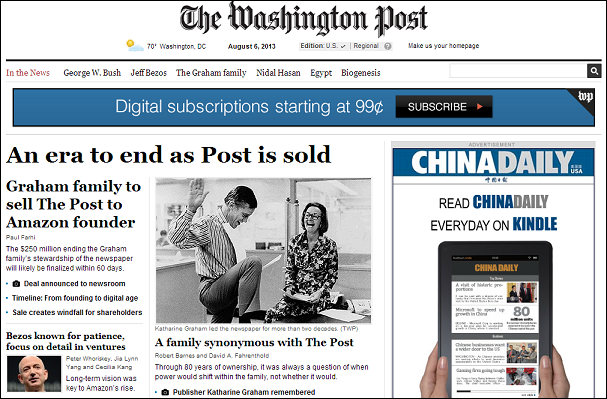
There’s something very neat about this front page:

Okay, okay, Jeff Bezos has bought the Washington Post. But what intrigues me about this front page of today’s digital edition as it appeared on my screen this morning was the way a color photo of Bezos sneaks in (left) below a larger black and while photo of Katharine Graham (center) — while an ad for the China Daily (right) takes up a third of the real estate (right), to be read, mark you, on Bezos’ own Kindle.

So we have today’s future, to coin a phrase, with the “pivot to Asia” and the “pivot to Bezos” right there together — and the “pivot to digital” pretty much a done deal.

**

The price of the Post was $250 million, and plenty of people have talked about what Bezos could have bought instead — and while we’re on the topic of neat design, I couldn’t help but notice that there’s a $250 million penthouse under construction in Monaco, described by HiConsumption as The World’s Most Expensive Penthouse, and that one of the numerous architectural illustrations provided also features a striking lesson on graphics:

What catches my eye here is the parallelism between the window with its center divider and balcony rail (left) with the geometry of the painting on the wall (right) — that’s a brilliant design choice, as the photographer well knows.

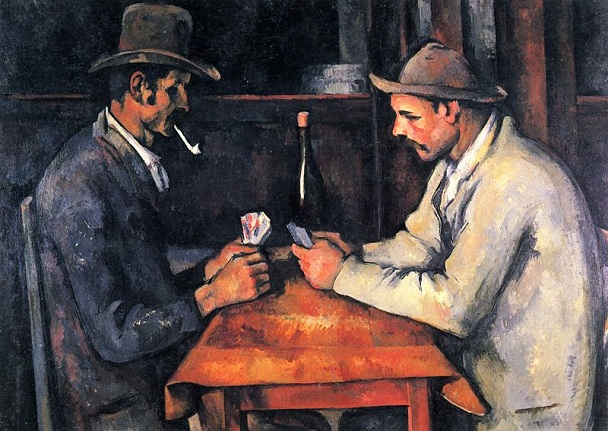
In my dreams I’d prefer my own choice of art-work, frankly — and if I only had $250 million to play with, I’d go for a small craftsman cottage in Pasadena, perhaps — with that luminous $250 million Cezanne to grace one of my walls…

**

That — and the digital Post on Kindle, I suppose.

Blessed are the conflict resolvers II: in dance and song

Monday, August 5th, 2013

[ by Charles Cameron — what can these two stunning performances tell us about conflict and / or peace? ]
.

I’m not sure if I’ve said it here before, but conflict resolution is pretty much the same as peace making, hence my title for both parts of this post, Blessed are the conflict resolvers (Matthew 5.9). In the second part of this post, I’d like to shared with you two stunning and highly stylized situations in which peace and conflict are brought together by sheer art.

Battle as dance, from Carlos Saura‘s Carmen — in the aftermath of a gambling disagreement, the jealous rivalry of two men over the young female lead bursts into violent dance:

And …

The battle of songs, from Breuer and Telson‘s Gospel at Colonus. Oedipus, played here by Clarence Fountain and the Blind Boys of Alabama, at the end of his days, wishes to enter the city of Colonus and find rest and the peace prophesied for him at last — the people of Colonus, knowing him accursed, try to resist him:

**

What can we learn from these two examples of conflict circumscribed within the parameters of art?

For comparison, here are two reports of the stylized Beating Retreat ceremony at the Wagah Border crossing, jointly performed each evening by the Indian Border Security Force and Pakistan Rangers and aptly described as a “synchronized display of stomps and shouts” — with some suggestive comments about the rivalry between the two nations in each.

From Michael Palin:

and from Voice of America:

Blessed are the conflict resolvers I: in three religions

Monday, August 5th, 2013

[ by Charles Cameronpeace making tells us that the goal of the activity is peace, conflict resolution tells us that this goal is not achieved in peace but on the field of conflict ]
.

Michael Lempert‘s book, Discipline and Debate: The Language of Violence in a Tibetan Buddhist Monastery, has a somewhat harsh take on the practice of debate in the education of Buddhist monks. The Introduction begins:

Buddhist ‘debate’ (rtsod pa), a twice-daily form of argumentation through which Tibetan monks learn philosophical doctrine, is loud and brash and agonistic. Monks who inhabit the challenger role punctuate their points with foot-stomps and piercing open-palmed hand-claps that explode in the direction of the seated defendant’s face. I was curious about the fate of this martial idiom in which monks wrangle, curious especially about its apparent disregard for ideals like nonviolence, compassion, and rights that Tibetans like the Dalai Lama have promoted…

For a more “nonviolent” view, see Daniel E. Perdue, Debate In Tibetan Buddhism — and by way of comparison, John Daido Loori‘s account of the Zen equivalent, Cave of Tigers: The Living Zen Practice of Dharma Combat

**

For a comparable Christian form of debate, we can turn to the writings of Peter Abelard, the medieval scholastic (educator and lover of Heloise) who introduced his book Sic et Non — “Yes and No” — in which he selected what are essentially DoubleQuotes from the Early Church Fathers, setting them one against another to display their seeming contradictions, with the following words:

In view of these considerations, I have ventured to bring together various dicta of the holy fathers, as they came to mind, and to formulate certain questions which were suggested by the seeming contradictions in the statements. These questions ought to serve to excite tender readers to a zealous inquiry into truth and so sharpen their wits. The master key of knowledge is, indeed, a persistent and frequent questioning. Aristotle, the most clear-sighted of all the philosophers, was desirous above all things else to arouse this questioning spirit, for in his Categories he exhorts a student as follows: “It may well be difficult to reach a positive conclusion in these matters unless they be frequently discussed. It is by no means fruitless to be doubtful on particular points.” By doubting we come to examine, and by examining we reach the truth.

**

The essence of both the above examples is conflict circumscribed, with the goal of enlightenment.

It’s my impression that Sura 49 verse 13 of the Qur’an implies a similar process, though here it is difference rather than conflict that is the starting point, and mutual understanding that is the goal:

O mankind, We have created you male and female, and appointed you races and tribes, that you may know one another. Surely the noblest among you in the sight of God is the most godfearing of you. God is All-knowing, All-aware.

That’s AJ Arberry‘s translation. Yusuf Ali‘s draws out more of the implications:

O mankind! We created you from a single (pair) of a male and a female, and made you into nations and tribes, that ye may know each other (not that ye may despise (each other). Verily the most honoured of you in the sight of Allah is (he who is) the most righteous of you. And Allah has full knowledge and is well acquainted (with all things).

**

In the second part of this post, I’ll present two extraordinary examples of conflict presented as art…


Switch to our mobile site