zenpundit.com » 2013

Archive for 2013

Of short stories and a dark sacrament

Monday, July 8th, 2013

[ by Charles Cameron — a powerful tale of “de-radicalization” as metanoia ]
.

Munir

.

Munir, by his own account, was drifting under the influence of various radical Muslim clerics, Abu Hamza al-Masri among them. One’s never too sure about the exactness of journo quotes, but here’s one media report to be going on with:

“Look who I ended up with,” he said.
“We had a fantastic relationship. It was a match made in heaven – his anger, my lack of self-esteem.
“He wanted me to die on the battlefield.”

It was, mashallah, not to be — Munir had a change of mind and heart, and now works to offer potentially susceptible British youth alternatives to the “al-Qaeda narrative”.

Here is his story in two brief tweets:

Sources:

  • Tweet 1: I once held a spoon
  • Tweet 2: That same spoon gouged
  • **

    That little double event — the holding of a spoon, the revelation of its invisible history — I am calling a dark sacrament. I draw the word “sacrament” my own theological background, but also from Joseba Zulaika‘s analysis of Basque terrorism in his fine book Basque Violence: Metaphor and Sacrament, wherein he quotes GB Ladner:

    The sacrament is altogether a very different kind of symbol: it not only signifies, but also effects what it symbolizes.

    I call this passing of the spoon a dark sacrament in two interwoven but opposite senses. The one who gave Munir the spoon intended it as a gesture making and marking a symbolic connection between Munir himself and its history, a gift of intensification in the dark religion of terror which calls on Islam for its justification.

    And yet it was also sacramental in another sense entirely from the one intended: it reached deep enough into that darkness to turn Munir himself towards the light — Islam rediscovered as the struggle of the soul to reorient from ignorance towards the Niche for Lights mentioned in the Verse of Light in the Qur’an, 24.35:

    God is the Light of the heavens and the earth; the likeness of His Light is as a niche wherein is a lamp (the lamp in a glass, the glass as it were a glittering star) kindled from a Blessed Tree, an olive that is neither of the East nor of the West whose oil wellnigh would shine, even if no fire touched it; Light upon Light; (God guides to His Light whom He will.) (And God strikes similitudes for men, and God has knowledge of everything.)

    Note those two last sentences: God strikes similitudes for men, so that each moment may be a signpost if we do but see it. And God guides to His Light whom He will.

    **

    Professional writers naturally have an affinity for all kinds of form, from the epic epic via the novel, novella, short story, sestina and sonnet to the haiku, and Twitter has unsurprisngly engaged their imaginations. Thus the New Yorker Fiction account, @NYerFiction, has been running a short story in tweets by Jennifer Eagan, while Teju Cole, more to my taste, has posted Seven short stories about drones in a tweet apiece.

    But those are prize-winning professional writers, which as far as I know Munir makes no claim to be: he is simply offering us his personal story, unvarnished — yet his effort effortlessly matches theirs. Here is a signal to myself and to the rest of us who try to understand radicalization, CVE and de-radicalization: that true epiphanies — sacramental signs, sacred moments — unleash a power into the system that no amount of calculation could predict.

    Mostly it’s religion, now and then it’s sports

    Sunday, July 7th, 2013

    [ by Charles Cameron — beheadings and the questions they raise ]
    .

    **

    Tim Furnish, friend of this blog, had a piece titled Beheading in the Name of Islam in the Middle East Quarterly back in 2005, in which he wrote:

    The February 2002 decapitation of Wall Street Journal reporter Daniel Pearl, true to its intention, horrified the Western audience. Chechen rebels, egged on by Islamist benefactors, had adopted the practice four years earlier, but the absence of widely broadcast videos limited the psychological impact of hostage decapitation. The Pearl murder and video catalyzed the resurgence of this historical Islamic practice. In Iraq, terrorists filmed the beheadings of Americans Nicholas Berg, Jack Hensley, and Eugene Armstrong. Other victims include Turks, an Egyptian, a Korean, Bulgarians, a British businessman, and a Nepalese. Scores of Iraqis, both Kurds and Arabs, have also fallen victim to Islamist terrorists’ knives. The new fad in terrorist brutality has extended to Saudi Arabia where Islamist terrorists murdered American businessman Paul Johnson, whose head was later discovered in a freezer in an Al-Qaeda hideout.

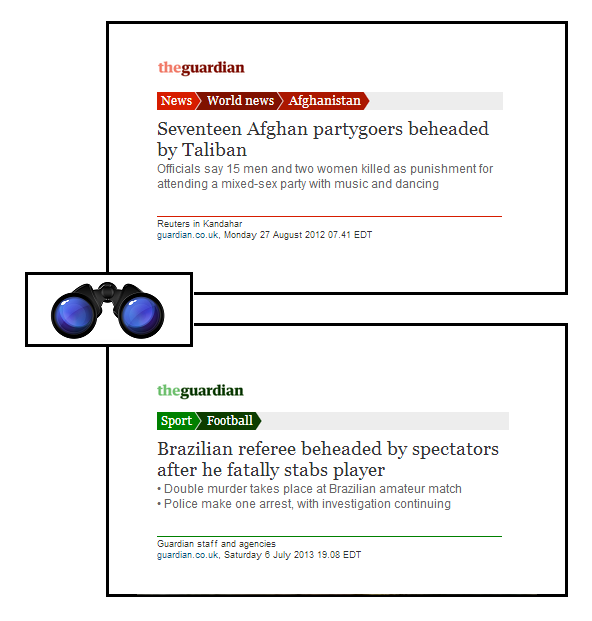
    For myself, convinced as I am that perceived, preached or proclaimed divine endorsement for such killings plays a major role in facilitating them, the existence of what are overtly at least non-religious examples of the same brutal behavior are valuable, albeit humanly distressing, for the questions they raise:

  • is the brutal behavior in question a bestial aspect of human nature in general, and religion merely a thin veneer with which it sometimes conveniently clothes itself?
  • or are sports in some way alternative modalities of group transcendence — and thus effectively religious in their essence?
  • **

    Bryan Alexander, another friend, comments today on a related story at his gothic-themed blog, Infocult, under the heading When sports fans attack, Russian remix.

    DoubleQuote Sources:

  • Seventeen Afghan partygoers beheaded
  • Brazilian referee beheaded
  • Where’s Ms. Waldo?

    Sunday, July 7th, 2013

    [ by Charles Cameron — on two technologies for human dot-connection ]
    .

    How long would it take you to find this particular woman:

    in this crowd, if you already had another photo of her?

    Click here and give it a try.

    Next question: how long would it take the best pattern recognition software in the world?

    For bonus points: how many cameras like this are there in the world, who has access to that kind of software, what countries are cameras and software in, what kinds of agencies use them, under whose supervision, how easily hacked — and how many such photos will have been taken, grand total, by the end of 2013?

    I don’t have even a hazy idea of the answers. I don’t even know where in the photo the woman in the headband can be found. I imagine there are export controls on both cameras and software, I suspect they can be circumvented…

    **

    As I noted in a comment here three weeks ago:

    Green party politician Malte Spitz sued to have German telecoms giant Deutsche Telekom hand over six months of his phone data that he then made available to ZEIT ONLINE. We combined this geolocation data with information relating to his life as a politician, such as Twitter feeds, blog entries and websites, all of which is all freely available on the internet.
    .
    By pushing the play button, you will set off on a trip through Malte Spitz’s life. The speed controller allows you to adjust how fast you travel, the pause button will let you stop at interesting points. In addition, a calendar at the bottom shows when he was in a particular location and can be used to jump to a specific time period. Each column corresponds to one day.

    You can give that one a whirl, too: feel free to zoom in and out.

    **

    Happy trails!

    Book Review at Pragati: The Strategy Bridge by Colin Gray

    Friday, July 5th, 2013

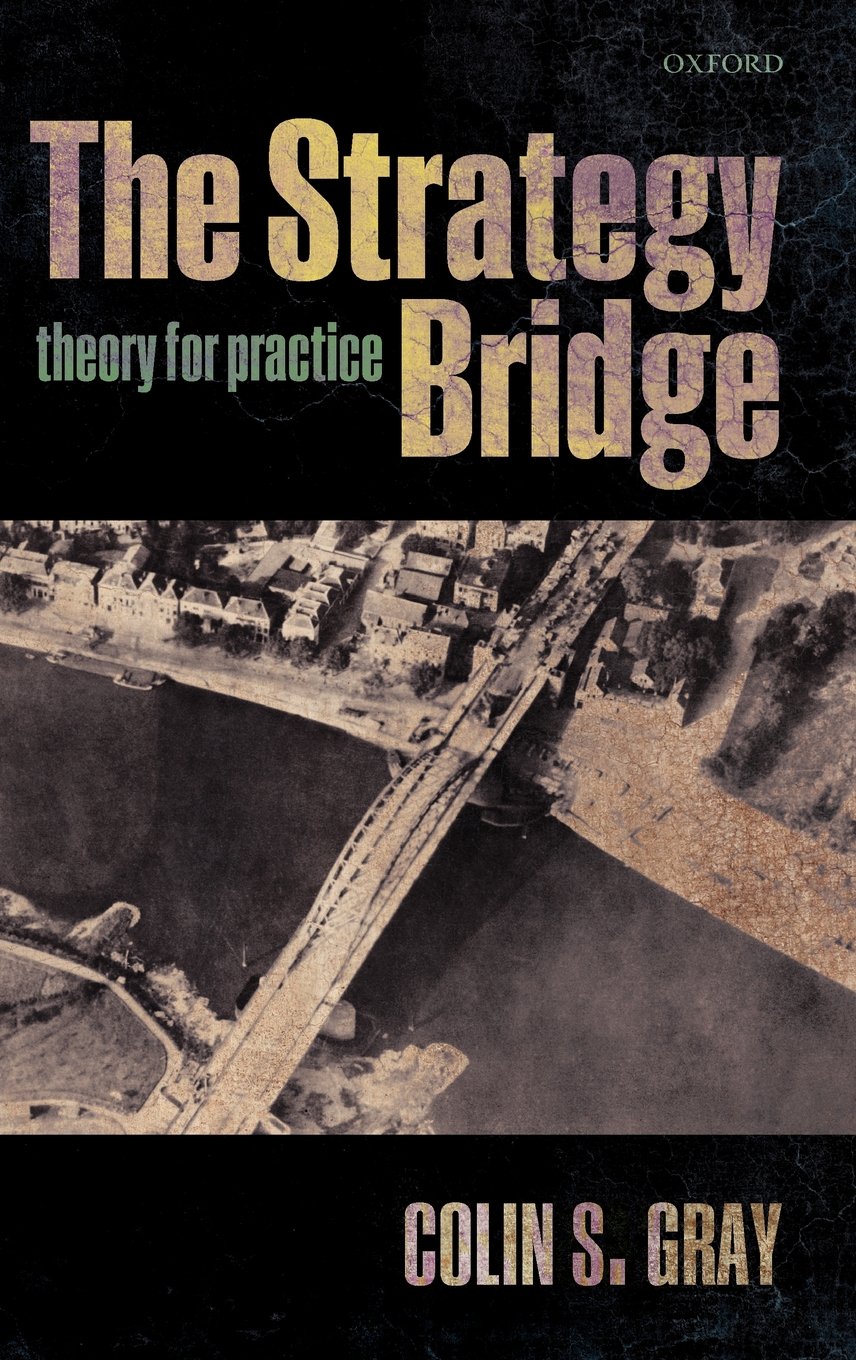
    I have a new book review up at Pragati Magazine this morning, The Strategy Bridge:Theory for Practice by Colin S. Gray which is a must read book for any serious student of strategy.

    Pragati, which is a national interest and policy magazine for India is starting to turn greater attention towards the subject of strategy and is also running another article in the same issue on strategy and the Maoist insurgency and recently on Indian grand strategy.

    A Bridge over Troubled Waters

    The title of The Strategy Bridge is also Gray’s operative metaphor, both for the purpose of strategy and the role of the strategist himself that represents the dialectical dynamic of war and strategy-making, the latter being a shared enterprise, save for some extreme historical outliers where strategy was vested in one man, like the regimes of Napoleon and Adolf Hitler. Strategy is the ‘bridge’ that must be built between policy determined by a national leadership and the operational and tactical behaviors of the military and other arms of national power. The strategist “mans the bridge”, orchestrating all of the elements within a master strategic concept and managing the iterative relationship.

    Gray writes “The function of the military strategist, his unique raison d’etre, is to ensure that policy and the military instrument are purposefully connected… The strategist must understand the whole nature of a conflict, including war and warfare if antagonism has escalated thus far, because subject to political control, he has the duty of care over the entire competitive performance of the security community… The mission of the military strategist is to decide how the enemy is to be defeated. It is his task to invent a theory of military victory. That theory has to be expressed in and revealed in plans, which are contingent predictions of an extended kind, and must be commanded by generals to whom the strategist delegates some restricted command authority. Whether or not the strategist wishes or is able to function as a general also, must vary with historical circumstances”

    ….The Strategy Bridge is subtitled “Theory for Practice” because it is intended as a serious work of theory, a framework for understanding enduring principles of strategy so that a practitioner can thoughtfully apply them in making strategies for the specific context in which they find themselves to provide correct guidance for the operational planners and tacticians who will execute it. Consequently, Gray has not written an introductory text for a novice student but an insightful book for the strategic practitioner of journeyman experience – field grade officers, senior intelligence and foreign policy analysts, academic strategists, think tank researchers and national security advisers to senior government officials – who have a store of knowledge of their own. Hence the repeated invocation of “the bridge” metaphor by Gray; his primary audience are the people “doing strategy” and their success or failure “manning the bridge” will help determine the degree to which government purpose remains connected to action or whether the whole business will go off the rails into a quagmire, as it too often does. 

    Read the rest here.

    For the Fourth of July: The Once and Future Republic?

    Thursday, July 4th, 2013

    Ahem….”I told you so“.

    “Congress intended to allow the intelligence communities to access targeted information for specific investigations. How can every call that every American makes or receives be relevant to a specific investigation?”

                                                                 – Representative James Sensenbrenner (R-Wisconsin)
                                                                     A primary author of The Patriot Act 

    “We have not yet seen any evidence showing that the NSA’s dragnet collection of Americans’ phone records has produced any uniquely valuable intelligence. Gen. Alexander’s testimony yesterday suggested that the NSA’s bulk phone records collection program helped thwart ‘dozens’ of terrorist attacks, but all of the plots that he mentioned appear to have been identified using other collection methods. The public deserves a clear explanation”

                                                                     – Senators Ron Wyden (D- Oregon) and Mark Udall (D- Colorado)

    “What I learned from our journalists should alarm everyone in this room and should alarm everyone in this country….The actions of the DoJ against AP are already having an impact beyond the specifics of this particular case. Some of our longtime trusted sources have become nervous and anxious about talking to us, even on stories that aren’t about national security. And in some cases, government employees that we once checked in with regularly will no longer speak to us by phone, and some are reluctant to meet in person. This chilling effect is not just at AP, it’s happening at other news organizations as well”

                                                                   – Gary Pruitt, President of the Associated Press 

    “The people who are worried about privacy have a legitimate worry….But we live in a complex world where you’re going to have to have a level of security greater than you did back in the olden days, if you will. And our laws and our interpretation of the Constitution, I think, have to change.”

                                                                  – Michael Bloomberg, Mayor of New York City 

    “One-party autocracy certainly has its drawbacks. But when it is led by a reasonably enlightened group of people, as China is today, it can also have great advantages.”

                                                                    -Thomas Friedman, NYT Columnist 

    “Toll records, phone records like this, that don’t include any content, are not covered by the fourth amendment because people don’t have a reasonable expectation of privacy in who they called and when they called, that’s something you show to the phone company. That’s something you show to many, many people within the phone company on a regular basis.”

                                                                     – James Cole, Deputy Attorney-General 

    “In the abstract you can complain about Big Brother and how this is a program run amok, but when you actually look at the details, I think we’ve struck the right balance.”

                                                                     -Barack Obama, President of the United States 

    While we need intelligence services, including the formidable collection capacity of the NSA, we don’t need a mammoth repository of information being continually compiled on every American, held in perpetuity by the US government.

    First, the mere existence of so massive a database on the data of all Americans is itself a critical strategic vulnerability and a potential risk to the national security of the United States because it centralizes for any would be spy or hacker not just anything, but virtually *everything* they would want to know about *everyone*. The greatest testament against the strategic wisdom of this scheme from a counterintelligence perspective is the erstwhile Mr. Edward Snowden – breach just one security regime and you walk away with the whole store or as much of the store as you have time and brains to snatch.

    How many Snowdens have we *not* heard about because they were quietly fired by a contractor? How many other Snowdens working for foreign intelligence services eluded government detection and got away with who knows what?  Or are still doing it now?

    Not exactly a resilient system from a cybersecurity perspective, is it?

    What the USG has done here is not dumb. It is fucking dumb with a capital F. Sometimes we get so caught up from a technical viewpoint in what we might be able to do that no one stops and seriously considers if we should do it. From such unasked questions come the unwanted second and third order effects we live to rue.

    Unless, of course,  building a draconian comprehensive digital dragnet for a  “leaky system” is what was desired in the first place. If so, bravo gentlemen.

    Which brings us to the second point: the surveillance state as currently configured in law with the legal equivalent of string and chewing gum is inimical to the long term survival of the United States as a constitutional Republic. This is not an attack on any particular person or politician or three letter agency. It’s a hard world filled with extremely bad men who would do us lasting harm, so we need our spooks, but the spooks need proper constitutional boundaries set by our elected representatives in which to operate and somewhere in the past decade we have crossed that Rubicon.

    The United States of America has had a historically remarkable run of 237 years of good government and in all that time the system failed us only once. That one time cost the lives of approximately 630,000 Americans.

    On a level of moral and political legitimacy, we have created a bureaucratic-technological machine, a sleepless cyber  J. Edgar Hoover on steroids that contradicts our deeply held political values that define what America is and aspires to be. There is no way to reconcile cradle-to-grave digital dossiers on the 24/7 life of every American with the provisions of the US. Constitution. Really, an ever-watching state was not in the cards at our Constitutional Convention, even with the delegates like Alexander Hamilton who privately thought George Washington might make a fine King.

    On a more pragmatic level, in creating the SIGINT-cyber surveillance state we have made not an idiot-proof system, but an idiot-enabling one that represents an enormous potential reserve of power that will be an unbearable temptation for misuse and abuse. The long, bloody and sordid record of human nature indicates that someone, eventually, will not be able to resist that temptation but will be smart enough to get away with it. If we are greatly fortunate, it will be a lazy person of limited vision looking merely to enrich themselves and their friends. Or a malevolent minor bureaucrat like Lois Lerner looking to punish “the little people” who raised her ire.  If we are unlucky, it will be a gifted figure of ill intent and outsized ambitions, an American Caesar.

    Or an American Stalin.

    In the long term, our Democracy will not be healthy when the government – that is, the Executive – monitors everyone and stores everything  we do forever. While most of us are not that interesting, reporters, public figures, newspaper publishers, members of Congress, aspiring politicians, their campaign donors,  judges, dissenters, writers and so on are very interesting to people in power. The Congress, for example, cannot do it’s job properly when it’s cloakroom is bugged and their email is read anymore than can the editorial office of the Associated Press. What we have built, if it existed in a foreign country, would be frankly described as a “Deep State.  Nations with deep states are not pleasant places to live and they usually do not work well. At best, they look like Russia and Turkey, at worst they look like Pakistan and Iran.

    Rolling the surveillance state back to targeting foreign enemies, it’s proper and constitutional role, instead of every American citizen – yes, we are all, every man, woman and child of every race, creed, color and political persuasion being treated as potential enemies by the Federal government – is up to us and only us.  Tell your Congressman, your Senator and the President what you think in a respectful and thoughtful way – and then make this an issue that decides your vote.

    If we do nothing, we have no one to blame but ourselves for what comes next. We can at least console ourselves with pride in the fact that the US had a good go at making freedom work unequaled in world history, but that democracy may had had it’s time.  Others in the distant future, may profit from our example the way we learned from Athens, Rome and Britain. Or we can leave while the door still remains open.

    Enjoy your Fourth.

                                                    “Well, Doctor, what have we got, a republic or a monarchy?”

                                                                          – Mrs. Powell

                                                 ” A Republic, if you can keep it”

                                                                          – Benjamin Franklin
                                                                             Signer of the Declaration of Independence
                                                                             Delegate, Constitutional Convention


    Switch to our mobile site