zenpundit.com » 2013

Archive for 2013

Heavy breathing on the line: The words of the prophets are written in the circuit switching

Tuesday, June 25th, 2013

[dots connected by Lynn C. Rees]

Sigh

Sigh

What did Lucius Aemilius Paullus know and when did he know it?

The path inaugurated by that question follows a specific route. A route is lit up by every move you make and every step you take.

At least if online.

In the beginning there was the circuit…

(more…)

Heavy breathing on the line: Boyd and the hare

Sunday, June 23rd, 2013

[dots connected by Lynn C. Rees]

Sigh

Sigh

? 1 ?

? Raises question ?

? 2 ?

What did Lucius Aemilius Paullus know and when did he know it?

? 3 ?

Ask Colonel John Boyd, USAF (1927-1997)

? 4 ?

Namedrop John Boyd

What do most respondants think?

? 5 ?

Naive OODA Loop

? 6 ?

Uncritical Insight

John Boyd is a cheerleader jumping up and down on the sidelines chanting “faster! Faster!! FASTER!!!”.

? 7 ?

Uncritical Insight (cont.)

This reduces Boyd to:

  1. Go fast.
  2. Go faster.
  3. Go ludicrous speed.
  4. Profit!!!

? 8 ?

? – Raises Question  – ?

Is this man a cheerleader?

? 9 ?

? and ?

? and ?

? 10 ?

Critique

NO

? 11 ?

Notice
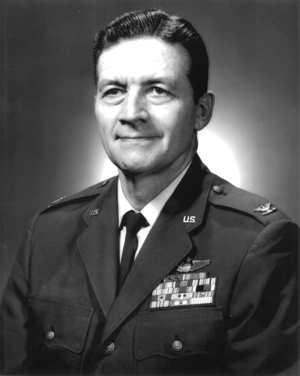
No

? 12 ?

Key Asymmetry

When Boyd smiles, he’s 100 million light years away from being a cheerleader.

? 13 ?

Key Asymmetry (cont.)

If a Boyd particle barely brushed a cheerleader particle, it would annihilate it, leaving behind nothing but:

  1. a tremendous burst of energy
  2. plans for a better fighter plane than the F-35 at 1/1,000,000th the cost.

? 14 ?

Critical Insight

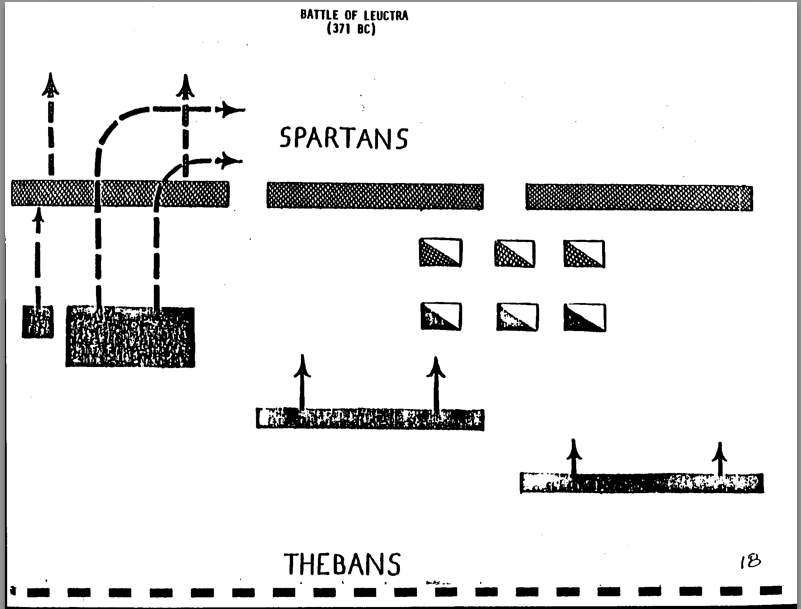
To understand Boyd, understand the battle of Leuctra (371 B.C.)

? 15 ?
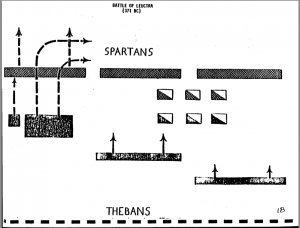
Leuctra

? 16 ?

Message

Boyd argued victory came by creating of a fatal disconnect between enemy and reality through:

  • mental isolation
  • moral isolation
  • physical isolation

? 17 ?

Message (cont.) 

All three are critical to the originality of Boyd’s thought:

Boyd was thinking outside the box.

? 18 ?

Message (cont.) 

This box:
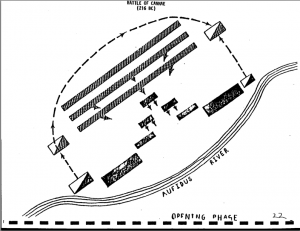
Cannae

? 19 ?

Message (cont.) 

More particularly, this box:
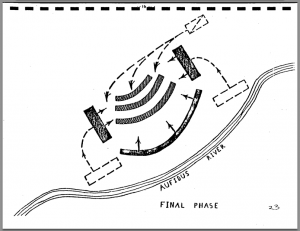
Cannae

? 20 ?

Message (cont.)

Battle of Cannae (216 BC)

Hannibal Barça put 50,000 or so Roman legionaries inside the box.

? 21 ?

Message (cont.)

Few Romans ever thought outside that box again.

? 22 ?

Problem

The physical kill box of Cannae became the mental kill box that military thinkers of the nineteenth century and early twentieth century kept their brains in.

? 23 ?

Problem (cont.)

This is your brain:
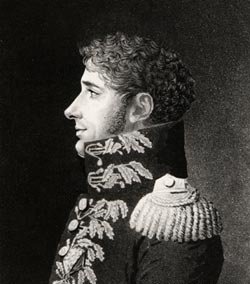
Baron Antoine Henri de Jomini

? 24 ?

Problem (cont.)

This is your brain on Cannae:

Schlieffen

? 25 ?

Worse

Schlieffen, Chief of the Great General Staff of the Second Reich from 1893-1906, was obsessed with Cannae.

He even wrote a book on it.

? 26 ?

Worse (cont.)

Schlieffen used an exhaustive checklist when planning future military operations.

? 27 ?

Worse (cont.)

  1. Does my plan destroy the enemy army like Buonoparte?

? 28 ?

Worse (cont.)

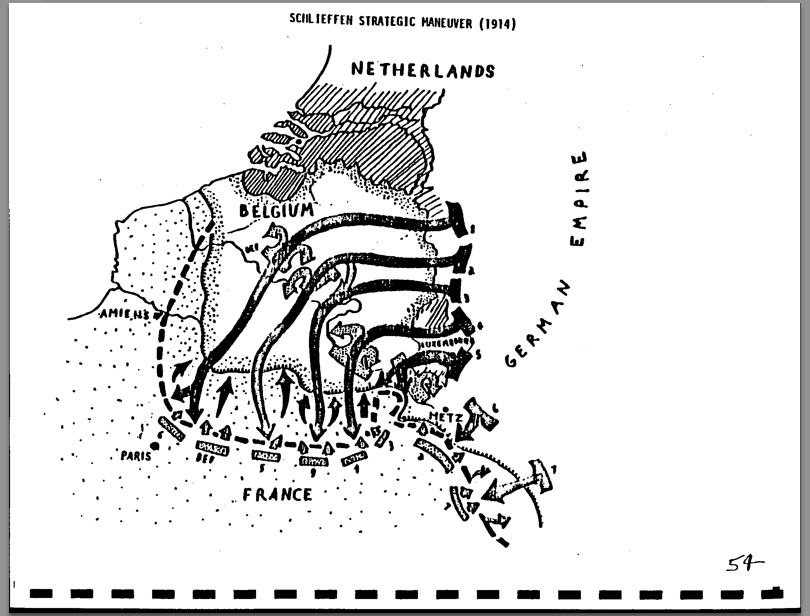
Satisfying those stringent requirements led to the Schlieffen-Moltke Plan:
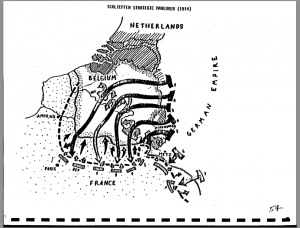
Schlieffen Plan

? 29 ?

Worse (cont.)

Its results were mixed.

? 30 ?

Critique

Schlieffen’s plan failed because it only aimed at physical annihilation of Franco-British forces.

? 31 ?

Critique (cont.)

It’s moral and mental isolation (or annihilation) components were few or vestigial.

This absence dominated the Western Front for the next three years.

? 32 ?

First Cut

Boyd suggested that the German development of infiltration techniques in the later half of the war countered this.

Instead of the long bombardments château generals thought would physically annihilate the enemy trench line, barbed wire, and fortifications…

? 33 ?

First Cut (cont.)

The artillery barrage that accompanied German infiltration attack was sudden and unexpected…

…providing suppression as much through sudden mental or moral disorientation as through physical destruction.

? 34 ?

First Cut (cont.)

Instead of the physical impact of large ranks of infantrymen trudging across No Man’s Land…

Small teams of infiltrators dribbled across the lines in small groups, causing moral and mental derangement by attacking the enemy from the flank or rear in unexpected places at surprising times.

? 35-36 ?

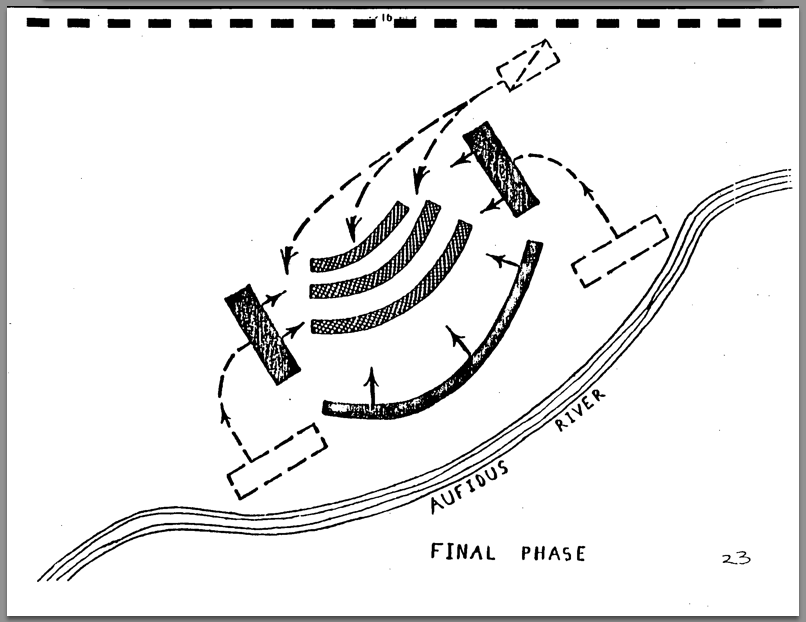
Traditional Greek Order of Battle vs Leuctra’s Order of Battle

Leuctra

? 37 ?

Battle of Leuctra

Boyd referred back to Leuctra rather than Cannae as a guide:

Epaminondas‘ seemingly simpler act of stacking his left 50 deep and weakening his right was just as effective as Hannibal’s more technically complex but brittle double envelopment at Cannae.

? 38 ?

Battle of Leuctra (cont.)

Epaminondas created a fatal disconnect between Spartiate and reality through a balanced attack:

  • physical isolation (more husky Boeotians to beat on the Spartan right)
  • moral isolation (that’s against the rules!)
  • mental isolation (the best Boeotian troops were on the left, not, as was tradition, on the right)

? 39 ?

Key Take Away

Epamimondas won a more efficient victory than Hannibal:

He mauled the Spartans just as effectively as Hannibal mauled the Romans …

Without the enormous luck and complexity involved in pulling off a double envelopment.

? 40 ?

And that’s why the NSA records (meta)data on all Americans.
Book review: Fountainhead of Jihad

Saturday, June 22nd, 2013

[ Charles Cameron — opening of my review of Vahid Brown & Don Rassler, Fountainhead of Jihad: The Haqqani Nexus, 1973-2012 for Pragati magazine ]
.

Deep insight into the Haqqani Network

Haqqani Network is at the centre of a nexus of jehadi violence in a triangle of relations with the Pakistani Taliban, the Pakistani military and al-Qa’ida.

.

.

by Charles Cameron
.

Charlie Wilson, the gaudy US congressman from Texas whose support for arming the mujahideen during the Soviet occupation of Afghanistan gave the name Charlie’s War to George Crile’s book (and the Tom Hanks feature adaptation of the same name), drank, lusted, flirted, bribed and persuaded with cheerful abandon — and once referred to Jalaluddin Haqqani as “goodness personified.”

That same Jalaluddin Haqqani, Vahid Brown and Don Rassler argue in their book, Fountainhead of Jihad: the Haqqani Nexus, 1973-2012, was pushing the line of obligatory global jihad even before Abdullah Azzam, and was the first to recruit Arab “foreign fighters” to the jihad back in the 1980s. The network that paragon of goodness established is still, some forty years later, continuing in a tradition that began before the Durand Line was scrawled across a map, already in place when the British attempted to ‘take’ Afghanistan in the First Afghan War of 1839 — and that has arguably prevailed repeatedly in that mountainous, mutinous region against all comers since Iskandar tried his own fortune at what would later be called the Great Game.

Read the rest at Pragati

**

The book, from the admirable Hurst Publishers in London and Columbia University Press in the US is available on Amazon and elsewhere.

Pragati is the magazine of India’s Takshashila Institution.

Recommended Reading & Viewing – Cyber Edition

Friday, June 21st, 2013

Top Billing! John Robb  DATA Dystopia. The NSA Scandal and Beyond. , Iran, Cyberwar, and the Perils of Lazy Thinking , and Canada Makes the Automation of Tyranny Easier 

John went from near blog dormancy to en fuego in a week.

….It’s safe to say that at the end of the day, there’s not much you can do without big brother detecting it.

So, should you be worried?  Of course.  There’s all sorts of nightmare scenarios that can emerge from this collection effort can enable the automation of tyranny (and that’s a very bad thing).

What do I find interesting about this situation?  

First off, it’s amazing how few people care about freedom and privacy.  In short, people have become so dependent on the bureaucracy, they will accept nearly any insult.

Secondly, this activity is clear proof that the government security system increase views all Americans as potential enemies.  It’s also a good indicator that people inside the system don’t have the backbone/character to stop this type of gross infringement from occurring (NOTE:  I don’t know what Snowden’s motivation was, so I’m not holding him up as a example).  We saw something similar with torture a couple of years ago.

Thirdly, this scandal is a good milestone on the decline of the national security system.  Simply, when the costs of it (snooping) far outweigh any potential benefit (protection), it needs to go.  Further, since the nation-state derives most of its legitimacy from its ability to deliver security to citizens, this failure is more proof that the nation-state is in decline as a form of governance.

Finally, unless something drastic occurs, this type of data will NEVER be deleted.  It’s there forever.  It will be used against you decades from now.  How it could be used against you is a matter of speculation today, but due to software automation, it could be used to do very bad things against a great many people in a very systematic way. 

Pundita – 2006: NSA Killed System That Sifted Phone Data Legally (ThinThread) , Classifed documents reveal “top secret rules that allow NSA to use US data without a warrant.” New Guardian report. , Ed Snowden is a transgender CIA operative from outer space: America’s Tin Foil Hat Tribe gets to the bottom of the NSA Affair 

 The National Security Agency developed a pilot program in the late 1990s that would have enabled it to gather and analyze massive amounts of communications data without running afoul of privacy laws. But after the Sept. 11 attacks, it shelved the project — not because it failed to work — but because of bureaucratic infighting and a sudden White House expansion of the agency’s surveillance powers, according to several intelligence officials.

The agency opted instead to adopt only one component of the program, which produced a far less capable and rigorous program. It remains the backbone of the NSA’s warrantless surveillance efforts, tracking domestic and overseas communications from a vast databank of information, and monitoring selected calls. 
Four intelligence officials knowledgeable about the program agreed to discuss it with The Sun only if granted anonymity because of the sensitivity of the subject. 

The program the NSA rejected, called ThinThread, was developed to handle greater volumes of information, partly in expectation of threats surrounding the millennium celebrations. Sources say it bundled together four cutting-edge surveillance tools. ThinThread would have: 

* Used more sophisticated methods of sorting through massive phone and e-mail data to identify suspect communications.

* Identified U.S. phone numbers and other communications data and encrypted them to ensure caller privacy. 

* Employed an automated auditing system to monitor how analysts handled the information, in order to prevent misuse and improve efficiency. 

* Analyzed the data to identify relationships between callers and chronicle their contacts. Only when evidence of a potential threat had been developed would analysts be able to request decryption of the records. 

An agency spokesman declined to discuss NSA operations

Small Wars Journal – Bandwidth Cascades: Escalation and Pathogen Models for Cyber Conflict Diffusion 

Adm. James Stavridis- The New Triad 

WIREDIntroducing Aaron’s Law, a Desperately Needed Reform of the Computer Fraud and Abuse Act   

Bruce Schneier –Has U.S. started an Internet war?

Foreign PolicyTOTAL RECALL 

New York TimesWeb’s Reach Binds N.S.A. and Silicon Valley Leaders

Ribbonfarm –War and Nonhuman Agency

Recommended Viewing:
Daniel Suarez: The kill decision shouldn’t belong to a robot

Yet More Biographies…..

Monday, June 17th, 2013


Alexander The Great by Robin Lane Fox  

Colonel Roosevelt by Edmund Morris 

Shadow Warrior: William Egan Colby and the CIA  by Randall Woods 

The first, was one of the works cited by Paul Cartledge in his own biography of Alexander the Great. Fox is an eminent historian at Oxford, now emeritus and his biography was a an important work in the field.

The next two were gifts from my own students. Now that I have Colonel Roosevelt, I will have to read the prize-winning trilogy as I have copies of the first two volumes (somewhere). The impression Morris made with his Reagan biography, Dutch, was very strange, but this will probably redeem him.

Not very familiar with Woods, but William Colby was a fascinating, controversial and contradictory DCI whose intelligence career spanned the OSS and much of the Cold War, dying in retirement under mysterious circumstances.

Added to the pile…..


Switch to our mobile site