zenpundit.com » 2013 » March

Archive for March, 2013

Tyrannicide and the Lost Republic

Tuesday, March 19th, 2013

“Beware the Ides of March”

T. Greer gave me a rousing recommendation that I read the following post on the death of Julius Caesar by Burt Likko of The League of Ordinary Gentlemen blog. Greer was correct, it was outstanding. You should read the post in it’s entirety:

Rue the Ides

….One of my big observations about Julius Caesar is that he took great care in his career to do nothing that he could not credibly claim that a political or military leader had not done before him. Scipio Africanus used his huge prestige from winning a massive war for Rome to monopolize all political power within his own family. The Gracchi disregarded informal controls in the cursus honorum in favor of pursuing needed reform. Pompey used extraordinary and open-ended military powers to wage a war of conquest for Rome and got personally rich doing it. Catalina had been a blue-blooded populist who thumbed his nose at the consuls in power. Both Marius and Sulla had marched on Rome; Marius was consul six times in a row and Sulla was a dictator for longer than the traditional six months and used attainders to purge the ranks of the elites of his enemies.

So all along, when people protested to Caesar that he was making himself into a king, he could point to precedent and say he was doing nothing new, and nothing that the republic hadn’t been through before without losing its republican character. This seemed a transparent fiction to his critics. But for a legal culture steeped in and heavily reliant on precedent, it mattered a lot. Not for nothing did Caesar spend the first chapter of both his books chronicling his own military conquests on offering political justifications for what he had done.

After all nearly two centuries of history that preceded Caesar’s rise to power demonstrated that in order for the government of Rome to be effective, it took a blue-blooded strongman brushing aside the niceties of the anti-autocratic but ossified constitution to actually do something. And that same history demonstrated to him that the public admired success much more than it did formal adherence to the law – which had grown too complex, too much a creation of the elite, and too distant from the realities of daily life and popular culture, to matter all that much to the average Roman on the street. The formalities of government were for the elites to worry about, not the common man functionally unaffected by them; justice was obtained through informal means and not through the courts.

By the end of the civil war against Pompey and the remnants of the Scipio Africanus family’s control group, every tribune, every judge, every junior official, and every decision-maker of consequence was a client of Gaius Julius Caesar. Caesar himself held a consulship, a censorship, and a dictatorship and was quite clear that he would never let those things go – he clearly intended to hold on to all of that prestige and power and immunity from criticism until his death, and he would brook no serious opposition. [….]

Read the rest here.

There is much to agree with here.

First, I think Likko understood the limitations, frustrated ambitions and political immaturity of the anti-Caesarian and Optimate conspirators very well. Tyrannicide in classical antiquity was not mere political assassination, but a noble act, usually accompanied by martyrdom, which further sanctified it. This was true of the Athenians who had put up statutes of  Harmodius and Aristogeiton who slew the tryrant Hipparchus and Lucius Junius Brutus, the ancestor of the assassin Brutus, was revered for his leadership in the overthrow of the Roman monarchy of the Tarquins.

That the conspirators expected that the participation of Brutus in the murder of his patron Caesar would resonate symbolically as an intended gesture of patriotism with the Roman people was reasonable; the romantic hope the assassination itself would prove politically transformative was not.  Likko was correct, Rome had changed since the second century BC – and not just from the abusive political intrigues of the Patrician elite but by the Social Wars that brought the bulk of Rome’s Italian allies into their political community as Roman citizens. The “People of Rome” had changed and the mob of landless poor – whom Populares like Caesar wished to aid with reforms over optimate objections – had grown much larger and dangerous.

This goes to Likko’s larger point that, as revered as the Republican traditional virtues and outward forms may have been in terms of lip service, in substantive practice as the first century AD progressed, they were increasingly ignored when convenient to powerbrokers, the wealthier classes or the mob.  Sulla’s attempt to “re-set” the Roman political system along traditionalist lines by blood purge and Cincinnatus-like personal example failed within a generation.  Other than the terrifying example of the proscriptions to inculcate political restraint, which lasted only so long as Sulla lived, nothing else was introduced to tamp down the subversive dynamic of unrestrained and aggressive aristocratic political competition for imperium and glory by the ambitious among Rome’s elite.

Where Likko errs, somewhat, in my opinion, is here:

The liberators did not think about institutions. They did not think about culture. They did not think about logistics. They did not think about government. They did not think about the contradiction inherent in a lawless act done in the name of preserving the law. They did not think about the immediate political aftermath. 

Some of this is right – the conspirators did not think clearly about politics, given the large numbers of patricians and rich “new men” alike who had fallen under Caesar’s spell or grudgingly accomodated themselves to his personal rule after the failure of Pompey and Cato. That they expected the sort of popular sympathy Cato received -really more public respect for his incorruptibility and intrangisent virtue than any widespread desire to emulate Cato’s antiquated Roman mores or reactionary politics – is itself evidence f how out of touch they were. That said, thinking in terms of institutions would have been nigh impossible for them.  As an aristocratic Republic, Rome’s institutions that composed what we might call “the state”  were very few in number and skeletal in form. This was because the expectation was that patrician leadership, informally exercised through their extensive clientelas, their public benefactions and donations, expressions of charismatic auctoritas even when not in power, would always provide the muscle to make things happen. These in turn would be regulated by age-old custom, tribunican vetoes, the signs of the augurs, the weight of Senatorial opinion and what formal laws existed.

When custom began to be lightly disregarded in pursuit of political vendettas and even the legions did not possess an “institutional” existence yet, there was little to stop aristocracy from transmogrifying into oligarchy and autocracy. Conceiving of institutions in the modern sense of an independent, self-regulating,  corporate body in the late 1st century BC would have been a radical innovation to say the least. Even Octavian’s assumption of imperial power was done under the mantle of amalgamating republican offices in his own person that took many lifetimes to crystallize “princeps” into an institutionalized, tyrannical, office of  “emperor” as understood later in the time of the Dominate.  Brutus, the wayward follower of Cato, could no more have conceived of institutionally-based constitutional reform to renovate Roman government than he could have invented an airplane

This however, is a mere quibble about a minor point in an excellent post.

Argo

Monday, March 18th, 2013

Argo 

Finally watched the Academy award -winning Argo the other night and must give it an endorsement.

While the film’s introduction initially made me groan, repeating as it did the popular ahistorical rubbish about Mossadegh and Operation Ajax,  the CIA coup that toppled him along with other new inaccuracies, it otherwise did an admirable job capturing the dismal spirit of those times.

Iran was portrayed every inch the chaotic, unpredictably despotic, backward, violently thuggish, theocratic Islamist regime wallowing in ignorance and hatred it remains to this day. Bodies swing from construction cranes, angry mobs burn US  flags and chant slogans, burly and bearded Basiji and Revolutionary Guardsmen ride motorcycles, scream and brandish automatic rifles, bullying Iranians and conducting mock executions of American hostages. Sneering revolutionary bureaucrats chain smoke in decrepit, steamy offices and stamp yellowed documents.

The American side has the Carter administration in all it’s  ineptitude with a country that is dispirited and visibly decaying – a mood captured perfectly by the visual shots half-demolished state of the Hollywood landmark sign. A weary cynicism and defeatism hangs in the air of the offices of high officials. Cyrus Vance is uncharitably but accurately portrayed as calling the shots on Hostage policy and State favors their plan of sneaking the six escapees hiding in the Canadian ambassador’s residence some bicycles with which to pedal 350 miles to the Turkish border.

In winter.

The CIA is not much better, barring Ben Affleck’s character – exfiltration expert operative Tony Mendez – who defies the orders from the White House or State to stand down and allow the escapees be captured by Iranian security – and his boss who leaps into action to support him and revive the canceled operation.

I won’t give the twists and turns, you can watch those yourself. The film is replete with actual news footage from the time of the American Hostage Crisis and it is just shocking how bad things were back then, which if you lived through it, will jar some memories.

Recommended.

Francis and the world: poverty

Saturday, March 16th, 2013

[ by Charles Cameron — “sell all that thou hast and give to the poor” in the context of a pope named Francis — the tremendous possibilities & complexities of the situation — proposal for a roundtable ]
.

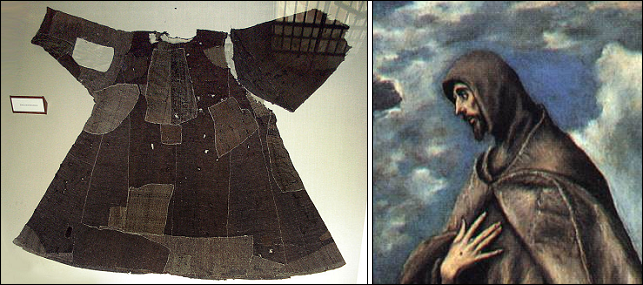
St Francis: his patchwork habit, and a portrait by El Greco

.
There’s a comedy routine going the innernet rounds featuring Sarah Silverman, in which she suggests “Sell the Vatican, feed the world” as her solution to world hunger. How can I put this? It’s funny if you like gross, and gross if you prefer fine — which is my side of the coin, so I won’t inflict her video on you, through you can click through and see it.

More seriously there’s the Harvard theologian, Harvey Cox. In his book The Seduction of the Spirit (pp 244-46), Cox has a great fictional press release that begins:

Rome and Geneva, Oct. 5, 1975, UPI. In a historic joint encyclical issued today by both the Vatican and the World Council of Churches, both religious bodies announced that they were beginning “forthwith” to divest themselves of all earthly possessions. The unprecedented pastoral letter, the first ever issued by both groups at once, was known in Rome as Lucrum Salax, after the first two words in its Latin text, “dirty money.” In Geneva the encyclical, recently adopted by a special session of the Central Committee of the World Council of Churches, appeared in French, German, English, Russian and Swahili. The document is signed, shattering another precedent, not only by Pope Paul VI and several other members of the WCC’s Central Committee, it also bears the signatures of hundreds of laymen from various parts of the world, including Juan Gonzales, a parishioner of San Martin de Porres, a small Catholic church in Bolivia, and by Franklin P. Jones, a sharecropper and a deacon in the Mount Pigsah A.M.E. Zion Church of Meridian, Mississippi. The statement was released today, it was explained, because October fifth is the Feast of St. Francis of Assisi who, it was pointed out by Vatican and WCC theologians, actually did obey the command of Jesus to sell all his worldly goods and follow him. …

Behind both Silverman and Cox, there’s the instruction Christ gives to the man who “had great possessions” who asked him what more – beyond following the commandments – he needed to do to inherit eternal life:

Then Jesus beholding him loved him, and said unto him, One thing thou lackest: go thy way, sell whatsoever thou hast, and give to the poor, and thou shalt have treasure in heaven: and come, take up the cross, and follow me.

Saint Francis of Assisi famously took that suggestion seriously and acted on it. And now we have a pope who has taken the name Francis as his papal name, who is known for his own forms of humility and austerity — and who made his priorities clear during his first press conference:

I would like a poor church and a church for the poor.

**

Saint Francis, whose name the Pope has taken, was known as the “poverello” or little poor one, and the new pope’s choice of name, according to the Vaticanista John Allen Jr, signifies “poverty, humility, simplicity and rebuilding the Catholic Church.”

Simplicity and lack of ostentation would seem to be both habitual with and characteristic of Pope Francis too, of whom it has been said, “This is a man who goes into the shantytowns and cooks with the people … I think the world is going to discover a very new style of being pope.”

COL. Pat Lang, a blogger and a Catholic with whom many Zenpundit readers will also be familiar, liked what he saw in early reports from the Vatican after the new pope’s choice of name was announced, and he had given his first blessing from the balcony:

The name choice is significant. This man rode the bus back to the clerical hotel last night. He rode the bus with his former colleagues and let his limo follow along behind. Once at the hotel, he went to his room, collected his things and went down to the front desk to pay his bill in person. When reminded that he was now the proprietor and need not pay the bill, he said that he wanted to make sure that they all pay their bills. It will be interesting to see how he has the papal apartments decorated or if he lives there at all. Vatican City is a big place, he could live anywhere within it.

COL. Lang also noted that a new pope, inspired by Francis of Assisi, might have a profound impact on the world as a whole:

The possibilities for this man to lead by example on issues of poverty and the spread of the Good News of the gospels is virtually unlimited.

It’s that “virtually unlimited impact” I’d like to investigate here.

**

Let’s take a look at some of the things our man has said which may throw further light on his current thinking.

In 2007, the then cardinal archbishop of Buenos Aires said:

We live in the most unequal part of the world, which has grown the most yet reduced misery the least. The unjust distribution of goods persists, creating a situation of social sin that cries out to Heaven and limits the possibilities of a fuller life for so many of our brothers.

As the Australian Lowy Institute for International Policy recently noted:

As a Latin American, he represents the region with the most practising Catholics but also one with vast experience of poverty. A Vatican that is much more vested in addressing poverty might see more concerted Church pressure on developed countries to improve their aid and trade policies and provide more opportunities to developing countries. In a world still beset by financial crises, this kind of advocacy from the leader of the world’s largest faith could prove decisive.

In 2009, the archbishop said:

human rights are violated by unfair economic structures that create huge inequalities

And here’s a little more nuance, from the BBC report of the pope’s first press opportunity since he became pope:

The Pope said he had been inspired to take the name Francis by a Brazilian colleague who embraced him and whispered “don’t forget the poor” when it was announced that he had been elected Pope.

He said he immediately thought of St Francis of Assisi, the Italian founder of the Franciscan Order who was devoted to the poor.

As well as representing poverty and peace, he said St Francis “loved and looked after” creation – and he noted that humanity was “not having a good relationship with nature at the moment”

So there’s a real possibility here that we might see the Catholic Church under the guidance of Pope Francis throwing its not inconsiderable influence behind the teaching of his predecessor’s encyclical on social justice, Caritas in Veritate, in which he declared “Every economic decision has a moral consequence” and “The market is not, and must not become, the place where the strong subdue the weak.”

Could the senior bishops and princes of the church do without their limousines, as Pope Francis himself appears to have done while a cardinal archbishop? I am trying to suggest that there almost certainly are cuts that could be made, and good works of the kind commanded by Christ facilitated as a result:

I was hungry and you gave me food, I was thirsty and you gave me drink, I was a stranger and you welcomed me, I was naked and you clothed me, I was sick and you visited me, I was in prison and you came to me. … Truly, I say to you, as you did it to one of the least of these my brothers, you did it to me.

**

Thus far we have been discussing hopes and possibilities in the realm of ideas and ideals. That’s the realm in which good thing begin, but then they have to get grounded, which is where all manner of details — obstacles and irritations, foibles and fumbles and sheer human nature — come in.

And that’s when things begin to get interesting.

Plenty of people have “liked” the new pope’s humility and concern with the world’s poor, sick and malnourished, but more interesting than the slogan Sarah Silverman offers is the real possibility of effecting change. It’s all very well to say, as Silverman does, “Sell the Vatican, feed the world” – but it’s not “genius” to suggest that, although she appears to think it is, and you can tell by the tone of the rest of her routine that she’s wooing her own comedic audience, not the pope…

Pope Francis, however, does indeed appear to be intent on feeding the poor, and if he is, the question arises:

What’s the most efficacious way to do that, without losing those of the church’s material possessions which are authentically useful in propagating love, forgiveness and understanding?

**

That’s a complex question, pitting the selfish and selfless interests of multiple very interested parties with and against one another, vastly cross-disciplinary in the different realms it touches on, deeply and richly complex and riddle with potential feedback loops and unintended consequences…

And thus a perfect, paradigmatic instance of the kind of problems our complexly-interwoven world more and more frequently faces. Which is why I would like to explore it, in the company of a diverse group of good hearts and bright minds.

My guess is that it’s a question the Pope himself must take quite an interest in — indeed, as the Anglican blogger known as Cranmer notes:

Both Pope Francis and [the Anglican primate] Archbishop Justin Welby have considerable knowledge of and interest in the worlds of finance, banking and welfare. Both grasp the value of free markets, liberal economies and the production of wealth. But both also understand the need for an ethical framework which recognises the dignity and freedom of the individual. They are both concerned with excessive inequality and know of the dangers to society posed by unregulated banking and unrestrained finance. They are likely to work together toward a moral economic framework.

Presumably selling Catholic hospitals to the highest bidder might not necessarily be the best way to care for the sick… So considerable thought, insight — and let’s go for baroque, inspiration and grace — is called for in building a practical answer to our question..

**

I haven’t gone into all the many areas that such a task would involve as yet, but to make sure I wasn’t being too foolish I did broach the topic with a friend.

Michael is a an appraiser, consultant, dealer and freelance writer on art and antiques who was at one time head of rare books and manuscripts at Phillips Fine Art Auctioneers in New York, and also brings to this topic a grounding in in matters ecclesiastical, his father having been both Canon Treasurer at Canterbury Cathedral — the Mother Church of the global Anglican Communion and seat of the original Archbishop of Canterbury, St. Augustine — which gave him overall responsibility for the cathedral “treasures,” its fabric and associated buildings.

I talked with Michael about the Catholic Church’s art treasures. I said I would hate to see the Sistine Chapel sold to some Howard Hughes think-alike, let alone “transported” like London Bridge and rebuilt in Vegas with neon highlights. I remember the Bamiyan Buddhas, I grieve for the old Abbey of Monte Cassino, I regret the destruction of the Sufi shrines of Timbuktu…

But there are lesser artworks that could perhaps be sold, although the question arises of what a large scale sell-off would do to the world art market – and hence to the ability of the church to capitalize on the value of such works.

I don’t want to preempt Michael’s possible more detailed response to these questions, but it was pretty clear from talking with him that all manner of moral, ethical and legal issues would be involved in dealing with the Church’s artistic patrimony alone — without even scratching the surface of its educational interests, all those hospitals, its real estate holdings and so forth.

**

Two last questions:

How rich is the Church?

Matt Yglesias at Slate asked this question this week, and his first paragraph read:

Pope Francis is not just the spiritual leader of one of the world’s major religions: He’s also the head of what’s probably the wealthiest institution in the entire world. The Catholic Church’s global spending matches the annual revenues of the planet’s largest firms, and its assets—huge amounts of real estate, St. Patrick’s Cathedral, Vatican City, some of the world’s greatest art—surely exceed those of any corporation by an order of magnitude.

Writing of the American Church (USA) alone, and referencing a detailed 2012 Economist article, he suggests:

Our best window into the overall financial picture of American Catholicism comes from a 2012 investigation by the Economist, which offered a rough-and-ready estimate of $170 billion in annual spending, of which almost $150 billion is associated with church-affiliated hospitals and institutions of higher education. The operating budget for ordinary parishes, at around $11 billion a year, is a relatively small share, and Catholic Charities is a smaller share still.

Apple and General Motors, by way of comparison, each had revenue of about $150 billion worldwide in Fiscal Year 2012.

The new pope, it appears, will “oversee a massive religious business whose holdings are worth billions of dollars” — I’m quoting another interesting source here, Kevin Roose‘s The Vatican’s Financial Empire in Charts from New York magazine earlier this week — “but whose finances on a yearly basis are often rocky.”

For details, see Roose’s article and accompanying charts…

**

And finally:

What do I propose?

There’s an opportunity here, as I see it, for the human race to lurch a few steps in a positive direction. And the more caring intelligence that’s broiught to bear on this possibility, the greater the chances of success.

But who should do the caring thinking?

I imagine the pope himself has some ideas, and some bright friends to discuss them with. I imagine the Jesuits could provide quite a wonk tank. But it’s my guess that the intricately networked diversity of the blogosphere will have some interesting contributions to make. So I’m floating the idea of an online round-table on the papacy and poverty as a starting point.

I’m not going into the details of exactly how and who and where at this point. I’m posting this first on Zenpundit, because it’s my online home — but if you like the idea, I’d encourage you to link to this post or report it, discuss it with your friends, get the word out, tweet it up.

If there’s interest, we’ll take it from there…

Fireworks: guns as dual-purpose devices?

Friday, March 15th, 2013

[ by Charles Cameron — the merest trifle — concerning things that go flash and bang, with potentially lethal consequences ]
.

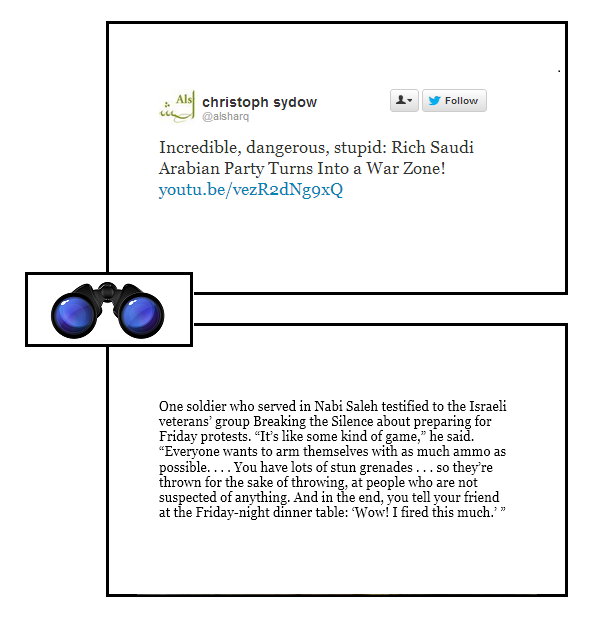
It’s exuberance, exhilaration, it’s celebration, it’s party time. It’s dangerous and stupid like the man says, and it’s unfortunate when your neighbors just happen to bear the brunt of it. It’s also pretty much human nature, in some places it’s how you celebrate your daughter’s wedding…

For your contemplative consideration:

**

here’s the video to which the tweet in the upper panel above refers:

**

The quote in the lower panel comes from a New York Times Magazine article today, Is This Where the Third Intifada Will Start?

New Article up at Pragati

Friday, March 15th, 2013

I have a new piece up at Pragati Magazine  this morning, which focuses on a book review of Makers by Chris Anderson:

The Re-industrial Revolution 

….If anything, Anderson has managed to understate the velocity with which the technology is advancing and the creative uses to which users are putting their machines. Since the publication ofMakers, a succession of news stories have revealed everything from Formlabs’ slickly designed Form 1 machine to users printing functional (if fragile) assault rifles, car bodies and biomedical surgical replacements for missing pieces of the human skull. One gets the sense that the genie is out of the bottle.

Anderson is not merely making a technologically oriented argument , but a profoundly cultural one. In his view, the existence of the Maker movement, operating on the collaborative, “open-source” ethos is an iterative, accelerative driver of economic change that complements the technology. Anderson writes: “…In short, the Maker Movement shares three characteristics, all of which are transformative:

Read the rest here.


Switch to our mobile site