zenpundit.com » 2013 » November

Archive for November, 2013

Ayatollah Khameini: Crony Capitalist and Slumlord

Wednesday, November 13th, 2013

[by Mark Safranski, a.k.a. “zen“]

Reuters has begun a remarkable series on the economic dealings of Iran’s Supreme Leader, Ayatollah Khameini who controls a staggering fortune of $ 95 billion dollars through a secretive fund Setad that expropriates the property of poor Iranians and religious minorities. This would put the venerable theocrat in the same superclass as Bill Gates, Carlos Slim, Warren Buffet and the Sultan of Brunei .

Up until now, former Iranian president Rafsanjani has always been the face of financial corruption in Iran’s clerical hierarchy, but to paraphrase John D. Rockefeller’s comment about J.P. Morgan, compared to Khameini ” he’s not even a rich man”:

Khamenei controls massive financial empire built on property seizures 

The 82-year-old Iranian woman keeps the documents that upended her life in an old suitcase near her bed. She removes them carefully and peers at the tiny Persian script.

There’s the court order authorizing the takeover of her children’s three Tehran apartments in a multi-story building the family had owned for years. There’s the letter announcing the sale of one of the units. And there’s the notice demanding she pay rent on her own apartment on the top floor.

Pari Vahdat-e-Hagh ultimately lost her property. It was taken by an organization that is controlled by the most powerful man in Iran: Supreme LeaderAyatollah Ali Khamenei. She now lives alone in a cramped, three-room apartment in Europe, thousands of miles from Tehran.

….But Setad has empowered him. Through Setad,Khamenei has at his disposal financial resources whose value rivals the holdings of the shah, the Western-backed monarch who was overthrown in 1979.

How Setad came into those assets also mirrors how the deposed monarchy obtained much of its fortune – by confiscating real estate. A six-month Reuters investigation has found that Setad built its empire on the systematic seizure of thousands of properties belonging to ordinary Iranians: members of religious minorities like Vahdat-e-Hagh, who is Baha’i, as well as Shi’ite Muslims, business people and Iranians living abroad.

Setad has amassed a giant portfolio of real estate by claiming in Iranian courts, sometimes falsely, that the properties are abandoned. The organization now holds a court-ordered monopoly on taking property in the name of the supreme leader, and regularly sells the seized properties at auction or seeks to extract payments from the original owners.

The supreme leader also oversaw the creation of a body of legal rulings and executive orders that enabled and safeguarded Setad’s asset acquisitions. “No supervisory organization can question its property,” said Naghi Mahmoudi, an Iranian lawyer who left Iran in 2010 and now lives in Germany.

The Persian name of the organization that hounded her for years is “Setad Ejraiye Farmane Hazrate Emam” – Headquarters for Executing the Order of the Imam. The name refers to an edict signed by the Islamic Republic’s first leader, Ayatollah Ruhollah Khomeini, shortly before his death in 1989. His order spawned a new entity to manage and sell properties abandoned in the chaotic years after the 1979 Islamic Revolution.

It used to be said back in the 70’s by Western intellectuals of the tweedy, social democratic, Left variety that the future would be a merging of Communism and Capitalism into a “Third Way”, perhaps, it was optimistically suggested, of the gentle Scandinavian variety with, democracy, universal free child care and quaint, bicycle-riding, constitutional monarchs. I doubt anyone thinks that today. If there is any emerging universal model at all it is that of nasty authoritarian governments being run, sometimes under a facade of elections, by a bareknuckle, crony capitalist Oligarchy that hollowed out the state.

Sometimes,the crony capitalists are merely the junior partners to the mandarins, siloviki and mullahs and at other times you could look “….from pig to man, and from man to pig, and from pig to man again” and be hard pressed to tell the difference.

Khamenei’s conglomerate thrived as sanctions squeezed Iran 

….The ayatollah’s organization would go on to acquire stakes in a major bank by 2007 and in Iran’s largest telecommunications company in 2009. Among dozens of other investments, it took over a giant holding company in 2010.

An organizational chart labeled “SETAD at a Glance,” prepared in 2010 by one of Setad’s companies and seen by Reuters, illustrates how big it had grown. The document shows holdings in major banks, a brokerage, an insurance company, power plants, energy and construction firms, a refinery, a cement company and soft drinks manufacturing.

Today, Setad’s vast operations provide an independent source of revenue and patronage for Supreme Leader Khamenei, even as the West squeezes the Iranian economy harder with sanctions in an attempt to end the nuclear-development program he controls.

“He has a huge sum at his disposal that he can spend,” says Mohsen Sazegara, a co-founder of the powerful Islamic Revolutionary Guard Corps military force, who is now living in exile in the United States. “When you have this much money, that’s power itself.” 

Indeed. It insulates Khameini’s core supporters from external financial pressure and allows Khameini to have an arsenal of carrots, not just sticks in dealing with other members of the Iranian ruling elite.

It is often overlooked how frequently dictators, even those who were known for ruling through terror like Hitler, Stalin and Mao, could be lavishly generous with gifts and financial rewards or indulged the blatant corruption of powerful subordinates like Goering, Abukumov or Kang Sheng. Every Grand Ayatollah and Marja in Shia Islam maintains a charitable trust to which their pious followers donate. I would be extremely surprised if Khameini, whose scholarly credentials share similarities with Leonid Brezhnev’s military decorations, had not made arrangements for substantial contributions over the years from Setad to the trusts of Iran’s most respected senior clerics.

Baksheesh is an older faith in Iran than is Islam.

Kristallnacht at Seventy-five

Monday, November 11th, 2013

[ by Charles Cameron — of fire and light ]
.

Since Zen tweeted a link to my own Armistice Day, Veterans Day post from last year and posted his own The Vietnam War at Fifty today, I’d going to skip back a day or two in my own calendar this time, and commemorate the 75th anniversary of Kristallnacht, which fell on the night of November 9/10, 1938.

I believe this is a photo of the Hannover synagogue burning:

**

I don’t know how we even begin to think about this.

George Steiner famously said “We know that a man can read Goethe or Rilke in the evening, that he can play Bach and Schubert, and go to his day’s work at Auschwitz in the morning” — and also observed, “The world of Auschwitz lies outside speech as it lies outside reason” — and Adorno: “to write a poem after Auschwitz is barbaric”.

Contemplating that photo of the burning of the Hannover synagogue, then, I am thrown back on a story told of the rabbi — a disciple of Rabbi Gershon — who came to visit the Baal Shem Tov, founder of Hasidic Judaism, and to whom that great master first revealed his spiritual station:

In the night the rabbi found no sleep. It seemed to him as if here and now the wonder of the far and the wonder of the near must flow together. In the middle of the night the command came to him, soundless and without form. He arose and went. Then he was already in the other chamber and saw: The chamber was filled with flames up to the height of a man. They rose dull and sombre, as if they were consuming something heavy, hidden. No smoke ascended from the fire, and all the furniture remained uninjured. But in the middle of the fire stood the master with uplifted forehead and closed eyes.

The rabbi saw further that a division had taken place in the fire which gave birth to a light, and the light was like a ceiling over the flames. The light was twofold. Underneath it was bluish and belonged to the fire, but above the light was white and unmoving and extended from around the head of the master unto the walls. The bluish light was the throne of the white, the white rested on it as on a throne. The colours of the bluish light changed incessantly, at times to black and at times to a red wave. But the light above never changed, it always remained white. . Now the bluish light became wholly fire, and the fire’s consuming became its consuming. But the white light that rested on it did not consume and had no community with the flame.

The rabbi saw that the head of the master stood entirely in the white light. The flames which leaped upward on the body of the master turned to light, and every little while the amount of light increased. At last all the fire became light. The blue light began to penetrate into the white, but every wave that penetrated itself became white and unchanging. The rabbi saw that the master stood entirely in white light. But over his head there rested a hidden light that was free of all earthly aspects and only in secret revealed to the beholder.

It was thus that the Baal Shem Tov become known to the wider world.

**

If I might draw the moral here, suiting my tale (quoted from Martin Buber‘s The Legend of the Baal-Shem) to the occasion — there is fire that destroys, and there is light indestructible.

We choose, always we choose.

The Vietnam War at Fifty

Monday, November 11th, 2013

[by Mark Safranski, a.k.a. “zen“]

Today is Veteran’s Day. It is a day when Americans remember all of those who served, in peace or war.

Originally, this day was called Armistice Day in honor of the cease fire that came in ” the eleventh hour of the eleventh day of the eleventh month” and brought the horrific slaughter of  World War I to an end. This was fitting.  The First World War loomed large in the memories of our great grandparents and grandparents the way the Civil War did for earlier generations. It was an ominous touchstone of the nadir of which Mankind was capable until it was thoroughly eclipsed by the subsequent horrors of Nazi barbarism in a Second World War – a conflict that seemed a maturation of the first. In the postwar era, Armistice Day became a national tribute to the sacrifices of all veterans.

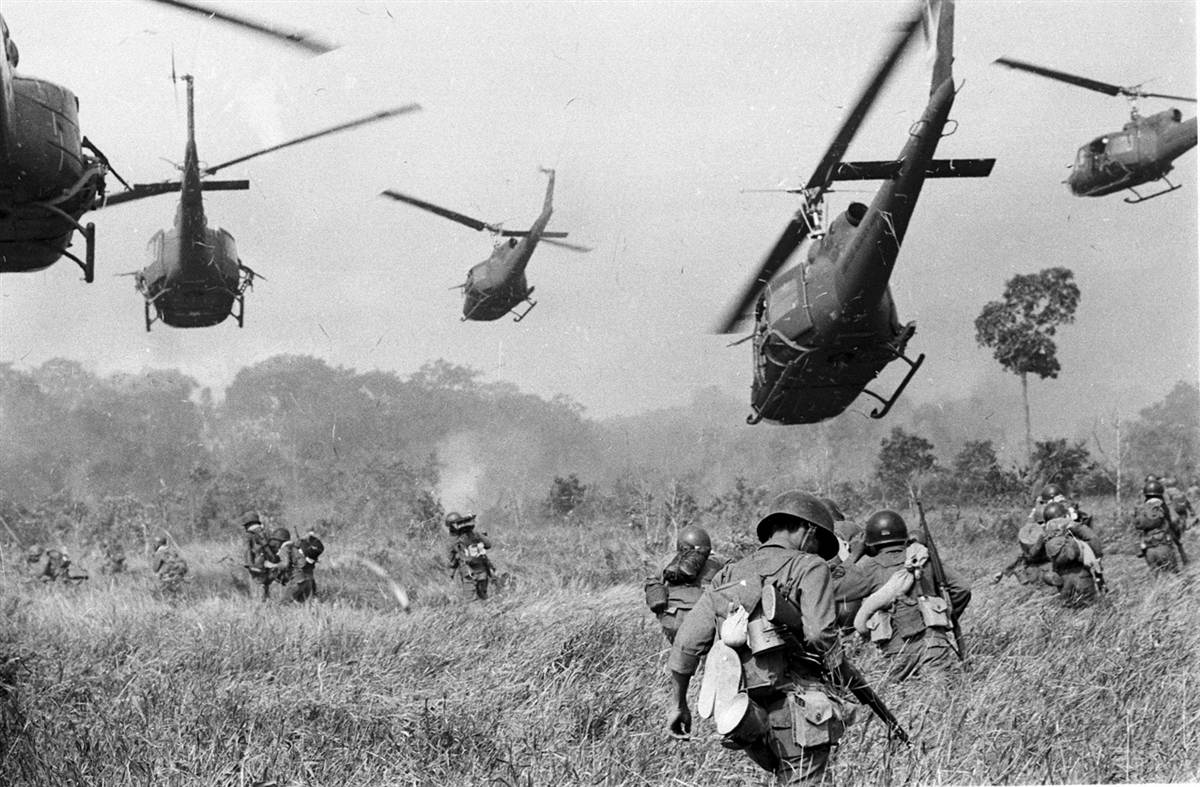
This year also marks the fiftieth anniversary of American entry into the Vietnam War.

Historians may quibble with this, as American involvement in Vietnam went back to WWII and OSS agents giving advice to Ho Chi Minh in the jungle war against Imperial Japan and Vichy French puppet colonialists, but 1963 is when “American boys” first went to South Vietnam in real numbers.  And many of them were indeed little more than boys. Fifty-eight thousand, two hundred and eighty six of them did not come home.

Those that did are now grown grey with the passage of time.

The Vietnam War caused deeper divisions in the American psyche than any other war except the one that began at Fort Sumter. The wounds have never really healed and they rest inflamed and sore just beneath the scabrous surface of American politics to this day. America has an unenviable historical track record of not treating its veterans very well and those who served in that unpopular war that ended in defeat received on their return home far more than their share of  disdain and abuse.

Even the attempt to build a memorial – the now famously cathartic Wall – roiled at the time in a controversy of unimaginable bitterness. The site eventually became a place of pilgrimage, alive with memory of the dead and compassion for the living. This was a good thing but in truth as a nation we could have done far, far better for the men who served in Vietnam than we did.

The best tribute to these veterans of Vietnam that we can make as a people would be to see that the veterans of Iraq and Afghanistan do not repeat the sad experience of their fathers.

Manea Interviews Colby on Air-Sea Battle

Friday, November 8th, 2013

[by Mark Safranski, a.k.a. “zen“]

Octavian Manea branches out from COIN to the realm of power projection:

The Role of an Air Sea Battle-Centric Posture in Strategic Reassurance: SWJ Interview with Elbridge Colby 

SWJ: In a time when the PLA is intensively investing in anti-access/area-denial (A2/AD) capabilities, how would you characterize the Chinese way of war? What are they preparing for?

EC: My understanding of what the Chinese are trying to accomplish is the ability to effectively counter a third party intervention. If you look at the strategic landscape in the Western Pacific, more or less starting from 1945, the US dominated the aerial and maritime spheres. Obviously, we had less success on the Eurasian landmass, but the whole system was predicated on the ability of the US fleet and airpower to dominate the Pacific.

The particular contingency for which this was most relevant was Taiwan. Now, the US continues to have a policy guided by the Taiwan Act which, at the very least, suggests that we might intervene militarily. This is something that the Chinese are not comfortable with. It [the claim to Taiwan] is a core element of their regime’s legitimacy. This issue became more salient after the Taiwan Strait crisis in 1995/1996. That was a wakeup call for the Chinese, and in its aftermath they decided to build up the ability to try to effectively push back the US military. The trajectory of Chinese military development has therefore been to build forces that would potentially enable them to prevent the US from operating effectively in the areas that we need to be able to dominate if we decide to defend Taiwan in the event of Chinese military attack or attempted coercion. In this context they have spent a lot of time and resources on more accurate ballistic and cruise missiles, aerial forces and naval forces, basically with the overarching idea of creating an A2/AD bubble in order to deny the US the ability to exercise its power in the Western Pacific. That challenge to our power projection ability has been compounded because of the centralization of the US military posture following the Cold War, becoming increasingly focused on Guam and a few other nodes in the Pacific region.

SWJ: What are the implications of China’s military build-up for the United States?

EC:  As we go forward and the Chinese economy likely continues to grow, they will presumably continue to put significant resources into these military capabilities. If we think about the basic military problem, the US is trying to project its power across the greatest expense of water on the globe, very far from our shores, using naval and airpower, all while the Chinese are operating from their mainland. The Chinese basically are trying to frustrate our ability to enter, while we are trying to get there and accomplish our objectives. As the Chinese military become more sophisticated, it will become a great problem for us.

SWJ: Are the Chinese A2/AD capabilities a long-term threat to the credibility of the deterrence capital that the US is providing to the region?

EC: Absolutely. We can see this in the case of Japan, where we see a lot more interest, focus, and essentially need for a stronger military posture. Publicly the Japanese are talking about North Korea, but what they are really worried about is China. The Senkaku Islands are the tip of the iceberg. A few months ago the Chinese state-affiliated press started to talk about the Chinese claims on the Ryukyu Islands, of which Okinawa is a part. It is a classic example of the downside of accommodation or appeasement in that the potential adversary can get hungrier rather than sated due to accommodation. And Taiwan’s closer relationship with mainland China is, in part, a result of the shifting regional military balance. More broadly, in these kinds of strategic competitions, perceptions of capability and resolve are crucial. If everyone thinks we are growing weaker, then they are likely to behave accordingly. 

A lengthy interview – read the rest here.

Recommended Reading

Tuesday, November 5th, 2013

[by Mark Safranski, a.k.a. “zen“]

Grand Blog Tarkin – Ender’s Shadow and Offense-Defense Theory 

“Ender’s Shadow” is a 1997 novel by Orson Scott Card, set in the same universe and roughly same time period as his more well-known “Ender’s Game.” “Shadow” centers on a child named Bean, a minor character in “Game,” fleshing out his backstory and trajectory. The setting is a future in which Earth was devastated two centuries prior by an attack from an alien race known as Buggers. Humanity won the war, and then set up an International Fleet to keep peace between states, coordinate future anti-Bugger action, and train the best and brightest children of the world to be military commanders in an off-planet installation known as Battle School, where most of both “Game” and “Shadow” take place.

War on the Rocks – (Frank Hoffman) Tuppence for your COIN Thoughts 

This is not a comfortable book to read for members or friends of the British armed forces.  And it should generate equally discomforting questions for its American readers.  Counterinsurgency in Crisis is a dispassionate and objectively critical evaluation of UK strategic performance in its last two conflicts-Iraq and then Afghanistan.  Both authors have relevant scholarly credentials and prior works on civil conflicts and counterinsurgency.  Ucko (who is a colleague of mine at the National Defense University) and Egnell begin slowly, but end up with an eviscerating indictment of British preparation, strategic direction, and operational practice.  “There is no fig leaf large enough here to cover the deep flaws in the British government’s own approach and conduct in their counterinsurgency campaigns,” they conclude.

Marine Corps Gazette – (Nicholas Joiner) Battle of Belleau Wood 

On the morning of 6 June 1918, in what became the bloodiest day in Marine Corps history, Marines launched an offensive attack against a heavily fortified German position on Hill 142 across an open field to the west of Belleau Wood. Hampered by flat terrain, the Marines advanced with fixed bayonets across open wheat fields swept by German machinegun and artillery fire. Caught in the open, retreating French soldiers advised the Marines to follow suit, where Capt Lloyd Williams was famously quoted as saying, “Retreat? Hell, we just got here!” Despite heavy losses, Hill 142 was taken following bloody hand-to-hand combat.

Selil – Where will the NSA be in 5 to 10 years?


A second effect I see for NSA is splitting off the CyberCom role. There is a lot of internal feuding and “facts” leading to the perception that the new role must be status quo. There is admittedly a lot of cost associated with a split of the two entities. The cost to society and inherent fight that is sure to come is likely even more costly. Arguments that this is new and we must allow it to continue are based on individuals desires to keep the status quo. A lot of people have skin in this game. So, they argue from their personal biases. I admit I’m biased. I want to see NSA and CyberCom succeed. Currently that will not happen if they are linked at the hip. The arguments of keeping them together are specious at best.

I think CyberCom should be severed from the NSA and the 4 star billet with associated staffs sent to at least Texas. Physical distance is needed to separate this war fighting entity from the intelligence entity NSA. The structure of CyberCom should be more like SOCOM. I think that the split will happen. I think the structure as a combatant command will not change

Michael Tanji – Sam and His (not so) Crazy Ramblings 

If intelligence agencies are good at one thing its burying bodies. Is anyone going to find themselves in front of Church Committee 2.0? No. Will the people who were leaning the furthest in the foxhole on efforts that were exposed going to find themselves asked to quietly find their way out the door? Absolutely. This is how it works: the seniors thank and then shepherd those that pushed the envelope to the side, those who take their place know exactly where the line is drawn and stay weeeellll behind it. They communicate that to the generations that are coming up, and that buys us a few decades of sailing on a more even keel…

…until the next catastrophic surprise…

The National Interest – (Michael Vlahos) Why Lists of Greatest Battles Don’t Work 

The first fallacy is our unconscious enshrining of “decisive battle”—not as in, “I won big”—but “I won history and changed the fate of nations, and the course of civilization, to boot”—in one battle. Jim shows us we actually still think this way.

There are actually a very few battles that meet this test: Hülegü’s sack of Baghdad in 1258 comes to mind. But the proliferation of “decisive”—as Jim suggests—may speak more of our bipolar search for, and simultaneous diminution of, ordinary significance in life than it does the role of decisive battles in history.

But such battles are even harder to find at sea.

SWJ  (Prescott) Heeding the Heretics 

Information Dissemination (Galrahn) We Need a Balanced Fleet for Naval Supremacy

Rebane’s Ruminations –Great Divide – ‘America 3.0’  

OPFOR –America 3.0: A Future 

Studies in IntelligenceCounterintelligence in Counterguerrilla Operations :50 Years Since Early Engagement in Southeast Asia

Foreign AffairsGoogle’s Original X-Man 

Forbes49-State Analysis: Obamacare To Increase Individual-Market Premiums By Average Of 41% 

That’s it.


Switch to our mobile site