zenpundit.com » media

Archive for the ‘media’ Category

On the narrative arc

Monday, May 23rd, 2016

[ by Charles Cameron — a recent Wapo example of how history gets bent (ever so slightly) out of shape to serve narrative ]
.

Riley Rainbow in Curved Air
One of the universal arcs, and a personal favorite
**

Story-telling shapes awareness.

Yesterday’s Washington Post has an article titled Patriots at the gate: The Americans preparing for battle against their own government. It’s an interesting overview, but I’m not interested in discussing the merits or demerits of the Patriot Movement, Southern Poverty Law Center, Oath Keepers, Waco, Ruby Ridge, Oklahoma City, the Bundy Ranch, or Malheur — what interests me is the way the story is told.

Here’s the section dealing with one participant:

Across the family-style table, Alex ­McNeely, 25, a drywaller and “avid YouTuber,” said he became interested in the patriot movement online and joined the group to feel that he was helping to defend the country.

“There’s this D.C. mentality that if you stand up for your rights, you’re dangerous and anti-government,” said McNeely, who has an AK-47 assault rifle tattooed on his forearm. “But if I’m denied my rights, what else can I do? Am I just going to stand there and take it, or am I going to do something?”

In the Constitutional Guard, McNeely said: “I feel what we do is stand up for people who don’t have the means to stand up for themselves. I have an overwhelming desire to help people.”

They have passed out more than 2,000 pocket-size copies of the Constitution that Soper said he bought for $500, sent food and clothes to victims of forest fires in Washington state and Oregon and given Christmas presents to more than three dozen children in need.

McNeely considered joining the military when he graduated from high school, but he turned 18 the month Obama was elected in 2008, and, because of Obama’s “socialist” policies, “I wasn’t going to accept him as my commander in chief.”

“I don’t like that he wants to fundamentally change America,” McNeely said.

**

The writer is Kevin Sullivan, a WaPo Senior correspondent, and I think we can safely assume he knows his trade. My interest focus on the sentence:

“There’s this D.C. mentality that if you stand up for your rights, you’re dangerous and anti-government,” said McNeely, who has an AK-47 assault rifle tattooed on his forearm.

Sullivan has already given his opening identification of McNeely —

Across the family-style table, Alex ­McNeely, 25, a drywaller and “avid YouTuber,” said he became interested in the patriot movement online and joined the group to feel that he was helping to defend the country

— that’s fair enough, and the bit about the “AK-47 assault rifle tattooed on his forearm” could have gone in there, or been added to the graph:

McNeely considered joining the military when he graduated from high school, but he turned 18 the month Obama was elected in 2008, and, because of Obama’s “socialist” policies, “I wasn’t going to accept him as my commander in chief.”

where the topic is his consideration of “the military” — but no, Sullivan posts it neither where he’s introducing McNeely nor where he’s talking about his thoughts about the military, but in the graph discussing the Patriot Mov ement ideals as McNeely describes them — see, once again:

“There’s this D.C. mentality that if you stand up for your rights, you’re dangerous and anti-government,” said McNeely, who has an AK-47 assault rifle tattooed on his forearm.

**

Sullivan wants the irony. He’s making a juxtaposition-with-purpose — long-time readers here will know that juxtaposition as a rhetorical device is a keen interest of mine — he’s linking the movement’s ideals with the AK-47 tattoo to add an inflection of irony.

It’s a tiny point — no more than an inflection — but it’s one that I note in the same way I noted the non-appearance of bin Laden‘s Qur’anic epigraph in media versions of a significant speech, in my post Close reading, Synoptic- and Sembl-style, for parallels, patterns. I don’t happen to share McNeely’s worldview, nor that of bin Laden, but I am deeply interested in the ways the media portray matters of substance and nuance. I am interested in “narrative”.

We’ve all heard MLK’s quote, “somehow the arc of the moral universe is long but it bends toward justice.” The arc of narrative has another aim: it bends towards “good reading” — and if the curve bends fast enough it will spiral ever more lightly and less helpfully in, and we wind up with “click bait”. I know this, because I practice my own version of the dark (and sometimes, brilliantly illuminating) art of writing.

**

There’s a lot more to say about narrative, and the various meanings it now has.

One of my own interests is the way in which we think a narrative can be spun out of words and images (aka “propaganda”), when facts, grounded realities, history may, as they say, tell a different tale — and facts may speak louder than words. In that sense, if we need a new narrative, we may need a new behavior, a new policy, a new strategy implemented, to speak it.

What interests me here though, getting back to the WaPo piece and McNeely, is how telling a story in a way that makes it a “good read” influences a narrative arc that is, significantly, also the arc of “the first draft of history”.
After IS, what next? — the missing (apocalyptic) strand

Monday, May 23rd, 2016

[ by Charles Cameron — four recent tweets, some lines of inquiry, & no certain conclusion, no date certain ]
.

The four recent tweets that set me off..

**

There are a multitude of voices now raising the question After ISIS< What Next? They can be heard from as far back as October 2014, onwards:

  • Al Arabiya English, What comes after ISIS’ defeat?
  • Foreign Policy, What Comes After the Islamic State Is Defeated?
  • Lexington Institute, What Do We Do The Day After ISIS Is Defeated?
  • The National Interest, We Defeat ISIS. Then What?
  • The Telegraph, What happens once Isil is defeated?
  • Wilson Center, Iraq: Now and After ISIS
  • The [Huffington] World Post, The Middle East after ISIS
  • and most recently:

  • The Atlantic, The Hell After ISIS
  • If IS continues losing territory, as suggested in the tweets above, this question can only gain in force.

    **

    I have been following Islamic eschatology since 1998 or thereabouts, when I met David Cook, and I thought that what was at that time an eerily unappreciated question had at last made its way into informed consciousness after..

  • 2002, David Cook, Studies in Muslim Apocalyptic
  • 2005, David Cook, Contemporary Muslim Apocalyptic Literature
  • 2011, J-P Filiu, Apocalypse in Islam
  • 2014, Martin Dempsey, speech: IS has “an apocalyptic, end-of-days strategic vision”
  • 2015, Jessica Stern & JM Berger, ISIS: The State of Terror
  • 2015, Graeme Wood, What ISIS Really Wants
  • 2015, Will McCants, The ISIS Apocalypse
  • But no, the question I’m interested in has not been raised:

    Is there a more potent form of apocalyptic movement than the two we have most recently seen?

  • a Mahdist movement, one focused on the army with black flags from Khorasan — AQ
  • a Caliphal movement, one focused on the establishment of the rightly-guided kingdom — IS
  • **

    Four hints:

    It seems to me that you can have a Caliphal (kingdom based), or a Mahdist (leader based) movement, and that the Caliphal approach, should IS be a clear failure as a global quasi-state, will be exhausted for quite some time — and that since AQ, to the extent that it is or was an apocalyptic movement, was one that looked to a future Mahdi, the only route “up” from either one would be the declaration of an actual Mahdi-claimant with armed insurrection to follow.

  • The worst messianic movement, in terms of fatalities, would still be China’s 19th Century Taiping Rebellion, 20-30 million dead. Strangely enough, Gordon of Khartoum was involved.
  • The most recent and widely notable Mahdist rebellion was the Sudanese one that killed Gordon, led initially by Muhammad Ahmad al-Mahdi.

  • The next highly plausible date for the appearance of a Mahdi would be at the start of the next Islamic century, 1500 AH / 2076 BCE, since ahadith suggest a Mujaddid or Reformer will be sent every 100 years, and there have been assertions that the Ummah will not endure longer than 1,500 years (see here eg)
  • My guess is that we’ll have a cooling-off period in terms of Islamic apocalyptic if IS is seen to fail — but as they say, mortal mind cannot know the time of the end, and Allah knows best.

    Doing it right, doing it wrong, & it could be your Sunday surprise

    Sunday, May 22nd, 2016

    [ by Charles Cameron — a quick note about putting the mind through hoops, aka connecting dots ]
    .

    For the record, the mind is not a phalanx but a swarm — IOW it gets creative when the links are leaps, not serried ranks.

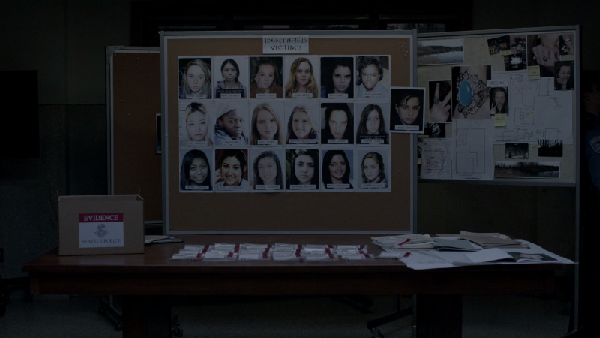
    So when your evidence board, memory jolt, graphical display looks like this (and it’s not the unavoidable dimness of the screen-grab I’m talking about):

    wrong way to stir memories The Killing s3 e8 around 39 mins 2

    the mind won’t see as many possibilities as when it’s more like this:

    **

    Randomize. Create uneven spaces between items. Shift items around. The idea here is to create fresh possibilities, not to look tidy.

    I had a friend once who was an artist. His studio and his life were both disasters — and in his studio, in the middle of that life, he created dazzling, gorgeously colored and delicately graduated geometric patterns — as though he was a disorder organizer, and the more disorderly his input, the greater the precision of his output.

    Think about that.

    Here is what may be a diagrammatic version of what I’m saying, or maybe not, but which stirs my mind in any case, just thinking about it — from Ron Scroggin about a year ago, shared in John Kellden‘s Conversations on G+:

    projectmixtape RC

    **

    Sources:

  • Evidence board, The Killing, series 3 episode 8
  • Al Qaida board, Manhunter
  • Gilmore Girls and FaceBook Friends

    Saturday, May 14th, 2016

    [ by Charles Cameron — on relationships today, a DoubleQuote found in the Wild ]
    .

    Call it unconscious humor, found art, or a DoubleQuote in the Wild — these things “catch the eye” and “capture the heart”. Nice work, David Masad, and thanks fore passing it along, Kelsey Atherton.

    Trying these shoes on for size — nah!

    Saturday, April 23rd, 2016

    [ by Charles Cameron — a little semi-private laughing at myself via Madam Secretary ]
    .

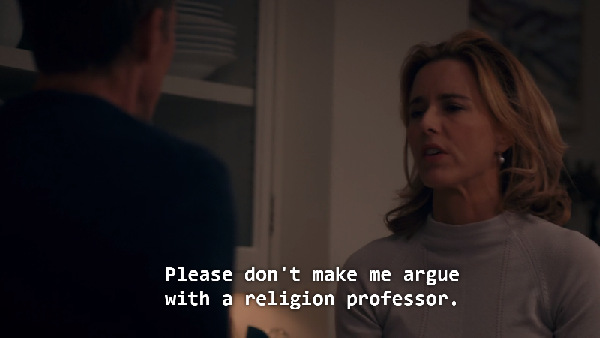
    I’ve been having some private chuckles watching season 1 of Madam Secretary, and I’m betting Dr Henry McCord, the religion professor / NSA guy, doesn’t have to beg his friends for copies of their journal papers the way I do, lol.

    Here are some screengrabs:

    argue with religion prof

    I’m afraid you may sometimes feel much the same when I forcefeed my own equivalent on you all.

    And then there’s this:

    not an expert on apocalyptic lit Madame Secretary s 1 e 18 ~25'

    He’s good on Aquinas and reads Arabic to boot. That’s impressive.

    But it’s true you know, religion professors don’t necessarily know apocalyptic, and apocalyptic specialists don’t necessarily know the full range of apocalyptic expressions across continents and centuries. At which point, may I recommend:

  • Richard Landes, Heaven on Earth: the Varieties of the Millennial Experience
  • **

    I was impressed that the show, in covering a “cult” situation in season 1 episode 18, showed knowledge not only for Jonestown and Waco, but more specifically of scholars of religion Phillip Arnold and James Tabor‘s contact with David Koresh, which had the potential to resolve the Waco situation in ways the FBI’s dismissal of theology as “Bible-babble” sadly ruled out:

    Henry McCord: You know, in Waco, Koresh was at an absolute standoff with the FBI until a couple of religious scholars got him talking about his beliefs, the Bible, and then that’s when he was ready to come out peacefully.

    Elizabeth McCord: So scholars almost saved the day at Waco, huh?

    Henry McCord: Okay. There’s no way of telling how that might have turned out.

    Spot on.

    And while we’re on this topic, may I recommend:

  • Nancy T. Ammerman, Waco, Federal Law Enforcement, and Scholars of Religion
  • James Tabor & Eugene Gallagher, Why Waco?
  • Jayne Docherty, Learning Lessons from Waco: When Parties Bring Their Gods to the Negotiation Table
  • **

    Okay, I can’t walk in Dr McCord’s shoes, but I’d happily follow his footsteps a little farther — once Season 2 arrives on Netflix.

    Envoi:

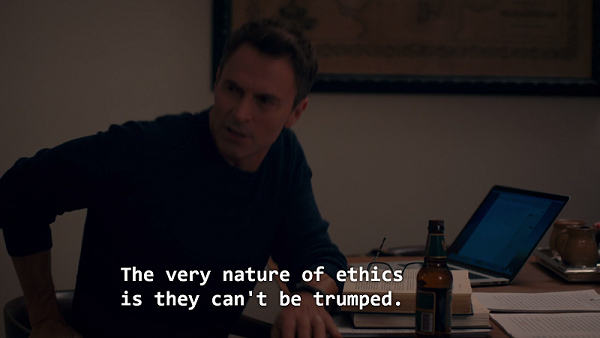
    For a little unintended current political input:

    ethics cant be trumped


    Switch to our mobile site