Saturday, August 4th, 2007
REVIEWING LEARNING TO EAT SOUP WITH A KNIFE
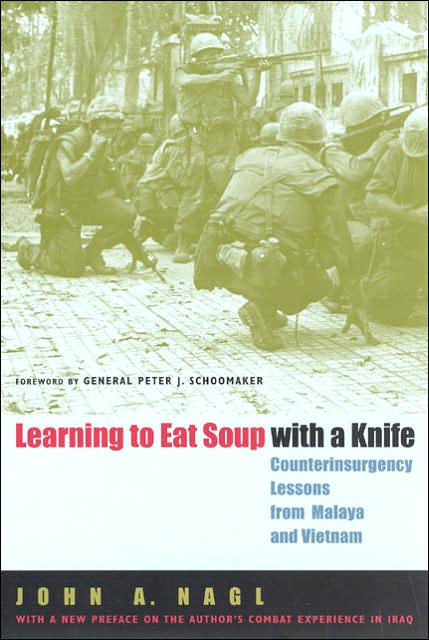
“Learning to Eat Soup With A Knife -Book Review” is now up at Chicago Boyz.
REVIEWING LEARNING TO EAT SOUP WITH A KNIFE
“Learning to Eat Soup With A Knife -Book Review” is now up at Chicago Boyz.
MOUNTAINRUNNER ON KENNAN’S LESSONS
Matt at MountainRunner has a fine post on lessons that can be drawn from George Kennan’s “Long Telegram“.
“For those who frame the modern conflict in Cold War images, it might be useful to remember the real designs and purposes of early Cold War policies. For those who think public diplomacy is simply a beauty contest to hopefully “win hearts”, should go back to the aggressive “five-dollar, five syllable” foundation of public diplomacy as a psychological struggle for minds and wills against an enemy who understood perception management.”
Kennan’s two volume memoirs make for some interesting reading, as does his work Russia and the West Under Lenin and Stalin, though it helps to have some of the period’s diplomatic historiography under your belt to better read between the lines of Kennan’s prose. If we have any George Kennan equivalents today, they are probably employed by the Defense Department or have been, which says a great deal about the intellectual and political decline of the State Department since Kennan’s time.
KENNAN ADDENDUM:
“America and the Russian Future (1951)” by George F. Kennan
“More reflections on George Kennan” by Dave Schuler
“LET HISTORY JUDGE THE FATHER OF CONTAINMENT ” – Zenpundit
“George Kennan Speaks to the War on Terror” and “Tipping Points” by CKR
DID NIXON INTEND TO WIN THE VIETNAM WAR?

I was perusing historian David Kaiser’s blog History Unfolding, when I came across a remarkable claim regarding Richard Nixon, based in part on Robert Dallek’s new book, Nixon and Kissinger:Partners in Power:
“Nixon and Kissinger, to begin with, came into office determined to win the Vietnam War. In an odd parallel to the current Administration—which decided that 9/11 totally discredited the Middle East policies of the last forty years—they evidently believed that the whole experience of the Johnson Administration had nothing whatever to teach them. Nixon, who saw himself far superior both to his two immediate predecessors and to any successor on the horizon, was convinced that Johnson had failed to win the war only because of a lack of will, the quality on which he prided himself the most. One omission from Nixon and Kissinger (which is more of a biographical study than a policy history) is any discussion of NSSM-1, a massive study of Vietnam which Kissinger commissioned upon taking office. It concluded that nothing the US had done had significantly weakened the enemy’s ability to fight, and that no agency of the US government could foresee the day when the South Vietnamese alone could deal with the enemy. A bold and rational leader must have concluded that the United States had to scale down its objectives to end the war, but Nixon did not. He and Kissinger spent about a year vainly trying to get the Soviet Union to end the war by pressuring the North Vietnamese, and then (as Nixon publicly admitted) tried to gain an advantage with the kind of “decisive” action which, Nixon thought, Johnson had avoided—the invasion of Cambodia. Meanwhile, political and military considerations (the latter involving the state of the armed forces) impelled Nixon to withdraw troops, but he continued to believe that he could make the North give in to our terms—an independent, non-Communist South Vietnam—by unleashing an all-out bombing attack whenever he chose. And historian Jeffrey Kimball was right: Nixon was determined not to make peace without giving such a campaign a chance, as eventually, in December 1972, he did—at the cost of 15 American B-52s, and without in the least improving the terms that Kissinger had already negotiated.”
For readers who are unfamiliar, Dr. Kaiser is a historian of the Vietnam War era, with special expertise in the Kennedy administration. I have not read the Dallek book yet, though I certainly intend to now ( I did anyway but David’s post has advanced it well up my reading list) as the assertion conflicts sharply with what has previously been known about Nixon’s strategic thinking at the time.
Nixon was one of the first major political figures to (gingerly to be sure) try to put South Vietnam into the context of it’s actual geopolitical value to the United States, which was small, in a major speech at Bohemian Grove and then in a Foreign Affairs article ” Asia after Vietnam”. Much of the discourse Nixon used about the war among his intimates involved his administration’s ( or America’s) “credibility” or “toughness” in the eyes of Communist adversaries in Hanoi, Beijing and Moscow. Having read innumerable documents and memoirs I’m hard-pressed to believe that Nixon ever thought the Vietnam War was ” winnable” and not an albatross that was hindering him from accomplishing his larger strategic goals, especially the China opening. Nixon desperately wanted to avoid outright defeat in Vietnam, certainly, and to use his handling of the war to send signals elsewhere but throwing his administration, heart and soul into winning the war was never on the table.
Nevertheless, Dallek has new material, according to Kaiser, for a new argument. It needs to be scrutinized objectively to see how or if Dallek broadens our understanding of the war and of Richard Nixon’s administration. This is how historical truth advances, one document, one argument, one book at a time.
I look forward to reading it.
DOES THE IC NEED TO FIND THE “TEACHABLE MOMENTS”?
From Kent’s Imperative:
” The potential implications of this study are of interest not only to those that must manage the effective instruction and mentoring of the next generation of analysts and officers, but there are tantalizing suggestions that similar dynamics may be at work when finding a successful briefer. Given that most decision-makers tend to be more extroverted, and outcomes oriented, the tendency of these individuals to rely more heavily on rapid conclusions drawn from initial thin slice impressions weighed against their own knowledge and experiences, is likely to be even more pronounced than the average student.”
Educators have a concept among themselves, known as ” the teachable moment” that is somewhat difficult for most outsiders to grasp (though sucessful salesmen, preachers, orators and litigators may recognize it). There is a particular place in time when a presenter of memes and the entirety of the audience to which they speak can meet and, for an instant, merge. Perhaps an accurate descriptor might be ” synchronized cognition”. In any event, like a wave, where there had once been darkness there is light; where ignorance had ruled, suddenly, insight reigns transcendent.
These moments are rare though accomplished instructors have a record of igniting them. Some became legendary life-influencers. Carroll Quiqley’s lectures at Georgetown on the nature and historical legacy of Platonic philosophy, the classroom antics of uber-physicist Richard Feynman , Chicago philosopher Allan Bloom’s master-mentoring of his students all were directed to a larger point and yielded ripples of effect far beyond their classrooms that have outlived these scholars themselves.
The IC is of course, not quite the same thing as an academic setting but the cognitive aspect is not unrelated and the stakes are far higher as briefers deal with top level policy maker “customers” who themselves, often, have an impressive store of experience and analytical capabilities of their own ( and very little time available to engage with the briefer). It was probably a fairly nerve-wracking experience for a CIA analyst to have to brief Secretary of State George Schultz with unwelcome news. Or a Zbigniew Brzezinski or any number the more formidible personalities of the Cold War era. Yet at times, briefs created historical tipping points such as the NIE that predicted a Soviet invasion of Afghanistan, IMINT analysis of U-2’s flying over Cuba and most famously, George Kennan’s “Long Telegram” which was less a diplomatic cable than an analytical tour de force by the leading Soviet expert of the Foreign Service.
Briefing has it’s teaching aspects and if briefs of unimpeachably solid intelligence are not creating the impact that the substance merits, then it might be time to study techniques of delivery instead of writing off poor results and a lack of influence to “politics” alone.
“CALLLING ALL CZARS”

Ivan the Terrible and His Son Ivan: November 16, 1581 by Il’ia Efimovich Repin . Probably not the kind of czar everyone has in mind.
The blogosphere is abuzz with the inability of the Bush administration to find an impressive figure to become “the War Czar” having suffered four rejections from high ranking retired military officers (this mirrors an inability to fill key posts in the intelligence community). There are strong reactions from Left, Right and Center, generally negative. I will ask a different question, however:
Why are Americans in love with the “Czar”metaphor?
First, we are a liberty-loving democracy without an autocratic tradition. We like inefficient government with lots of checks and balances, staggered electoral terms, judicial review and leaks to the media. Secondly, it is not as if the”Czars” ( henceforth spelled correctly as “Tsar”) have an impressive track record that we should be following, just read the Marquis de Custine sometime.
Tsar Paul was mad and several others were feebleminded; Catherine the Great was an usurper and poseur French intellectual-wannabe; Tsar Nicholas I and Alexander III were iron-fisted tyrants; and the last Tsar, Nicholas II ” the Unlucky” was a complete incompetent who ended up being slaughtered in a basement by third-rate Bolshevik revolutionaries who threw the body of Russia’s last Autocrat down a mineshaft. Because of Nicholas, Russians suffered seventy years of Communist totalitarianism, terror, famine and poverty. Hoo-boy! I want him running the war in Iraq! He did such a great job on the Eastern Front!
Even the “good Tsars” were no great shakes. Peter the Great was a far-seeing modernizer but his namesake capital, St. Petersburg rests upon unnumbered bones of the serfs who toiled in the swampy mire to build it. Russia’s equivalent to Abraham Lincoln, Alexander II “the Tsar-Liberator” freed the serfs but left them landless and impoverished, ended his life being blown up by an anarchist’s bomb. These two top the Tsar-list; it goes downhill from there.
And then of course, there is Ivan Grozny or “Ivan the Terrible”, the terrifying medieval Tsar whom Stalin idolized as a role model. It was Ivan who drove away the ferocious Tatar hordes, unleashed Russia’s first secret police, the Oprichnina, had his nobles torn apart by dogs and even killed his own son in a fit of blind rage. Tsar Ivan was feared by all of Russia’s neighbors and none dared stand against him.
Hmmm….maybe that’s exactly the kind of “czar” we need after all.

Zenpundit is a blog dedicated to exploring the intersections of foreign policy, history, military theory, national security,strategic thinking, futurism, cognition and a number of other esoteric pursuits.
Customized Web Site & Blog Design

