[ by Charles Cameron — on the difficulties that may be posed when “reading” graphics ]
.
**
The question I want to ask in this post is: how much can you safely read into a political cartoon?
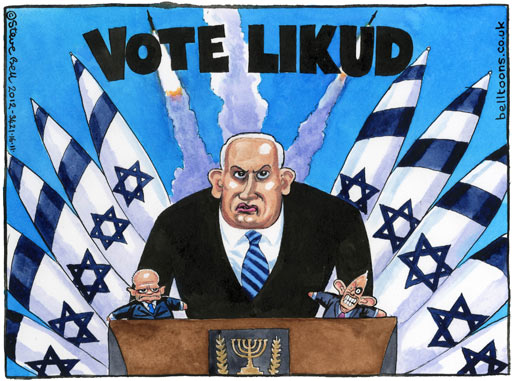
Here is the particular cartoon I have in mind:
It was published in The Guardian (UK) yesterday, and as you may be able to see, it portrays Israeli PM Benjamin Netanyahu as a puppet-master, with British politicians Tony Blair and William Hague as his puppets, and was published to illustrate the cartoonist’s view of British reaction to the Gaza situation.
How much can we read into it?
**
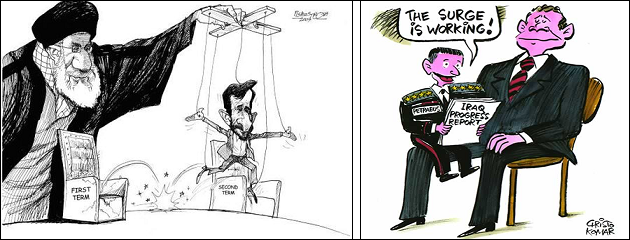
If you are used to seeing cartoons such as these —
showing Khamenei pulling Ahmadinejad‘s strings and Petraeus as a puppet of GW Bush, when you come across the Netanyahu cartoon in the Guardian, you may well view it as another in a long series of political cartoons suggesting that someone is running someone else’s show behind the scenes. It’s the old idea of the eminence grise, in other words, expressed in cartoon form.
**
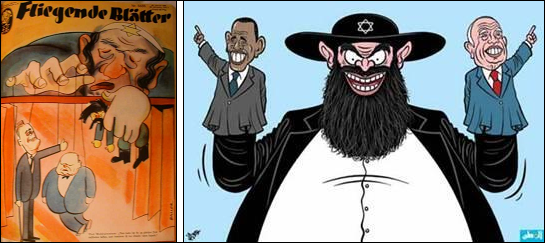
If, on the other hand, you’ve been exposed way too often to cartoons like these —
the one portraying Churchill, FDR and Stalin as Jewish puppets, taken from a 1942 issue of the Nazi paper, Fliegende Blätter, or the one depicting McCain and Obama as Israeli puppets, taken from a 2008 issue of the Saudi paper, Al-Watan… you may well see the same cartoon in a very different — and distinctly antisemitic — light.
**
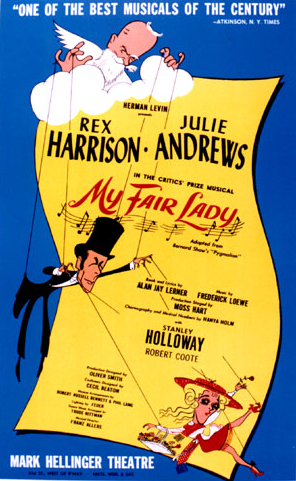
The last two graphics, at least, are extremely offensive, and I would like to offer another graphic here — one which also uses our “puppet master” theme — as a visual equivalent of offering a glass of water to cleanse the palate:
I’ll be addressing this My Fair Lady poster from a very different angle, in a later post in my “form is insight” series — this one on “dolls within dolls”, the “world stage which we have dotted with stages of our own devising” and “turtles all the way down”…
**
Having hopefully reduced the emotional freight which some of the cartoons above must surely have carried with them, I would now like to offer you some background which seems relevant to me. Characteristically, perhaps, it comes from a very different field of knowledge.
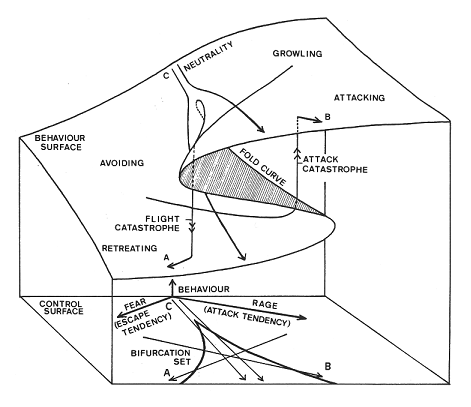
EC Zeeman‘s April 1976 article Catastrophe Theory in the Scientific American was my introduction to the mathematician Rene Thom’s remarkable body of work, an introduction which sailed mostly over my head — but one of Zeeman’s points, which he illustrated with the graphic below, made perfect sense to me.
The annotation to this illustration read in part:
If an angry dog is made more fearful, its mood follow* the trajectory ‘A’ on the control surface. The corresponding path on the behaviour surface moves to the left on the top sheet until it reaches the fold curve; the top sheet then vanishes, and the path must jump abruptly to the bottom sheet. Thus the dog abandons its attack and suddenly flees. Similarly, a frightened dog that is angered followes the trajectory ‘B’. The dog remains on the bottom sheet until that sheet disappears, then as it jumps to the top sheet it stops cowering and suddenly attacks.
My translation:
A dog that reaches the point where its ears are fully pinned back, indicating full-on fear, and its teeth are also fully bared, indicating full on rage, will behave differently depending on whether its fear level or its rage level was the first to be raised to “full”.
Just as a dog’s reaction to a full on mix of rage and fear may depend on which stimulus came first, so — I am suggesting — our own reaction to the cartoon in question — inherently antisemitic, or merely critical of a particular Israeli operation — may depend on our previous exposure to cartoons, politics, the Israeli-Palestinian conflict, or antisemitism.
**
We now have several levels of ease or difficulty in reading graphics. The Zeeman graphics are hard to read because they’re too small to be legible — but put them in the context of Zeeman’s article, and view them full size as originally published, and the only problem might be in following Zeeman’s text, itself a popularization and simplification of Rene Thom‘s work.
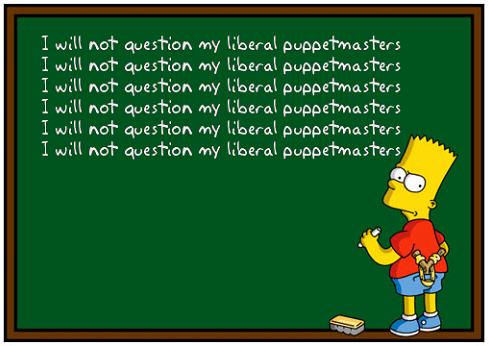
The Bart Simpson graphic is fairly straight forward, and regular viewers of the show would “read” it in line with hundreds of similar frames in which Bart writes repeated lines on a classroom chalkboard, from Season 1 episode 2’s “I will not waste chalk” to Season 23’s “There’s no proven link between raisins and boogers”.
And then there’s the disputed Netanyahu graphic… which can be “read” differently, depending on what previous “puppet master” associations the viewer beings to the task. Here, it seems to me, the task of interpretation can be viewed in one of two ways: (i) as an exploration of how it is likely to be read, which I’m suggesting will depend on previous association, and (ii) as an exploration of what “must have been” in the cartoonist’s heart.
**
Assessing the cartoon’s probable impact on segments of the public is one thing — knowing what the cartoonist intended, even though we tend to conflate the two, is quite another. Not for nothing does St Paul in I Corinthians 2.11 ask (in my own translation)
Who knows the qualities of a man but the spirit of that man within him?
[ by Charles Cameron — IDF terminology and the Gaza conflict, explanations of Exodus, an IDF video, Megillah 10b and the koan “with God on our side” / “with God on all sides” ]
.
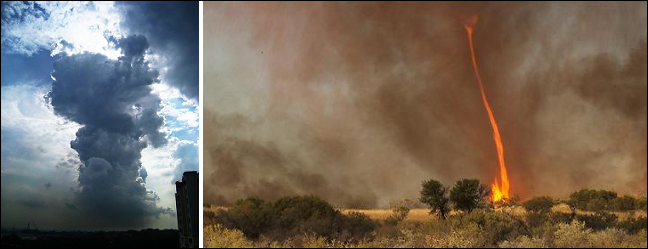
photo credits: Schristia, Cloud; Chris Tangey, Fire
.
I’m curious.
The IDF calls today’s Israeli operation in Gaza “Operation Pillar of Defense” in English, but as John Cook points out in Gawker, uses the term Hebrew term “Pillar of Cloud” in Hebrew.
There’s a great deal of interest here, apart from the difference between their use of non-Biblical terminology in English and Biblical terminology in Hebrew. One point that catches my ear, a poet being a poet, is that the phrase “Pillar of Cloud” is in fact only one half of a double reference…
Thus in Exodus 13.21-22 we read:
And the LORD went before them by day in a pillar of a cloud, to lead them the way; and by night in a pillar of fire, to give them light; to go by day and night: He took not away the pillar of the cloud by day, nor the pillar of fire by night, from before the people.
**
There are various ways of understanding the pillar of cloud and pillar of fire, but it’s pretty clear that there’s only one pillar —
And it came to pass, that in the morning watch the LORD looked unto the host of the Egyptians through the pillar of fire and of the cloud… [Exodus 14.24]
which is called a pillar of cloud by day and a pillar of fire by night, perhaps simply because we are speaking of theophany — the Divine Presence made visible — perhaps because smoke from a brazier is more visible in daylight and flames at night — perhaps because as Hans Goedicke, then chairman of the department of Near Eastern Studies at Johns Hopkins, suggested, the source of both fire and smoke was the eruption of Santorini around 1600 BCE.
The difference in worldviews behind those explanations alone is a matter of considerable interest.
**
Linguistically, however — and this is where the poet being a poet comes in — there are two pillars, and I have to wonder whether the name “Pillar of Fire” is being saved for a later and perhaps more impressive (“shock and awe”) operation, or — in line with the “by day and by night” distinction — refers to the covert side of the same op?
Not that anyone would be likely to give me that information, or that I’d have any use for it if they did.
But the Biblical phrasing is powerful, and “Pillar of Defense” doesn’t make a whole lot of sense — besides, cloud and fire go together in Hebrew in much the same way smoke and mirrors do in English.
Of the three choices, I’d have gone with “Pillar of Fire” myself.
**
An IDF spokesperson, in a response to Cook’s Gawker article, claimed:
I think that every example of Bible quotes you cited has defensive connotations, rather than “vengeful.”
One of those quotes is Exodus 14:24, which I quoted above but will now give in full, along with verse 25:
And it came to pass, that in the morning watch the LORD looked unto the host of the Egyptians through the pillar of fire and of the cloud, and troubled the host of the Egyptians, and took off their chariot wheels, that they drave them heavily: so that the Egyptians said, Let us flee from the face of Israel; for the LORD fighteth for them against the Egyptians.
I think calling that “defensive” is a bit one-sided, but on the other of the two hands in question, so is calling it “vengeful”.
The Israelites saw themselves in the larger context as escaping Egyptian oppression, the Egyptians obviously considered themselves under attack in the short term — just as surely as the people of Gaza must feel under attack by the oppressive Israelis today, while the Israelis clearly feel under attack by terroristic Hamas and its rockets. But hey, the IDF spokesman only offered his explanation that the Pillar of Cloud and Defense was “defensive” as “Just my two cents”…
FWIW, those two verses from Exodus sound just a little like Quran 33.26:
And He brought down those of the People of the Book who supported them from their fortresses and cast terror in their hearts; some you slew, some you made captive. And He bequeathed upon you their lands, their habitations, and their possessions, and a land you never trod. God is powerful over everything.
That’s an ayat that has always interested me, because of the use of the word “terror” found in a number of translations including this one, by AJ Arberry — others have “awe” or “panic”, but “terror” is interesting in the context of its contemporary usage.
**
Here’s the current strike counter strike in two tweets:
**
Okay, let’s get as close to visceral as modern technological warfare permits. After the recent truce was broken and numerous rockets fired into Israel, the IDF fired a missile that killed Hamas military leader Ahmed Jabari, and quickly put the video feed up on YouTube:
**
People are killing and getting killed. Should that be a matter for concern, or delight?
The narrative from which the IDF drew the name of their campaign in Gaza is taken from that of Israel’s escape from Egypt in Exodus, which also includes the parting of the waters and destruction of the Egyptian army:
And the angel of God, which went before the camp of Israel, removed and went behind them; and the pillar of the cloud went from before their face, and stood behind them: And it came between the camp of the Egyptians and the camp of Israel; and it was a cloud and darkness to them, but it gave light by night to these: so that the one came not near the other all the night. And Moses stretched out his hand over the sea; and the Lord caused the sea to go back by a strong east wind all that night, and made the sea dry land, and the waters were divided…. [Exodus 14.19-21]
And it came to pass, that in the morning watch the Lord looked unto the host of the Egyptians through the pillar of fire and of the cloud, and troubled the host of the Egyptians, And took off their chariot wheels, that they drave them heavily: so that the Egyptians said, Let us flee from the face of Israel; for the Lord fighteth for them against the Egyptians. And the Lord said unto Moses, Stretch out thine hand over the sea, that the waters may come again upon the Egyptians, upon their chariots, and upon their horsemen. And Moses stretched forth his hand over the sea, and the sea returned to his strength when the morning appeared; and the Egyptians fled against it; and the Lord overthrew the Egyptians in the midst of the sea. [Exodus 14.24-27]
Here again we see an instance of what I have called the two-fold logic of scriptures: In the Babylonian Talmud, Megillah 10b, R. Johanan tells us:
The ministering angels wanted to chant their hymns, but the Holy One, blessed be He, said, The work of my hands is being drowned in the sea, and shall you chant hymns?
to which R. Eleazar responds:
He himself does not rejoice, but he makes others rejoice.
**
To my mind, what we’re looking at here is a global koan: the immediate and eternal paradox of life and death.
[ by Charles Cameron — the different types of “leaders” should give us an idea of the different mental operations in play in the individual minds of the led, as well as the “mind” of the organization — plus fun ]
.
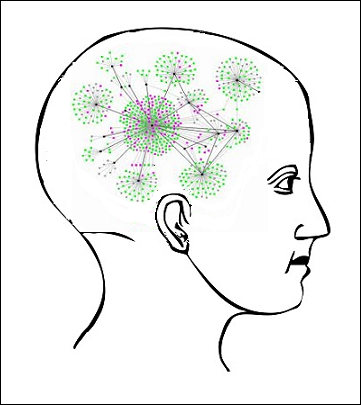
credit for mind map aspect of composite image to valdis krebs
.
Okay, I made my basic point here quite nicely in that little tag-line that gives you the brief overview of each of my posts right next to my name, so I’ll just repeat it here, very slightly amplified for focus:
The different types of “leaders” we identify in AQ should give us an idea of the different mental operations usually in play in the individual minds of jihadists, as well as within the “mind” of the organization itself.
I tried to show how cross-grain thinking in general, and thinking that includes both “subjective” and “objective” realities specifically, might play a considerable role in understanding some pressing contemporary issues in my recent post on Mozart — a figure so removed from those problems that some of you may have skipped it. Here’s my ending, with the Mozart details safely removed:
I think we should track that pattern, know as much as we can of that pattern, write the biography of the way in which some piece of music weaves between inspiration and thought, composer and instrument, mind and matter, performer and audience, studio and home digital music center…
Then, perhaps, we could begin to map other patterns – in some ways simpler and more urgent ones.
The sorts of “simpler and more urgent” patterns I was thinking of there include:
how discussions become deliberations and deliberations decisions
how scenarios are built and understood and sometimes poorly configured to our later detriment
how foreign policy plus feedback loops can create blowback and how to minimize it..
and specifically,
how the “jihadist” radicalization process moves from floating frustration and shame, via identification of a plausible “other” to rage against, to commitment, then via theology (!!) (for divine sanction of otherwise unpalatable acts) to the recognition of a binding moral obligation (fard ‘ayn in AQ terms) — and thence to camps for training in weaponry and the requirements and subtle limitations on Quranically sanctioned war…
**
That last one has been an interest of mine, sitting in the back of my mind as an unanswered problem, quietly gathering data and forming insights for a while now, under a rubric along the lines of the question:
Can we figure out a rough map of the workings of the “typical” mind of a potential jihadist as it radicalizes?
It occurs to me that the leadership of an organization likely maps well to the organization’s functions, and those functions to the thought processes in which members are involved so a map of the aspects of leadership may well give us a rough draft of a mind-map for the individual member, including the passage from uninvolved observer to active participant: the process of radicalization.
This may seem pretty obvious to some of you, but it’s a fresh idea for me, and to me it’s important because we already map communications networks and organizational flows, but the mind — the individual mind is one place we don’t seem to go.
So I’m thinking in terms of sketching the mind of a “person” who is in some ways AQ as a whole, considered as if it were one sensate human-like being, filled with the usual variety of thoughts and emotions, ideals and pragmatisms, hopes and fears, hunches and hard data, clarities and confusions.. And I’m thinking of doing this by treating “leaders” as though they were distinct but coordinated processes in a single mind.
We track and map people and their connections, we track and map groups and their connections, we track and map communications and their connections — are we tracking and mapping memes as such? ideas and their connections? minds?
If we are already tracking ideas and minds — or if we aren’t doing that yet, but could — I’d be on the lookout for possible positive and negative feedback loops within the system, some that enhance the overall operation and could be disrupted, and some that fragment and damage it and could be amplified.
So that, among other things, God willing, we could learn better ways to dampen some of the oscillations of hate…
**
I was looking at a comment in the recent ICSR report, Al-Qaeda at the Crossroads [h/t @azelin], and ran across this quote which struck me from an oblique angle:
About ten core leaders have been subsequently killed, including Atiyah Abd al-Rahman, Abu Hafs al-Shahri, Samir Khan, Anwar al-Awlaki, and Abu Yahya al-Libi.
Let’s take a look at these folk: Atiyah Abd al-Rahman was reported via Bill Roggio at Long War Journal as al Qaeda’s “operations chief” and a major planning a major attack on the US for the tenth anniverary of 9/11, as AQ’s “general manager” and bin Laden‘s “chief of staff”. Abu Hafs al-Shahri was another “operations chief”. Samir Khan was a publicist, the editor of the English-language magazine Inspire. Anwar al-Awlaki was a minor theologian with a talent for publicity and a decent understanding of his American audience…
And as for Abu Yahya al-Libi, here’s an excerpt from an NYT piece about him:”I call him a man for all seasons for A.Q.,” said Jarret Brachman, a former analyst for the Central Intelligence Agency who is now research director of the Combating Terrorism Center at West Point. “He’s a warrior. He’s a poet. He’s a scholar. He’s a pundit. He’s a military commander. And he’s a very charismatic, young, brash rising star within A.Q., and I think he has become the heir apparent to Osama bin Laden in terms of taking over the entire global jihadist movement.”
On that telling, al-Libi alone would be almost enough for my purposes — but let’s go with the whole list. The AQ mindset involves courage, poetry, scholarship, punditry and command and control. Specify that the scholarship needs to include theology (AQ at one point sent al-Libi to Mauretania for advanced Islamic studies) as well as strategy and guerrilla warfare (think Abu Mus’ab al-Suri, who was well-read in Taber’s The War of the Flea, Chairman Mao, Che Guevara, and Vo Nguyen Giap), and the significant influences on the jihadist mind begin to swim into focus.
**
See, I’m nudging my way to something fairly close to the Lincoln mention in Fred Kaplan‘s Slate piece about Petraeus the other day:
Toward the end of the war, as the senior planning aide to Army Chief of Staff Gen. George Marshall, Lincoln realized that the Army needed to breed a new type of officer to help the nation meet its new global responsibilities in the postwar era. This new officer, he wrote to a colleague, should have “at least three heads—one political, one economic, and one military.” He took a demotion, from brigadier general to colonel, so he could return to West Point and create a curriculum “to improve the so-called Army mind” in just this way: a social science department, encouraging critical thinking, even occasionally dissent.
How would we map these mental processes? How would we map the jihadist’s equivalent?
**
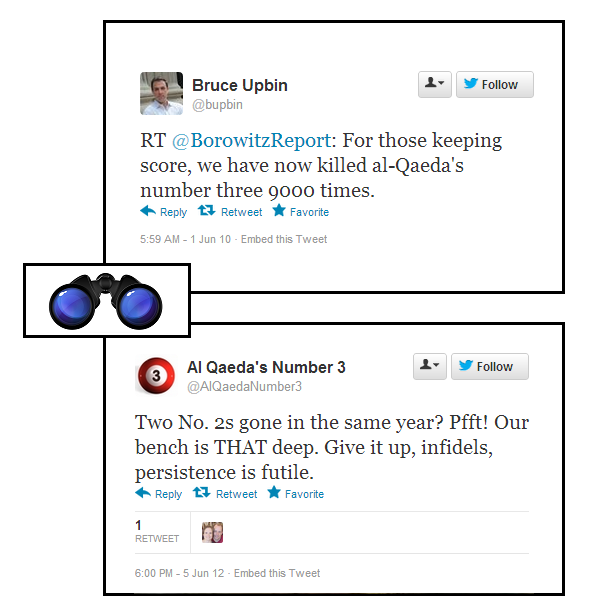
While I was fishing around for AQ leadership lists in search of an education, I ran across Robert Mackey‘s amusing piece on his NYT blog back in 2010, titled Eliminating Al Qaeda’s No. 3, Again, in which he mentioned as killed or captured claimants to the #3 spot Mustafa Abu al-Yazid, described as “a top financial chief for Al Qaeda” and quotes a colleague as saying “many of Mr. Yazid’s predecessors in Al Qaeda’s No. 3 slot” – from the Bush years alone, he lists Abu Zubaydah, Khalid Shaikh Mohammed, Abu Faraj al-Libbi, Hamza Rabia and Saif al-Adel.
Okay, we should definitely add “financial chief” to my list above.
The humorist and the artist in me often lead the more serious analyst in me to insights I’d not otherwise have access to, and since I’m worrying away at the notion that analysis needs to feature both “interior” (mind, heart) and “external” (world) realities, I keep the artistry and humor in my analyses, and hope that makes them more rather than less accessible — so let’s run with the AQ#3 nonsense for a bit.
Mackey’s is a slightly tongue in cheek treatment of a reasonably serious topic. On Twitter the humor gets more incisive, with Andy Borowitz claiming 9,000 AQ#3s have been killed, and AQ#3 in person setting up a twitter account and tweeting merrily away for a while, see the two sample tweets in this SPECS graphic:
To be honest, I find the AQ#3 business both irritating — since it shows how little depth our popular understanding of who we’re dealing with really has — and amusing — because it’s so very ripe for satire…
**
I’ve been working at this post so long I’m mentally cross-eyed, so feel free to fill me in or chew me out…
[ by Charles Cameron — another insight into mujahideen ethos via their graphics, this time from their Soviet era campaign ]
.
First, a current graphic which I’ve already shown you in a recent post on jihadist imagery — then a version of the same visual idea from earlier days:
credits: above, Ibn Siqilli, below, Mathew Trevithick for Foreign Policy
.
Ibn Siqilli‘s image is contemporary, Trevithick‘s is drawn from his fascinating series of images titled The Not-So-Funny Papers, which I missed myself when it first came out, and warmly recommend. The legend the flag in Trevithick’s piece carries is “Jihad”.
This post is intended as a footnote to my earlier post, Iwo Jihad? — the muj have clearly been at this business of graphical borrowing for a while…
[ by Charles Cameron — The Last Temptation of Christ troubles, an early warning re the upcoming Jesus of Nazareth movie — the blood libel and more ]
.
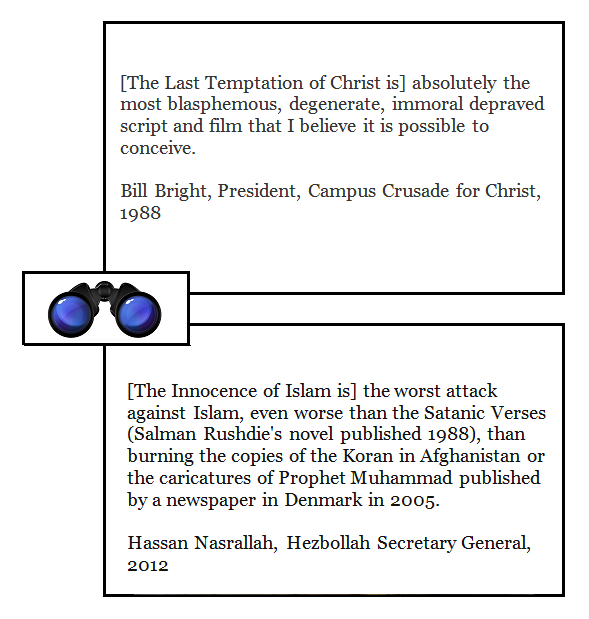
American and European Christians, too, can react violently to films they perceive as blasphemous, and this too we should remember as we weigh our own responses to the rioting in Cairo and elsewhere.
Martin Scorsese‘s Last Temptation of Christ gives us a sense of how modern American and European Christians can react to perceived blasphemy, while the forthcoming Paul Verhoeven movie of his own book Jesus of Nazareth will test the degree to which we’ve learned the lessons of a quarter century ago — and of this last week.
.
**
Martin Scorsese’s The Last Temptation of Christ: stirred strong feelings when it opened. I was in LA at the time, and was following the controversy fairly closely having attended an early screening, and having both literary and theological interests.
The short video clip below is a little choppy, it doesn’t make it particularly clear that the clips you see are from the film Martin Scorsese made of a novel — written by the Nobel laureate Nikos Kazantzakis — which makes no attempt nor pretense to be a historical or religiously orthodox portrayal of Christ. IMO, it is worth watching for the glimpse it gives of just how strong the undercurrents of emotion aroused by Scorsese’s film were at the time:
**
I’m bringing this subject up and attending to it in some detail because NBC World News mentioned Martin Scorsese’s movie on the 13th of this month, in an explanation as to Why films and cartoons of Muhammad spark violence, but without gwetting the picture quite right:
Director Martin Scorsese’s adaptation of a book by the same name showed Jesus struggling with lust, depression and doubt, and engaging in sex — in his imaginings — before snapping back to reality and dying on the cross. That movie was seen as blasphemy by some Christians, who — though not violent — were vocal enough to prevent the film from being shown in many parts of the United States.
There may have been no violence done to humans in the US — but there as certainly damage to property, and some vicious threats made, as The Encyclopedia of Religion and Film records:
At the Cineplex Odeon Showcase Theater in New York City, vandals slashed seats and spray-painted threats aimed at the chairman of MCA: “Lew Wasserman: If you release ‘The Last Temptation of Christ,’ we will wait years and decimate all Universal property. This message is for your insurance company.”
In parts of Europe, the violence was more intense:
Overseas, at the September 28 opening in Paris, demonstrators who had gathered for a prayer vigil threw tear gas canisters at the theater’s entrance. Catholic clergy led rock-throwing and fire-bombing assaults on theaters in many French municipalities. A thousand rioters in Athens trashed the Opera cinema, ripping apart the screen and destroying the projection equipment.
In Paris, specifically, the violence severely injured some human targets. From Wikipedia (with their footnotes removed — you can track the various quotes from the original page):
On October 22, 1988, a French Christian fundamentalist group launched Molotov cocktails inside the Parisian Saint Michel movie theater while it was showing the film. This attack injured thirteen people, four of whom were severely burned. The Saint Michel theater was heavily damaged, and reopened 3 years later after restoration. Following the attack, a representative of the film’s distributor, United International Pictures, said, “The opponents of the film have largely won. They have massacred the film’s success, and they have scared the public.” Jack Lang, France’s Minister of Culture, went to the St.-Michel theater after the fire, and said, “Freedom of speech is threatened, and we must not be intimidated by such acts.”
The Catholic response — from the Cardinal Archbishop of Paris among others — reproved both the blasphemy and the rioting:
The Archbishop of Paris, Jean-Marie Cardinal Lustiger, said “One doesn’t have the right to shock the sensibilities of millions of people for whom Jesus is more important than their father or mother.” After the fire he condemned the attack, saying, “You don’t behave as Christians but as enemies of Christ. From the Christian point of view, one doesn’t defend Christ with arms. Christ himself forbade it.” The leader of Christian Solidarity, a Roman Catholic group that had promised to stop the film from being shown, said, “We will not hesitate to go to prison if it is necessary.”
There was apparently a connection with French far-right politics, too:
The attack was subsequently blamed on a Christian fundamentalist group linked to Bernard Antony, a representative of the far-right National Front to the European Parliament in Strasbourg, and the excommunicated followers of Archbishop Marcel Lefebvre. Lefebvre had been excommunicated from the Catholic Church on July 2, 1988. Similar attacks against theatres included graffiti, setting off tear-gas canisters and stink bombs, and assaulting filmgoers.
There were legal proceedings following the Saint Michel incident, and it’s notable that Fr. Gérard Calvet OSB, founder and Prior of the Benedictine Abbaye Sainte-Madeleine du Barroux, testified at the tribunal on behalf of the convicted youths, describing their motives if not their mode of expression as “noble”. Would that term be equally applicable to protesters of blasphemies against other faiths? We now live in a dense-packed world where such comparisons are easily made.
Let’s pause for a minute over the twinned remarks of the late (and widely respected) Cardinal Lustiger concerning Last Temptation —
Jean-Marie Cardinal Lustiger, said “One doesn’t have the right to shock the sensibilities of millions of people for whom Jesus is more important than their father or mother.” After the fire he condemned the attack, saying, “You don’t behave as Christians but as enemies of Christ. From the Christian point of view, one doesn’t defend Christ with arms. Christ himself forbade it.”
and compare the remarks of a similarly authoritative religious figure in Libya to the Innocence of Muslims video:
Libya’s Grand Mufti, Sheikh Sadeq Al-Ghariani, has issued a fatwa condemning Tuesday’s killing of US Ambassador Chris Stevens along with three other American diplomatic staff and a number of Libya security guards. He said those involved were criminals who were damned by their action.
He also condemned the production of any film, picture or article insulting the Prophet Mohammad or any of the prophets by “extreme fanatics” in the US or elsewhere. The Prophet Muhammad, Ghariani said, had specifically forbidden the killing of ambassadors and envoys.
**
Almost a quarter century has passed since Scorsese’s movie opened, but as I said above, we will soon have an opportunity to show what we have learned from those lamentable events in Paris and the more recent tragedies in Benghazi, Cairo and elsewhere.
Paul Verhoeven — the director of such blockbusters as RoboCop, the original Total Recall, and Basic Instinct — has raised the financing for his upcoming movie Jesus of Nazareth, based on his book of the same name, and scripted by Roger Avary, who shared an Oscar with Quentin Tarrentino for their Pulp Fiction screenplay.
Verhoeven, be it noted, is not only a writer and movie director, but also a member of the Jesus Seminar — a group of scholars which, as Wikipedia nicely puts it, “treats the canonical gospels as historical sources that represent Jesus’ actual words and deeds as well as elaborations of the early Christian community and of the gospel authors” and prepares color-coded editions of the gospels suggesting which sayings of Jesus should be considered original, and which are better understood as later additions.
Deadline reports that the legendary Paul Verhoeven — a guy who, amazingly, only directed three movies in the past fifteen years — has received financing to adapt his own book, Jesus of Nazareth, which discounts every mythical story surrounding Christ and, instead, opts to present him as a simple human figure with a message powerful enough to radiate throughout time. Roger Avary (Tarantino‘s story partner on Pulp Fiction) will write the film, while Muse Productions are doing the proper backing.
Almost any work going against the long-held Biblical grain will get groups up in arms — no, I don’t even need to provide examples — but the claims of Nazareth are, even in this context, still mighty contentious. Most notable is the idea that Jesus is not the son of God, but was actually the product of Mary being raped by a Roman soldier; so, right off the bat, you’re discounting the entire foundation of his story.
I am pointing this out because right now would be a good time for the various churches to begin a general conversation about the film-maker’s right to hold an opinion, write a book and make a movie, the hurt that may be felt by believers, and the importance of responding without hatred or violence when offended.
**
In our concern with matters of Christian and Muslim issues, let us not lose sight of the fact that Jews too have movies made about them that may not only hurt feelings but also represent real threats against them, reminiscent of Nazi and earlier Russian antisemitic propaganda fabrications.
In 2003 a private Syrian film company created a 29-part television series Ash-Shatat (“The Diaspora”). This series originally aired in Lebanon in late 2003 and was broadcast by Al-Manar, a satellite television network owned by Hezbollah. This TV series, based on the antisemitic forgery The Protocols of the Learned Elders of Zion, shows the Jewish people as engaging in a conspiracy to rule the world, and presents Jews as people who murder Christian children, drain their blood and use this blood to bake matzah.
Al-Shatat: Jews Murder A Christian Child and Use His Blood for Passover Matzos. anti Semite Arab propaganda against Jews, Judaism and Israel.
The following is a scene from the Syrian-produced TV series Al-Shatat. Al-Shatat was first aired on Hizbullah’s Al-Manar TV during the month of Ramadan 2003, and then on two Iranian channels during Ramadan 2004. Al-Mamnou’ TV, a new Jordanian channel, is airing Al-Shatat during Ramadan 2005.
It is worth recalling, too, that Mel Gibson‘s film, The Passion of the Christ, was perceived by many Jews, Christians and others as anti-Semitic — and that nonetheless the Orthodox Jew and conservative movie critic Michael Medved wrote:
The possibility of anti-Jewish violence in response to the film has been irresponsibly emphasized and has become, self-fulfilling prophecy. In parts of Europe and the Islamic world, anti-Semitic vandalism and violence occur daily, and hardly need a film by a Hollywood superstar to encourage them. In this context, Jewish denunciations of the movie only increase the likelihood that those who hate us will seize on the movie as an excuse for more of hatred.
**
I trust it is not too late to wish our Jewish readers l’shana tova: may your apples be dipped in honey and all our days bathed in peace.
Zenpundit is a blog dedicated to exploring the intersections of foreign policy, history, military theory, national security,strategic thinking, futurism, cognition and a number of other esoteric pursuits.