zenpundit.com » judaism

Archive for the ‘judaism’ Category

Kristallnacht at Seventy-five

Monday, November 11th, 2013

[ by Charles Cameron — of fire and light ]
.

Since Zen tweeted a link to my own Armistice Day, Veterans Day post from last year and posted his own The Vietnam War at Fifty today, I’d going to skip back a day or two in my own calendar this time, and commemorate the 75th anniversary of Kristallnacht, which fell on the night of November 9/10, 1938.

I believe this is a photo of the Hannover synagogue burning:

**

I don’t know how we even begin to think about this.

George Steiner famously said “We know that a man can read Goethe or Rilke in the evening, that he can play Bach and Schubert, and go to his day’s work at Auschwitz in the morning” — and also observed, “The world of Auschwitz lies outside speech as it lies outside reason” — and Adorno: “to write a poem after Auschwitz is barbaric”.

Contemplating that photo of the burning of the Hannover synagogue, then, I am thrown back on a story told of the rabbi — a disciple of Rabbi Gershon — who came to visit the Baal Shem Tov, founder of Hasidic Judaism, and to whom that great master first revealed his spiritual station:

In the night the rabbi found no sleep. It seemed to him as if here and now the wonder of the far and the wonder of the near must flow together. In the middle of the night the command came to him, soundless and without form. He arose and went. Then he was already in the other chamber and saw: The chamber was filled with flames up to the height of a man. They rose dull and sombre, as if they were consuming something heavy, hidden. No smoke ascended from the fire, and all the furniture remained uninjured. But in the middle of the fire stood the master with uplifted forehead and closed eyes.

The rabbi saw further that a division had taken place in the fire which gave birth to a light, and the light was like a ceiling over the flames. The light was twofold. Underneath it was bluish and belonged to the fire, but above the light was white and unmoving and extended from around the head of the master unto the walls. The bluish light was the throne of the white, the white rested on it as on a throne. The colours of the bluish light changed incessantly, at times to black and at times to a red wave. But the light above never changed, it always remained white. . Now the bluish light became wholly fire, and the fire’s consuming became its consuming. But the white light that rested on it did not consume and had no community with the flame.

The rabbi saw that the head of the master stood entirely in the white light. The flames which leaped upward on the body of the master turned to light, and every little while the amount of light increased. At last all the fire became light. The blue light began to penetrate into the white, but every wave that penetrated itself became white and unchanging. The rabbi saw that the master stood entirely in white light. But over his head there rested a hidden light that was free of all earthly aspects and only in secret revealed to the beholder.

It was thus that the Baal Shem Tov become known to the wider world.

**

If I might draw the moral here, suiting my tale (quoted from Martin Buber‘s The Legend of the Baal-Shem) to the occasion — there is fire that destroys, and there is light indestructible.

We choose, always we choose.
Myanmar between Woolwich and Al-Aqsa 1: interfaith hatred

Wednesday, October 23rd, 2013

[ by Charles Cameron — in which jihadis take on Jews, Christians, Muslims and Buddhists, quite an interfaith haul for hatred ]
.

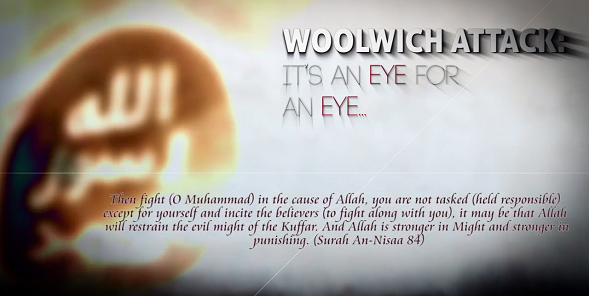
Aaron Zelin at Jihadology posted an hour-long video entitled Woolwich Attack a week or so ago, and I found it particularly interesting on two accounts: first, that it makes a multi-faith attack that includes Buddhism in its catalogue of enemies of Islam, and second, that it uses an innovative feature of modern digital typography. Here, I’ll concentrate on the first. Here’s the video’s title:

**

Christianity as a target is well represented in the form of Dr Justin Welby, the recently-appointed Archbishop of Canterbury:

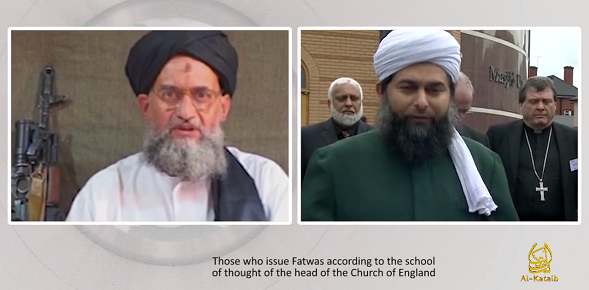
Notice also the lower of these two screengrabs, this one showing Ayman al-Zawahiri (left) berating a leading Muslim spokesman in the UK, Ibrahim Mogra of the Muslim Council of Britain (right), for speaking at the same event as the Archbishop. The damning subtitle suggests he’s one of those “who issue Fatwas according to the school of thought of the head of the Church of England”.

**

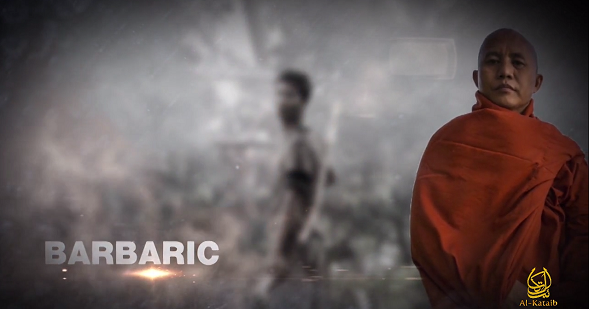
It wasn’t the attack on Christians or fellow Muslims that caught my eye, though, but the unexpected presence of the monk Wirathu, the rhetorical leader of Myanmar’s recent Buddhist rioting against Burmese Muslims. I’d seen his face on Time magazine and elsewhere, but it came as a bit of a shock here in a jihadist video — I’d filed him and his 969 movement under “Buddhism” rather than “Islam” in my mental listing of violent movements with religious underpinnings.

Ugly, ugly.

**

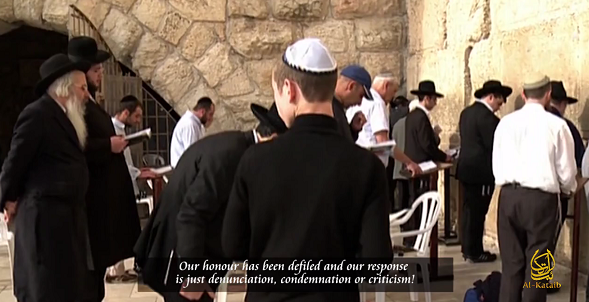
Finally, no invitation to jihad these days is complete without its mention of the al-Aqsa mosque and Jerusalem — and it is here that Judaism comes in for attack. Consider these two screengrabs:

**

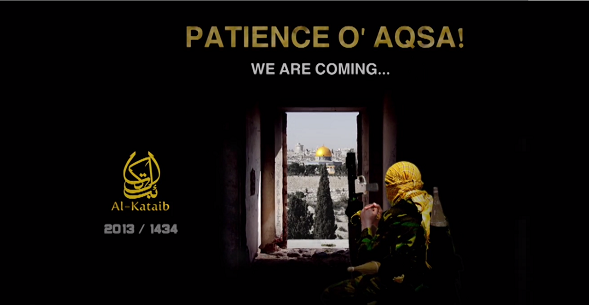
The video closes, significantly, with a long shot of the Dome of the Rock through a window…

Yesterday my friend William Benzon made a post titled On Describing a Painting which began:

Harvard art historian Jennifer Roberts bills her article thus: The Power of Patience: Teaching students the value of deceleration and immersive attention. OK. But I take a different lesson from it, one about one of my current hobby horses: description. Roberts focuses on an 18th Century painting by John Singleton Copley, A Boy with a Flying Squirrel. Her point is that the more you look at the painting, the more you notice and hence the more you can note in a written description. She asks her students to spend a full three hours with a single painting.

Of her own experience with that painting she observes:

It took me nine minutes to notice that the shape of the boy’s ear precisely echoes that of the ruff along the squirrel’s belly—and that Copley was making some kind of connection between the animal and the human body and the sensory capacities of each. It was 21 minutes before I registered the fact that the fingers holding the chain exactly span the diameter of the water glass beneath them. It took a good 45 minutes before I realized that the seemingly random folds and wrinkles in the background curtain are actually perfect copies of the shapes of the boy’s ear and eye, as if Copley had imagined those sensory organs distributing or imprinting themselves on the surface behind him. And so on.

She begins her next paragraph: “What this exercise shows students is that just because you have looked at something doesn’t mean that you have seen it.”

Looking at that final screengrab with this in mind, I see a close correlation between the golden Dome that focuses our attention on the Noble Sanctuary / Temple Mount, and the round, yellow-gold keffiyeh of the jihadist observing it through his window — “making some kind of connection between” them, to echo the words of Harvard’s Elizabeth Cary Agassiz Professor of the Humanities…

It’s a skilled and meaning-filled use of the medium.

**

In my second post in this series, I’ll point to a significant development in graphics and technology introduced in this video.

DoubleBurn: mosque and synagogue

Sunday, October 20th, 2013

[ by Charles Cameron — tipping my hat to a moving interfaith gesture ]
.

This past Wednesday, a person or persons unknown torched a mosque in Gdansk, Poland, known to me as the place where Lech Walesa founded the Solidarnosc movement.

Thankfully, the physical damage doesn’t appear to have been complete [upper panel, below]:

What brings this particular event to our attention is the response from the city’s Jewish community [lower panel, above: an image of a current Gdansk synagogue].

The Jewish Telegraphic Agency [JTA] gives us the story:

Polish Jews say mosque torching reminiscent of Kristallnacht

Representatives of the Jewish community of Gdansk, Poland, said the torching of a mosque had “frightening connotations” of the Nazi-inspired Kristallnacht pogroms against Jews.

The association was inescapable, three of the city’s Jewish leaders wrote in a statement Thursday.

“On the eve of the 75th anniversary of Kristallnacht, during which synagogues were burned in the Free City of Gdansk, the burning of the mosque must bear frightening connotations,” the statement said.

Unidentified individuals started the fire early Wednesday morning. It consumed the mosque’s door and some of the equipment, resulting in damages to the tune of $16,000.

“In the face of this cowardly act of barbarism, Jews of Gdansk cannot stand idly by,” wrote the authors of the statement, Michal Samet, Michal Rucki and Mieczyslaw Abramowicz. “We express our deep indignation against the attack on the temple and the sadness of the fact that it took place in Gdansk.”

**

An echo in time.

A powerful analogy, deeply felt.

And a little child shall lead them…

Monday, October 14th, 2013

[ by Charles Cameron — on two viral videos of children ]
.

Malala Yousafzai has been in many hearts and minds recently, and deservedly so. Her speech before the United Nations Youth Assembly, like her John Stewart interview, went viral on YouTube– here’s a version that has the grace to include her opening invocation of the Name of God:

Thinking idly about her the other day I was reminded of anither video of a schoolchild that went viral just a few months ago — this one the more off-the-cuff speech of a boy, Ali Ahmed, interviewed on the street. He’s twelve, Malala spoke at the UN on her sixteenth birthday, but he testifies eloquently to Malala’s point by his own obvious clarity and intelligence:

I think it’s worth holding these two video clips in mind together, the young woman and the young man, she almost fatally wounded and now recovered, he happening to be at the right spot on the right moment to be interviewed, her words reaching us directly in her fluent English, his coming to us only via sub-titles, as in an art-house “foreign” movie… If she has eclipsed him, let us remember him again.

The intelligence, the clarity. the education. And how many thousands more must there be, unviral and unsung, but no less intelligent?

**

Unless ye become as little children, saith the Gospel, and a little child shall lead them, saith the Prophet.

Of dualities, contradictions and the nonduality

Thursday, June 27th, 2013

[ by Charles Cameron — on the basis, the mathematics, the essence of conflict and resolution ]
.


.

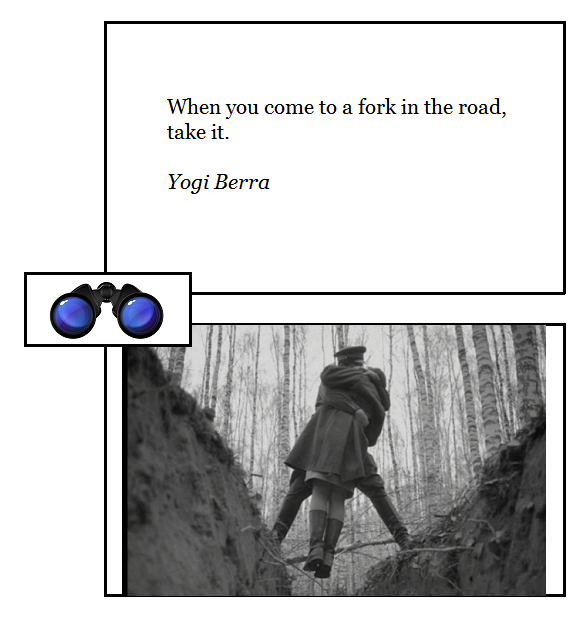
This DoubleQuote features two great masters on duality and the coincidentia oppositorum: the upper quote is Yogi Berra at his best, a koan worthy of a discourse by John Daido Loori, Roshi, while the lower image a still from Andrei Tarkovsky‘s first feature film, Ivan’s Childhood — which I stole from the ever-bountiful Gwarlingo.

Two is one and one is all and evermore shall be so.

**

Two into one won’t go, they told me in my schooldays — though not with nearly as much rigor as I presume is found in this article in Physics B

Questions of the two and the one are always of interest, because they are played out in the tensions we are faced with in daily life, and specifically in the tug of war with peace.

Thus, from my miscellaneous readings these past few days, they feature everywhere from a headline like Demonizing Edward Snowden: Which Side Are You On? in the New Yorker, who seem to feel that one should take a side, preferably the one with the least guns:

I’m with Snowden — not only for the reasons that Drake enumerated but also because of an old-fashioned and maybe naïve inkling that journalists are meant to stick up for the underdog and irritate the powerful. On its side, the Obama Administration has the courts, the intelligence services, Congress, the diplomatic service, much of the media, and most of the American public. Snowden’s got Greenwald, a woman from Wikileaks, and a dodgy travel document from Ecuador. Which side are you on?

to some relatively arcane areas of theological debate, in this case Fussing Over the 15th of Sha‘ban:

Question: Is marking out the 15th night of Sha’ban (laylat al-nisf min sha’ban) with extra prayers and devotion sanctioned by Islam, or is doing so judged to be a reprehensible innovation (bid’ah)?

Answer: Each year, a fair amount of fussing and fighting takes place over this issue. Yet the truth of the matter is that scholars have long-held this issue to be one over which there is a valid difference of opinion. The first group considered the night to have no specific virtues over and above any other night of the year, and believed that singling the night out for extra acts of worship is unsanctioned. Another group begged to differ and held that the middle night of Sha’ban does possess special merits and should be earmarked for extra prayers and devotion.

All those who hold the shari’ah to lack nuance and variety, incidentally, would do well to note (a) that it is far from exclusively devoted to the chopping off of hands or feet, and (b) combines within itself debates worthy of the Tannaim and Amoraim, or of the medieval scholastics of the Roman church…

**

By way of closure, here’s the koan from Alice in Wonderland that Loori Roshi studies in his discourse:

The caterpillar said, “One side will make you grow bigger, and the other side will make you grow smaller.” “One side of what? The other side of what?” thought Alice to herself. “Of the mushroom,” said the caterpillar. Alice looked at the mushroom, trying to make out which were the two sides of it, as it was perfectly round.

If you love your enemies [Matthew 5.44], Who’s side are you on?

And here’s what the great Cardinal Nicholas Cusanus had to say about dualities and opposites in his Of the Vision of God:

I have learned that the place wherein Thou art found unveiled is girt round with the coincidence of contradictories, and this is the wall of Paradise wherein Thou dost abide


Switch to our mobile site