zenpundit.com » Islam

Archive for the ‘Islam’ Category

Vital knowledge — or fatal ignorance?

Sunday, September 22nd, 2013

[ by Charles Cameron — a DoubleQuote in two tweets on the importance of religious knowledge in due season ]
.

From about a month ago:

**

Today:

Rant Day, twelve years and two days on

Wednesday, September 11th, 2013

[defrosted by Lynn C. Rees]

Eleven years ago, on September 9, 2001, the Web rudely informed me that Ahmed Shah Masood had been assassinated.

I was annoyed.

I hated the Taliban. To me, they were the enemy of all mankind. My hate didn’t single them out just for their Third World thuggishness, their seventh century flavored oppression, or their harboring of a declared enemy of my country. No, my hate singled them out for blowing up a few statues that had stood for 1,500 years.

For 1,000 of those years, Islam lived alongside the Buddhas of Bamiyan. During that time, weather, entropy, and sporadic iconoclastic enthusiasm had heavily damaged the Buddhas. But, until March 2001, they still stood, as they had stood for one millennium and a half.

Then the Taliban came. They were different. They had the iconoclast ends of March 622 and the means of March 2001 to carry them out. Dynamite, artillery, and rocketry let the Taliban do in three weeks what history had failed to do in fifteen centuries.

History is fragile. What survives down to us is idiosyncratic. We inherit only a few suggestive piles of rubble from the past. From this debris, numberless castles of the imagination have been conjured. One very insistent ghost of conjured history drove the Taliban to destroy the statues: an idealized vision of the community created by Muhammad in Medina and then Mecca from the hegira in 622 to his death in 632. From an antiseptic remove far from the compromised Islam of March 2001, this phantom umma looked down on the Taliban from the heights of 15 centuries and commanded them to erase the Buddhas of Bamiyan from history. The phantom umma promised that, as each piece of shattered idol fell away, the sacralized community of the Prophet would draw nearer and nearer.

And so the Buddhas of Bamiyan fell.

Since history consumes itself anyway, I oppose those who feel that history needs help swallowing. Human meddling in what survives and what doesn’t is unneeded: accident and negligence will always chew up more history than intention can aspire to. But the Taliban insisted on speeding the work of history along. Furthermore, they figured that they could not only speed it up but make it flip 180° and make it run backwards. And so they declared war on history.

To me, this made the Taliban barbarians. To me, they deserved to be removed from history themselves. The only man who seemed to be actively helping the Taliban out of history was Massood. And now Massood had gone to Allah, assisted by these same barbarians.

Downstairs I went. I ranted in the kitchen about the tragedy of Ahmed Shah Massood and his death to Mom and the occasional passing sibling. They didn’t know who Ahmed Shah Massood was. They didn’t know where Afghanistan was. To them, it was a quarrel in a far-away country between people of whom they knew nothing. Massood of Afghanistan might as well have been the Massood in the Moon, fighting to keep one small grubby corner of the lunar surface Space Taliban-free.

Mom patiently listened as dinner was set. Over the years, she’d grown used to my ranting on and on about this or that distant obscurity. She knew that, with time, I’d fulminate my way out of my momentary idée fixe and go back to quietly tending my garden of trivia. The world would go on. Normalcy would flow unvexed to the future.

She was right. Rant mode ran out of steam. I ate dinner. I went back to my lair where my books and my computers would protect me. The sun set on September 9th, 2001. I went to sleep.

Two Buddha statues and the Lion of Panjshir would be only be the first to fall. Unseen in the gathering dark, history, with brutal intent, blatantly ignoring its own death in 1989, crept up the East Coast to be reborn.

Sent to Coventry and much else besides

Monday, September 2nd, 2013

[ by Charles Cameron — shall we say, not a great enthusiast for war? ]
.


.

This image of Winston Churchill in the bombed out ruins of Coventry Cathedral is almost a self-referential paradox in itself, if you still believe the canard that he knew the Germans were going to bomb Coventry that night, and did nothing about it to avoid divulging allied knowledge of the German ENIGMA code.

It it walks like a canard and quacks like a canard…

For a rebuttal of the suggestion that Churchill knew Coventry would be the target that night, see Sir Martin Gilbert, Coventry: What Really Happened [pdf, pp. 32-3] — the post-literate can listen to this Angry History podcast instead.

**

As an aside, I wonder what Churchill had in mind when he coined his celebrated mot about Russia:

It is a riddle wrapped in a mystery inside an enigma; but perhaps there is a key.

According to Wikipedia, the Poles had delivered their early Enigma-breaking theories, tools and sample cryptologic bombs to British military intelligence in Warsaw on 25 July 1939. Churchill’s broadcast, The Russian Enigma, was given on 1st October 1939.

*

And another aside, while we’re here — just to note that conspiracy theories are often among the gaseous components of a fog of war…

On the other hand, conspiracy theories can often be revealing of popular and or archetypal hopes and fears. In the present case, the anxiety revolves around situations such as that invoked by Caiaphas’ claim “It is expedient for us, that one man should die for the people“.

**

Coming at the destruction of Coventry Cathedral from another angle…

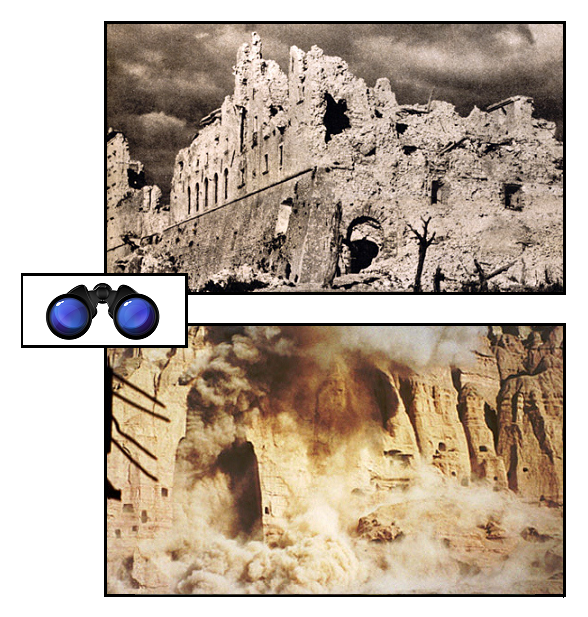
I have mourned before the losses at Bamiyan and Monte Cassino:

Here’s what’s happened to the Green Mosque or Mazjid Sabz, famous for its dome (upper panel only, lower panel h/t Bilal Sarwary), in the course of fighting in Afghanistan — the country whose oldest mosque it is:

**

And yet prayer continues:

FWIW, the lower panel image (above) is from a Christian Science Monitor article titled Israeli settlers respond to mosque burning allegations — the caption reads in part:

Palestinian men pray Monday near a burnt part of the carpet in a mosque that was damaged in the West Bank village of Beit Fajjar near Bethlehem. Palestinians accused Jewish settlers of setting fire to the West Bank mosque on Monday

The upper panel image, as far as I can determine, shows the continuing celebration of Mass in a German church after Allied bombardment in World War II.

**

It is at least worth pondering the words of these Trappist sisters in Azeir, Syria…

They came to Azeir to continue in spirit the work of the monks of Tibhirine, about whom I wrote, giving extensive background and the entire text of Fr. de Chergé‘s great, final testament here. The sisters write:

Today we have no words, except those of the Psalms that the liturgical prayer puts onto our lips in these days:

Rebuke the Beast of the Reeds, that herd of bulls, that people of calves…oh God, scatter the people who delight in war…Yahweh has leaned down from the heights of his sanctuary, has looked down from heaven to earth to listen to the sighing of the captive, and set free those condemned to death…Listen, God, to my voice as I plead, protect my life from fear of the enemy; hide me from the league of the wicked, from the gang of evil-doers. They sharpen their tongues like a sword, aim their arrow of poisonous abuse…They support each other in their evil designs, they discuss how to lay their snares. “Who will see us?” they say. He will do that, he who penetrates human nature to its depths, the depths of the heart…Break into song for my God, to the tambourine, sing in honor of the Lord, to the cymbal, let psalm and canticle mingle for him, extol his name, invoke it…For the Lord is a God who breaks battle-lines! … Lord, you are great, you are glorious, wonderfully strong, unconquerable.

We look at the people around us, our day workers who are all here as if suspended, stunned: “They’ve decided to attack us.” Today we went to Tartous…we felt the anger, the helplessness, the inability to formulate a sense to all this: the people trying their best to work and to live normally. You see the farmers watering their land, parents buying notebooks for the schools that are about to begin, unknowing children asking for a toy or an ice cream…you see the poor, so many of them, trying to scrape together a few coins. The streets are full of the “inner” refugees of Syria, who have come from all over to the only area left that is still relatively liveable…. You see the beauty of these hills, the smile on people’s faces, the good-natured gaze of a boy who is about to join the army and gives us the two or three peanuts he has in his pocket as a token of “togetherness”…. And then you remember that they have decided to bomb us tomorrow. … Just like that. Because “it’s time to do something,” as it is worded in the statements of the important men, who will be sipping their tea tomorrow as they watch TV to see how effective their humanitarian intervention will be….

Reprehending Ignorance about Syria

Thursday, August 29th, 2013

I’ve had the pleasure of introducing Timothy R. Furnish, PhD, as a guest blogger here before. Today he offers us his timely commentary on factors which should influence US decision-making regarding Syria. Here I would invite you to note especially his comments on the religious factors involved, which he characterizes as “the most salient issue at hand” and details in the long paragraph which begins “Finally…”

Charles Cameron
.

Ottoman Asia (partial map, 1893)

.
American intervention in Syria, most likely in the form of air- or cruise missile-strikes against select targets, now seems a certainty, considering that not just the Obama Administration but a whole host of politicians and commentators — ranging across the political spectrum, from Bill O’Reilly to Senator John McCain and to “The New York Times” editorial board — stridently supports military action. The reasons adduced are primarily these:

1) The usage of chemical weapons is an atrocity and violation of international law and must be punished accordingly
2) Syria being Iran’s “pawn,” any strike at the Damascus regime is tantamount to one at the Islamic Republic and, thus, ipso facto a good thing
3) al-Asad is a Hitleresque “monster” — no further discussion required
4) President Obama’s credibility is at stake, his having previously deemed usage of chemical weapons to be an uncrossable “red line” that would trigger retaliation.

Those opposed to the US attacking the al-Asad regime invoke, rather, points such as:

1) Realpolitick-wise, the US has no national security interest in Syria
2) Any action that degrades the al-Asad regime actually helps the jihadist elements of the Syrian opposition, especially the al-Qa`ida-affiliated, pro-caliphate Jabhat al-Nusra li-Ahl al-Sham min Mujahidin al-Sham fi Sahat al-Jihad (“The Front of Support to the Family of Syria from the Holy Warriors of Syria in the Battlefields of Jihad”). As LTC Ralph Peters put it on “The O’Reilly Factor” (8.27.13), “do we really want to help the jihadists who perpetrated 9/11?”
3) US bombing — even if attempted “surgically” — will result in collateral damage to Syrian civilians and motivate Syria and its allies (especially Iran and Hizbullah) to activate terrorist cells against Americans, certainly in the larger Middle East, probably in Europe and possibly even in the US homeland.

Three major areas of ignorance are manifested in these two Manichaean positions (albeit moreso in the pro-bombing camp).

First, it is not (yet) certain that it was indeed the al-Asad regime that employed chemical weapons. According to a source with whom I am in contact — a former intelligence operative who worked in Syria for a number of years — it is quite possible that Jabhat al-Nusra, or one of the other jihadist opposition groups (Syrian Islamic Front, Ahrar al-Sham, Ansar al-Islam, Ahfad al-Rasul, etc.) pilfered a government chemical weapons stockpile and wielded the lethal bounty in a false flag operation. It is also possible that such jihadist groups were supplied chemical weapons directly by* North Korea.

Second, it is simply not the case in modern times that use of chemical or nerve agents automatically provokes the international community’s wrath. Libya used such weapons in Chad in 1986, and (more infamously) Saddam Husayn did likewise against Iraqi Kurds in 1987. Neither of those events engendered US or NATO retaliation. Furthermore, Syria is not a signatory to the 1993 Chemical Weapons Convention prohibiting utilization of chemical or nerve agents; and Damascus signed the similar 1925 Geneva Protocol when it was under the French Mandate—thus having no choice in the matter. This in no wise lessens the horror of chemical weapons, but an American administration headed by a self-styled former law professor would do well to get its international legal ducks in a row before launching the first cruise missile.

Finally, and most importantly, neither the pro- nor anti-bombing faction seems aware of the most salient issue at hand: that the ruling regime is composed of Alawis, a heretical Shi`i offshoot sect the adherents of which have long been condemned as murtaddun, “apostates,” in Sunni Islam — first by the (in)famous Sunni cleric Ibn Taymiyah in his early-14th c. AD fatwas, then again just last year by the al-Qa`ida cleric Abd Allah Khalid al-Adm, who said “don’t consult with anyone before killing Alawites.” Alawis have existed for about a millennium, mostly in the mountains of coastal Lebanon and Syria, and have always been persecuted by Sunni rulers, going back to the first days of Ottoman Turkish control of the Levant in the 16th century. Under the French Mandate, post-World War I, and afterwards they insinuated themselves into the military and intelligence service such that, eventually, one of their own, Hafiz al-Asad, took control in 1970. Spurned by Sunni Arab countries, the elder al-Asad cleverly got his Alawi sect officially declared Shi`i by the influential Lebanese Twelver Shi`i cleric Musa al-Sadr (before the latter disappeared in Libya in 1976); and when the ayatollahs took control of Iran in 1979, Damascus and Tehran began, if not a beautiful, certainly a mutually beneficial, friendship — which has existed ever since. Hafiz and his son Bashar al-Asad both ruled largely as secularists — due to their sectarian affiliation, and to their official ideology of Arab socialism, articulated as the Ba`ath Party. (So to be fair to Hillary Clinton — who, in March 2011, referred to Bashar al-Asad as a “reformer” — he was much more modernizing and tolerant than many Sunni leaders of the region, if only out of political necessity.) That meant that the 10% of the Syrian population that is Christian largely supported the leader of the strange Islamic sect (also comprising about 10% of Syrians) over against the 3/4 of the population that is Sunni, fearing what a Muslim Brotherhood/Salafi takoever would portend for them. Such fears have skyrocketed since the “Arab Spring” came to Syria over two years ago — especially as groups like Jabhat al-Nusra and its ilk have trumpeted their hatred of Alawis and their burning desire for a Sunni caliphate that would relegate Christians (and Jews) to their historical, second-class dhimmi status. Thus, it is not totally beyond comprehension why a beleaguered, religiously-heterodox regime might feel it necessary to deploy, and perhaps even use, chemical weapons — as a means of staving off probable extermination at the hands of jihadists.

All in all, it appears that the pro-bombing position is much weaker than the anti-attack one. As noted previously, chemical weapons’ usage has not automatically resulted in international action in punishment; Syria is not, legally, bound by relevant conventions; and we are not certain which side actually used these arms. The idea that “any strike against the Damascus regime is a blow to Iran” is dubious at best: Iraq is at least as solicitous of the Islamic Republic as is Syria, but no calls for bombing Baghdad have been proffered. Some advance the thesis that striking al-Asad’s forces helps Israel’s geopoliticial position — but one can equally well argue that cutting off Tehran’s access to Lebanese Hizbullah would undercut the ayatollahs’ main conventional warfare outlet, and thus make it more likely they would want to use the nuclear weapons they will very soon possess. Furthermore, why should the Alawi, Druze and Christian minorities of Syria pay the price for US cowardice about attacking Iran directly? As for the “al-Asad = Hitler” trope — how many years will it take before the West, particularly the US, can wage war without “Hitlerizing” the opposition? That’s not a rational argument; it’s an emotional one. And regarding the allegation that President Obama needs to attack Syria in order to resurrect his political credibility, at home and abroad — let us hope that he is not, still, that callow after over five years in the White House. At least Richard III only needed his ignorance, not his political cunning, reprehended.

On the other side of the equation: the US does have security interests in the region, but not specifically in Syria; it is certainly true that vitiating al-Asad’s military will simultaneously empower the opposition — and not just the ostensibly-Westernized Free Syrian Army but also the jihadists like Jabhat al-Nusra; and it’s very likely that extant Iranian-trained terrorist cells will activate in Europe and the US if we intervene in Syria.

As Gandalf advised in The Fellowship of the Ring: “Do not be too eager to deal out death in judgement. Even the very Wise cannot see all ends.” The Obama Administration, and its supporters advocating attacking the Syrian regime, may not be able to see all ends; but they could certainly strive to be a bit wiser and consider some relevant data that might just be inconvenient to their position — before meting out yet more American death in the Middle East.

_____________________________________________________________________________________________________

To view the Ottoman Empire map at the head of the post at full size, see here and click for high resolution.

FTR, this post was received from Dr Furnish dated, and posted here, 8.28.2013. * indicates an edit made at Dr Furnish’s request upon rereading after publication.

Qusayr: bell-tower and minaret

Tuesday, August 20th, 2013

[ by Charles Cameron — equal opportunity destruction — church and mosque ]
.

These two images are taken from the remarkable slideshow accompanying HuffPo’s article, King Of Jordan Abdullah II: Sectarian Violence Could Destroy Muslim World. Highly recommended.


Switch to our mobile site

