zenpundit.com » hinduism

Archive for the ‘hinduism’ Category

When myth breaches the news media ocean

Wednesday, January 2nd, 2013

[ by Charles Cameron — Draupadi in the Mahabharata, the anonymous med student recently gang-raped on an Indian bus ]
.

Humpback whale breaching, source: Wikipedia under CC Attribution-Share Alike 2.5 Generic license

.
Some people go out on the oceans and watch and wait for whales to “breach” the surface — you know me, I go out on the interwebs and search for fragments of scripture and myth to breach the surface of the daily news — as when a minor warlord in Aleppo reports seeing angels, or Gregory Johnsen quotes the prophet Hosea in the title of a post on Waq-al-Waq.

**

Today’s main sighting concerns the rape of the young medical student in India, one of many tragedies in the tapestry of griefs and joys we all live with, and perhaps one that will make an incremental shift in global awareness.

It seems to me that India has had her share of violence both during and after Partition — most recently the Babri masjid takedown in Ayodhya, the Gujarat riots, two major sets of bombings in Mumbai, swathes of India under Naxalite influence, and so forth.

I’ve been noticing references to the recent rape, but not really following it in detail until today, when this Al Jazeera report, Rape of Draupadi: Why Indian democracy has failed women, caught my eye.

The author, Dinesh Sharma, quotes blogger Nilanjana Roy — the other person whose writing on the subject had particularly moved me — to list earlier instances of anti-woman violence:

Sometimes, when we talk about the history of women in India, we speak in shorthand. The Mathura rape case. The Vishaka guidelines. The Bhanwari Devi case, the Suryanelli affair, the Soni Sori allegations, the business at Kunan Pushpora. Each of these, the names of women and places, mapping a geography of pain; unspeakable damage inflicted on women’s bodies, on the map of India, where you can, if you want, create a constantly updating map of violence against women.

For some, amnesia becomes a way of self-defence: there is only so much darkness you can swallow.

When I’d first read that on Roy’s blog, I’d been saddened as much by my own ignorance of the named events as by the litany of sorroes Roy put together.

**

But it was Sharma’s invocation of Draupadi that triggered this post:

Draupadi, heroine of the Mahabharata epic, is bold and forthright even in adversity. Her husband Yudhisthira succumbing to his weakness for gambling, stakes and loses all (in a rigged game), including his wife. Draupadi challenges the assembly and demands to know how it is possible for one who has staked and lost his own self to retain the right to wager her.

Duryodhana, the winner of the bet, insists that Draupadi is indeed his to do with as he pleases and orders that she be disrobed. Furious at this insult to her honor, Draupadi loosens her coifed hair and vows that she will not knot it again until she has washed it in Duryodhana’s blood. As she is disrobed, the more her sari is pulled away the longer it becomes. It is this event which turns Draupadi from a contented, but strong willed wife into a vengeful goddess.

Until I saw the title of Sharma’s piece, I hadn’t thought of Draupadi — but she’s the quintessential figure of the woman wrongly treated in the rich mythology of the subcontinent, and thus offers the appropriate background against which to see the terrible event.

Draupadi is celebrated for her devotion to Krishna, the anonymous woman raped in the recent incident on a bus for her devotion to education, medicine, healing…

**

As Sharma says:

The perennial question has to be asked – “Who will protect Draupadi’s honour?”

Ashura: the Passion of Husayn

Sunday, November 25th, 2012

[ by Charles Cameron — today’s solemn commemorations in Iraq, Afghanistan, Pakistan and India in comparative religious perspective ]
.

I was listening to Mozart‘s Requiem last night, and it is rich in grief shot through with glory. That’s the thing about mourning celebrations in which death is accompanied by the “sure and certain hope of the Resurrection into eternal life”.

One such observance is found in Shia Islam, and falls this year on the 25th of November — today. It is the day of Ashura, the 10th day of Muharram in the Islamic calendar, and its epicenter is at Karbala in Iraq. As the saying goes:

Every day is Ashura and every land is Karbala.

For the Shia, Ashura commemorates the martyrdom of Husayn, grandson of the Prophet, at the Battle of Karbala, when he refused to give allegiance to the Umayyad caliph Yazid. Husayn’s martyrdom is dramatized in Ta’zieh, passion plays, giving us a hint that the martyrdom of Husayn at Ashura figures in the devotional life of the Shia much as the passion and death of Christ figures within Christianity, both in passion plays such as that at Oberammergau and in Catholic rituals such as the Stations of the Cross. This may seem a far-fetched analogy to some of my readers, but both deaths are viewed as redemptive. As another saying has it:

A single tear shed for Husayn washes away a hundred sins.

**

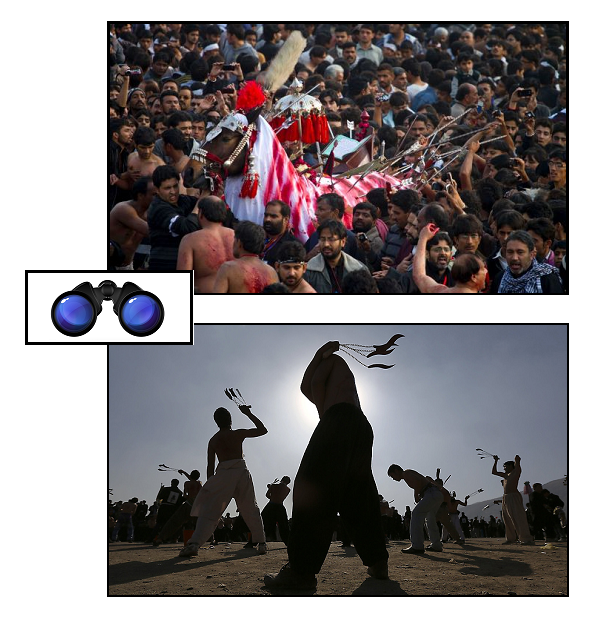
As you can see depicted in the lower panel above, Shiite mourning can include flagellation with chained blades, not something that sits easily with most westerners — yet as Roy Mottahedeh has said (quoted in SA Hayder, Reliving Karbala: Martyrdom in South Asian Memory):

Self-mutilation in emulation of the “passion” of heroes who are human yet divine is no stranger to the West: flagellants who whipped themselves both in penance and in remembrance of the scourging and crucifixion of Jesus appeared in almost every western European country in the Middle Ages…

The upper panel above depicts Husayn’s horse, riderless and bloody, and can perhaps give us some sense of the dark ceremonial beauty of the occasion for those whose grief transcends time and unites them in aspiration with Husayn himself — their flagellation attesting to their wish that they themselves could have stood beside him on that day so long ago, standing for truth against an army of injustice.

**

Their grief may be trans-temporal, but the possibility of dying for their faith persists to this day, for Sunni militants of the jihadist sort view Ashura differently — primarily as a day of fasting first performed by Moses and continued by Muhammad — and detest the breakaway sect of the Shia as rafidun, heretics.

In Iraq, Ashura there has seen millions of pilgrims visiting Karbala this year, with comparatively little violence:

Millions of Shiites flooded the Iraqi shrine city of Karbala on Sunday for the peak of Ashura rituals, which have been largely spared the attacks that struck pilgrims in past years. A bomb wounded 10 pilgrims in Diyala province, north of Baghdad, but it was the first such attack since a car bomb against pilgrims killed three people on November 17.

Farther afield, what the Pakstani police describe as a “major terror plot to attack the Muharram processions in Karachi” was avoided this year when “large amounts of explosive material, two suicide jackets and grenades” were confiscated during a raid, with the Minister for Religious Affairs declaring that the Tehreek-e-Taliban were behind the plots. Elsewhere in Pakistan:

At least five persons were killed and over 70 others injured on Sunday when a Shia procession was targeted with a bomb at Dera Ismail Khan in Pakistan’s restive northwest, the second such attack in the city in as many days.

Meanwhile in Kabul:

For the past week, the Afghan capital has been draped with black cloth arches and festooned with huge colored banners. Mournful, pounding chants pour from loudspeakers across the city, filling the air with slow martial intensity.

The dramatic display is all part of Muharram and the 10-day Shiite festival that commemorates the slaying of Imam Hussein, a 7th-century holy figure and early champion of Islam. But it is also a symbol of the growing religious and political freedom that Afghanistan’s long-ostracized Shiites have had in the past decade.

That’s from a Washington Post piece yesterday titled Afghan’s Shiite minority fears a return to old ostracism — and the next two paragraphs bear out the title:

Now, as Western military forces prepare to leave the country by 2014, Afghan Shiites, most of whom are from the Hazara ethnic minority, fear that their window of opportunity may slam shut again, leaving larger rival ethnic groups as well as Taliban insurgents, who are radical Sunni Muslims, dominating power.

“Everything we have achieved, our ability to come out and participate in society, has been in the shade of the international community and forces,” said Mohammed Alizada, a Hazara Shiite who was elected to parliament in 2009. “We are very concerned that once they leave, the fundamentalists will reemerge, ethnic issues will return, and we will lose what we have gained.”

Tribal politics, sectarian issues, the impending departure of US forces, the Taliban, cross-border alliances — and the sheer power of devotion — all these are intricately intertwined in today’s Afghanistan and its future. We may do well to understand something of the meaning of this day of Ashura, in our own calendar, 25th November 2012.

**

Annemarie Schimmel, the great Harvard scholar of Islamic mysticism, has a fine essay on the poetry of Ashura, encompassing both Sunni and (strongly Shia-influenced) Sufi traditions, Karbala and the Imam Husayn in Persian and Indo-Muslim literature. The mindset is very different from contemporary secular westernism, seeing death itself — and the grief that accompanies it — as a prelude to resurrection, and thus part of the timeless love-play of God with those who love him:

In having his beloved suffer, the divine Beloved seems to show his coquetry, trying and examining their faith and love, and thus even the most cruel manifestations of the battle in which the ‘youthful heroes’, as Shah Latif calls them, are enmeshed, are signs of divine love.

The earth trembles, shakes; the skies are in uproar;
This is not a war, this is the manifestation of Love.

The poet knows that affliction is a special gift for the friends of God, Those who are afflicted most are the prophets, then the saints, then the others in degrees’, and so he continues:

The Friend kills the darlings, the lovers are slain,
For the elect friends He prepares difficulties.
God, the Eternal, without need what He wants, He does.

**

The spirit here is not too far from that of the Greek philosopher Plotinus, who wrote in his Enneads [III.ii.15]:

Men directing their weapons against each other- under doom of death yet neatly lined up to fight as in the pyrrhic sword-dances of their sport- this is enough to tell us that all human intentions are but play, that death is nothing terrible, that to die in a war or in a fight is but to taste a little beforehand what old age has in store, to go away earlier and come back the sooner.

together with that of the early Christian Father, Origen, who wrote [De Martyrio, 39]:

And let each of us remember how many times we have been in danger of an ordinary death, and then let us ask ourselves whether we have not been preserved for something better, for the baptism in blood which washes away our sins and allows us to take our place at the heavenly altar together with all the companions of our warfare.

**

In India, indeed, the martyrdom of Husayn takes on an interfaith character in some places, as Hindus and Christians join Muslims in Ashura commemorations, as Naim Naqvi relates:

One can observe the richness and beauty of the diversity of Indian Culture at the occasion of Muharram. Since the martyrdom of Imam Hussain, Muharram ceremonies are observed all over the world including India. Hindus take part in them with great reverence and devotion. The tragedy of Karbala has become the harbinger for interfaith understanding in the Indian sub-continent. Participation of Hindus in the mourning rituals of Imam Hussain has been a feature of Hinduism for centuries in large parts of India. Hindus, Sikhs, Jains and even Christians observe Muharram. In the city of Varanasi which is the holiest city for Hindus many Hindu families participate in Muharram processions.

Describing the participation of one such Hindu family in Orissa, we read:

District police chief Lalit Das said Padhihary family has been doing this every year for the last 338 years, adding other local Hindu families also participate in the procession.

Muslims said it reflected the perfect harmony between the two communities in the area.

Introducing the Person / Position Paradox

Saturday, October 6th, 2012

[ by Charles Cameron — ye olde war of science vs religion embodied in Rep. Paul Broun, with sundry comparisons to human rights, UN, dominionism, JFK, creeping shariah etc ]
.


.

Lest we forget, Muammar Gaddafi‘s Libya, in the person of Ms. Najat Al-Hajjaji (above, left), was elected to preside over the United Nations Commission on Human Rights in 2003:

The Commission on Human Rights — meeting this morning under a new procedure two months in advance of its annual six-week session — elected Najat Al-Hajjaji of the Libyan Arab Jamahiriya as Chairperson for 2003, along with three Vice-Chairpersons and a Rapporteur.

And as recently as May 2010, still under Col. Gaddafi’s rule, Libya was elected a member of the UN Human Rights Council, and only suspended in February 2011.

Might we call this an instance of a Person / Position Paradox?

**

You know I like what I term “forms” as analytic tools — this would be another one to keep an eye out for, a particularly intriguing sub-type of the self-referential paradoxes I discussed in an earlier post.

It isn’t, of course, an analytical breakthrough for me to recognize the paradox inherent in a brutal dictatorship gaining the chair of the international Human Rights Commission at this late date: the United States protested Libya’s nomination at the time, which is why there had to be a secret ballot in the first place.

Let’s look at some of the accompanying language. Here’s Ms. Al-Hajjaji herself:

In an address following the ballot, Ms. Al-Hajjaji said among other things that the Commission must send a message that it would deal with human rights in all countries, and not just some of them; that it would take into account in its activities the world’s many different religious, cultural and historical backgrounds; and that among its tasks was to affirm the universality, indivisibility, and complementarity of human rights

Who could complain about that? And here’s the UN High Commissioner, praising the system that got her elected for its wisdom:

High Commissioner for Human Rights Sergio Vieira de Mello, also speaking briefly, reviewed his recent mission to the Democratic Republic of the Congo and to Angola, lauded the Commission’s new procedure for early election of a Bureau, and said it was important for the Commission to demonstrate that it could manage with wisdom, speed and restraint its procedural business so as to create the best possible spirit and conditions for addressing and resolving the many substantive issues on its agenda.

The lesson I learn here?

Paradoxes of this kind lead to a divergence of words from truths — in line with de la Rochefoucauld‘s maxim:

Hypocrisy is the homage vice pays to virtue.

**

Now comes the potentially contentious part.

Rep. Paul Broun MD (R-GA) (top, right), member of the US House Committee on Science, Space and Technology and chairman of the US House Science Subcommittee on Investigations and Oversight, told the Liberty Baptist Church of Hartwell, Georgia’s Sportsman’s Banquet last month:

God’s word is true. I’ve come to understand that. All that stuff I was taught about evolution and embryology and the Big Bang Theory, all that is lies straight from the pit of Hell. And it’s lies to try to keep me and all the folks who were taught that from understanding that they need a savior. You see, there are a lot of scientific data that I’ve found out as a scientist that actually show that this is really a young Earth. I don’t believe that the Earth’s but about 9,000 years old. I believe it was created in six days as we know them. That’s what the Bible says.

As a student of religions, I don’t find that statement particularly surprising: while the original 1611 edition of the King James Version of the Bible doesn’t include Archbishop Ussher‘s dating of the creation to 4004 BC, many versions of the KJV since 1701 have done so, the wildly popular “dispensationalist” Scofield Reference Bible, first published in 1909, does so… and Broun is being somewhat generous in allowing for the passage of 9,000 years since creation, where others might see the earth as entering the seventh (Sabbath) day (or millennium) about now…

As a religious belief, then, this is one of many attempts to fit chronology to scripture. I recall from my days studying the religious impact of millennial rollover (“Y2K”) concerns that one Rabbi Pinchas Winston claimed the year 2,000 (5760 in the Jewish calendar) would be a year of purification:

The secret regarding this is that, at the end of the year 5760 from creation, the verse, ‘I [God] will remove the impure spirit from the land’ (Zechariah 13.2) will be fulfilled.

For my source and further millennial date issues in Islam, Hinduism etc, see my chapter, Y2KO to Y2OK in Cathy Gutierrez and Hillel Schwartz, eds., The End that Does: Art, Science and Millennial Accomplishment, Equinox, 2006.

Politics, though — and the politics of science and science funding at that? Here’s more of Rep. Broun’s talk, explaining how Broun’s theology affects his politics:

And what I’ve come to learn is that it’s the manufacturer’s handbook, is what I call it. It teaches us how to run our lives individually, how to run our families, how to run our churches. But it teaches us how to run all of public policy and everything in society. And that’s the reason as your congressman I hold the Holy Bible as being the major directions to me of how I vote in Washington, D.C., and I’ll continue to do that.

**

I’m afraid this reminds me all too clearly of RJ Rushdoony‘s Institutes of Biblical Law, which opens with the following words:

When Wyclif wrote of his English Bible that “This Bible is for the government of the people, by the people, and for the people,” his statement attracted no attention insofar as his emphasis on the centrality of Biblical law was concerned. That law should be God’s law was held by all…

Those are the opening words of Rushdoony’s Introduction to his magnum opus. And I know, I know, I’m cherry-picking from its 850-page first volume, but on p. 251 he writes:

The law here is humane and also unsentimental. It recognizes that some people are by nature slaves and will always be so. It both requires that they be dealt with in a godly manner and also that the slave recognize his position and accept it with grace.

Is this all just another version of “creeping” theocracy?

Compare John Hubbard, Arkansas State Rep, whose book Letters to the Editor: Confessions of a Frustrated Conservative (not on Amazon) apparently includes this choice morsel:

… the institution of slavery that the black race has long believed to be an abomination upon its people may actually have been a blessing in disguise …

**

Some possible parallels that may be worth pondering, coming at similar issues from a diversity of angles — hopefully with enough different implications to generate some questioning of easy assumptions:

Can a Catholic be POTUS (JFK, eg) without serving the every whim of a foreign Head of State? Can a Mormon be POTUS without serving the wishes of a living prophet, seer and revelator? Can a person who aspires to the highest post in a “government of the people, by the people, for the people” be relied upon if he says things like this?

There are 47 percent of the people who will vote for the president no matter what. All right, there are 47 percent who are with him, who are dependent upon government, who believe that they are victims, who believe that government has a responsibility to care for them, who believe that they are entitled to health care, to food, to housing, to you name it. … And so my job is not to worry about those people — I’ll never convince them that they should take personal responsibility and care for their lives.

And what if he then admits he was in error?

In this case, I said something that’s just completely wrong.

Is that hypocrisy (see above) — or humility? And come to that: in politics, is honesty a vice?

**

But I’m sliding from religion into politics here, unless you take the Gettysburg Address as one of the central documents — akin to a scripture — of American civil religion. Or remember it was the Bible translator John Wyclif who said those words about government of, by, and for the people first…

Religion, not politics, is my concern and my “beat” — but right now, the “Warfare of Science With Theology” (to quote the apt title of Andrew Dickson White’s celebrated 1895 book) is once again in full swing, so the question of whether Rep. Broun’s positions as a a member of the US House Committee on Science, Space and Technology and chairman of the US House Science Subcommittee on Investigations and Oversight, given his views on voting according to his reading of the Bible, is also an instance of the Person / Position Paradox?

**

It seems to me that questions such as these are of vital to many of us. The question is: are they vital to our democratic principles — or to our salvation?


Switch to our mobile site
