Archive for 2012
Damascus, Dearborn, Rome, Vienna?
Sunday, July 1st, 2012[ by Charles Cameron — first in a series of three posts about celestial & terrestrial geographies ]
.

.
Joel Rosenberg, again. This time it’s Damascus he’s on about, and he’s been discussing it with “a prominent Member of Congress”:
… the official asked, “What are your thoughts on Isaiah 17?” For much of the next hour, therefore, we discussed the coming judgment of Damascus according to Bible prophecy, and how this scenario could possibly unfold in the coming years in relation to other Bible prophecies and current geopolitical trends in the Middle East.
Should we file that under Foreign Policy background, Syria?
Rosenberg clearly thinks Damascus is Damascus — and it’s easy to see why, it’s almost a tautology, one might think:
These prophecies have not yet been fulfilled. Damascus is one of the oldest continuously inhabited cities on earth. It has been attacked, besieged, and conquered. But Damascus has never been completely destroyed and left uninhabited. Yet that is exactly what the Bible says will happen. The context of Isaiah 17 and Jeremiah 49 are a series of End Times prophecies dealing with God’s judgments on Israel’s neighbors and enemies leading up to — and through — the Tribulation.
How exactly will Damascus be destroyed? When will exactly it be destroyed? What will that look like, and what will be the implications for the rest of Syria, for Israel and for the region? The honest answer is that the Bible does not say. I’m currently writing a novel entitled, The Damascus Countdown, that envisions how these prophecies could come to pass.
**
But wait — the idea that Damascus (the word) means Damascus (the place) may not be so obvious at all. Consider the possibility that the names of peoples and places are, well, somtimes a bit mixed up.
Read this, for instance, from Rafil Kroll-Zaidi, Byzantium: Their ears were uncircumcised, in Harper’s, May 2102:
The Byzantines called themselves Greeks (because they were) and also Romans (because they had been). To the Muslims, who had been the Arabs (who had coveted Constantinople even before they were Muslims) but were later the Turks, the Byzantines were usually the Romans (Rum) and sometimes, though these Romans spoke Greek, the Latins (which to the Byzantines meant the barbarians of Western Europe), and sometimes the Children of the Yellow One, who was Esau. The Arabs called the Byzantine emperor (who signed his letters in purple ink EMPEROR AND AUTOCRAT OF THE ROMANS) the Dog of the Byzantines, and by the fifteenth century the sultan of the Ottoman Turks (whom the Muslims farther east called Romans and whom the Byzantines called Trojans) called himself sultan i-Rum in expectation that he soon would be and in recognition that he already, for most purposes, was.
You can see why GEN Boykin might think Dearborn is Damascus:
Dearborn, in fact, I’ve been there a couple of times recently, and if you walk down the streets, you would think you were in Beirut or Damascus.
Just kidding — Boykin sees a cultural similarity between them, that’s all.
**

.
But Rum — that means Rome, remember? — figures prominently in Islamic apocalyptic, so we “need to know” what it actually refers to. Here’s Harun Yahya on the topic:
Another astonishing piece of revelation that the Quran gives about the future is to be found in the first verses of Surah Rum, which refers to the Byzantine Empire, the eastern part of the later Roman Empire. In these verses, it is stated that the Byzantine Empire had met with a great defeat, but that it would soon gain victory.
“Alif, Lam, Mim. The Romans have been defeated in the lowest land, but after their defeat they will themselves be victorious in a few years’ time. The affair is God’s from beginning to end.”(The Quran, 30:1-4)
Okay, Rome is Byzantium, got it. Constantinople. Istanbul.

Stamboul.
**
Ibn Kathir, in The Signs Before Day of Judgement, offers this hadith from the collection Sahih Muslim:
Nafi’ ibn ‘Utbah said, “The Prophet said, ‘You will attack Arabia, and Allah will enable you to conquer it. Then you will attack Persia, and Allah will enable you to conquer it. Then you will attack Rome, and Allah will enable you to conquer it. Then you will attack the Dajjal, and Allah will enable you to conquer him.'”
Let’s get into a little more detail. Stephen Ulph quotes a writer in Al-Jama’a, a “periodical magazine on Algerian jihad affairs” in a 2004 piece in CTC’s Terrorism Monitor:
From Afghanistan comes the kernel of the Nation; it was the beginning…proud Iraq was not the end…for those infidels and the apostate agents in our lands there are not enough graves…it is high time that Rome had its Cross uprooted and the city decked out for the arrival of the new conquerors, passing through Al-Andalus and the Pavement of the Martyrs, and Vienna and Constantinople, to which we are yet drawn by a longing that grows in our breasts day by day. For our Prophet (who does not lie when he speaks, being the most truthful of speakers) did promise: “God hath set aside for me the world, and I beheld its east and western lands, and the dominion of my Nation shall reach unto that which was set aside for me.”

So Afghanistan is Afghanistan, Al-Andalus is Andalusia, Vienna is Vienna — and Rome is Rome along with the Vatican, eh?
Or is Al-Andalus Spain — or Afghanistan Khorasan for that matter?
**

**
I was reminded by another sentence in Rafil Kroll-Zaidi’s piece in Harper’s —
Halfway between Heaven and earth were tollbooths where demons taxed the sins of the Byzantines.
— of the beautiful opening sentences of Charles Williams‘ lyrical “short history of the Holy Spirit in the Church”, The Descent of the Dove:
The beginning of Christendom, is, strictly, at a point out of time. A metphysical trigonometry finds it among the spiritual Secrets, at the meeting of two heavenward lines, one drawn from Bethany along the Ascent of the Messias, the other from Jerusalem against the Descent of the Paraclete. That measurement, the measurement of eternity in operation, of the bright cloud and the rushing wind, is, in effect, theology.
And the title essay of Guy Davenport‘s book The Geography of the Imagination should give us a clue that confusion as to what exactly is where is not solely the province of prophets and their interpreters. In a memorable sentence about the American artist Grant Wood, he writes:
If Van Gogh could ask, “Where is my Japan?” and be told by Toulouse-Lautrec that it was Provence, Wood asked himself the whereabouts of his Holland, and found it in Iowa.
**
Photo credits:
Damascus: Roberta F under CC BY-SA 3.0
Vatican: Sébastien Bertrand under CC BY 2.0
Istanbul: Preference-events & elsewhere
Vienna: Canaletto, Kunsthistorisches Museum Wien via Wikipedia
Cordoba: Timor Espallargas under CC BY-SA 2.5
**
So. Where is Zion / Jerusalem?
Miracles and rumors of miracles
Saturday, June 30th, 2012[ by Charles Cameron — Timbuktu tombs, cultural preservation, WWII, miracle stories, della Robbia ]
.

.
A report on Al Jazeera today is sub-headed:
Al-Qaeda-linked group in northern Mali attacks tombs of Sufi saints just days after sites put on UNESCO endangered list.
**
My friend Michael Robinson just pointed me to this piece by Dr. Laurie Rush on “Cultural Property Protection as a Force Multiplier, from the March-April edition of Military Review:
Preservation of cultural property can be critical for social restoration in a devastated community. During World War II, the Germans systematically blew up every single structure in the small town of Pieve Santo Stefano, Italy. Incredibly, they failed to destroy the Andrea della Robbia altarpiece relief, Assumption of the Virgin, in the local church. The MFAA wanted to remove the piece for its own protection, but the prospect of its relocation was unthinkable to the citizens of the community. Instead, the MFAA worked with them to save the altarpiece as part of the town’s restoration. Cultural property that survives war, sometimes miraculously, offers hope when all else seems lost.
**
Miracles and rumors of miracles…
Picking up where I left off last time: people with a non-miraculous worldview are apt to use the word “miraculous” to describe something like that altarpiece surviving, meaning roughly “fortunate” — while those whose worldview includes and welcomes miracles will use the same term in a very different sense, and with very different feeling.
These are differences that make a difference.
**
Here, because I was curious, is another Andrea della Robbia Assumption of the Virgin altarpiece, this one from the Victoria and Albert Museum collection, London:
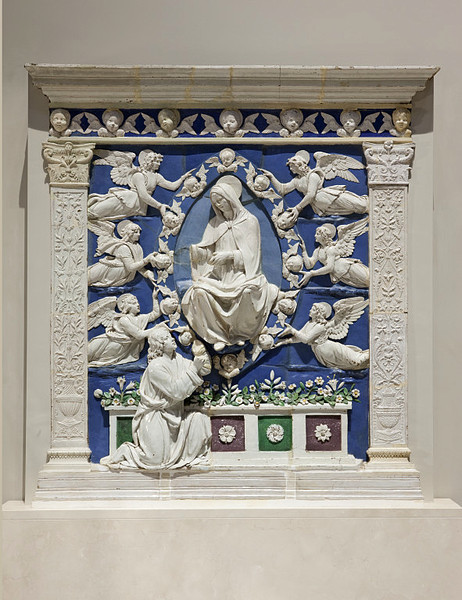
Miraculous? Me personally, I’d say so.
Recommended Reading & Viewing
Saturday, June 30th, 2012Top Billing! Information Dissemination Guest Post Series
Galrahn needs to be commended for organizing this excellent series and also the top-notch contributors who participated, including a sitting Member of Congress. A first-rate blog event!
Wayne P. Hughes, Jr., Captain USN –Is there a connection between your strategic and tactical assertions?
Dr. Andrew Exum –What should the US Army be contributing to AirSea Battle?
Jan Van Tol –When matching the strategic objective of preventing war to resources, can the US Navy prevent war in the 21st century, and if so, how?
Rep. J. Randy Forbes (R-Va.) –What is the potential and what are the challenges the Navy faces in fielding a UCLASS to the fleet?
Feedback and Discussion
SWJ Blog 1. (Octavian Manea) The Russian COIN Campaign in North Caucasus
How different is the ranking of priorities in the Russian COIN compared to the Western pop-centric approach? In what kind of missions and priorities were the main resources invested?
I assume you’re referring to doctrinal approaches here. It’s important to point out that there are still plenty of Western analysts who believe that heavy “enemy-centric” approaches are more effective than the “population-centric” approaches upon which our doctrine is based. Western doctrinal COIN approaches start with and revolve around “security” – for the government as well as the local population, whereas you can see from the chart in my book on page 201 that the Russian approach considers security of the local population a much lower priority. In the Western approach, it is important to start trying to gain the support of the indigenous population through a number of means (security, economic, civil affairs projects, diplomatic, etc), while the Russians initially put these types of activities way at the bottom of their list (although Ramzan Kadyrov has placed a much higher emphasis on those types of activities since he has assumed the presidency). The Russian Main Effort has always been focused on the general Russian population within Russia proper, as opposed to the indigenous peoples of the North Caucasus. And as an enemy-centric approach, they have emphasized killing the enemy over building support for themselves among the local population. All in all, I’d say the Russian and Western priorities are generally very different.
2. (Alex Verschoor-Kirss) Foucault and Fourth Generation Warfare: Towards a Genealogy of War and Conflict
Inclusion does not equate with my endorsement. Frankly, there’s a cocked-up misunderstanding of historical methodology (and the field of military history) and hero-worship of Michel Focault; however, the piece is certainly thought-provoking as it is a critique of 4GW coming way out of left field and worth a read.
Abu Muqawama (Kelsey Atherton) –Guest Post: Learning from Greece the Hard Way
….At the beginning of the current system is America’s involvement by proxy in the Greek Civil War. Following an awkward post-war realization that maybe arming every faction fighting against the Nazi occupation was not the wisest run in the long term, the Allied powers (initially the United Kingdom) decided to disarm as many partisans as they could in the immediate outbreak of peace, while shoring up support for the royalist government. Not all partisans were agreeable to being disarmed or towards the ancien regime, and Greece developed a communist insurgency. In 1947, the UK decided they could no longer afford their investment in the Greek government, and in their stead Truman decided to shoulder the task of providing military assistance in their stead. He did this through the American Mission for Aid to Greece “outside and independent of the embassy at Athens and of Ambassador Lincoln MacVeagh.” Inevitably, the Greeks observed that Griswold controlled the resources, so they bypassed the Ambassador and dealt directly with him. The Ambassador’s authority diminished, and a conflict within the Embassy emerged.
PARAMETERS (Ralph Peters) –In Praise of Attrition
Dr. Von –Do We Have the Educational Infrastructure to do Major STEM Education?
Diane Ravitch –Bill Gates Turns His Attention to Higher Education
Eide Neurolearning Blog –Education for Misfits and Neurodiversity and The Steps of Creativity – Early Crowd sourcing and Prototyping
Robert Slavin –A Call to Arms for Education Innovation
Chicago Boyz – (Ginny) Taylor 1: Liberal Arts Purpose to Leave Our Selves Behind
Recommended Viewing:
When you have a worldview, it all fits together
Saturday, June 30th, 2012[by Charles Cameron — the difficulty of difference, plus a poem for M ]
.

.
When you have a worldview, it all fits together pretty seamlessly. You see a map of record high temperatures such as the one above, swiped from emptywheel today, and it’s either global warming, and maybe:
this is getting to a point where the terror industry and the homeland security industry, generally, needs to come to grips with the fact that the biggest immediate threat to the “homeland” is not terrorism or drugs or even hackers, but climate change…
or it’s the hot face of an angry God:
And the fourth angel poured out his vial upon the sun; and power was given unto him to scorch men with fire.
— Revelation 16.8
**
I read the Book of Revelation in much the same spirit in which I read William Blake or WB Yeats — as figurative, imaginative thinking rather than future history. Record high temperatures, rising sea levels, dazzling storms, wildfires and the like I tend to view as natural phenomena belonging to the realm of science as far as causation is concerned, and to first responders and FEMA in terms of crisis response.
But they’re still awesome, the poet in me still stirs…
**
What concerns me here, though, is not to explain my own position nor to refute or approve either the prophetic or scientific explanations, but to emphasize that when you have a worldview, you have explanations ready-made in place for (almost) whatever happens.
And that goes for the Taliban, for Al Qaida, for the Brotherhood, for Christians of the Dominionist or Soon Coming or Episcopalian varieties, for Buddhists, for Scientists, and for many who are braiding their own, picking up different strands in different places as they go along.
If someone else’s worldview is not your worldview, it may very well be as different as the world in which God is blasting His displeasure at Washington DC is different from the world in which Washington DC needs to do something about global warming before nature re-balances our ecosystem in a manner we find decidedly inhospitable.
**
In a shared worldview, you can talk face to face. Across worldviews, you can only talk worldview to worldview — and the “other” worldview may well be unable to make sense of what you say or do, or take a meaning from it that has serious negative consequences for you in your world.
Just yesterday, Gulliver tweeted:
I know this sounds crazy for a defense analyst, but sometimes I put myself in another country’s place and think about how it must see U.S.
— Gulliver (@InkSptsGulliver) June 29, 2012
Ha!
But it’s true, as Paul Van Riper said and I know, I’ve quoted him before, but this is good:
What we tend to do is look toward the enemy. We’re only looking one way: from us to them. But the good commanders take two other views. They mentally move forward and look back to themselves. They look from the enemy back to the friendly, and they try to imagine how the enemy might attack them. The third is to get a bird’s-eye view, a top-down view, where you take the whole scene in. The amateur looks one way; the professional looks at least three different ways.
The thing is: how do you get inside a magical head with a rational mind?
It’s not impossible, mind you — but it takes great strength of imagination.
That’s the point I’m trying to make here. Done. Finished.
**
And this is for Madhu, who encourages me to post my poems:
Storm words
.There are no words for the stride of thunder –
pounding stride of clouds across a drumhead of plains,
the traveling downpour, drenching
the dry gullies and passing, words cannot
see nor show what the eye sees, the great lights
thrown, the target trees scorched and left —but for man who lives in the path of thunder,
wrestling a little grass for soup from the parched land,
feeling thrum of a god’s advance under bare feet,
seeing the lowering god with his bright arms striding,sensing the god’s strong coming, longing
for the fresh grasses after the storm’s passing,
the calm that follows the god: fearing
the god’s blasting, scorching, man’s words are prayer.




_058.jpg)
