….Surely, it cannot be as bad as all that, you might say. True. It may not be as bad as I say, but it will surely be more messy than the glib op-ed that Anne-Marie Slaughter threw together for the New York Times last week. CNN reports that the military is looking at using as many as 75,000 troopsjust to secure potential Syrian chemical weapons sites. The realities of a Syrian intervention are far messy than Dr. Slaughter is willing to countenance in her infantile fantasy masquerading as policy prescription. Therein lies the rub. Dr. Slaughter is a respected policy elite and people take her ideas seriously. Therefore, she has a responsibility to be honest and open in her advocacy with regard to the risks and complexities of her proposal. Dr. Slaughter tweeted a few weeks ago that those outside of government could partake in one-sided advocacy, leaving policy-makers in government to sort out the details. This is the height of irresponsibility. Essentially, she is saying that people like her are free to sell the American people on a policy in NYT op-eds without fully disclosing the costs and complexities, leaving the unhappy recipients in government with the task of dealing with the unstated costs and risks, while public debate shaped by dishonest people like her has closed off some of their policy options.
Slaughter states that simply arming the opposition would lead to destabilizing civil war. However, arming the Free Syrian Army to create “no-kill zones,” that is enabling the FSA to control swathes of territory just within the sovereign borders of Syria would somehow bring an end to the butchery. Not mentioned is how the FSA would take or hold this territory against the likely violent disagreement of the regime. We are talking about battle here. Not potshots against regime forces, but the taking and holding of territory. This is not just glossed over in the Slaughter plan, but completely ignored. She speaks blithely of the use of special forces to enable the FSA, and how they could enable the FSA to cordon population centers and rid them of snipers. What you don’t see here is the bloody battle and likely airstrikes needed to push the bulk of the regime forces away from these population centers to be cordoned. Nor does it discuss the brutal and psychologically exhausting game of counter-sniper operations.
Peter just gave one of the nation’s best known FP academics a USMC wire-brushing worthy of R. Lee Ermey.
Israel, it must be said, is no friend of the Assad regime and the loathing in Damascus is mutual. Yet despite having demonstrable air superiority over Syria since at least 1986 and numerous provocations, Jerusalem has never attempted an Operation Desert Fox-style EBO campaign to grind down the Assad regime’s machinery of coercion to powder. That fact ought to give advocates of intervention in Syria some pause.
….I have long supported the mission both in Afghanistan and Iraq, and it troubles me to no end to see that progress is mired in choosing the wrong weapons to deal with what nature, geography, and a people, who only understand the ancient pre-religious tenets of revenge and blood honor, to guide their every move; has seen our best hopes dashed on the rocks of reality. As politically in-correct as it might sound, looking back at the original strategy of surgical strikes, should have also carried the accompanied effort to risk what ever troops necessary in the beginning, too capture or kill every leader from Osama, to the entire Taliban and AQ leadership. Then make it crystal clear that any future sanctuaries would bring a rain of carpet bombing upon that region until all are gone. That, as harsh as it sounds strategy, would send a “straightforward” message in a language all Afghan’s and their allied cohorts understand, and have used to settle disputes for millenniums. An old friend and mentor, whose military and historical credentials are as deep as the sea, predicted the outcome the US is currently experiencing and a decade ago, suggested the most politically in-correct path, would have resulted in surgically cutting out the cancer, much like we rely on radiation and surgery as proven tools. Then following up with check-ups and changes in behavior to keep the cancer from returning. Finally, if the cancer of terrorism returns, more surgery, and if needed, doses of radiation to kill those dangerous cells.
….This scenario sounds utterly practicable as part of a theory conjured up in the comfort of the ivory tower. But in practice, Western military technology cannot stop messy civil wars in foreign lands. Ending the internal conflict in Syria and producing a peaceful aftermath would entail a long-term American commitment to armed nation building. The wars in Iraq and Afghanistan should have made this clear. Armed nation building isn’t done in eight or eleven years but eighty or a hundred years beyond.
But here is where good strategy should kick in. Good strategy might and probably should discern that in these kinds of civil wars, considering U.S. security interests, using military force is not the solution. Force might be a good option if Americans were willing to stay for generations, but then strategy might also determine that a prolonged engagement is simply not worth it.
Infinity Journalhas released it’s first Special Edition – Clausewitz and Contemporary Conflictfeaturing articles by Antulio Echevarria, David Kaiser, A.E. Stahl, Beatrice Heuser, Hugh Smith, Wilf Owen and Adam Elkus
[ by Charles Cameron – extended analytic game on Israeli-Palestinian conflict — continuing ]
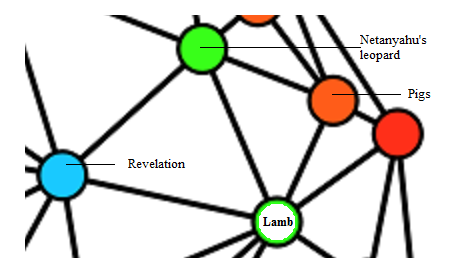
Move 18: The Lamb of God
Move content:
If you want it in short form, the move content here is: “the Lamb slain from the foundation of the world” (Revelation 13:8) — note in particular the curious involvement of time in this formulation…
*
The Lamb of God is a superposition, a simultaneous envisioning of multiple meanings with their inherent values – it’s a thought (concetto) in a style of thinking that once was and should properly be known by the name of Poetry – a style of thinking in which a rich cluster of meanings is concentrated, potentiated, distilled as wine is distilled into brandy.
It is not, therefore, simply a decorative motif for churches, hymnals and religious pamphlets, not is it that brilliant but weak thing, a metaphor. Layered after the manner of Blake‘s fourfold vision (move 4), it is at once:
the radiance of Godhead;
focused in the person, life and death of the window, Christ, through which that radiance streams;
in his act of permitting his own slaughter, nailed and bleeding, on the tree that echoes the tree in an eternal garden;
prefigured in his breaking of bread and offering of wine, wheat ground by millstone and grape trodden in winepress, the fruits of the earth, the seasons and human labor;
offered in substitution as a Passover sacrifice;
repeated wherever and whenever Eucharist is celebrated;
portending the great union to which we are invited, the Marriage Supper;
seen in the image of a lamb, a child of sheep…
through all of which the divine radiance takes form, is colored, may be glimpsed, may be made ours… by means of which — “take, eat, this is given for you” — we may be made his.
This sounds like religion, and no doubt it is – but the mode of perception required to apprehend it is not material, not literal, not within reach of camera or microscope or x-ray, of fact, but symbolic, transcendent, within the reach of insight, of poetry, of love.
Likewise, the relation of time with the timeless in sacrifice is expressed as poetic truth in the words “slain from the foundation of the world “.
*
You may know these things from experience, you may see them as I write this, or this may all be as dust to you, the merest dull preachment, so many wasted pixels, so much spilled ink.
Perhaps I can convey some of the life of this matter through the works of great artists… for that is what they are great for.
Visually, the appropriate illustration would be the Adoration of the Lamb from van Eyck‘s Ghent Altarpiece, sonically the Agnus Dei from Bach‘s B Minor Mass – which I can happily present together in this video of John Eliot Gardiner conducting the Monteverdi Choir and English Baroque Soloists:
Here too, from Handel‘s Messiah, is the final chorus Worthy is the Lamb that was Slain and concluding Amen, sung by the Ichud Choir with the Herzliya Chamber Orchestra under Harvey Bordowitz:
I am particularly delighted to feature a choir and orchestra from Hertzliya here, because I generally associate Hertzliya with Dr Reuven Paz of the Interdisciplinary Center (IDC) in Herzliya, a noted counter-terrorism (CT) analyst — and besides, a Jewish choir and orchestra singing Messiah is interesting in its own way. More on that later…
Links claimed:
To pigs, move 16: it is indeed a pleasure to move from the use of animals such as the pig in an imagery of hatred to that of the lamb in an imagery of love, and it may be noted that this shift accompanies the motif of sacrifice…
To Revelation, since “the Lamb slain from the foundation of the world” is a quotation from Revelation 13:8.
To Netanyahu’s leopard, via this lovely quote from Isaiah 11.6:
The wolf also shall dwell with the lamb, and the leopard shall lie down with the kid; and the calf and the young lion and the fatling together; and a little child shall lead them.
Comment:
Different moves can be seen as the “heart” of the game from different perspectives: this one presents the heart of the game’s (and my) metaphysics.
Specifically, there’s a great deal more I want to say in terms of the move content, laying out in more detail the relationship of “the Lamb slain from the foundation of the world” to the Wedding Supper of Revelation, the Eucharist, the Seder, ritual in general, time and eternity. For the sake of clarity, I’ll lay this out in a cadenza, an excursus — please read it as part of the move content for purposes of play.
____________________________________________________________________________________________
Cadenza
Time lies at the heart of this move – or more precisely, time with eternity.
The thing being, that “time” contains “eternity” in the hidden heart of every moment, while “eternity” simultaneously contains every moment of “time”. Christ seems to be thinking along these lines in mind when he says “Before Abraham was, I am” – and the Zen Master Hui Neng‘s koan, “What is your face before your mother and father were born” carries a similar implication.
Indeed, this whole business of time, space and the Lamb is highly paradoxical, when viewed from a linear, secular perspective.
I am aware that this perception of the symbolic superposition of one time on another — like washes of watercolor on a painting and with “eternity” like the white canvas beneath them all — is an unfamiliar one in our clock-driven world. But it is an essential mode of perception if we are to understand the long memories of the Jewish and Palestinian peoples, and the eschatological hope that each of the three Abrahamic religions perceives in the spiritual topography of the Temple Mount / Noble Sanctuary in Jerusalem.
In playing this move, I wish to give the reader a background awareness of this style of perception: for it is this manner of thinking which allows centuries-ancient scriptures to map to the disputed terrain of these contested times.
It may thus serve us well as, moving further into the game, we encounter the more urgent and immediate voices of our contemporaries, friend and foe, skeptic and believer, warrior and peacemaker alike:
*
Within Judaism:
It was ever thus with prayer and sacrifice, as Martin Buber observes:
… prayer is not in time but time in prayer, sacrifice not in space but space in sacrifice, and to reverse the relation is to abolish the reality …
We find this sensibility spelled out explicitly in Jacob Neusner‘s account of the Passover seder, in his Introduction to Judaism:
Through the natural eye, one sees ordinary folk, not much different from their neighbors in dress, language, or aspirations. The words they speak do not describe reality and are not meant to. When Jewish people say of themselves, “We were the slaves of Pharaoh in Egypt,” they know they never felt the lash; but through the eye of faith that is just what they have done. It is their liberation, not merely that of long-dead forebears, they now celebrate.
Here lies the power of the Passover banquet rite to transform ordinary existence into an account of something beyond. … Now, in the transformation at hand, to be a Jew means to be a slave who has been liberated by God. To be Israel means to give eternal thanks for God’s deliverance. And that deliverance is not at a single moment in historical time. It comes in every generation and is always celebrated. Here again, events of natural, ordinary life are transformed through myth into paradigmatic, eternal, and ever-recurrent sacred moments.
Indeed the Haggadah, the liturgical text of the seder, itself expresses the need for this folding of time upon time:
In every generation a person is obligated to regard himself as if he had come out of Egypt, as it is said: “You shall tell your child on that day, it is because of this that the L-rd did for me when I left Egypt.”
*
Within Christianity:
Christ, who is simultaneously the sacrificing Priest and the sacrificial Lamb, is understood in the theology of the Eucharist as extending throughout and beyond all times and spaces – he is “slain from the foundation of the world” (Rev. 13.8 as quoted above), he re-enacts the original Passover in the Last Supper (Mark 14.14) and at his Crucifixion (his body broken and blood spilled), and is present at every Eucharist…
Dom Gregory Dix, after 700 pages of exceedingly detailed scholarship on the early formation of the Eucharistic rite in his seminal book, The Shape of the Liturgy — suddenly bursts out with this stunning paragraph:
Was ever another command so obeyed? For century after century, spreading slowly to every continent and country and among every race on earth, this action has been done, in every conceivable circumstance, for every conceivable human need from infancy and before it to extreme old age and after it, from the pinnacles of human greatness to the refuge of fugitives in the caves and dens of the earth. Men have found no better thing than this to do for kings at their crowning and for criminals going to the scaffold; for armies in triumph or for a bride and bridegroom in a little country church; for the proclamation of a dogma or for a good crop of wheat; for the wisdom of the Parliament of a mighty nation or for a sick old woman afraid to die; for a schoolboy sitting an examination or for Columbus setting out to discover America; for the famine of whole provinces or for the soul of a dead lover; in thankfulness because my father did not die of pneumonia; for a village headman much tempted to return to fetich because the yams had failed; because the Turk was at the gates of Vienna; for the repentance of Margaret; for the settlement of a strike; for a son for a barren woman; for Captain so-and-so, wounded and prisoner-of-war; while the lions roared in the nearby amphitheatre; on the beach at Dunkirk; while the hiss of scythes in the thick June grass came faintly through the windows of the church; tremulously, by an old monk on the fiftieth anniversary of his vows; furtively, by an exiled bishop who had hewn timber all day in a prison camp near Murmansk; gorgeously, for the canonisation of S. Joan of Arc — one could fill many pages with the reasons why men have done this, and not tell a hundredth part of them. And best of all, week by week and month by month, on a hundred thousand successive Sundays, faithfully, unfailingly, across all the parishes of christendom, the pastors have done this just to make the plebs sancta Dei — the holy common people of God.
And every Eucharist, the Constitution on the Sacred Liturgy of the Second Vatican Council tells us, offers us “a foretaste of that heavenly liturgy which is celebrated in the Holy City of Jerusalem toward which we journey as pilgrims, where Christ is sitting at the right hand of God, Minister of the sanctuary and of the true tabernacle.”
*
Within Islam:
We find the same in the profound reaches of Islam, where as Gerhard Böwering notes in The Concept of Time in Islam:
Through a distinct meditational technique, known as dikr, recollection of God, the mystics return to their primeval origin on the Day of Covenant, when all of humanity (symbolically enshrined in their prophetical ancestors as light particles or seeds) swore an oath of allegiance and witness to Allah as the one and only Lord. Breaking through to eternity, the mystics relive their waqt, their primeval moment with God, here and now, in the instant of ecstasy, even as they anticipate their ultimate destiny. Sufi meditation captures time by drawing eternity from its edges in pre- and post-existence into the moment of mystical experience.
*
I’ll leave off with the celebrated words of St. Augustine on time:
For what is time? Who can easily and briefly explain it? Who even in thought can comprehend it, even to the pronouncing of a word concerning it? But what in speaking do we refer to more familiarly and knowingly than time? And certainly we understand when we speak of it; we understand also when we hear it spoken of by another. What, then, is time? If no one ask of me, I know; if I wish to explain to him who asks, I know not.
— Augustine of Hippo, Confessiones lib xi, cap xiv, sec 17 (ca. 400 CE)
[ by Charles Cameron – extended analytic game on Israeli-Palestinian conflict — continuing ]
Move 16: Pigs
Move content:
Dehumanizing by bestializing.
Here is a cartoon – I believe from al-Watan – it is about the mildest image I could find that is reflective of the theme of this move: the association of the Jews, Israelis, Zionists, and/or the State of Israel with pigs aka swine in some Arab and/or Muslim sources… and more generally, the practice of dehumanizing one’s enemies by portraying them as animals, beasts…
The Hilali-Khan translation of the Qur’an, 5:60 reads:
Those (Jews) who incurred the curse of Allah and his Wrath, and those of whom (some) He transformed into apes and swine.
This is a translation which was sponsored by the Saudi government and made freely available by them. It is also interspersed with paranthetical notes expanding on the original text. Thus of the 8 parallel English versions of this ayah found in the Leeds Qurany Tool site, only the Hilali-Khan translation quoted above includes the word “Jews” – an addition that derives from the interpreters’ desire to clarify the meaning as they see it, a desire found also in the same translation at 8.60, where “And make ready against them all you can of power, including steeds of war” is followed “(tanks, planes, missiles, artillery)” – tanks, planes, missiles and so forth being a little too modern for the original Arabic to have specified them.
The word “Jews” is also lacking in the original Arabic — but the context makes it clear that “People of the Book” (both Jews and Christians included) are being addressed, and that it is when they turn away from the One God and, as the Old Testament prophets would say, “go whoring after false gods” that the wrath and curse falls upon them.
What it means – whether it should be applied to a sub-group of Christians and Jews at the time of the Prophet or to the entire Jewish race today, and whether it is to be read in a literal or metaphorical sense – it is certainly widely taken in a literal sense as applying specifically and literally, today, to the Jews, in Israel.
Jerusalem is exposed to every vagabond, and its parts belong to every nomadic traveler – and this since the settlers, the rabble descendants of apes and pigs began defiling the parts of Jerusalem … Allah, we have entrusted you with the throats of the Jews; Allah, count them and kill them one by one, do not leave even one of them upon the land of Palestine.
The Quranic quote with which I opened this move, the Al-Aqsa (Hamas) TV quote above, and many other similar jibes and curses against the Israelis / Jews can be found in this PalWatch study of the Demonization of Jews/Israelis.
The spring carnival has retained its [Palestinian] flavor in towns such as Bethlehem, Beit Sahour and Ramallah… with the demonstrations of the Scouts, songs, dances, and popular Palestinian hymns about Christian-Islamic unity and internal Christian unity. These hymns carry meaningful messages, in response to the Israeli prohibition [to enter Jerusalem], as seen in the calls of the youth who lead the procession of light, waving swords and not caring if anyone accuses them of Antisemitism: … ‘Our master, Jesus, the Messiah, the Messiah redeemed us, with his blood he bought us, and today we are joyous while the Jews are sad,’ and, ‘Jews, Jews! Your holiday is the Holiday of the Apes, while our holiday is the Holiday of the Messiah.’
*
A furious anti-Semitism, backed by claims of scriptural sanction, is one of the drivers of the Middle East impasse…
Contrary to many of the commentators who take this reference to “apes and swine” in a literal sense, the famous tabi’i Mujahid explains it as a metaphorical description (mathal) of the moral degradation which such sinners undergo: they become wildly unpredictable like apes, and as abandoned to the pursuit of lusts as swine (Manor VI, 448). This interpretation has also been quoted by Tabari in his commentary on 2:65.
Links:
Three links are claimed:
To Netanyahu’s leopard, in the sense that Israeli and Palestinian, Jewish and Islamic scorn and hatred form an echo chamber in which viewing the other, the opposite number, the enemy as an animal dehumanizes them – a necessary prerequisite for killing them, as Sebastian Junger recently noted with regard to the US military in the Washington Post:
of course they have dehumanized the enemy — otherwise they would have to face the enormous guilt and anguish of killing other human beings
To moral equivalence – because comparing and contrasting Netanyahu’s remark with the many Palestinian quotes describing Jews as “these pigs on the face of the earth” and so on raises the question of moral equivalence – with a vengeance – each side claiming the moral high ground, the right to speak of the other as if speaking of animals, of their others as less than human, and to kill…
For lighter reading, this time on the possible moral equivalence between pigs and other treif creatures — for example, eagles — see: Is Pig More Unkosher Than Other Animals? — a view from Chabad.
And to Bob Dylan, because after such verbal abuse the mouth needs washing out, and the original naming of animals by Adam is the source of poetry – and in his song Man Gave Names To All The Animals on the album Slow Train Coming, Dylan restores a lost innocence to the animals and their naming:
He saw an animal leavin’ a muddy trail
Real dirty face and a curly tail
He wasn’t too small and he wasn’t too big
“Ah, think I’ll call it a pig”
Comment:
The Said Symphony is a fugal work, and it is only natural that its themes will recur. This business of throwing animal names around has been with us for quite a while, and Jerusalem herself has been assailed in this way, by Muslim and Jew, across at least a millennium.
Moreover, the city itself—alternately desolate or bitter and divided—has outraged generations of believers. “A golden goblet full of scorpions,” wrote the tenth-century traveler Muqaddasi, who yet loved Jerusalem; while Amos Oz called it “a black widow who devours her mates while they are still penetrating her.”
Our games of language, war and peace are ages older than we ourselves, or our grandfathers, grandmothers…
And sometimes, just sometimes, the hatred backfires.
Omar bin Laden, son of Osama, turned against his father and his father’s ways in part because of his own childhood affection for a baby monkey which was run over and killed by one of his father’s workers:
We were furious, failing to understand how anyone could deliberately harm such a cute little creature who did nothing but bring much needed gaiety into our lives. Imagine our shock when we learned that the ex-warrior gleefully told everyone who would listen that the baby monkey was not a monkey at all, but was a Jewish person turned into a monkey by the hand of God. In his eyes, he had killed a Jew!My entire body shook when I heard such ridiculous talk. I was young and admittedly unsophisticated, but I was a rational thinker who knew that monkeys were not Jews and that Jews were not monkeys. One had nothing to do with the other.
Like many Arab children, I was aware of the enormous dislike, and even hatred in some cases, between Muslims and Jews and between Muslims and Christians. Children are not born with prejudice, however, so although I knew that many Muslims considered Jews their bitter enemies, my thoughts did not go in that direction.
I was even more astonished when I was later told that it was my father who had convinced the veteran of the ridiculous Jew/monkey theory.
Judah ha-Levi, accordingly, is in full accord with the spirit of Judaism when he declares the revelation on Sinai to be the great historical fact upon which the Jewish faith, as far as it is a truth revealed, rests (“Cuzari,” i. 25, 87, 97; iv. 11); and this is also the rabbinical view. “The Lord appeared to the people of Israel on Sinai face to face in order to pledge them for all generations to come to remain true to Him and worship no other God.” The Lord spoke with every single Israelite on Sinai, so that each heard Him say, “I am the Lord thy God”; as it is said, “the Lord spoke with you face to face in the mount out of the midst of the fire” (Deut. v. 4). He appeared to them in differing aspects (“panim” = “countenance”)—now with a stern and now with a mild face, corresponding to the varying relations and attitudes of men and times (Pesi?. R. 20-21; Mek., Beshalla?, Shirah, 3).
Thus also ‘Ibn Arabi, the Islamic mystic and scholar commonly known as the Greatest Sheikh, quotes a hadith qudsi revealed to him:
I was a hidden treasure and I loved to be known; so I created the creatures and made Myself known to them; so they knew Me.
It was revelation that gave him this insight, and revelation is the mode of knowing by which we gain theophanic knowledge of the divine.
More specifically, Revelation is the final book of the Christian Bible, Omega to the Alpha of Genesis, setting forth the revelation of things unseen which was given to John on the Greek isle of Patmos… and it is with that book chiefly in mind that I play this move.
See also Son House‘s John the Revelator. Depeche Mode‘s very different variant of the same song attacks apocalyptic fear and trembling, and can be seen on YouTube in what is described as an unofficial video, accompanied by some astonishing examples of contemporary apocalyptic imagery, see above.
Links claimed:
To Netanyahu’s leopard: because opposite Netanyahu’s comment about the Palestinian leopard that “has sunk its teeth in our flesh, in the flesh of our children, wives, our elderly” we may place this, from the Book of Revelation, 13.2:
And the beast which I saw was like unto a leopard, and his feet were as the feet of a bear, and his mouth as the mouth of a lion: and the dragon gave him his power, and his seat, and great authority.
To the pause (fermata):
We are used in this modern era of shock and awe to the impact of the explosive, the raucous, the noisy, the very loud – but there are few things as impressive as silence, which is why one of the most extraordinary verses in the Book of Revelation is 8.1:
And when he had opened the seventh seal, there was silence in heaven about the space of half an hour.
Comment:
In Greek, the Book of Revelation is known as the Apocalypse – “apocalypse” simply meaning “the revealing of what was hidden”.
Our modern use of the term “apocalyptic” to refer to terrible times of destruction, fictional or prophesied, stems from the fact that the vision of John of Patmos as described in the book of that name foresees times of terrible destruction (it’s hard to beat “every island fled away and the mountains were not found” for global catastrophe) before God’s kingdom is established and the “holy city, new Jerusalem” descends from heaven “prepared as a bride adorned for her husband” (2.12).
I am grateful to my friend Stephen O’Leary, author of Arguing the Apocalypse, Oxford, 1994, for pointing me to the leopard in Revelation 13.2 and thus suggesting this move to me.
[ by Charles Cameron — creative, automotive, drone? whither music? classical, pop, film? — & other questions ]
.
Mozart on skates with ski sticks:
I’m posting three videos here that have quite a bit in common, each of which has gone viral at some point recently, and each of which features music making.
OK Go’s Needing/Getting on Chevy Sonic:
Three styles of music, three kinds of instrumental set-up… there’s something admirable about each of them, and also something I find faintly disturbing — a different something disturbing in each case
Quadrotor Drones play the James Bond theme:
So what do you make of them? I’ll be back with a John Cage video and my own comments in a follow-up post a few days hence.
Zenpundit is a blog dedicated to exploring the intersections of foreign policy, history, military theory, national security,strategic thinking, futurism, cognition and a number of other esoteric pursuits.