zenpundit.com » 2013 » June

Archive for June, 2013

D-DAY, June 6, 1944

Thursday, June 6th, 2013
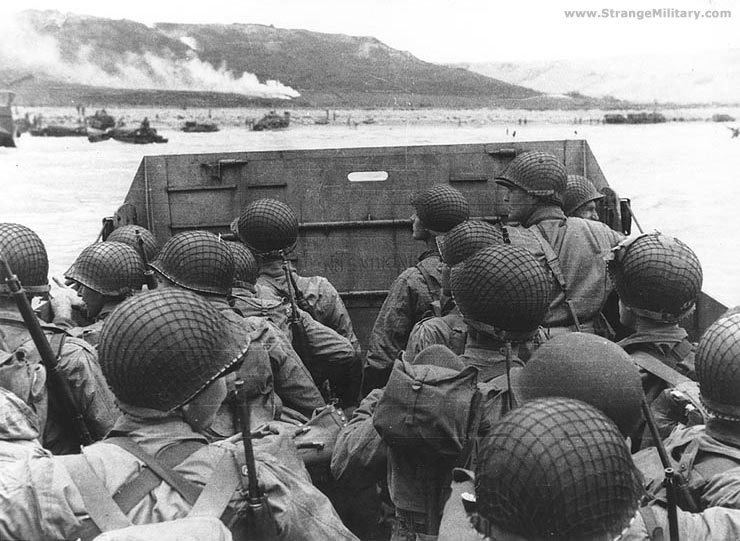
“Soldiers, Sailors and Airmen of the Allied Expeditionary Force! You are about to embark upon a great crusade, toward which we have striven these many months. The eyes of the world are upon you. The hopes and prayers of liberty loving people everywhere march with you. In company with our brave Allies and brothers in arms on other fronts, you will bring about the destruction of the German war machine, the elimination of Nazi tyranny over the oppressed peoples of Europe, and security for ourselves in a free world.

Your task will not be an easy one. Your enemy is well trained, well equipped and battle hardened, he will fight savagely.

But this is the year 1944! Much has happened since the Nazi triumphs of 1940-41. The United Nations have inflicted upon the Germans great defeats, in open battle, man to man. Our air offensive has seriously reduced their strength in the air and their capacity to wage war on the ground. Our home fronts have given us an overwhelming superiority in weapons and munitions of war, and placed at our disposal great reserves of trained fighting men. The tide has turned! The free men of the world are marching together to victory!

I have full confidence in your courage, devotion to duty and skill in battle. We will accept nothing less than full victory!

Good Luck! And let us all beseech the blessings of Almighty God upon this great and noble undertaking.

— Gen. Dwight D. Eisenhower “

Sixty-nine years ago over 9,000 American men, some hardly older than boys, laid down their lives on the beaches of Normandy in the greatest military operation in the history of the world. The white crosses stand row upon row in Colleville-sur-Mer,  in silent testimony of their supreme sacrifice.

Others who scrambled ashore on bloody Omaha Beach, or who climbed the rocky cliffs of Pointe du Hoc or who parachuted behind enemy lines with the 82nd and 101st Airborne lived to fight their away across France and across the Rhine into the heartland of Germany to break the power of the Third Reich forever. Others who survived the terrible ordeal of D-Day and fought on were not so lucky and did not come home.

The median age of WWII veterans now stands at 92. The “Greatest Generation” is receding into history in increasing numbers with each passing year but their deeds are destined to become legend.

….The men of Normandy had faith that what they were doing was right, faith that they fought for all humanity, faith that a just God would grant them mercy on this beachhead, or on the next. It was the deep knowledge – and pray God we have not lost it – that there is a profound moral difference between the use of force for liberation and the use of force for conquest. You were here to liberate, not to conquer, and so you and those others did not doubt your cause. And you were right not to doubt.

You all knew that some things are worth dying for. One’s country is worth dying for, and democracy is worth dying for, because it’s the most deeply honorable form of government ever devised by man. All of you loved liberty. All of you were willing to fight tyranny, and you knew the people of your countries were behind you.

The Americans who fought here that morning knew word of the invasion was spreading through the darkness back home. They fought – or felt in their hearts, though they couldn’t know in fact, that in Georgia they were filling the churches at 4:00 am. In Kansas they were kneeling on their porches and praying. And in Philadelphia they were ringing the Liberty Bell.

Something else helped the men of D-day; their rock-hard belief that Providence would have a great hand in the events that would unfold here; that God was an ally in this great cause. And so, the night before the invasion, when Colonel Wolverton asked his parachute troops to kneel with him in prayer, he told them: “Do not bow your heads, but look up so you can see God and ask His blessing in what we’re about to do.” Also, that night, General Matthew Ridgway on his cot, listening in the darkness for the promise God made to Joshua: “I will not fail thee nor forsake thee.”

…..Here, in this place where the West held together, let us make a vow to our dead. Let us show them by our actions that we understand what they died for. Let our actions say to them the words for which Matthew Ridgway listened: “I will not fail thee nor forsake thee.”

Strengthened by their courage and heartened by their value [valor] and borne by their memory, let us continue to stand for the ideals for which they lived and died.

Thank you very much, and God bless you all. ”

– Ronald Wilson Reagan, President of the United States, June 6, 1984

Disrespect of the Prophet’s Mosque in Medina in Azan #2?

Wednesday, June 5th, 2013

[ by Charles Cameron — the second holiest site in Islam disrespected by the editors of Azan? ]
.

I’ve taken out the surrounding matter, but here’s the section on “decorated mosques” as a sign of the time of the Dajjal or Islamic antichrist, from Maulana Asim Umar‘s Third World War and Dajjal in the second issue of Azan:
.


.

**

There’s no doubt that the photo that has been dropped in there is of the interior of the Mosque of the Prophet in Medina — compare, for instance here and specifically the larger image here — and the accompanying hadith are less than flattering of “decorated” mosques — suggesting they signal the time of the Dajjal:

Anas ibn Malik narrates that the Prophet of Allah said that the Hour would not arrive until the people show off to each other in (the construction and going to) of mosques. [Saheeh Ibn Khuzaima Vol. 2 Pg. 282, Saheeh Ibn Hibban Vol. 4 Pg. 493]

Abu Darda said that when you start decorating your mosques and beautifying your Mushaf (i.e. The Quran – adorning it with jewellery etc.), then upon you will be destruction. [Kashf-ul-Khifa’ Vol. 1 Pg. 95]

Abdullah ibn Abbas narrated that the Prophet said that when the sins of a nation increase, then their mosques become greatly decorated. And decorated mosques will only be constructed at the time of the emergence of the Dajjal. [Al Sunnan Al-Waridah Fil Fitn: Vol. 4 Pg. 819]

**

What exactly do the Pakistani brothers intend to signal to their readers with this juxtaposition? As Mr Orange has reminded me, they are Deobandis, and consider devotions at the tombs of saints to be a form of shirk — but would they bring bulldozers to the Prophet’s mosque on that account, as their Wahhabi brothers in jihad did to a small shrine commemorating Abraham in Ayn al-Arous, Syria, recently?

I’d like to get a better sense of whether the juxtaposition is as unexpected in Pakistani context as it was to me, thousands of miles away, and would appreciate further clarification…

Apocalyptic Fire in Azan #2

Wednesday, June 5th, 2013

[ by Charles Cameron — on end-times rhetoric and having no need of sun or moon ]
.

Detail from a Commentary on the Apocalypse by Beatus of Liebana

**

On the whole, the “signs of the end times” described in the installment of Maulana Asim Umar‘s Third World War and Dajjal, pp. 23-31, and now posted in the second issue of Azan on pp 83-89 are standard fare of the “wars and rumors of wars” type that could fit pretty much any time n history, including our own — “When the most despicable person of a nation would be its leader” would fit an astounding number of rulers across recorded history, depending on your point of view, including Nero and Diocletian, George III and Abe Lincoln, and a slew of Saddams, Mubaraks and Assads

There was one section, however, that struck me as a powerful piece of visionary apocalyptic, and I wanted to bring it to the attention of those interested in such things.

The Maulana writes [I’ve omitted the Arabic honorifics since I lack Arabic, and corrected one typo in Enlish]:

“Hazrat Abu Hurayrah narrates that the Prophet of Allah said that the Day of Judgment would not occur before a fire erupts from Hijaz and lights up the necks of the camels of Basra.” [Bukhari, Muslim]

The incident mentioned in this Hadith has already occurred according to Hafiz Ibn Kathir (RA) and other historians. This fire appeared in 650 H on the Day of Jumu’ah in some valleys of Madinah Munawwarah and remained for about a month. The narrators have said that the fire suddenly erupted from the direction of Hijaz. The scene looked like a whole city of fire – containing a whole castle, tower or battlement etc. Its height was 4 “farsakh” (around 12 miles) and its width was 4 miles. The fire would melt any mountain it reached as if the mountain was made out of wax or glass. Its flames had the sound of thunder and the energy of river waves. Blue and red-colored rivers looked to be coming out of the fire. In such a (horrible) state, the fire reached Madinah Munawwarah. But the curious thing was that the wind that was emanating from the direction of the flames felt cool in Madinah. The scholars have written that the fire had encompassed all the jungles of Madinah such that in the Haram-e-Nabwi and in Madinah, all the houses were lit up as if from the sun. The people would do all their work in the night from the light (of the fire); in fact, the light of the sun and the moon would became faded because of the light of the fire.

Some people of Makkah (at the time of the fire) bore witness that they saw the fire while they were in Yamama and Basra.

A strange quality of the fire was that it used to burn the stones to coal but it would not have any effect on the trees. It is said that there was a large stone in a jungle – half of it was in the limits of Haram-e-Madina and half of it was outside the limits. The fire burnt to coal the half of the stone that was outside the limits of the Haram-e-Madina. However, it cooled when it reached to the other half and hence, this half remained safe.

The people of Basrah bore witness that they saw the necks of camels light up from the light of the fire…

[The Beginning and the End: Ibn Kathir (RA)]

**

You know my interest in semblances and parallelisms. Compare:

in fact, the light of the sun and the moon would became faded because of the light of the fire

in that narrative with:

the city had no need of the sun, neither of the moon to shine in it, for the glory of God did lighten it

in Revelation 21:23.

I am not arguing that there is an echo between the two accounts, nor that they describe the same phenomenon — simply that the rhetoric of each has a similar poetic intensity. This just happens to be one of those occasions when there are more things in heaven than are dreamed of in your natural sciences.

Boston special issue promoted in Azan #2

Wednesday, June 5th, 2013

[ by Charles Cameron — for the record, there’s a Boston “special edition” of Azan, though I’ve only seen the ad! ]
.

The second issue of Azan magazine is out, and not all that exciting — but just as I did last time, I’ve scanned it for bits that interest me, and come up with a couple — but first I’d like to note is the teaser on p. 49 (below) for a “special issue” on the Boston bombings, dated 15/5 on the cover and claiming to have been published “soon after the attacks”:

I haven’t seen it, but there’s corroboration. SITE appears to have found a copy and announced it in this tweet on May 25th:

So somewhere between Azan #1 and Azan #2, there would seem to have been an out of series issue. Since it concentrates on Boston, however, and not Khorasan, there’s probably not much in it along my line of interest, so knowing it’s out there only piques my curiosity just a tad.

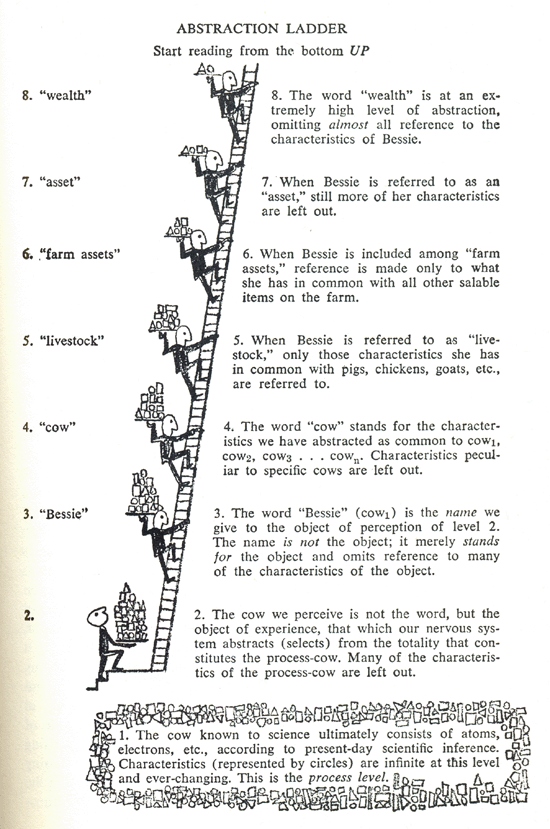
A woman, a ladder, four goats, and a cow named Bessie.

Tuesday, June 4th, 2013

[ by Charles Cameron — the four goats go with the woman, the cow called Bessie belongs with Hiyakawa’s Ladder of Abstraction ]
.

**

My friend the anthropologist Peter van der Werff recently wrote this paragraph about a woman he met in India:

The very poor woman explained me she and her four goats needed the shadow of a tree to escape from the blistering afternoon sun in their semi-arid part of India. There was a tree at the edge of the village, but the owner did not allow her to come near that tree. Therefore, she and her goats suffered from the heat, at the cost of her health and the productivity of the goats.

I was reminded of SI Hayakawa‘s Ladder of Abstraction.

**

Caution: you really do need, as it says, to “read” this image from the bottom up…

See Bessie, the Cow, in SI and AR Hayakawa, Language in Thought and Action, pp. 83-85, 5th ed..

**

Why did I think of Hayakawa’s ladder?

Here are two other things m’friend Peter had to say about the woman and her goats, the merciless sun, and that tree with its abundance of merciful shade:

As long as economists don’t include oppression and exploitation in their models, they cannot understand poverty.

and:

Such cruel relationships occur in many of the 750,000 villages of India. Without including those oppressive and exploitative realities, real poverty is not captured. We may invite economists to fit this reality in the computer.

**

We humans can do it. But how do we configure models that can hold those levels of granularity and abstraction — of individual human concern and global decision-making necessity — close enough together to give our grand plans humane flexibility?

I suspect writers such as Lawrence Wright know more about this than the number crunchers — and that the well-selected anecdote must become as significant as the well-chosen statistic


Switch to our mobile site