zenpundit.com » 2016

Archive for 2016

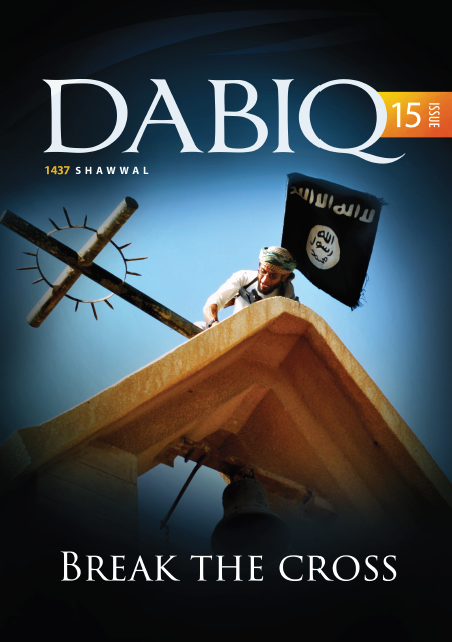
Dabiq issue 15, specific notes part 1, Crucifixion

Wednesday, August 3rd, 2016

[ by Charles Cameron — first of two parts of an essay on Dabiq‘s attack on Christian doctrines ]
.

dabiq 15 cover

**

I have written a two part essay examining the latest issue of ISIS’ Dabiq magazine, which is essentially an attack on Christianity and invitation ot Islam.

The first part, dealing mostly with the Crucifixion, is now out at LapidoMedia under the title ‘Breaking the cross’: Pathetic ISIS ‘theologians’ get wires crossed. Here’s the opening:

Misapprehension of Christian doctrine once again provides the excuse for Islamic State war-mongering.

The latest issue of its propaganda magazine Dabiq focuses on the crucifixion of Jesus and the Trinity, although Judaism, secularism, atheism, and feminism also get a drubbing.

The issue invites Christians in particular, and other non-Muslims in general, to abandon their beliefs and adopt Islam – an invitation accompanied by violent threats against those who refuse.

The introduction exults in recent attacks in Orlando, Nice, Germany and Normandy, adding: ‘[W]e take this occasion of multiple massacres inflicted upon their citizens and interests to call them once again to the religion of pure monotheism, truth, mercy, justice, and the sword. ‘

As in previous issues of Dabiq, the magazine opens with the declaration of the group’s founder, Abu Mus’ab az-Zarqawi, that the jihad will not end ‘until it burns the Crusader armies in Dabiq’ – a reference to the site of the great end-times battle in an otherwise obscure apocalyptic hadith [alleged saying of Muhammad].

The back cover of the magazine closes with another hadith. ‘By the One in whose Hand is my soul, very soon shall the Son of Maryam descend in your midst, being an equitable judge. He shall break the cross, kill the swine, and put aside the jizyah.’

Please click through to read the rest on the LapidoMedia site.

The second part of my essay will be posted at Lapido shortly — likely on Friday — and mainly deals with the ISIS magazine’s attack on the Christian doctrine of the Trinity viewed as a denial of God’s unity (Tawhid).

I’ll post an announcement here when it comes out.

**

Also of note, from Tim Furnish:

Tim Furnish is quoted discussing Dabiq 15 in a WND piece, ISIS: Christians are pagan ‘cross worshippers’. If he writes anything on MahdiWatch or elsewhere on the topic, Ill let you know.

Meanwhile, Tim’s tweet gives the short version:

Happiness in the proximity of faith and death

Monday, August 1st, 2016

[ by Charles Cameron — the emotional impact of faith, from a nun present at the Normandy attack to a failed suicide bomber in Syria ]
.

According to this IB Times article, Tragic last words of Catholic priest killed by Isis terrorists revealed, Sister Helene Decaux, one of the nuns who was present at the killing of Fr Jacques Hamel, reported his last words thus:

Jacques shouted at them, ‘Stop! What are you doing?’ It was then that one of them struck the first blow to his throat.

What caught my attention more forcefully, however, was the following:

Fearing for her life, she added: “Thinking I was going to die, I offered my life to God.” The nun then described how Petitjean and Kermiche had at first been aggressive, but quietened down after they had cut Jacques’ throat. Showing remarkable calm, Helene asked the two terrorists if she could sit down. “I asked for my cane, he gave it to me,” she said. One of the attackers asked: “Are you afraid to die?” To which the nun replied no. “I believe in God, and I know I will be happy,” Helene said. Sister Huguette Peron, who was also in the church, told Catholic newspaper La Vie: “I got a smile from the second (man). Not a smile of triumph, but a soft smile, that of someone who is happy.”

Not only is Sister Helene happy in the face of death because she believes in death, but Sister Huguette reports that one of the attackers gave her a smile, “Not a smile of triumph, but a soft smile, that of someone who is happy.”

**

Compare those two descriptions of people who are happy with this, from Murtaza Hussain‘s Intercept piece, New Documentary Pierces the Psychology of Modern Suicide Bombers:

In a scene from Norwegian journalist Paul Refsdal’s new documentary Dugma: The Button, Abu Qaswara, a would-be suicide bomber, describes the sense of exhilaration he felt during an aborted suicide attack against a Syrian army checkpoint. “These were the happiest [moments] I’ve had in 32 years. If anyone had felt exactly what I felt at that moment, Muslims would want to go through the same feeling and non-Muslims would convert just to experience it,” he enthuses to the camera, visibly elated by his attempted self-immolation.

Abu Qaswara’s attack failed after his vehicle was blocked by obstacles on the road placed by the Syrian military. But speaking shortly after he returned from his mission, it was clear that his brush with death had filled him with euphoria. “It was a feeling more than you can imagine,” he says. “Something I cannot describe, it cannot be described.”

My primary purpose in recording these instances of happiness is to emphasize how strongly religious faith exerts what to the modern secular mind must be an unexpected and perhaps even unimaginable emotional impact on those who possess it. And even if the Normandy attacker’s ‘soft smile” had more to do with a blood lust slaked, the same cannot be said either for Sister Helene or for Abu Qaswara.

If we are to understand the motivations of suicide bombers and other jihadists, comprehending not just intellectually but viscerally the emotions involved will be a task of some importance — and one for which many of our analysts will not be prepared.

**

There’s a second point to be made, however. Hussain goes on to write:

Only the few Syrians who appear in the film speak at length about their grievances over the crimes of the Syrian government. In contrast, the foreign volunteers appear largely driven by personal motivations. Liberating the local people from oppression appears at best a secondary concern. Perishing in the conflict and reaping the existential rewards of such an end takes precedence. Both Abu Qaswara and Abu Basir gave up comfortable lives to come to Syria, knowing that certain death would be the outcome of that decision. But rather than deterring them, the prospect of a rewarding death was a primary factor motivating their decision to fight.

That para sets the scene for the following one, in which Mustafa Hamid, as reported in his book with Leah Farrall, notes how contrary this motivation is to the practical pursuit of victory:

This impulse toward self-destruction is actually seen as selfish by some fellow insurgents. In his co-authored 2014 memoir The Arabs at War in Afghanistan, Mustafa Hamid, a former high-ranking Egyptian volunteer with the Afghan mujahideen in the 1980s, described his own frustration with many of the later waves of volunteers arriving to that conflict. “One of the negatives that emerged from the jihad, and which continues to have severe consequences today, was the tendency for the youth to focus not on success and achieving victory and liberating Afghanistan, but on their desire for martyrdom and to enter paradise,” Hamid wrote. This overriding preoccupation with becoming a martyr meant that participation in the conflict, “became individual instead of for the benefit of the group or the country where the fight for liberation is taking place.”

That’s one of the more striking of Hamid’s observations in The Arabs at War in Afghanistan — itself an astonishing book, product of the collaboration between Hamid (aka Abu Walid al-Masri) the man who brought bin Laden‘s oath of allegiance to Mullah Omar, and Farrall, a respected scholar-analyst who was the Australian Federal Police al-Qaida subject matter specialist at the time of the Bali bombings.

It is an extraordinary book, and one I cannot recommend too highly.

Of martyrdom and forgiveness

Monday, August 1st, 2016

[ by Charles Cameron — of martyrdom according to ISIS and the church, & of forgiveness in response to hate — continuing from Of sacrifice and martyrdom ]
.
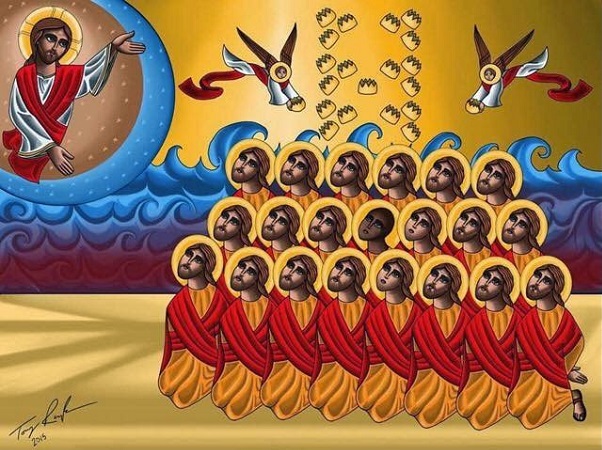
Martyrs

Icon by Coptic artist Tony Rezk. The martyrs’ faces are the faces of Christ.

**

My Lapido piece closed with these words:

That is, in part, why Pope Francis in his official comment on the event said he was “particularly troubled to learn that this act of violence took place in a church, during Mass, a liturgical act that implores of God His peace on earth.”

The Pope went on to say he “asks the Lord to inspire in all thoughts of reconciliation and fraternity in this new trial, and to extend to everyone the abundance of His blessings”. And that, perhaps, is the hardest thing for us – and for France – to understand.

The natural reaction to such a barbarous act as the killing of a defenceless 86-year old priest is horrified anger, and French President François Hollande, true to France’s claim to be secular, described the killing as a “desecration of French democracy” – and declared “France is at war.”

**

Democracy was far from the only thing that was desecrated. The image of God in the person of Fr Hamel was desecrated, his priesthood, speaking the words and making the gestures Christ himself had made at the Last Supper was desecrated, the sacred place in which he stood and woshipped was desecrated, and the sacrament of the Mass was desecrated .

And to all this, The Pope responded with words of forgivesness, asking God “to inspire in all thoughts of reconciliation and fraternity”.

**

Martha Nussbaum:

The American philosopher Martha Nussbaum has recently written an essay titled Beyond Anger, in which she begins to explain the futility of vengeance, citing Nelson Mandela as someone who went beyond anger to achieve great things:

He often said that he knew anger well, and that he had to struggle against the demand for payback in his own personality. He reported that during his 27 years of imprisonment he had to practice a disciplined type of meditation to keep his personality moving forward and avoiding the anger trap.

Nussbaum is presenting in psychological, philosophical and political terms the outlook which for Pope Francis is embodied in the words of Christ: “Love your enemies, bless them that curse you, do good to them that hate you, and pray for them which despitefully use you, and persecute you; that ye may be children of your Father which is in heaven.”

This attitude runs strikingly against the grain of secular thinking in our age.

With the tragic death of Fr Jacques Hamel and the words of Pope Francis, we are reminded once again that there exists another possibility than retribution, a way of forgiveness and peace in place of redoubled fury and war.

**

Tibhirine:

We hve seen this forgivesness before. To grasp how different Pope Francis’ message is from the vegneance which seems like second nature to us, we may want to recall the French Trappist monks of Tibhirine in Algeria, killed by Islamist terrorists in 1996, and to read again the remarkable words of Christian de Chergé in his Last Testament:

If it should happen one day – and it could be today – that I become a victim of the terrorism which now seems ready to encompass all the foreigners living in Algeria, I would like my community, my Church, my family, to remember that my life was given to God and to this country. I ask them to accept that the One Master of all life was not a stranger to this brutal departure.

Addressing his future attacker, de Chergé says:

And you also, the friend of my final moment, who would not be aware of what you were doing. Yes, for you also I wish this “thank you” – and this adieu – to commend you to the God whose face I see in yours.

**

Copts:

We witnessed it among the Coptic Christians when so many of their sons were brutally beheaded by ISIS.

As I noted at the time in Some recent words from the Forgiveness Chronicles, Angaelos, General Bishop of the Coptic Orthodox Church in the United Kingdom, said when he was interviewed shortly after the event:

Q: Not long after the video released, you tweeted about the killings, using the hashtag #FatherForgive. Did you mean that you forgive ISIS?

A:Yes. It may seem unbelievable to some of your readers, but as a Christian and a Christian minister I have a responsibility to myself and to others to guide them down this path of forgiveness. We don’t forgive the act because the act is heinous. But we do forgive the killers from the depths of our hearts. Otherwise, we would become consumed by anger and hatred. It becomes a spiral of violence that has no place in this world.

**

For Christians, it is clear that Fr Hamel was killed for his faith, and died a martyr. For the followers of ISIS, the same kind of claim will be made — that the two jihadist “soldiers” died at the hands of the French police while fighting jihad fi sabilillah — in the cause of God. But for the Muslim community of France as a whole, the killing of Fr Hamel was an act of brutality without religious sanction — indeed, quite the opposite:

Community leaders in Saint-Etienne-du-Rouvray, Normandy said they did not want to “taint” Islam by having any association with Adel Kermiche, the 19-year-old jihadist who killed Father Jacques Hamel in his hometown in northern France.

Mohammed Karabila, president of the local Muslim cultural association and imam of one of the town’s mosques, told Le Parisien newspaper: “We’re not going to taint Islam with this person. We won’t participate in preparing the body or the burial.”

Considering the importance of quick burial in Muslim theology, that is a pretty clear indication of the distance the Muslims of St Étienne-du-Rouvray wish to put between their faith and its distorted image in the mind of ISIS.

Not only didnthe local Muslims refuse to accept Kermiche’s body for burial, an appeal went out for Muslims to attend Mass on today, Sunday, in grief and solidarity with the Catholics and with the people of France. As Hend Amry put it:

Catholic priests were invited to attend, and spoke at Saint-Etienne-du-Rouvray mosque, which had been built on land donated by the church — and across France, in tears, countless Muslims attended Mass, in St Étienne-du-Rouvray, in Rouen Cathedral, and as far away as Italy and Corsica.

**
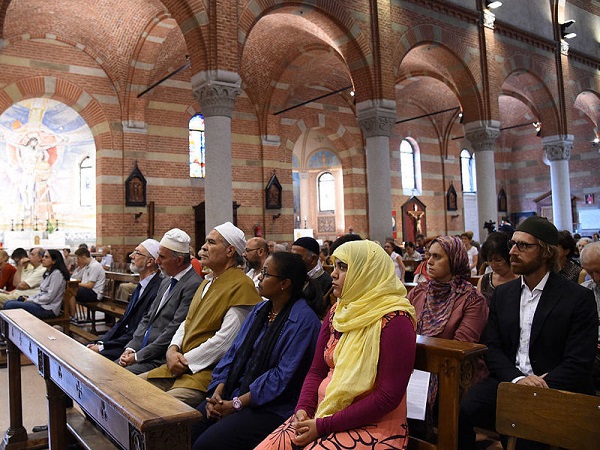
Muslims at Mass in Milan
Muslims at Mass in Milan, Italy

Solidarity AFP photo JCMagnenet
Catholic-Muslim friendship in wake of killing of Fr Hamel, AFP.
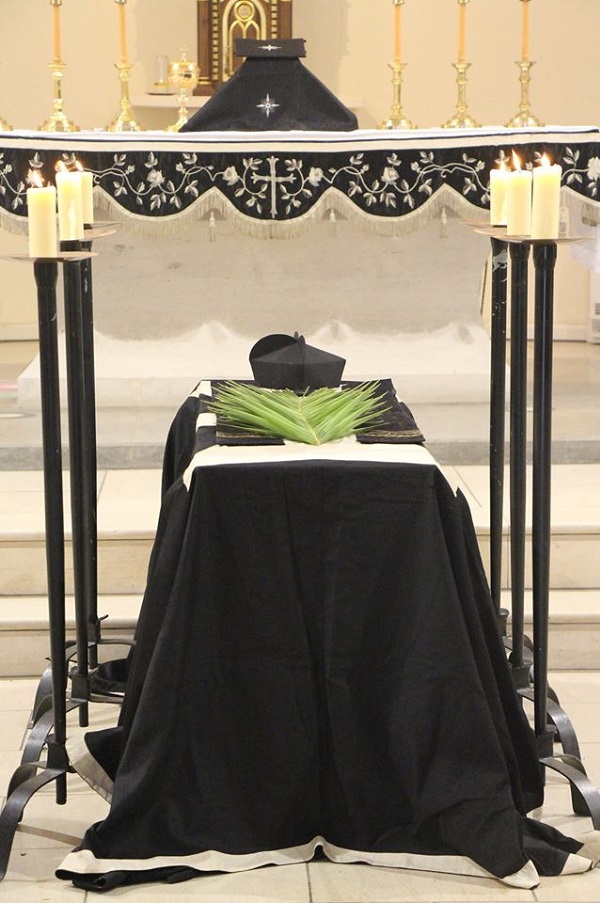
Catafalque, Requiem for Fr Hamel
Catafalque, Requiem Mass for Fr Hamel, Faternity of St Joseph the Guardian, La-Londe-Les-Maures.
Of sacrifice and martyrdom

Monday, August 1st, 2016

[ by Charles Cameron — martyrdom in the church of the proto-martyr, sacrifice at the sacrifice of the Mass ]
.

Boom! Here you have it:

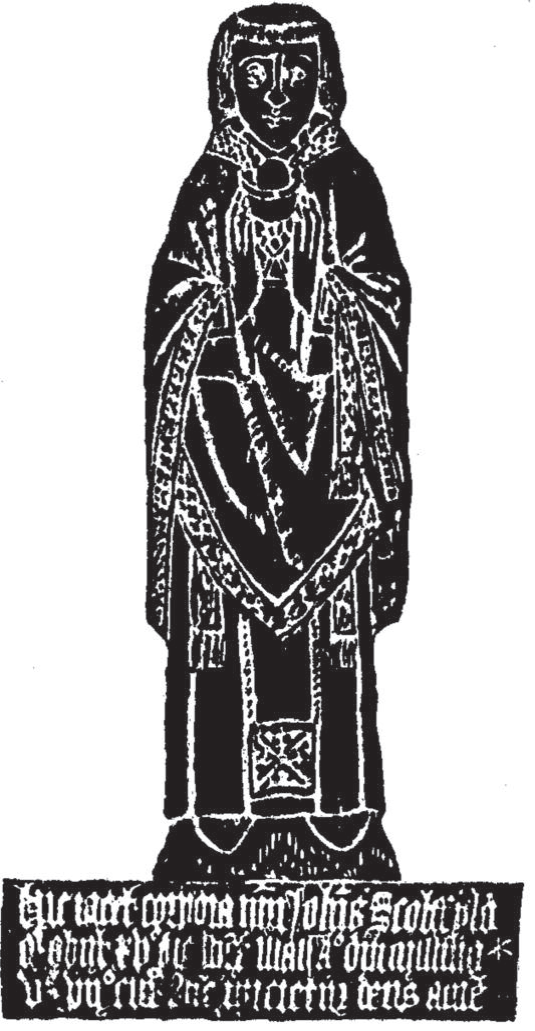
Brightwell brass rubbing

That brass rubbing comes from the church of St Agatha’s in Brightwell-cum-Sotwell, the village where I did much of my growing up, and commemorates one Fr John Scoeffyld, who was murdered, as I recall, on his way to say Mass at the Lady Chapel of that church, in 1507.

I served Mass in that church — and its sister, St James, Sotwell — many times in my Anglican youth, and remember that brass vividly enough, though the current web accounts of the parish [1, 2] fail to mention it — with the exception of Fred Heyworth‘s History of Brightwell.

**

A priest, killed as he was saying Mass — for me, there’s an emotional connection there.

These last days, that phrase has had a current application — in the appaling death of the French Catholic priest, Father Jacques Hamel, while he was saying Mass in the church of St Stephen, proto-martyr, in the town named for the church, Saint-Étienne-du-Rouvray.

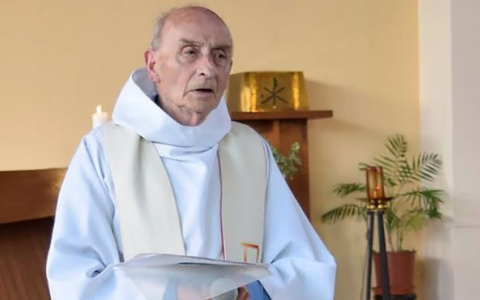
Here’s a video of Fr Hamel, so you can get some sense of the man:

I wrote the incident up for LapidoMedia, one of my other haunts — here’s the beginning:

ANALYSIS: The French state has no category for the killing of Fr Jacques

Fr-jacques-hamel

THE FRENCH Catholic priest Fr Jacques Hamel was murdered yesterday by two men claiming to act on behalf of the Islamic State (ISIS). It was a religious crime in a secular state.

They forced the 86-year-old priest to his knees while he was saying Mass in the Église St.-Étienne (Church of St Stephen) in the Rouen suburb of St.Étienne-du-Rouvray, and cut his throat – some reports indicate they beheaded him.

Sister Danielle, a nun who escaped the church during the killing, told reporters his assailants filmed themselves cutting his throat and ‘appeared to preach in Arabic at that altar.’

ISIS later claimed the attack.

Please click through to the Lapido site to read the rest, and bookmark them for informed religious commentary on current events.

**

When you’ve read the LapidoMedia piece — why, return to Zenpundit for the second part of this post, because my Lapido piece was necessarily focused on the secular / spiritual axis, but the issues of martyrdom and forgiveness call for further consideration.

Sunday surprise: peering digitally around corners 2: Blade Runner

Sunday, July 31st, 2016

[ by Charles Cameron — moving from a consideration of Holbein’s Ambassadors to a celebrated scene in Ridley Scott’s Blade Runner — and thence, wide-angle, to Kumbh Mela ]
.

Here’s the Bladerunner scene:

What Ridley Scott depicts is a camera with the ability to see around corners — a fantastic piece of science fictional cinematography, demonstrating a sufficiently advanced technology with a skill amounting to wizardry.

**

How close, though, can state-of-the-art cameras come to seeing around corners? Here’s what Nature has to say:

Andreas Velten, Thomas Willwacher, Otkrist Gupta, Ashok Veeraraghavan, Moungi G. Bawendi & Ramesh Raskar, Recovering three-dimensional shape around a corner using ultrafast time-of-flight imaging:

Abstract:

The recovery of objects obscured by scattering is an important goal in imaging and has been approached by exploiting, for example, coherence properties, ballistic photons or penetrating wavelengths. Common methods use scattered light transmitted through an occluding material, although these fail if the occluder is opaque. Light is scattered not only by transmission through objects, but also by multiple reflection from diffuse surfaces in a scene. This reflected light contains information about the scene that becomes mixed by the diffuse reflections before reaching the image sensor. This mixing is difficult to decode using traditional cameras. Here we report the combination of a time-of-flight technique and computational reconstruction algorithms to untangle image information mixed by diffuse reflection. We demonstrate a three-dimensional range camera able to look around a corner using diffusely reflected light that achieves sub-millimetre depth precision and centimetre lateral precision over 40 cm×40 cm×40 cm of hidden space.

Here’s another illustrative video:

**

Okay, seeing is simple, but we’re Zenpundit, so there’s gotta be a military angle we can see around, no?

Here are two possibilities — the first is called CornerShot:

while the second is called ShotView:

**

We’re still pretty far from Ridley’s Blade Runner, but the idea of seeing / shooting around corners has clearly caught the imagination of others.

Okay, those last two videos are for those interested in matters martial.

Kumbh Mela

For my own sake, and for the possible interest of blog-friend Pundita, let’s take a look at a video of Ramesh Raskar, head of MIT Media Lab’s Camera Culture research group and one of the authors of the Nature paper quoted above.

Here Dr Raskar is talking about that most fascinating of Hindu festivals — and largest of human gatherings? — the Kumbh Mela

Talk about wicked problems — and crowd-sourcing solutions — and genius — and the manifold intersections of the secular and the sacred!


Switch to our mobile site