Gloria Mundi Rapid Transit
[ by Charles Cameron — that’s the thing: only what’s deep survives ]
.
.
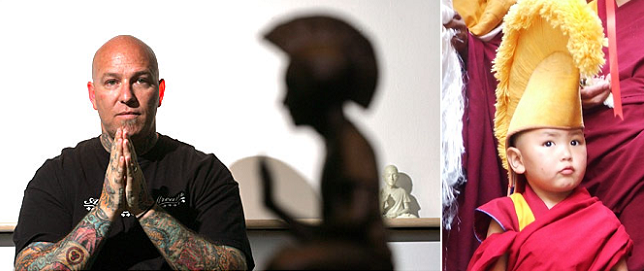
I don’t think the shadow on the wall behind and to the right of Noah Levine (above, left) is wearing a mohawk — I think it’s the shadow of a Tibetan monk wearing the kind of headdress you’ll see on the young Tulku (above, right)… but even so, the picture does remind me of this one, which I posted a few days ago, titled “choir punk”:
.

.
The similarities are more than visual, however — and they’re instructive.
**
As you may recall, the lower of the two images is one that I used to illustrate my opening post on the topic of Pussy Riot, and it illustrates the theme that punk and Orthodoxy have something important in common. The upper image (left) shows another punk who got religion — in this case, Buddhism. His name is Stephen Levine, and he’s the guy who set the Dharma Punx wheel rolling, coming out of a life of prison, punk and crack addiction into the stillness of meditation in much the same way that the punk monks featured in that earlier piece came out of their own nihilism, punk and despair into the stillness of contemplation…
From nihilism to peace.
I’ve never been into punk music myself, I’m a Bach and Gregorian Chant man — but what’s striking me here is the sense that punk knows the first thing there is to know: that the things we do to try to keep ourselves happy necessarily ring hollow after some time. Possessions, status — these things may appease us for a while, but they don’t truly satisfy.
The punk knows this, and the monk knows this — whether the monk in question is Buddhist or Christian or whatever. Only the monk makes the discovery that leads out of contemptus mundi into the alternative strategy.
**
And somehow, you need to reach full tilt boogie to get there, howsoever full tilt boogie may be defined in your own case, and whatever form the contemplative, relaxed, inward life may take.
Here are two versions of what it takes:

Samuel Johnson, I’d say, is seeing something very close to either one of these when he says:
Depend upon it, Sir, when a man knows he is to be hanged in a fortnight, it concentrates his mind wonderfully.
**
A close brush with death — or sure knowledge of one’s mortality. A red-hot iron ball stuck in your throat. Rock bottom…
All of these things can concentrate the mind wonderfully, and the concentrated mind can do things, can allow things that the bothered mind would get insanely bothered by.
You may wear rose-tinted glasses for a while, and get away with it. You can try out the dark glasses of ironic superiority. Both ways of looking involve a measure of self-delusion, however, for they catch surfaces and miss the depths.
At times — when you or someone you love gets an unexpected and advanced cancer diagnosis, say, or you lose your house to the bank — the illusions get stripped away, and you simply see. And what you see will either be enough to make you cry and rage, or enough to make you dance and sing.
Because when the illusions get stripped away, only what’s deep survives.
**
I’d like to take this just a step further.
The old Lakota medicine man Archie Fire Lame Deer told his biographer, Richard Erdoes:
I am no wino or pishko, but I am no saint either. A medicine man shouldn’t be a saint. He should experience and feel all the ups and downs, the despair and joy, the magic and the reality, the courage and the fear, of his people. He should be able to sink as low as a bug, or soar as high as an eagle. Unless he can experience both, he is no good as a medicine man.
I don’t suppose anything I say in words can get this exactly right anyway, but I’ll try.
If you try to give advice to someone who is suffering more than you have ever suffered, your advice is liable to come across as uncomprehending and shallow. You have to have known your own blues to sing the blues. And you have to be in peace to convey peace…
And that, it seems to me, is what allows monks to hear and understand and talk, peer to peer, with punks — and that’s what allows punks to become monks.
**
Noah Levin’s book, Dharma Punx, is available on Amazon, as is the DVD of Meditate and Destroy, the 2007 documentary about him.
**
Punk may still not be my kind of music — but I’m beginning to see the punk mohawk as a kind of instinctive tonsure…



September 4th, 2012 at 4:27 pm
The question I have is how do you hold onto the state you’re describing? I think what you’re talking about is somewhat similar to going into the woods or the desert and slowly having all externalities stripped away until you have a moment where you see, very clearly a pale blue dot sort of moment. Once you leave the wilderness the feeling slowly fades and more and more you’re only able to pull back a faint echo of what it was. (this should probably be in the first person since I’m mostly relying on my own experiences, not sure how to do much differently on the subject but to lean on what I know and have felt even in the context of what others seem to have achieved with what you’re describing) Moments of grief and loss drive it home quicker and more deeply and leave a stronger echo, but it’s still an echo. Is it a matter of avoiding embracing the loss of hope, the utter emptiness that’s left, instead compromising by going through the motions, whistling past the graveyard as it were instead of consuming/being consumed by that state? Or are those moments of clarity just that, moments? Or am I so far into left field that I’m about to get run over by a scrum-half when I’m expecting bloopers at the warning track?