The Said Symphony: moves 13 – 15
[ by Charles Cameron – extended analytic game on Israeli-Palestinian conflict — continuing ]
.
It has been a while since I last played a move in the Said Symphony: our game has been quiet since July, and it is now December. Meanwhile, the world has moved on, and many of the knowns of the Middle East have become unknowns – the Egyptian view of Israel among them.
My next move, then, will recognize this lapse of time — but for those who may be unacquainted with the game, and wish to follow it, here is a quick recap.
The Said Symphony Game, played in the spirit of Hermann Hesse‘s fictional Glass Bead Game, is an attempt to “concept-map” the various voices in the Israeli-Palestinian conflict and its wider context, both contemporary and historical/mythological, so that its many voices can be held in counterpoint in the mind, and parallelisms and oppositions discerned between them as in a great fugue of Bach or Beethoven — inspired by the Palestinian public intellectual and music critic’s suggestion:
When you think about it, when you think about Jew and Palestinian not separately, but as part of a symphony, there is something magnificently imposing about it. A very rich, also very tragic, also in many ways desperate history of extremes — opposites in the Hegelian sense — that is yet to receive its due. So what you are faced with is a kind of sublime grandeur of a series of tragedies, of losses, of sacrifices, of pain that would take the brain of a Bach to figure out. It would require the imagination of someone like Edmund Burke to fathom.
The game thus far:
The game is a solo game, and you may wish to read it slowly.
I will now play moves 13 – 15.
____________________________________________________________________________________________
Move 13: Pause

Move Content:
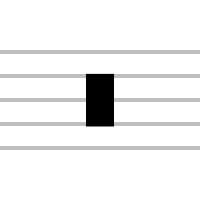
The rest [in this case a “long” rest] is the indication in the score of a musical silence: that is, a silence heard as musical, silence within the music. The rest extends over time, the music continues – so I’m adding a fermata or hold to the rest, which will extend it further, thus:

To my way of thinking, the pause is, above all else, a sabbath, a time of rest:
“Labor is a craft, but perfect rest is an art”, writes Abraham Joshua Heschel in his great, short book, The Sabbath — “He who wants to enter the holiness of the day must first lay down the profanity of clattering commerce … He must go away from the screech of dissonant days” and “How else express glory in the presence of eternity, if not by the silence of abstaining from noisy acts? These restrictions utter songs to those who know how to stay at a place with a queen…”
Links claimed:
There are other pauses, pauses of dissonance, pauses of rending.
To Auschwitz: The pause that Auschwitz enforces on us is a silent scream, atonal, ultra-modern in its sensibility, the attempt of a little, unmoored, desacralized western consciousness to get to moral grips with the factory extermination of one’s fellow beings by the millions, perpetrated by people who wear the same shoes and suits and ties, and carry the same briefcases as ourselves. It lacks all that has previously been called musicality: it cannot cope.
I do not believe there is any escaping this scream: it is to be heard and held, embraced even. It is ugly, and it is an ugliness increaed by magnitude, by repetition, by number.
To Golgotha: The pause that Golgotha asks of us is of another order. Christ, “when he had cried again with a loud voice, yielded up the ghost.” The Word is silenced. Only after three days will it begin to speak again.
Comment:
Leading into the next move, I have suggested that the rest is a musical silence – whether it be the deathly silence we may sense in Golgotha, the hideous silence that Auschwitz draws from our exhausted lungs, or the encompasing silence of glory of which Rabbi Heschel speaks.
It is a musical silence, a silence in each case to be listened to – tolerable or intolerable – a John Cage zen silence if you will…
In that silence, sounds can be vaguely sensed, emerging as if a morning mist is lifting, and some bird or twig or trill takes form…
Our board thus far:

[ my appreciation and thanks to Cheryl Rofer, who corrected me with regard to the notation of rests ]
____________________________________________________________________________________________
Move 14: Jerusalem
And so a new movement in our Symphony begins.
I have been aching for this moment: as move 14, I play Jerusalem
Move 14: Jerusalem

Move content:
Jerusalem is at the heart of the Israeli / Palestinian and Israeli / Arab problem, and thus of much of the tension in the Middle east and the world.
It is also the city of peace, Salem – and you might say the ultimate hope, not of this game, which cannot aspire so high, but of the heart, is expressed in the three words: shalom salem salaam… In fact, ubi shalom, ibi salaam might be the motto of this work: where there is peace, let there be peace.
In making the opening move of this second movement of my game Jerusalem, then, I am taking us into the heart of the conflict, and into the heart of the hope for peace.
Jerusalem is a contested city, and we shall explore that contest in the moves to come.
Links claimed:
First, to the rest in 13: because in the silence, three sounds can be heard. I quote here the words of Jamal Zahalka, a Palestinian Knesset Member — not for who he is but for their music:
The sound of the Muezzin, the church bells and the blowing of the shofar have always existed.
Those are the sounds “that can be vaguely sensed, emerging as if a morning mist is lifting”, in the silence of the musical rest.
Second, to Golgotha, the place outside Jerusalem where, according to the Christian telling, the body of the man who compared his body to the temple was so cruelly tortured that he “yielded up the ghost” – and at that moment, as if in sympathy, in the spiritual heart of Jerusalem and all Israel “behold, the veil of the temple was rent in twain from the top to the bottom; and the earth did quake, and the rocks rent…”
Third, to the Glass Bead Game: because “the holy city, new Jerusalem, coming down out of heaven from God, made ready as a bride adorned for her husband” of Revelation 21.21 finds its intellectual avatar in “the hundred–gated cathedral of the mind” to which Hesse’s Game aspires.
Fourth, to William Blake, prophet, for whom Jerusalem was so urgent a matter that he must have it with him in England – as many Americans must have it with them in America — singing (as I myself have lustily sung):
And did those feet in ancient time.
Walk upon England’s mountains green:
And was the holy Lamb of God,
On England’s pleasant pastures seen!And did the Countenance Divine,
Shine forth upon our clouded hills?
And was Jerusalem builded here,
Among these dark Satanic Mills?Bring me my Bow of burning gold;
Bring me my Arrows of desire:
Bring me my Spear: O clouds unfold!
Bring me my Chariot of fire!I will not cease from Mental Fight,
Nor shall my Sword sleep in my hand:
Till we have built Jerusalem,
In England’s green & pleasant Land
But Blake did better than to write these words – he illuminated them, and I shall place the text as he presented it at the bottom of this post.
Next: to Bob Dylan. Well, there’s this:

— but it seems to be someone’s personal graphic for a compilation of Dylan songs, so this – Dylan at the Wailing Wall, 20 February 1983, attending his son’s Bar Mitzvah – will have to suffice:

And finally, I find there’s a peruasive link to Moral Equivalence — because Palestinians claim possession of the Noble Sanctuary and parts of the old city, while Israelis claim the same rights over the whole of Jerusalem including the Temple Mount – the Temple Mount and Noble Sanctuary being one and the same physical space — and there are wise and foolish, hardliners and diplomats, scholars and treatises on both sides, and in the interstices between them.
And the question is: are the claims and complaints of one side justified and the other baseless, or is there a moral equivalence between them.?
That is a question of balance on the scale of justice, to be tempered, one always hopes, with mercy.
Comment:
What are the claims and counter-claims, ancient and modern – and what do the peace-makers say?
Addendum:
A page from Blake’s Preface to Milton:
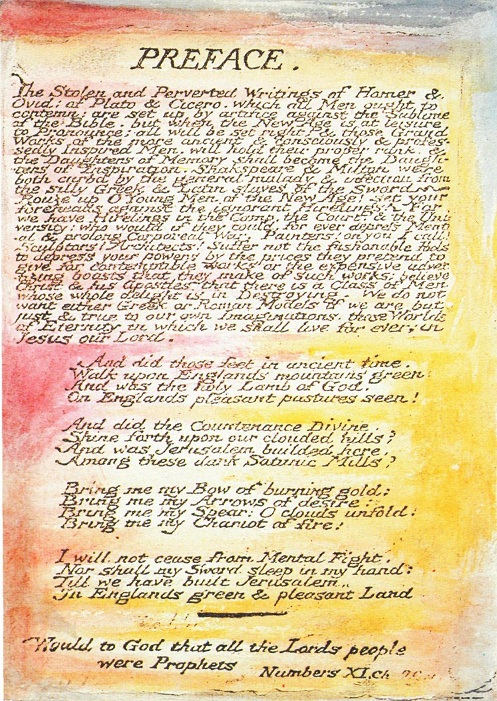
It would be a marvel to have purchased his book at the time, to have held it and read and savored it, each copy uniquely illuminated by his own hand…
____________________________________________________________________________________________
Move 15: Netanyahu’s Leopard
Move 15: Netanyahu’s Leopard
sforzando

Move content:
“A leopard has sunk its teeth in our flesh, in the flesh of our children, wives, our elderly, and we will not be tempted to believe that this leopard has now changed its spots. We will not ignore its voracious growls. We will strike it down.”

From the desk of Israeli Prime Minister Netanyahu, speech at the Memorial Ceremony for Victims of Terror, October 5th, 2011.
Links claimed:
To rest or pause, I suppose, because the lull between intifadas may seem like a sort of temporary truce, but it’s really mostly an opportunity for the enemy to regroup and rearm; and then to Jerusalem, because Jerusalem is Irael and Israel Jerusalem; and finally to — what was it — moral equivalence because there is no moral equivalence, is there?
I’m sorry if that seems a bit abrupt, but the musical signature at the top of the move says sforzando, and we’ve got work to do.
Comment:
Getting into the thick of it, Netanyahu’s speech doesn’t leave much room for compromise. And sforzando, a musical term, literally means “forcibly” — “with strong emphasis”.
Conflict is not pretty, in the way one might hope that symphonies and other works of art and beauty might be. There’s death to be distributed and withheld, and wealth and power — and the urgency they bring to the fight.


