Prof Hadar Aviram’s close reading of Mueller, 2
[ by Charles Cameron — Hadar Aviram continues her distillation of the Mueller report, here providing us with the essence of volume 2 ]
.
Mueller Investigation Report, Volume II: Obstruction of Justice.
2. The report starts off with a decline of the “binary” decision to prosecute or decline, because of the DOJ’s opinion that indicting a sitting president would “impermissibly undermine the capacity of the executive branch to perform its constitutionally assigned functions.”
3. Despite Mueller’s opinion that a sitting president cannot be indicted, they conducted the factual investigation “when memories were fresh and documentary materials were available.” The report EXPLICITLY states that “a president does not have immunity when he leaves office.”
4. They deliberately refrained from an ordinary determination whether crimes were committed because ordinary channels for clearing one’s name are unavailable in this case, and because the consequences of a recommendation would extend “beyond the realm of criminal justice.”
5. Most importantly: they did not find that the president did NOT obstruct justice and say so explicitly. The money shot is enclosed:

6. The report proceeds to review the efforts to cover up the contacts with Russia, which were reviewed in my previous thread. The chronology is as follows:
7. During the campaign, Trump repeatedly denied links to Russia, denied that the leaks were coming from Russia, and denied that he or other campaign officials sought any information from Russians. As my previous thread shows, the Mueller team found these denials to be false.
8. In Jan 2017, Flynn lied to Pence about meeting Kislyak. When Trump found out, he summoned Comey, then FBI director, and told him that he needed “loyalty.” He then proceeded to fire Flynn and commented to an outside advisor, “now that we fired Flynn, the Russia thing is over.”
9. Later that evening, Trump summoned Comey to a one-on-one meeting, telling Comey, “I hope you can see your way to letting this go.”
Trump proceeded to ask Deputy National Security Advisor McFarland for a letter saying that Trump did not order Flynn to meet Kislyak. McFarland declined because he did not know if it was true and didn’t want that to look like a quid-pro-quo favor for his Ambassadorship.
11. As Sessions began to consider recusing himself, Trump asked White House counsel McGahn to instruct Sessions not to recuse, and after Sessions’ recusal, took Sessions aside and asked him to “unrecuse.”
12. Later, when Comey admitted that there was an FBI investigation on Russia, Trump reached out to National Security Advisors asking them what they could do to dispel this suggestion. Despite McGahn’s advice to the contrary, he also reached out twice personally to Comey.
13. On May 3, Comey testified in a congressional hearing, refusing to say that Trump himself was under investigation. Within days, he was terminated. Trump claimed that the termination was unrelated to the testimony, but the timeline does not bear this out.
14. On May 17, Rosenstein appointed Mueller special counsel. Trump reacted by telling advisors that this was “the end of [his] presidency.” He first demanded that Sessions resign (but then did not accept his resignation.)
15. Trump then argued that Mueller had a conflict of interest, but his advisors told him that claim was meritless.
16. When Mueller announced that Trump was a target, the latter called McGahn at home and asked him to fire Mueller. Fearful of starting a Saturday Night Massacre, McGahn resigned, instead.
17. Two days after the convo w/McGahn, Trump met with Corey Lewandowski, asking him to relay a message to Sessions, who as you recall had recused himself.
18. Lewandowski was to instruct Sessions to issue a public announcement that, notwithstanding his recusal, Trump had done nothing wrong, and to instruct the Special Counsel to redirect the focus of the investigation toward “future elections.”
19. Lewandowski told Trump he understood the message, but did not want to relay it himself, so he asked senior White House official Rick Dearborn to do it. Dearborn didn’t want to do it either and did not relay the message.
20. In the meantime, while Trump was waiting for Lewandowski to relay the message to Sessions, Trump went on a twitter tirade, criticizing Sessions and implying that firing Sessions was imminent.
21. In the summer of 2017, news of the meeting at Trump Tower leaked to the press. On numerous occasions, Trump instructed aides not to reveal any information about the meeting and expressed confidence that the information would not leak on its own.
22. When Trump Jr. issued a statement about the meeting, Trump (the father) edited out what we know to be true: that the campaign was promised incriminatory information on Clinton. The edited statement stated that the meeting was about adoptions of Russian children.
23. Trump’s lawyer subsequently denied to the press that Trump played any role in crafting or editing Trump Jr.’s statement.
24. In Summer 2017, Trump made several efforts to reach out to Sessions and convince him to “unrecuse” himself. Trump met with Sessions at the Oval Office and asked him to “take [a] look” at investigating Clinton.
25. When Flynn pleaded guilty and collaborated with the Mueller investigation, Trump called Sessions again and told him that, if he “unrecused” himself, he would be “a hero”. Sessions did not “unrecuse” himself.
26. In early 2018, the media revealed the story behind McGahn’s resignation. Trump directed White House officials to tell McGahn to publicly deny that Trump had ordered McGahn to sack Mueller. McGahn refused to publicly deny this, saying that the reports were factually accurate.
27. Subsequently, Trump summoned McGahn to the Oval Office and pressured him to deny the reports, interrogating him about what he had told Mueller. McGahn told the investigation team later that he got a sense that the President was “testing his mettle.”
28. When Flynn started to collaborate with the Government, Trump reached out to him and asked him for a “heads up” if he learned “information that implicates the President.”
29. Flynn informed Trump that he was unable to cooperate with this request. Trump’s personal counsel said he would make sure that the President knew that Flynn expressed “hostility” toward the President.
30. During Manafort’s trial, Trump praised Manafort for not “flipping” (pleading guilty and cooperating with the investigation team), saying among other things that “flipping” “ought to be illegal.”
31. In 2017, as explained in Vol. 1, Michael Cohen falsely testified before Congress that Trump’s involvement in the Trump Tower Moscow project ended long before the campaign (when in fact it continued well into 2016.) Trump praised Cohen for his testimony.
32. In April 2018 the FBI raided Cohen’s home. Trump encouraged him to “stay strong” and relayed messages of support. Cohen reached out to Rudy Giuliani to discuss the possibility of a pardon.
33. When Cohen started cooperating with the investigation in Summer 2018, Trump turned on him, called him a “rat”, and suggested that his family members had committed crimes.
34. We now turn to how the Mueller team analyzed whether these facts constitute Obstruction of Justice.
35. Obstruction of Justice has three elements: [1] an obstructive act [2] a nexus between the obstructive act and an official proceeding and [3] a corrupt intent.
36. The offense covers both successful endeavors and attempts to obstruct justice.
37. The report enumerates the people they questioned in connection with the report. It explicitly says that “The President declined to be interviewed” and there are redacted bits around this statement.
38. The Mueller team had the power to subpoena Trump and refrained “in view of the substantial delay that such an investigative step would likely produce at a late stage in our investigation.” Also, even w/o his testimony, they had enough evidence “to understand relevant events.”
39. In deciding whose version was credible, they relied on general principles, including reasons to lie, good memory, opportunity to observe events, corroboration, and contradictions.
40. The part of the report that discusses Trump’s reaction to the Russian hacks and his instructions to Cohen and Manafort in this respect is heavily redacted.
41. Trump reached out to the intelligence community asking them to publicly deny the Steele Memo after it leaked through Buzzfeed.
42. We now move on to the Mueller team’s conclusions about whether Trump’s behavior constituted obstruction of justice.
43. Regarding Flynn’s resignation and pressure on Comey: Trump’s effort to procure false reports about Flynn, and especially the 1-on-1 convos w/Comey, count as “obstructive acts”.
44. This was directly related to concerns about criminal exposure for Flynn (=”official proceeding.”)
45. Corrupt intent: Trump’s demeanor in pressuring Comey suggests he knew he was not doing something that was above board. => OBSTRUCTION OF JUSTICE.
46. Regarding the pressure on Comey and others in the intelligence community to end the investigation: Trump’s convos about this, through McGahn and others, were not interpreted as inappropriate efforts to end the investigation.
47. There was a nexus to official proceedings that would follow disclosures about the involvement with Russia.
48. The nature of the pressure on intelligence officials does not clearly reveal corrupt intent. => NO CONCLUSIVE OBSTRUCTION OF JUSTICE. Read on.
49. Re firing Comey and claiming it was unrelated to Russia: This would qualify as an obstructive act if the anticipated effect was ending the investigation, which is unclear here.
50. Nexus: There is some connection this is related to the proceedings against Flynn.
51. Corrupt intent: The evidence supports the idea that the firing was aimed at protecting the president and that the other reasons were merely pretextual. => IF NOT “OBSTRUCTIVE ACT” THEN DOESN’T RISE TO LEVEL OF OBSTRUCTION OF JUSTICE.
52. Re the efforts to remove Mueller through McGahn and others: This is clearly an “obstructive act” to terminate Muller.
53. Nexus: There is a clear nexus between the effort to remove Mueller and the desire to end the investigation.
54. Corrupt intent: Substantive evidence links this to an effort to end the investigation and not to aboveboard behavior. => OBSTRUCTION OF JUSTICE
55. Efforts to curtail the investigation through Lewandowski, Sessions, etc: Obstructive acts: Trump’s directives show that he was trying to push Sessions to deviate the Mueller investigation.
56. Nexus: This was directly related to the Mueller grand jury.
57. Corrupt intent: Provable through Trump’s 1-on-1 meeting with Lewandowski. => OBSTRUCTION OF JUSTICE
58. Trump’s efforts to cover up the Trump Tower meeting: Obstructive act – there’s no strong evidence that this was more than a press strategy.
59. Nexus: unclear.
60. Corrupt intent: Unclear from these facts if it’s merely a press strategy. => NO SUFFICIENT PROOF OF OBSTRUCTION OF JUSTICE.
61. Trump’s efforts to “unrecuse” Sessions and have him take control of the investigation: Obstructive act b/c clearly aimed at terminating the Russia investigation.
62. Nexus to the Russia investigation is clear.
63. Corrupt intent: “a reasonable inference” on Trump’s side was that Sessions would “play a protective role.” => OBSTRUCTION OF JUSTICE
64. Trump tries to get McGahn to lie that he wasn’t ordered to fire Mueller. Obstructive intent: Duh – he’s trying to get McGahn to create a false record.
65. Nexus: It was foreseeable that McGann would testify about these matters, so there’s a connection to the Russia investigation.
66. Corrupt intent: an effort to influence McGahn’s account in order to deflect or prevent further scrutiny of Trump. => OBSTRUCTION OF JUSTICE
67. Trump’s statements to Flynn and Manafort in the context of the criminal proceedings against them: Obstructive act in the sense that his statements could influence the jury.
68. Nexus to both trials.
69. Intent: because of Atty-client privilege issues, we don’t exactly know what Giuliani did when threatening Flynn and whether he properly represented Trump’s opinion. => NOT ENOUGH FOR OBSTRUCTION OF JUSTICE
70. Trump’s about-face toward Cohen (praise then excoriation when Cohen cooperated w/the Feds.) Obstructive act: Trump knew that Cohen provided false testimony but no proof that he procured said false testimony.
71. Proceeding: Cohen’s testimony at investigations.
72: Intent: There’s evidence to support the inference that he hoped Cohen would falsely testify. => BUT NOT ENOUGH TO SUGGEST HE PROCURED THE FALSE TESTIMONY.
73: Now the report looks at these instances as a whole. The report cautiously suggests that Trump might have just been upset because the Russia investigation (which, as per Part I, stops short of arguing conspiracy) cast doubt on his legitimacy as president.
74. There were multiple efforts to exert undue influence, but they were largely unsuccessful (this, I think, is a legal mistake, because obstruction of justice does not require success, merely an attempt.)
75. In general, federal law advances a broad definition of obstruction.
76. Also, other obstruction statutes might be relevant to Trump’s conduct, including tampering with witnesses.
77. This speaks for itself – no criminal charges against a sitting president, but there are other avenues (“I won’t indict, but you can impeach”):
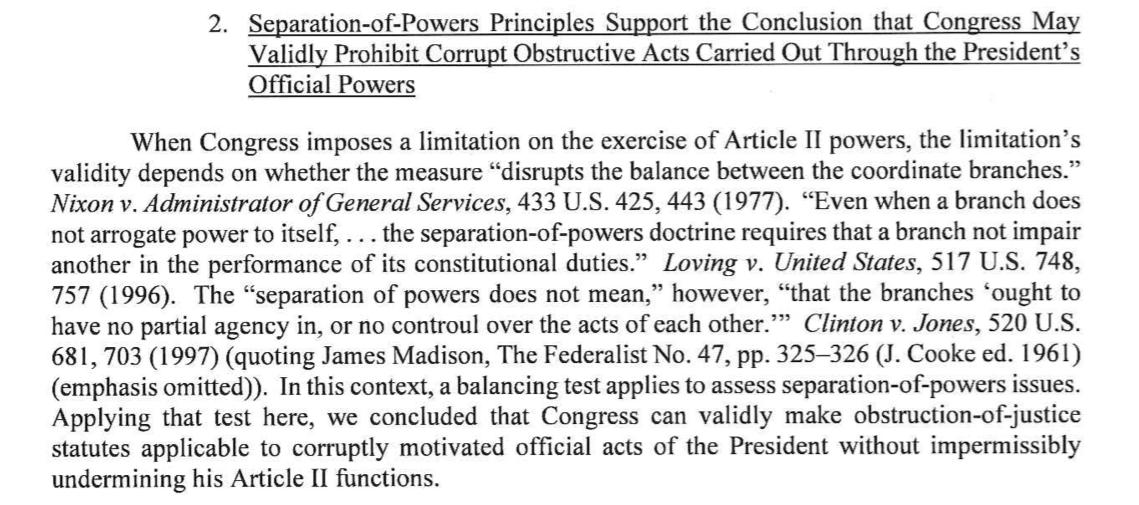
78. More “I won’t indict, but you can impeach” statements:

79. I’ll let the parting shot speak for itself:

80. Thank you all for reading along. I hope this was helpful to you. Please tweet and share in case others find this useful.
**
Note from Charles Cameron:
I’m grateful to Thread Reader, the application which makes extensive Twitter threads like this one available in easily readable, sequential form, and which was used to reformat Hadar’s threads before posting them here on ZP.



April 21st, 2019 at 4:44 am
Hi Charles
.
“Despite Mueller’s opinion that a sitting president cannot be indicted, they conducted the factual investigation “when memories were fresh and documentary materials were available.” The report EXPLICITLY states that “a president does not have immunity when he leaves office.”
.
I think Mueller is correct here on both counts. Indicting a sitting POTUS raises immediate constitutional questions related to separation of powers, Federal supremacy (were a state court to attempt it) and due process (finding an untainted jury pool for starters)as well as the practical concern of a Chief executive being responsible for the Executive Branch wile undergoing a trial or in a jail cell. Nor does the Constitution render any immunity to former presidents for illegal actions undertaken while in office, only immunity from claims covered by sovereign immunity or criminal complaints that may be shielded by questions by the constitutionality of the law under which the POTUS might be indicted (say a law attempting to restrain conduct as Commander-in-Chief). Any crimes otherwise committed by the President would be fair game for DOJ once he leaves office.
.
“Most importantly: they did not find that the president did NOT obstruct justice and say so explicitly. The money shot is enclosed”
.
Aside from the fact that Mueller or any other Special Counsel does not “clear” figures, I find this section suspect for the reason that while the POTUS may not be indicted any agents acting on his behalf in obstruction could be and if the evidence was sufficient, it should have been brought to a grand jury as the Special Counsel did with Paul Manafort. Given the career history of Mueller’s top prosecutor to overcharge and then be reversed by appellate courts, it is more likely that in many of these instances there wasn’t evidence to make even a simple conspiracy charge stick and the report is attempting to present forward theories or speculation as evidence of obstruction. What would be much more convincing to the public (or rather the part of the public that didn’t wish to impeach him even before Trump took office) or the Senate would be indictments of secondary figures for obstruction who acted illegally on the President’s instructions. Guilty pleas or cooperating testimony on this point seems to be conspicuously lacking unless the remaining cases referred by the Office of Special Counsel proceed in this vein.
April 23rd, 2019 at 4:49 pm
Well, Zen, I had a long response wrought with difficulty here, and it got lost when the system decided I wasn’t logged in.
.
In short, the last few years have taught me something of the deep reverence with which citizens of the United States hold the history of American governance, allowing me to see the whole as an authentic religious expression — something I really hadn’t grasped when I first came here.
.
There was stuff in there about John Locke, under whose grim portrait I sat for a few years when I attended dinner in college in my misspent youth, but I no longer recall quite what the relevance was.
.
In Any case, watching attorneys discussing the finer points of Mueller, his indictments, his referrals to other jurisdictions and his choices not to indict, I’ve come to feel a far greatest respect and affection for this great country, which has been my generous and kindly host for so many years.
.
And I really do need to acquaint myself with the Federalist Papers.
April 25th, 2019 at 2:58 am
Hi Charles
.
Being a country that could only have been born the way it was during the Enlightenment, Americans are (increasingly, were) tied to each other by a set of ideals which we have always had difficulty living up to in reality but nevertheless, saw as our hallowed values. A system that worked best when politicians were guided by restraint and respect.
.
The Federalist Papers and Madison’s notes on the Constitutional Convention alongside John Adams book on the constitutions of the states and the Antifederalist Papers are the best windows onto how the framers and the founders viewed the new Constitution and what it meant at the time. That in turn hearkened back to the British experience, especially the Whig version of the Glorious Revolution, distilled through roughly two centuries of colonial life on the fringes of European civilization.
.
Also interesting are the debates at the state conventions to ratify the Constitution which showed how more ordinary Americans saw it – locally important to be sure, but more often relatively poor yeomen farmers than wealthy merchants, lawyers or planter grandees