zenpundit.com

Recommended Reading & Viewing – Cyber Edition

June 21st, 2013

Top Billing! John Robb  DATA Dystopia. The NSA Scandal and Beyond. , Iran, Cyberwar, and the Perils of Lazy Thinking , and Canada Makes the Automation of Tyranny Easier 

John went from near blog dormancy to en fuego in a week.

….It’s safe to say that at the end of the day, there’s not much you can do without big brother detecting it.

So, should you be worried?  Of course.  There’s all sorts of nightmare scenarios that can emerge from this collection effort can enable the automation of tyranny (and that’s a very bad thing).

What do I find interesting about this situation?  

First off, it’s amazing how few people care about freedom and privacy.  In short, people have become so dependent on the bureaucracy, they will accept nearly any insult.

Secondly, this activity is clear proof that the government security system increase views all Americans as potential enemies.  It’s also a good indicator that people inside the system don’t have the backbone/character to stop this type of gross infringement from occurring (NOTE:  I don’t know what Snowden’s motivation was, so I’m not holding him up as a example).  We saw something similar with torture a couple of years ago.

Thirdly, this scandal is a good milestone on the decline of the national security system.  Simply, when the costs of it (snooping) far outweigh any potential benefit (protection), it needs to go.  Further, since the nation-state derives most of its legitimacy from its ability to deliver security to citizens, this failure is more proof that the nation-state is in decline as a form of governance.

Finally, unless something drastic occurs, this type of data will NEVER be deleted.  It’s there forever.  It will be used against you decades from now.  How it could be used against you is a matter of speculation today, but due to software automation, it could be used to do very bad things against a great many people in a very systematic way. 

Pundita – 2006: NSA Killed System That Sifted Phone Data Legally (ThinThread) , Classifed documents reveal “top secret rules that allow NSA to use US data without a warrant.” New Guardian report. , Ed Snowden is a transgender CIA operative from outer space: America’s Tin Foil Hat Tribe gets to the bottom of the NSA Affair 

 The National Security Agency developed a pilot program in the late 1990s that would have enabled it to gather and analyze massive amounts of communications data without running afoul of privacy laws. But after the Sept. 11 attacks, it shelved the project — not because it failed to work — but because of bureaucratic infighting and a sudden White House expansion of the agency’s surveillance powers, according to several intelligence officials.

The agency opted instead to adopt only one component of the program, which produced a far less capable and rigorous program. It remains the backbone of the NSA’s warrantless surveillance efforts, tracking domestic and overseas communications from a vast databank of information, and monitoring selected calls. 
Four intelligence officials knowledgeable about the program agreed to discuss it with The Sun only if granted anonymity because of the sensitivity of the subject. 

The program the NSA rejected, called ThinThread, was developed to handle greater volumes of information, partly in expectation of threats surrounding the millennium celebrations. Sources say it bundled together four cutting-edge surveillance tools. ThinThread would have: 

* Used more sophisticated methods of sorting through massive phone and e-mail data to identify suspect communications.

* Identified U.S. phone numbers and other communications data and encrypted them to ensure caller privacy. 

* Employed an automated auditing system to monitor how analysts handled the information, in order to prevent misuse and improve efficiency. 

* Analyzed the data to identify relationships between callers and chronicle their contacts. Only when evidence of a potential threat had been developed would analysts be able to request decryption of the records. 

An agency spokesman declined to discuss NSA operations

Small Wars Journal – Bandwidth Cascades: Escalation and Pathogen Models for Cyber Conflict Diffusion 

Adm. James Stavridis- The New Triad 

WIREDIntroducing Aaron’s Law, a Desperately Needed Reform of the Computer Fraud and Abuse Act   

Bruce Schneier –Has U.S. started an Internet war?

Foreign PolicyTOTAL RECALL 

New York TimesWeb’s Reach Binds N.S.A. and Silicon Valley Leaders

Ribbonfarm –War and Nonhuman Agency

Recommended Viewing:
Daniel Suarez: The kill decision shouldn’t belong to a robot

Yet More Biographies…..

June 17th, 2013


Alexander The Great by Robin Lane Fox  

Colonel Roosevelt by Edmund Morris 

Shadow Warrior: William Egan Colby and the CIA  by Randall Woods 

The first, was one of the works cited by Paul Cartledge in his own biography of Alexander the Great. Fox is an eminent historian at Oxford, now emeritus and his biography was a an important work in the field.

The next two were gifts from my own students. Now that I have Colonel Roosevelt, I will have to read the prize-winning trilogy as I have copies of the first two volumes (somewhere). The impression Morris made with his Reagan biography, Dutch, was very strange, but this will probably redeem him.

Not very familiar with Woods, but William Colby was a fascinating, controversial and contradictory DCI whose intelligence career spanned the OSS and much of the Cold War, dying in retirement under mysterious circumstances.

Added to the pile…..

Turkey and the unicorn

June 17th, 2013

[ by Charles Cameron — i don’t do much in the way of cat pics, so here’s a timely geopolitical unicorn for you ]
.

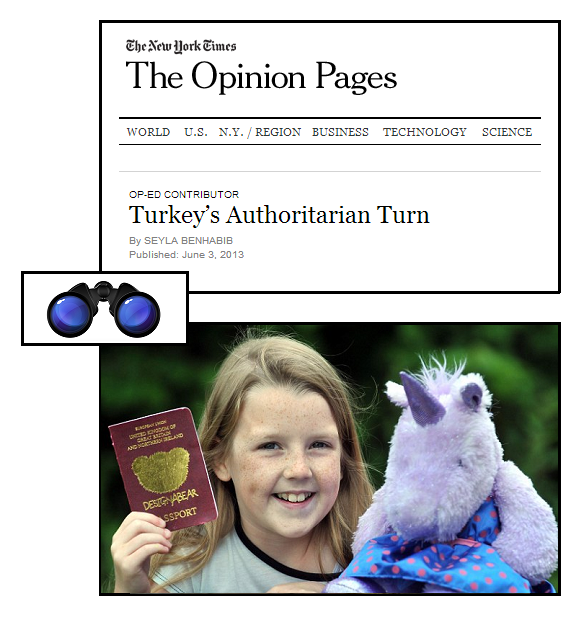
What with the Whole Wired World looking a bit both “1984” and “Brave New” this week, and with Turkey clearly itching to up its rep as an authoritarian state, you might not think this would be the week a Turkish customs official would stamp a unicorn’s passport…

What can I tell you? Someone did. A Turkish customs official allowed this young British girl, Emily Harris, into Turkey by stamping her unicorn’s passport.

**

If I was Recep Tayyip Erdogan — and I’m not, and unlikely yo be any time soon — I might want to give that man a medal for providing the one news item this week favorable to the Turkish tourist trade — at a time when images of tear gassings in hotels and water cannonades in parks can hardly be helping the country’s image as an attractive place to visit.

Seriously — Public Diplomacy, one child’s passport at a time.

And while you’re at it, quit gassing hotels with children in them, will you? It’s barbaric.

Night vision, x-rays – what do we have for the fog of war?

June 17th, 2013

[ by Charles Cameron — it occurred to me to ask ]
.

I have a question for the assembled horde — but first, the shoes:


Getting your feet x-rayed and fitted for a new pair of shoes, ca. 1950

**

You know the way they say (Elizabeth Kübler-Ross, eg, with no implied claim of veracity here, just interest) that you go through various stages of grief: denial, anger, bargaining, depression and acceptance?

Suppose there are stages of response to terror that governments, agencies, leaders, pundits, analysts & journos tend to go though. Suppose at the start they lean to the vengeful and are therefore prone to see things in black and white, no nuance, confrontational, response intense & military rather than diplomatic — and in later stages get calmer, begin to see motives less single-strandedly, catch details previously missed, suggest responses that are more measured, more proportional, etc.

If we got really clear on how this tends to work, could we begin to have an understanding of the ratio between “heat of the moment” and “after the fog of war clears” thinking, which in turn could allow us to discount initial reactions, look for “next stage” signals in the cognitive periphery, and get a more accurate read through the fog from the start?

We know now, eg, that the first reaction at OKC was to expect Muslim blame, but it become clear that McVeigh did it — and first expectations were dashed. With WMD in Iraq the clearing of the fog took longer, but it still happened.

I’m suggesting that people who have just been affronted or attacked will understand better, later, and that for more appropriate response, some time lag may be required. But does the lag time have formal features, styles of assumption that gradually give way identifiably and reliably to more nuance and accuracy as certain formal issues are addressed — so there could be a checklist, and a kind of 2 week, two month, two year, two decade look ahead / lookback methodology devised, charted, and implemented, eg as a part of scenario planning and / or red teaming?

Is some of this implicit in the second O in the OODA loop? Can we take it usefully further?

**

Yes, when I was a boy, you stepped up to the x-ray machine in the shoe store, pushed your feet in and peered into the viewer at the top of the machine to see how well your new shoes fit your ghost-of-a-skeleton feet.

Later on, this was viewed as an unhealthy way to judge the fit of a shoe, and life and choice in shoe stores became more complicated.

Two beauties, or how the mind meanders

June 16th, 2013

[ by Charles Cameron — on the proposition that no topic is more than a link or two away from beauty ]
.

I was butting in on a conversation about terrorism between JM Berger and Suzanne Schroeder — JM had said something about me and I chipped in, one link or tweet led to another, and soon we were at these two images —

The top one is a Magritte-like photo that comes from the mind and eye of Alexandre Parrot, hat tip to El Cid Barett — the second a still from Maya Deren‘s extraordinary film, Meshes of the Afternoon.

**

One beauty for the startled mind; one beauty for the ravished heart…


Switch to our mobile site