zenpundit.com » ISIS

Archive for the ‘ISIS’ Category

Two new collections from Tim Furnish, plus two

Friday, July 31st, 2015

[ by Charles Cameron — a chance to have Tim Furnish’s recent writings in book form, plus a couple of recent apocalyptic issues bcoz apocalypse hasn’t gone away, oh no ]
.

Friend, blog friend and colleague Dr Tim Furnish recently tweeted:

I hope to review these two volumes of Tim’s essays here on Zenpundit.

**

Plus Two:

While we’re on the topic of apocalypse..

Sara A. Carter of the American Media Institute posted on the 28th on USA Today:

Islamic State recruitment document seeks to provoke ‘end of the world’

An apparent Islamic State recruitment document found in Pakistan’s lawless tribal lands reveals that the extremist group has grand ambitions of building a new terrorist army in Afghanistan and Pakistan, and triggering a war in India to provoke an Armageddon-like “end of the world.”

The 32-page Urdu-language document obtained by American Media Institute (AMI) and reviewed by USA TODAY details a plot to attack U.S. soldiers as they withdraw from Afghanistan and target American diplomats and Pakistani officials.

AMI obtained the document from a Pakistani citizen with connections inside the Pakistani Taliban and had it independently translated from Urdu by Harvard researcher and translator Mustafa Samdani. The Pakistani’s identity was shared with USA TODAY, which has agreed not to identify him publicly because of concerns for his safety.
The document was reviewed by three U.S. intelligence officials, who said they believe the document is authentic based on its unique markings and the fact that language used to describe leaders, the writing style and religious wording match other documents from the Islamic State, also known as ISIL and ISIS. They asked to remain anonymous because they are not authorized to discuss the matter publicly.

The undated document, titled “A Brief History of the Islamic State Caliphate (ISC), The Caliphate According to the Prophet,” seeks to unite dozens of factions of the Pakistani and Afghan Taliban into a single army of terror. It includes a never-before-seen history of the Islamic State, details chilling future battle plans, urges al-Qaeda to join the group and says the Islamic State’s leader should be recognized as the sole ruler of the world’s 1 billion Muslims under a religious empire called a “caliphate.”

“Accept the fact that this caliphate will survive and prosper until it takes over the entire world and beheads every last person that rebels against Allah,” it proclaims. “This is the bitter truth, swallow it.”

Retired Defense Intelligence Agency Director Lt. Gen. Michael Flynn, who also reviewed the document, said it “represents the Islamic State’s campaign plan and is something, as an intelligence officer, I would not only want to capture, but fully exploit. It lays out their intent, their goals and objectives, a red flag to which we must pay attention.”

That. friends, is the Ghazwa e-Hind, which we’ve been discussing on occasion here on Zenpundit for several years:

  • http://zenpundit.com/?p=4462
  • http://zenpundit.com/?p=12683
  • http://zenpundit.com/?p=12756
  • http://zenpundit.com/?p=20592
  • http://zenpundit.com/?p=31402
  • http://zenpundit.com/?p=44267
  • Look for Tim Furnish to have more to say about this document and its implications

    **

    And…

    from a Jewish source quoted and discussed in the Times of israel on March 11 this year — yes, I’m playing catch up here — comes an apocalyptic call for two nuclear attacks — with a specific reference to the coming of the Messiah in the final paragraph:

    Op-ed calls on Israel to nuke Germany, Iran<

    Right-wing media outlet Israel National News published an opinion piece Tuesday calling on Israel to launch nuclear bombs at Iran and Germany, only days after the outlet came under fire for publishing a piece accusing a war widow of killing her husband over her pro-peace views.

    In the opinion article published Tuesday, the author claims that only through nuclear annihilation of Iran and Germany, with 20 or 30 nuclear bombs each, can Israelis prevent the state’s destruction.

    “If Israel does not walk in the ways of God’s Bible,” author Chen Ben-Eliyahu wrote in Hebrew, “it will receive a heavy punishment of near complete destruction and doom and only a few will be saved.”

    One of Israel’s missions is to remember the crimes of Amalek, a tribe representative of pure evil in the Bible, whom Jews are commanded to obliterate. Among those descended from the band, the author writes, are Iranian leaders Ayatollah Ali Khamenei, former president Mahmoud Ahmadinejad and current President Hassan Rouhani.

    “They don’t miss an opportunity to discuss the need for the annihilation of Israel,” he wrote.

    To combat this Israel must respond in kind, Ben-Eliyahu declared. “To an existential threat we must respond with an existential threat,” he wrote, “not with speeches in Congress. We must make it clear to the Iranians that Israel will wipe out their nuclear program and Tehran and Isfahan as well.”

    “If [an enemy] rises up to destroy you, rise earlier to destroy him: twenty, thirty nuclear bombs will do to assure the job gets done,” he continued.

    He also called on the Jewish people to remember its near destruction at the hands of the Nazis and exact revenge on Germany, now a staunch ally of Israel.

    When the Messiah comes, Ben-Eliyahu wrote, Israel will reverse the Final Solution. “Twenty, thirty atomic bombs on Berlin, Munich, Hamburg, Nuremberg, Cologne, Frankfurt, Stuttgart, Dresden, Dortmund and so on to assure the job gets done. And the land will be quiet for a thousand years,” he wrote.

    Of note here: The phrase rendered here “If [an enemy] rises up to destroy you, rise earlier to destroy him” is not a remark of Ben-Eliyahu — he is quoting the Babylonian Talmud, Sanhedrin 72a:

    Im ba l’hargekha, hashkem l’hargo

    variously translated “If he come to slay thee, forestall by slaying him<" in the Soncino edition and more colloquially "If someone comes to kill you, rise up and kill him (first)" on the AJC site.

    Iran: The Debate We Should Be Having

    Friday, July 24th, 2015

    By T. Greer

    Major religions in the Middle East
    Image Source: Columbia University’s Gulf 2000 Project

    ——–
    I am not a specialist in arms control or nuclear technology. I must rely on the judgement of others with relevant expertise to assess the viability of the new agreement with Iran. This makes things difficult, for the opinions of experts I trust are divided. Lawrence FreedmanCheryl Rofer, Aaron Stein, and the other folks at Arms Control Wonk all support the deal. Most do so with great enthusiasm.  Thomas Moore and Matthew Kroenig, on the other hand, oppose it with uncharacteristic harshness. Over at the excellent blog Zionists and Ottomans, Michael Koplow sticks to the middle ground. He accepts that the provisions of the JCPOA will successfully deter Iran from developing nuclear weapons, but worries that this focus on Iran’s nuclear program misses the forest for the trees. As he writes:

    It is difficult to see how this deal advances conventional peace and stability in the Middle East over the next decade even as it pushes a nuclear Iran farther away. Contra the president’s assumptions, Iran is almost certainly going to use the money in sanctions relief to continue fighting proxy wars in Syria, Iraq, and Yemen, and continuing its general covert war with the Sunni world, not to mention its sponsorship of terrorism against Israeli and Western targets. By all means celebrate a temporary victory on the nuclear front, but the idea that this will bring peace in our time or stability to the Middle East is ridiculous. The impetus for the deal from the administration’s perspective has clearly been a conviction that Iran is changing socially and politically and that the regime cannot go on forever, and that a nuclear deal will empower moderates, create pressure from below for change, etc. This view is hubristic; I know of nobody who can accurately predict with any type of certainty or accuracy whether and when regimes will collapse, or how social trends will impact a deeply authoritarian state’s political trajectory (and yes, Iran is a deeply authoritarian state, liberalizing society and elected parliament or not). Certainly providing the regime with an influx of cash, cooperation on regional issues, and better access to arms is not going to hasten the end of the mullahs’ rule, so much as I find it hard to condemn the deal entirely because of some clear positives on the nuclear issue, I find it just as hard to celebrate this as some clear and celebratory foreign policy victory. [1]

    Koplow is not the only person to express such concerns. In a thoughtful write up for the Brookings Institute, Tamara Coffman Wittes warns that this deal “will not stabilize a messy Middle East.” Kenneth Pollack’s recent testimony to the House of Representatives explores these themes in even greater detail, and should be required reading for anyone who wants to contribute to these discussions. (And of course, throw-away lines about Iranian plans to destabilize the region have found their way into almost every speech given by those who oppose the deal). [2]

    This is an important turn in the debate. For many the finer points of technical issue like uranium enrichment centrifuges or IAEA enforcement policies have been eclipsed by broad questions about Iran’s role in the regional order. These questions will only became more prevalent  as the newness of this deal wears away with time.

    This is not a conversation Americans are prepared to have. The mental model most American observers–and if their statements are to be taken at face value, American officials–use to make sense of Iran, America’s allies in the region, and America’s role in upholding the regional order are faulty and simplistic. You can see this quite clearly in comments like these:

    Iran’s nuclear program—for obvious reasons—has been the most important issue in that country’s relations with the West, but it is very far from the only issue. Iran remains one of the most prolific state-sponsors of terrorism in the world. It has and will certainly continue to seek hegemony in the Middle East, to deliberately destabilize its neighbors and other states in the region, and to promote ballistic missile proliferation and human-rights abuses throughout the Near and Middle East and beyond.

    Only a comprehensive strategy, led by the United States and supported by our major allies, can neutralize Iran’s malign activities, and this will take time. In particular, that program must take into account the views and interests of U.S. allies in the region, including Israel and those Arab States that understand and fear Iran’s ambitions and capabilities.[3]

    The role played both by Iran and “U.S. allies in the region” is far more complicated than this. Each plays a part in the instability now wrecking the Near East. Like America, Iran’s relationship with other actors in the region is convoluted and sometimes contradictory. By simplifying the region’s geopolitics into a narrow contest of good and evil we do ourselves a great disservice. A more accurate narrative would recognize that there are two separate conflicts  threaten the stability of the Near East. These conflicts are related but distinct. The failure to distinguish between them is the root problem behind much of America’s flawed commentary and confused policy.

    The first of the two contests is the strategic rivalry between Iran and her regional enemies, Israel and the Saudi led Gulf Cooperation Council (GCC). As with the great geopolitical contests of the last century, this rivalry has a hard ideological edge that makes compromise difficult. However, the ambitions of its central players fall squarely within the realm of traditional power politics. The roles each claim are as old as Thucydides, with today’s Persians playing the part of rising challenger to the existing order, and their opponents acting as its main defenders. This is a war of the shadows, waged through sabotage, assassination, espionage, terrorism, and the occasional full blown insurgency. The instability caused by American intervention in Iraq and the Arab Spring has raised the stakes of this competition. Now Tehran and Riyadh both desperately scour the region, ever seeking some new opportunity to tilt the balance of power in their favor.  It is the civilians of the smaller powers caught in the middle that suffer most. That is where the proxy campaigns are fought. For the most part it is also where they end.  But just below the surface remains the constant fear that these endless maneuvers in the shadows might lead to open war in the light.

    It is to prevent such a war that analysts like Mr. Pollack—whose testimony to congress I urged you to read above—favor a strong U.S. presence in the region. This has been the traditional role of the United States since the ‘80s, with America acting as a guarantor of sorts of the existing order. Under such conditions Iran and the United States are natural enemies. When upstart dictators like Saddam Hussein don’t call attention to themselves, “maintain the regional order” is short hand for holding back the tide of Persian hegemony. It is important to realize, however, that no matter how hostile Iran and its proxies may be towards America, their power to harm American citizens and servicemen will always be proportional to how invested America is in the region. This was Ronald Reagan’s central insight when he ordered the withdrawal of American troops from Lebanon in 1984. Americans are only a target in the shadow war if they decide to participate in it.

    This does not hold true for the second conflict that roils the Near East. (more…)

    Actions speak louder than.. ahem, narratives

    Monday, July 20th, 2015

    [ by Charles Cameron — pondering the use of narratives to “counter violent extremism” ]
    .

    I’m pondering the use of narratives to “counter violent extremism”, and have been thinking about letting this post consist of its title and the government-sponsored words:

    This Page Intentionally Left Blank

    I’m hoping this post will find its place in the comments section, in other words. If the opposing party — whether that means, effectively, IS, salafist-jihadis, the Ikhwan, or Islamists in general — pushes a narrative about US actions towards the Islamic world, can a narrative alone succeed at pushing back? What actions can we show that refute the simple form of that narrative? What actions might we take in future that would appear to affirm it? To refute it?

    Are we so busy thinking about counter-narratives that we allow our actions to undercut our words?

    **

    Come to that, is the appeal of IS really its apocalyptic theology (which is what I mostly address), its success as a military force (which may be down to the presence of ex-Baathist military in high positions of command), its critique of US policy in respect of the Islamic world (dictatorships included), the prospect of adventure (and perhaps concubines?) in foreign lands, or, as Prof Andrew Silke would have it, altruism?

    The key message is that you have got to see the terrorists as they see themselves if you genuinely want to understand why people are getting involved. If you talk to terrorist themselves, they portray themselves as altruists – they see themselves as fighting on behalf of others, whether it’s the IRA fighting on behalf of the Catholic community in Northern Ireland, or if it’s Islamic State fighting on behalf of the Muslim ummah.

    **

    I suspect there’s a lot to be said here, and the floor is open. I’m eager to hear your voices..

    The Boston IS and Apocalyptic Conference

    Thursday, July 16th, 2015

    [ by Charles Cameron — I was (unexpectedly) almost totally deaf at the time, so the videos of the conference allowed me a second go-around, for which I’m profoundly grateful ]
    .

    CMS Landes 602
    Richard Landes, opening the Boston conference

    **

    With what I hope will turn out to be the wisdom of a fool, I am going to propose the importance of (a) Richard Landes‘ now defunct Center for Millennial Studies at Boston University, and (b) its recent resurgence as a single and singular conference on Apocalyptic Hopes, Millennial Dreams and Global Jihad.

    Bear with me, I’m an enthusiast.

    **

    Gregory Bateson died thirty-five years ago July 4th, the day I started writing this post — a fact I only know because I’m inclined to associate the Boston Conference as one of the great cross-disciplinary and initially underestimated conferences alongside the early Macy conferences on Cybernetics, in which Gregory Bateson was so significant a partner — or the seminal Eranos Conferences attended by the friends of CG Jung.

    The Macy conferences ushered in the computer age, the Eranos conferences celebrated the highest level of cross-cultural and cross-disciplinary exchanges between psychologists, philosophers, religious scholars and physicists — while the Millennial Studies conferences focused on a studiously ignored area of knowledge that has swung into heightened significance via the arrival on scene of Al-Qaida and the Islamic State.

    **

    Participants, Macy and Eranos:

    The Macy Cybernetics Conferences included such participants as William Ross Ashby, William Grey Walter, Kurt Lewin, J. C. R. Licklider, Warren S. McCulloch, Margaret Mead, Oskar Morgenstern, F. S. C. Northrop, Walter Pitts, I. A. Richards, Claude Shannon, Heinz von Foerster, John von Neumann, and Norbert Wiener.

    The Eranos Conferences included presentations by Carl Gustav Jung, Rudolf Otto, Mircea Eliade, Wolfgang Pauli, Karl Kerényi, Erich Neumann, Henry Corbin, G van der Leeuw, Louis Massignon, Gilles Quispel, Hellmut Wilhelm, Hugo Rahner, Erwin Schrödinger, Gershom Scholem, Heinrich Zimmer and Martin Buber.

    In each case, the ideation was intensely and deliberately cross-disciplinary, and the importance of the series of conferences only widely apparent at a later date.

    **

    Participants, Center for Millennial Studies:

    In the case of the Boston conference on Apocalyptic Hopes, Millennial Dreams and Global Jihad, the series in whicb it partakes is that of the new defunct Center for Millennial Studies, an extraordinary organization which studied millennial movements from the Dead Sea Scrolls via the Taiping Rebellion (20-30 million dead), and the Siege of Mecca (1979 CE), to Aum Shinrikyo, Waco and Y2K — with implications for future events at least as far as the 2000th anniversary of the crucifixion in the 2030s and the start of the next Islamic century in the 2070s.

    Among the attendees at this year’s conference were Richard Landes, William McCants, Graeme Wood, Timothy Furnish, Cole Bunzel, Jeffrey M. Bale, myself, David Cook, JM Berger, Itamar Marcus, David Redles, Paul Berman, Charles Strozier, Brenda Brasher, Mia Bloom and Charles Jacobs. Husain Haqqani was expected to attend and intended to speak about the Ghazwa e-Hind but couldn’t make it, and Ayaan Hirsi Ali cancelled her appearance for security reasons as a result of the Garland, TX, shooting the day before.

    Speakers at previous CMS conferences included, in additiopn to some of the above, Steven O’Leary, Michael Barkun, Albert Baumgarten, Chip Berlet, Bruce Lincoln, Moshe Idel, Michael Tolkin, Gershom Gorenberg, Damian Thompson and Robert Jay Lifton.

    **

    You can see the entire series of CMS 2015 Conference videos

  • here
  • In particular and given my own special interests, I recommend the talks by

  • Will McCants (on IS eschatology)
  • Cole Bunzel (on the 1979 Mahdist assault on Mecca), and
  • David Cook (on Islamic apocalyptic and Boko Haram)
  • You can follow those up with such friends and worthies as Tim Furnish, JM Berger, and (on Palestinian messaging) Itamar Marcus — Itamar’s brilliant presentation shifted my thinking on the Israeli-Palestinian question by about ten degrees.

    My own contribution is

  • here
  • **

    My recent discombobulations (see previous post) and an over-busy writing schedule have prevented me from posting separately on each of the talks at the conference, which I had hoped to do — but McCant’s forthcoming book will soon be with us, and this brief introduction (and my three reading lists) will hopefully provide background while we await it.

    The book I brought with me, for (heh!) light reading, was A. Azfar Moin‘s The Millennial Sovereign: Sacred Kingship and Sainthood in Islam. Path-breaking, scholarly, intelligent, unfailingly curious, written with grace — a true delight!

    Jabhat al-Nusra rebukes Islamic State for killing Alan Henning

    Friday, July 10th, 2015

    [ by Charles Cameron — I hav to say, the senseless death of Alan Henning makes me very sad ]
    .

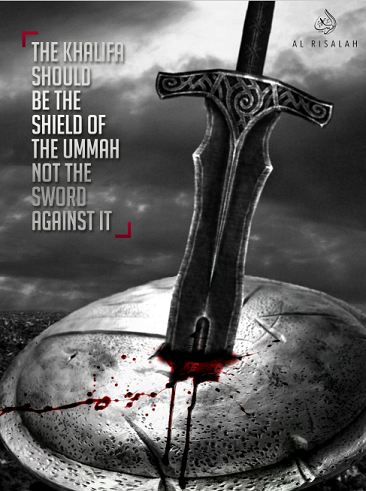
    In the first issue of its magazine, al-Risalah, Jabhat al-Nusra attacks al-Baghdadi’s supposed caliphate.

    Jabhat al Nusra vs IS

    The item that caught my eye, though, was a section in the article Khilafa One Year On titled The Murder of Alan Henning. We read:

    Next, we have the murder of Alan Henning, a forty-seven year old British humanitarian aid worker in Syria, who was abducted by the ‘Islamic State’ and beheaded on camera. Although he was a disbeliever, we mention his case here because he was under the protection of the Muslims. Abu Salaam al-Britani, an aid worker who worked alongside Henning, pleaded to Baghdadi to have him released:

    “I appeal and request in general to all of the members of ad-Dawlah al-Islamiyyah and specifically to Shaykh Abu Bakr al-Baghdadi and Abu ‘Ali al-Anbari to release Alan Henning as he had been given an Amana (security) from two sets of believing parties. Henceforth in the light of the Shari’ah he is considered a Mu’ahid and it is impermissible to harm him…”

    A footnote at this point leads us to Al-Britani’s A personal account of Alan Henning and the covenant of security (Amana) afforded to him by Muslims, in which we read the full version of al-Britani’s appeal. Following a detailed account of this “wonderful man called Alan Henning”, he writes:

    From your brother in Islam Abu Salaam al-Britani,

    I appeal and request in general to all of the members of ad-Dawlah l-Islamiyyah and specifically to Shaykh Abu Bakr al-Baghdadi and Abu ‘Ali al-Anbari to release Alan Henning as he had been given an Amana (security) from two sets of believing parties henceforth in the light of the Shari’ah he is considered a Mu’ahid and it is impermissible to harm him.

    The first Amana was given by me and the rest of the brothers travelling in the aid convoy. We reassured and informed Alan he will be safe and not harmed as he is with a group of Muslims who are going deliver aid to the people of Syria.

    The second Amana was given by indigenous people of ad-Dana they had sent several men to escort us once we entered Syria through the Bab al-Hawa border crossing. They assured us all we will be under their protection and escorted us to the town of ad-Dana.

    I ask you by Allah to honour these covenants as our Lord said in the Qur’an

    “O you who believe, honour your covenant (‘uqud)”

    [Surat Al-M?’idah, Ayah 1]

    The Prophet (peace and blessings of Allah be upon him) also said:

    “If anyone kills a ‘Mu’ahid’ ‘i.e. a person guaranteed protection’ without a just cause, Allah will prevent him from even smelling the fragrance of Paradise”.

    [Sahih Sunan an-Nasai No .4422].

    The Prophet (peace and blessings of Allah be upon him) also said:

    “On the Day of Judgment, I will be protesting against anyone who oppresses a ‘mu’ahid’ ‘i.e. a person guaranteed protection’, belittles him, charges him to do things beyond his ability, or extorts anything from him.

    [Sahih Sunan Abi Dawud, No. 2626]

    Any Muslims is entitled to give protection on their behalf, and that this type of protection can be given to the non-Muslim by any individual from the Muslims whether a male or a female, a nobleman or a poor, a righteous or an evil-doer.

    Ash-Shaybani said in as-Siyar, vol.1, pg.175:

    “The security covenants that a free Muslim man, whether virtuous or immoral, gives are binding to all the other Muslims because of the Hadith, “Muslims are equal in respect of blood. They are like one hand over against all those who are outside the community. The lowest of them is entitled to give protection on their behalf.” The meaning of “protection” is the security covenant whether it is temporary or permanent.

    Zaynab, the daughter of the Messenger of Allah (peace be upon him), granted protection to her husband Abu al-‘As bin Rabi’ah, and the Prophet (saw) approved of her protection.

    It was reported that Umm Hani said:

    “I granted asylum to two non-Muslim relatives of mine, and then Ali bin Abi Talib (may Allah be pleased with him) came upon them to kill them. So I told him, you are not going to kill them unless you kill me first! Then, I locked my door on them and went to the Messenger of Allah (saw) and told him about what happened.

    He (saw) said: “Ali is not allowed to kill them. We grant asylum and protection to the ones you have granted asylum and protection.

    Considering the powerful significance of Ali bin Abu Talib — born in the Kaaba, the son-in-law and cousin of the Prophet, distinguished at the Battle of Badr and subsequent battles, victor in his duel with Amru ibn Abd Wudd, fighter with the sword Zulfiqar of whom it was said, “There is no brave youth except Ali and there is no sword which renders service except Zulfiqar”, named “Lion of God” by the Prophet, fourth of the Rashidun Caliphs and also first Imam of the Shiites — this last is indeed a powerful citation.

    I don’t intend to draw any conclusions here, just to say that this reminds me of OBL’s reproof of Faysal Shahzad in his letter to Atiyya, which I discussed in my post, Key bin Laden para raises translation and other questions.


    Switch to our mobile site