zenpundit.com » IS

Archive for the ‘IS’ Category

ISIS, bridal and burial veils, Rilke

Monday, July 17th, 2017

[ by Charles Cameron — some non-Islamic (archetypal) context for a jihadist’s bride receiving a suicide belt as a wedding gift ]
.

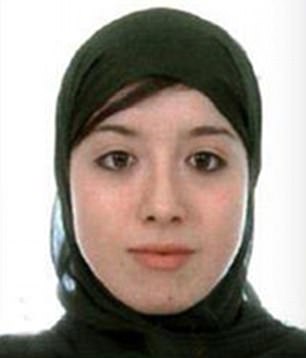
Asia Ahmed Mohamed, 26 (left), was given a suicide belt as dowry by her jihadi husband Mohammed Hamdouch – Daily Mail
**

The unfortunate King Admetus, who had shown great hospitality to Apollo when the latter was banished from Olympus for nine years, was gifted by the spinners of fates with an extended lifespan — provided a substitute was found at the time death came to claim him.

Death came for Admetus, and in the great poem that Rainer Maria Rilke wrote, after his father, mother and closest friend have each refused the chance to save Admetus’ life at cost of their own — Admetus’ loving wife Alcestis steps forward to offer herself..

Here Rilke describes her inner state:

No one can be his ransom: only I can.
I am his ransom. For no one else has finished
with life as I have. What is left for me
of everything I once was? Just my dying.
Didn’t she tell you when she sent you down here
that the bed waiting inside belongs to death?
For I have taken leave. No one dying
takes more than that. I left so that all this,
buried beneath the man who is now my husband,
might fade and vanish–. Come, lead me away,
already I have begun to die, for him.

**

The young, free, wild woman, the Artemis in every young bride, loses not just her father’s name but her identity, her life even, at the moment of marriage: the more sober, adult, bound woman, the wife, succeeds toi her flesh and days.

This theme, in which the (presumably white) bridal veil is seen to imply the (presumably black) burial veil, is a central strand in Greek tragedy, not just in Euripides ALcestist, from which Rilke drew his narrative, but in all three great tragedians, as Rush Rehm shows in his book, Marriage to Death: The Conflation of Marriage and Funeral Rituals in Greek Tragedy:

The link between weddings and death — as found in dramas ranging from Romeo and Juliet to Lorca’s Blood Wedding–plays a central role in the action of many Greek tragedies. Female characters such as Kassandra, Antigone, and Helen enact and refer to significant parts of wedding and funeral rites, but often in a twisted fashion. Over time the pressure of dramatic events causes the distinctions between weddings and funerals to disappear. In this book, Rush Rehm considers how and why the conflation of the two ceremonies comes to theatrical life in the tragedies of Aeschylus, Sophocles, and Euripedes.

**

Oh yes, and here’s Santa Muerte as Death Bride:

Regarding Santa Muerte, here’s R. Andrew Chesnut‘s abstract for his book, Devoted to Death: Santa Muerte, the Skeleton Saint:

Although condemned by mainstream churches, this folk saint’s supernatural powers appeal to millions of Latin Americans and immigrants in the U.S. Devotees believe the Bony Lady (as she is affectionately called) to be the fastest and most effective miracle worker, and as such, her statuettes and paraphernalia now outsell those of the Virgin of Guadalupe and Saint Judetwo other giants of Mexican religiosity. In particular, the book shows Santa Muerte has become the patron saint of drug traffickers, playing an important role as protector of peddlers of crystal meth and marijuana; DEA agents and Mexican police often find her altars in the safe houses of drug smugglers. Yet Saint Death plays other important roles: she is a supernatural healer, love doctor, money-maker, lawyer, and angel of death. She has become without doubt one of the most popular and powerful saints on both the Mexican and American religious landscapes.

In Santa Muerte we see the conflation of wedding and funeral alive and well in 21st century Mexico — and rippling out into the wider world.

**

That’s pretty much the cross-cultural context against which I understand a Jihadist’s bride given SUICIDE BELT as wedding gift:

Asia left Spain for Syria in March 2014 where she married Hamdouch, also known as Kokito de Castillejos, ‘the decapitator of Castillejos.’

During the ceremony, the terrorist gave his wife a belt of explosives. They had a son.
In which one might look to Boko Haram for a suitable husband?

Sunday, June 25th, 2017

[ by Charles Cameron — oy, there’s nuance, even among one’s enemies ]
.

Consider:

The media’s portrayal of jihadi groups’ horrific rule in the Sahel is a double-edge sword in the fight against these armed movements. On the one hand, their typical coverage provides a classic and possibly efficient form of war propaganda, which calls for unity against the common enemy.

But on the other hand, the depiction of Islamist presence and political influence as unequivocally oppressive misses some critical points: namely, the jihadis’ interest in managing their use of coercion rather than just unleashing it; and their ambition to govern aspects of life through both violent and non-violent ways, sometimes in accordance with local customs.

That’s what you’ll find under the subhead Easy narratives vs. difficult thinking in an African Arguments post titled Mali: The stoning that didn’t happen, and why it matters. That’s almost a disappointing headline, isn’t it? I mean, what? — was there nobody there who was without sin to cast the first stone?

**

The idea that there was a stoning — in Mali, which I for one have never visited and was not even remotely thinking about until that headline popped up in my news feed — had a sort of immediate appeal, a frisson, of the type that characterizes clickbait. So I clicked.

Stonings, however, are abhorrent in my culturally conditioned view, and it’s fairly convenient for me to abhor them at a distance when indulged in by those I like to think of unkindly, the damn jihadists.

The thing of it is, there was no stoning.

That’s a hard thing to report, however. Breaking news — no stoning occurred near Aguelhoc in northern Mali — Christiane Amanpour reports!

Reporting that there has been a stoning, on the other hand, by jihadists — those damn jihadists — that’s not only easy to report, it’s welcome news. Somehow. Despite, or perhaps because of, our abhorrence of stoning — as a punishment for adultery — by, and this is the final twist in our abhorrence, those jihadists.

That’s welcome news, even if stoning is unwelcome, as are jihadists, and even if there was no stoning, despite them.

**

Even if sharia law is not the monolith we tend to think it is — and, returning to that African Arguments post — specifically to those punishments “which are mandated and fixed by God and are applicable in cases of fornication, apostasy etc”:

Questions over these penalties (known as had, plural hudud) were debated at length in 2012 when allied Islamist movements occupied Mali’s three main northern regions: Al-Qaeda in the Islamic Maghreb (AQIM) in Timbuktu; the Movement for Unity and Jihad in West Africa (MUJAO) in Gao; and Ansar Eddine in Kidal.

At that time, judiciary decisions were delegated to local Islamic judges (cadis). Crucially, there were many differences in the application of hudud across these three regions. For instance, there were multiple cases of amputations for robbery in Timbuktu and Gao. But in Kidal, Ansar Eddine agreed with local Islamic judges that sentences would be maintained in line with local customs that historically prefer detention over physical punishment.

Oops. As the writers go on to note, there was actually one stoning for adultery in Aguelhoc in 2012, though the one-time leader of the Ansar, Iyad Ag Ghaly, apparently didn’t know about it. And:

Such complexities and variations between regions supposedly governed by the same Shariah provisions demands additional investigation. Why would hudud, a pillar of political and social legitimation across jihadi movements, be suspended in some places but not others?

**

Okay, now I don’t really know who the Ansar are, and if you’d told me they are Malian jihadis and Iyad Ag Ghaly is or was their leader, I wouldn’t off the top of my head imagine he would disfavor huhud pubishments — as mandated by Allah — in favor of detentions.

But Boko Haram.

I’ve heard of Boko Haram, they don’t like western education, and they abducted the Chibok and other girls, marrying some and selling others into sexual slavery, if that’s a valid distinction. They too are, in a word, abhorrent.

And then I read this, in the same article:

In the Lake Chad area, several organisations – including The International Crisis Group – have documented that a significant number of young Kanuri women have voluntarily joined Boko Haram in order to find a suitable husband or benefit from new economic opportunities. For some women living in particularly impoverished rural areas, joining the jihadi insurgency may be more attractive, at least to start, than their daily routine in the strict patriarchy of rural villages.

The idea of members of Boko Haram as suitable husbands somehow hadn’t occurred to me. But then I’m not a young woman, nor even a local.

**

If what I’ve written thus far interests you, I’d encourage you to read the whole article. There was no stoning in Aguelhoc, despite the reports in Agence France-Press (reporting from Bamako) and Radio France Internationale (reporting from Paris), picked up by Le Monde and The Guardian.

In sum:

Most media accounts depict an unequivocal reign of terror under Islamist rule in northern Mali. But field interviews reveal a more ambiguous situation in which egregious violence by radical groups coexists with a non-violent governance agenda and willingness to deliver services.

In central Mali, jihadi movements forcibly gather local population to preach. They also regularly assassinate those perceived to be collaborating with state officials and foreign armed forces. But at the same time, these groups provide mobile justice courts in places where judges have long been absent. They advocate for the suppression of land rights that benefit a tiny and contested aristocracy. They offer much-needed protection to cattle herders during seasonal migrations. And the simplified marriage procedures they impose allow youths to escape elder’s control over marital engagements.

How much simpler the world is, if we see it from a distance.

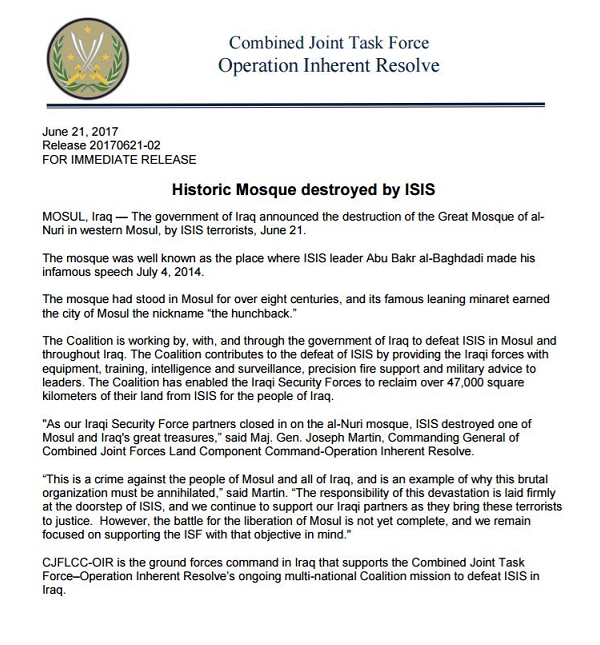
On the Night of Power, in Mosul

Thursday, June 22nd, 2017

[ by Charles Cameron — figurative self-destruction by ISIS at the Nuri Mosque in Mosul ]
.

**

**

**

Will McCants comes closest to my own sense of the business with his invocation of symbolism and his words “self-inflicted decline” — this is an ouroboric moment, the (yes, self-inflicted) death of the birthplace of ISIS, a homecoming with a vengeance.

**

ISIS denies responsibility:

**

Indeed, the Atlantic has a piece titled Who Blew Up Mosul’s Al-Nuri Mosque? — but points out that ISIS might prefer its founding edifice destroyed to its certain capture and propaganda use against it:

New York Times reporter Rukmini Callimachi notes ISIS has not shied away from using mosques for battle purposes, and suggests its destruction could be aimed at preventing coalition forces from taking control of it themselves — a move that could be of symbolic importance given the landmark’s role in the self-proclaimed caliphate’s founding.

And there we go again — “the self-proclaimed caliphate” — ouroboric from start to finish.

**

All this takes place on, of all nights, the Night of Power!

Gartenstein-Ross on ISIS and Iran

Wednesday, June 7th, 2017

[ by Charles Cameron — sometimes a flurry of tweets can be the thing itself — see also today Michael Kenney on al-Muhajiroun ]
.

Here you go — Daveed as recommended by Phillip Smyth just now: today

Assuming that ISIS was behind the Tehran attack, as it has claimed, I have a few observations.

1) Attacking Iran differentiates ISIS from al-Qaeda. AQ has probably wouldn’t attack Iran due to the contours of the AQ/Iran relationship. Similarly, ISIS propagandized against the Taliban by arguing that they wouldn’t fight Pakistan, while ISIS was killing Pakistani soldiers. So there’s an obvious propaganda play ISIS can make here for a Sunni audience, parallel to its earlier Pakistan propaganda.

2) Iran is at the forefront of pushing ISIS’s caliphate back. So this is similar to other ISIS attacks against coalition countries. Nor is it clear that ISIS is concerned about provoking Iran: They already have provoked Iran. It’s fighting them on the ground now.

3) Wild card possibility: Unlikely, but could ISIS be making a play for Sunni state support, similar to what al-Qaeda gets? There are various reasons that I would bet against this, but I would put it on the table as a possibility, however remote.

Mindanao: Curse, bless, me now with your fierce tears, I pray.

Sunday, June 4th, 2017

[ by Charles Cameron — witnessing the darkness, and the light shining in darkness ]
.

Curse and blessing, simultaneously, might be termed a mized blessing, ne?

Our understanding of Islam in relation to Christianity may be enhanced by a telling of the cursed, blest hehavior of Muslims in Mindanao, during the evacuation of the city of Marawi: curse and blessing are inextricably intertwined, the light shineth in darkness; and the darkness comprehended it not, the light shineth in darkness..

**

Philippine sectarian bloodshed unites Muslims and Christians
Despite Islamist militants’ attempts to cause division, their violence has prompted selfless interfaith compassion

[ .. ] Islamist militants in black masks were stationed on bridges – the only way out of the besieged city of Marawi – looking for Christian hostages. A priest had already been kidnapped. Risking his own life, a local Muslim leader had hidden dozens of Christians in a rice mill.

“He was giving them an orientation,” said the city’s bishop, Edwin de la Peña. “How to respond to questions, to recite prayers, to wear their veils, how to say assalamu alaikum (peace be upon you).”

The plan worked, but others were not so fortunate, de la Peña said. “When they were asked if they were Christians, they said yes readily. So they were pulled out. And we just heard that they were killed and thrown down into a ravine.”

Residents of Marawi, on the Mindanao island of the Philippines, were fleeing a surprise takeover by fighters claiming to be Islamic State supporters. They left a burning cathedral and corpses in their wake.

Stories such as these of brutal sectarian bloodshed, but also selfless interfaith compassion, have rippled across the Philippines.

Muslims protect Christians under attack from Isis-linked group as they flee Marawi
“We had a tip from the general commander that we should go out,” said Leny Paccon, who gave refuge to 54 people in her home, including 44 Christians

More than 160 civilians walked out of the besieged Philippines city of Marawi just after dawn on Saturday, deceiving Islamist fighters they encountered by hiding the identity of the many Christians among them. [ .. ]

“We saved ourselves,” said Norodin Alonto Lucman, a well-known former politician and traditional clan leader who sheltered 71 people, including more than 50 Christians, in his home during the battle that erupted on 23 May in the town of more than 200,000 on the southern island of Mindanao. “There’s this plan to bomb the whole city if Isis don’t agree to the demands of the government,” he said, referring to local and foreign fighters who have sworn allegiance to the ultra-radical Islamic State. [ .. ]

“We had a tip from the general commander that we should go out,” said Leny Paccon, who gave refuge to 54 people in her home, including 44 Christians. “When I got the text, immediately we go out … about 7 o’clock.”

By then, Lucman and his guests had begun their escape march from another area, holding white flags and moving briskly.

“As we walked, others joined us,” he told reporters. “We had to pass through a lot of snipers.”

Some of the civilians were stopped and asked if there were any Christians among them, said Jaime Daligdig, a Christian construction worker.

“We shouted ‘Allahu akbar’,” he told Reuters, adding that thanks to that Muslim rallying cry they were allowed to pass. [ .. ]

Christians have been killed and taken hostage by the militants, a mix of local fighters from the Maute Group and other Islamist outfits, as well as foreigners who joined the cause under the Islamic State banner. [ .. ]

Lucman said that many of those trapped were on the verge of starvation, which also gave them the courage to leave.

**

many of those trapped were on the verge of starvation, which also gave them the courage to leave.

There’s a close and provocative analogy there to the idea that darkness brings out the light, ne?


Switch to our mobile site

