zenpundit.com » media

Archive for the ‘media’ Category

Pussy Riot V: Kasparov

Tuesday, August 21st, 2012

[ by Charles Cameron — the Garry Kasparov arrest ]
.

It isn’t chess. It isn’t, as we’d say in England, cricket. It besmirches the good name athletes like Arsen Galstyan brought Russia in the London Olympics.

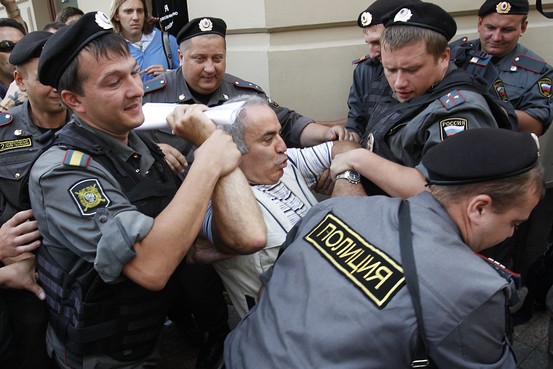
It is Garry Kasparov, arrested for protesting the trial of Pussy Riot.

photo credit: Reuters

.

In yestrdays Wall Street Journal, under the title When Putin’s Thugs Came for Me, Kasparov — Russia’s one-time youngest ever undisputed World Chess Champion — wrote:

The men refused to tell me why I was being arrested and shoved me into a police van. When I got up to again ask why I had been detained, things turned violent. I was restrained, choked and struck several times by a group of officers before being driven to the police station with dozens of other protesters. After several hours I was released, but not before they told me I was being criminally investigated for assaulting a police officer who claimed I had bitten him.

It would be easy to laugh at such a bizarre charge when there are already so many videos and photos of the police assaulting me. But in a country where you can be imprisoned for two years for singing a song, laughter does not come easily. My bruises will heal long before the members of Pussy Riot are free to see their young children again. In the past, Mr. Putin’s critics and enemies have been jailed on a wide variety of spurious criminal charges, from fraud to terrorism.

But now the masks are off. Unlikely as it may be, the three members of a punk band have become our first true political prisoners.

**

If it was chess, here’s what we’d have to call it: a knight hustled into a van by pawns.

Glenn Greenwald misses target, hits good guys

Friday, August 17th, 2012

[ by Charles Cameron — I pretty much follow the people I follow because I learn from them, and that builds trust and friendship ]
.

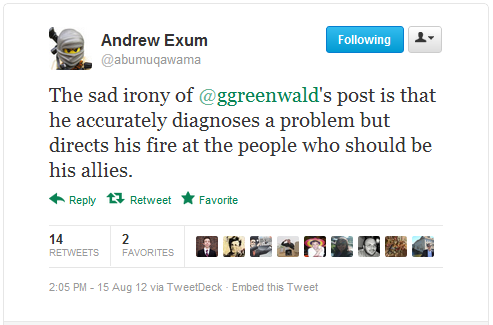
Exum nails it.

I mean, I can well imagine there are some phony “experts” on terrorism out there, but Glenn Greenwald hasn’t done his homework and misfires. Let me explain.

**

I don’t know about you, but I sometimes think the words that someone ends a book with are kinda significant. They’re the ones that give you the impression the author wants to leave you with. That’s partly why I go on and on at such length about the final hundred pages of Abu Musab al-Suri‘s Treatise being devoted to an exposition of apocalyptic hadith with strategic application.

So when Daveed Gartenstein-Ross writes an entire book arguing that al-Qaida’s strategy is to defeat the US by draining its economy – fair enough, given that bin Laden himself said he was continuing a policy of “bleeding America to the point of bankruptcy” – it should come as no surprise when Gartenstein-Ross closes his book with the following words:

When we are facing a crushing national debt, the interest payments for which are projected to eclipse our current defense budget by 2019, we cannot afford to overreact to every terrorist threat and to intervene in every conflict.

The course to maintaining American power in the twenty-first century begins with conserving our resources. And this must be as true of our counterterrorism and military efforts as it is of any other segment of the federal budget.

Likewise, when someone writes a 30-page analysis of the FBI’s infiltration of the Patriot movement, as JM Berger did in his report on PATCON for the New America Foundation, it’s hard to imagine that he’s solely concerned with Islamic terror. Indeed, Berger was researching the “Aryan Republican Army” at least as far back as 2006, when he posted Richard Guthrie’s Suicide: New Details Of ‘Aryan’ Bank Robber And OKBOMB Suspect’s Death In Prison; more recently, he published a piece about the Turner Diaries and today’s Patriot movement in the Daily Beast in June of this year.

**

It’s curious, then, and sad, that these are the two people that Glenn Greenwald specifically picks out by name and photograph to attack in his final, ill-informed piece for Salon, The sham “terrorism expert” industry, writing:

Gartenstein-Ross’ entire lucrative career as a “terrorism expert” desperately depends on the perpetuation of the Islamic Terror threat.

of the fellow who wrote:

we cannot afford to overreact to every terrorist threat

and similarly:

he spends his time doing things like shrieking about the Towering Menace of Anwar al-Awlaki and generally hopping on whatever Muslim-Terrorism-is-a-Grave-Danger train that comes along.

about the fellow who has been tracking many forms of US native terror – including all those mentioned in his piece, A Nation of Spies and Snitches in Foreign Policy in May of this year:

And it isn’t just about Muslims, or even terrorism. In recent months, informants and undercover agents have played a key role in criminal cases involving anarchists in Ohio associated with the Occupy movement and right-wing extremists in Georgia, Arizona, and Michigan

**

Greenwald has gotten this same sort of thing wrong at least once before, when he pilloried Will McCants. Greenwald had written:

I had a somewhat lengthy debate on Twitter last night about the Awlaki assassination with several people often identified as “Terrorism experts” — such as Will McCants and Aaron Zelin — and they and others (such as Andrew Exum and Robert Farley) objected rather vigorously when I said I found the entire concept of “Terrorism expert” to be invalid, as it is a honorific typically assigned due to ideology and interests served rather than actual expertise.

Ouch.

Exum neatly skewered him that time, too, albeit at greater length, writing:

Second, let me consider the case of my friend Will McCants, who Greenwald very much picked on in his Twitter feed along with Aaron Zelin (who I do not know well but who seems really smart in his own right). Greenwald is correct that the decade after the September 11th attacks created all kinds of incentives for self-proclaimed terrorism “experts” to rise to the fore, hawking their “expertise” and opinions on both the consulting market as well as in the mainstream media. Too often, this expertise has been ignorant or barely concealed Islamophobia. Ironically, though, one of the scholars who has done the most to condemn what he calls “CT hucksters” is Will McCants. Will is one of the more rigorously credentialed scholars studying violent Islamist extremist groups as well as being one of the most careful. Will fell into a study of terrorism after doing a Ph.D. in Near Eastern Studies at Princeton. He had no initial academic training in strategic studies or military affairs as far as I know, but his Arabic and understanding of the intellectual currents of political Islam made him ideal to work on al-Qaeda as a case study. And just like I started a dissertation on Hizballah with a background in Middle Eastern Studies and boned up on the theories related to small wars and insurgencies as I went along, so too did Will with respect to terrorism as a phenomenon. At the end of the day, Will is best described as an Arabist, perhaps, but if he is not a bona fide terrorism expert as well — again, no scare quotes necessary this time — I don’t know who is.

History may not repeat, but Greenwald seems to.

The equivalent skewering this time around can be found in Foreign Affairs — in Dan Trombly‘s What’s Glenn Greenwald’s Problem?

**

[ Saving grace note: I don’t think it quite admits me to the clique, but I’ve exchanged emails or tweets with all four of the people Greenwald mentioned with less than due diligence, and consider each of them “virtual acquaintances” and in some cases “friends” ]

For Klan read Islam?

Tuesday, August 14th, 2012

[ by Charles Cameron — headlines, McVeigh, mea culpa, Breivik, media, guessing games and blame, puns, great tweet ]
.


.

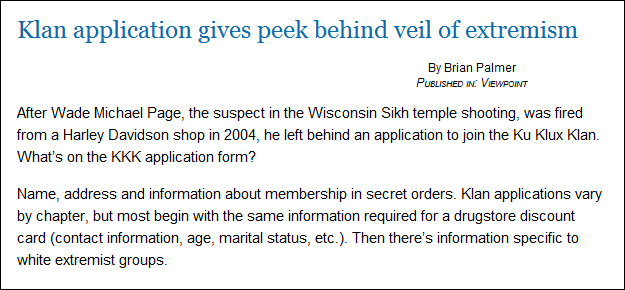
That’s yesterday’s Charlotte Observer‘s headline and opening paras for an article they reposted from Slate, which had more cautiously titled it What’s on a Ku Klux Klan Membership Application?

We’ll come back to that headline later.

**

Okay, seriously.

Educated guesses can prove wrong in retrospect. Educated guesses can lay considerable blame. Educated guesses can have pernicious side effects.

When a bomb ripped through the Federal building in Oklahoma City, many people’s first reaction — including my own — was that it was probably the work of Al-Qaida “Muslim terrorists”.

The media initially broadcast the “Islamist” theory of the bombing quite extensively, and one of the results, according to Penny Bender Fuchs in an American Journalism Review piece titled Jumping to Conclusions in Oklahoma City? was:

A Muslim woman who suffered a miscarriage in her Oklahoma City home said she was afraid to seek medical attention because a crowd of people was throwing stones at her house.

Two more clips from that article:

Within hours of the bombing, most network news reports featured comments from experts on Middle Eastern terrorism who said the blast was similar to the World Trade Center explosion two years earlier. Newspapers relied on many of those same experts and stressed the possibility of a Middle East connection.

The Wall Street Journal, for example, called it a “Beirut-style car bombing” in the first sentence of its story. The New York Post quoted Israeli terrorism experts in its opening paragraph, saying the explosion “mimicked three recent attacks on targets abroad.”

“We were, as usual, following the lead of public officials, assuming that public officials are telling us the truth,” says John R. MacArthur, publisher of Harper’s magazine and author of a book on coverage of the Persian Gulf War. He believes the media overemphasized the possible Middle Eastern link and ignored domestic suspects because initially the police were not giving that angle much thought.

“Reporters can’t think without a cop telling them what to think,” MacArthur says. “If you are going to speculate wildly, why not say this is the anniversary of the Waco siege? Why isn’t that as plausible as bearded Arabs fleeing the scene?”

Most news organizations did mention other possible culprits. They noted the bombing took place on the second anniversary of the government raid on the Branch Davidians in Waco, Texas, suggesting that homegrown terrorists might be responsible. But that angle was buried in most stories.

And:

Jim Lobe, bureau chief for Inter Press Service, says tying the bombing solely to the Middle East “was in a sense a comforting story for Americans.”

Inter Press, a small wire service for papers in the Third World and development agencies in Europe and Canada, was perhaps the first news outlet to raise the possibility that domestic paramilitary fanatics carried out the bombing.

“Of course the Middle East has to be considered,” Lobe says. “But when you considered the weight of all the evidence, it takes you a different direction.”

Lobe, who is familar with militia groups, says many news organizations failed to notice a big clue: traffic on the Internet detailing bomb recipes and talking about the need to avenge the government’s attack on the Branch Davidians. He says the bombing coverage offers “a major lesson for the profession.”

Will that lesson be heeded? MacArthur doesn’t think so. The media are doing a poor job covering Timothy McVeigh and the militia groups around the country, he says. “They are going to turn them into oddball crazies, caricaturing McVeigh as a trailer park terrorist, which is no better than the caricature of the Arabs.”

**

Something similar happened in the immediate aftermath of the Oslo bombing, as this account from the media watch-dog group FAIR details:

On news of the first round of attacks–the bombs in Oslo–CNN’s Tom Lister (7/22/11) didn’t know who did it, but knew they were Muslims: “It could be a whole range of groups. But the point is that Al-Qaeda is not so much an organization now. It’s more a spirit for these people. It’s a mobilizing factor.” And he speculated confidently about their motives:

You’ve only got to look at the target–prime minister’s office, the headquarters of the major newspaper group next door. Why would that be relevant? Because the Norwegian newspapers republished the cartoons of Prophet Mohammad that caused such offense in the Muslim world…. That is an issue that still rankles amongst Islamist militants the world over.

CNN terrorism analyst Paul Cruickshank (7/22/11) took to the airwaves to declare that “Norway has been in Al-Qaeda’s crosshairs for quite some time.” He added that the bombing “bears all the hallmarks of the Al-Qaeda terrorist organization at the moment,” before adding, almost as an afterthought, that “we don’t know at this point who was responsible.”

On Fox News Channel’s O’Reilly Factor (7/22/11), guest host Laura Ingraham declared, “Deadly terror attacks in Norway, in what appears to be the work, once again, of Muslim extremists.” Even after Norwegian authorities arrested Breivik, former Bush administration U.N. ambassador John Bolton was in disbelief. “There is a kind of political correctness that comes up when these tragic events occur,” he explained on Fox’s On the Record (7/22/11). “This kind of behavior is very un-Norwegian. The speculation that it is part of right-wing extremism, I think that has less of a foundation at this point than the concern that there’s a broader political threat here.”

**

Peter Bergen, who wrote the book more than once on Bin Laden and his demise, recently discusses the topic, Right-wing extremist terrorism as deadly a threat as al Qaeda? for CNN — some key findings for perspective:

The word “terrorism” in the United States usually brings to mind plots linked in some way to al Qaeda, while the danger posed to the public by white supremacists, anti-abortion extremists and other right-wing militants is often overlooked.

Militants linked to al Qaeda or inspired by jihadist ideology have carried out four terrorist attacks in the United States since September 11, which have resulted in 17 deaths. Thirteen of them were in a shooting incident at Fort Hood, Texas, in November 2009.

By contrast, right-wing extremists have committed at least eight lethal terrorist attacks in the United States that have resulted in the deaths of nine people since 9/11, according to data compiled by the New America Foundation.

And if, after investigation, Sunday’s attack on the Sikh temple in Wisconsin is included in this count, the death toll from right-wing terrorism in the U.S. over the past decade rises to 15.

The shooting suspect, Wade Michael Page, posed with a Nazi flag on his Facebook page and has played a prominent role in “white power” music groups. The FBI is investigating the case as a “domestic terrorist-type incident.”

Here’s a link to the SPLC’s updated roster: Terror From the Right: Plots, Conspiracies and Racist Rampages Since Oklahoma City.

And there are no doubt other threats, some from potential left wing sources — and some from other half-crazed wingless entities who roam among us on two legs.

**

I said we’d come back to that Charlotte Observer headline later. Here we are:

.

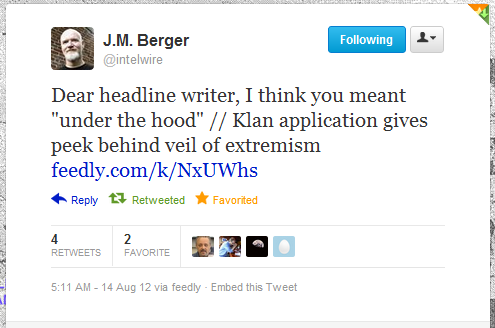
That tweet from friend JM Berger — think about it, “veil” suggests “Muslim”, doesn’t it? — and “hood” means “KKK”? — that’s really quite a double-barreled pun — and, given the context, it makes so much more sense!

JM gets my Tweet of the Month award.

Who among us can comprehend religion? — recent shootings

Wednesday, August 8th, 2012

[ by Charles Cameron — slaughters of Sikhs and Christians and questions of nomenclature: second addendum to my post responding to Scott Atran ]
.

Scott Atran recently argued that it is imperative that we understand religions, and in my post Landmines in Paradise Garden I agreed, while differing with Atran on what kinds of people are best suited to the task.

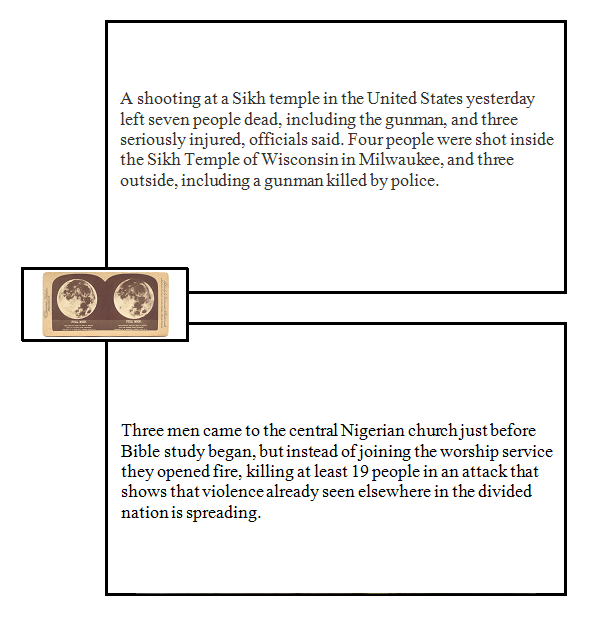
Here I would like to offer a second addendum to that post of mine, this time inviting ZP’s readers to compare and contrast the two quotes above, and likewise the two tweets below:

using them as, in effect, verbal Rorschach blots — allowing each of us individually to see something of our own ways of comparing and contrasting the two situations, their respective contexts and the ways in which we feel they have been treated by the media — and the two ways of “accurately” describing the tragic event in Oak Creek, Wisconsin.

We can see religion — we can see politics — we can see our own — we can see the other — the possible views and manners of relating to these events are many and varied, but the untimely deaths remain.

It is imperative for us to begin to get a better understanding of religion, in all its shadows and its lights. A little discussion might help.

**

Sources:

Shooting at the Wisconsin Gurudwara
Shooting at the Nigerian Church

Accuracy Org tweet
Chip Berlet tweet

For a chilling account of the Nigerian shooting, see this Christian Science Monitor piece (h/t Daveed Gartenstein-Ross)

Recommended reading: the meat

Sunday, July 22nd, 2012

[ by Charles Cameron — a couple of courteous debates on topics of considerable interest ]
.

I’d like to draw your attention to two recent conversations:

The first begins with Mark Jacobsen‘s Armed Forces Journal piece, How to teach about Islam, and continues with a guest post from Tim Mathews at Abu Muqawama, Insha’Allah they learn something useful. Mark then responds to Tim at his own blog, Building Peace.

Mark lays out the problem:

Much of the debate now hinges on which voices educators should trust. The question is no longer “What is Islam?” but “Who should teach about Islam?” Government agencies struggle to answer that question, because they often feel compelled to choose between two camps: those who believe extremism is intrinsic to Islam itself, and those who see no relationship whatsoever between Islamic doctrine and extremism. Although much thoughtful and scholarly discussion of Islam does exist, it is these two camps who now dominate the popular conversation.

Government agencies will never escape their dilemma if they continue searching for an authority who can speak for “true” Islam. Islam is a deeply contested religion, even among Muslims, and the arguments of both extremes are shot through with truth, falsehood, exaggerations, omissions and assumptions. Much of the debate about Islam in the United States is intellectually dishonest. Rival voices are less concerned with sincere discussion than with heavy-handed tactics to dominate the conversation, such as efforts to control government classrooms. The only way out of this dilemma is also the most intellectually honest one: to understand the battle for American perceptions of Islam, to map out the topography of the debate and to teach students to critically evaluate rival arguments.

Tim responds:

As should be clear, I agree with problems that the author identifies in the US. However, I fail to see what this has to do with the issue of educating our personnel. We are not training our personnel to be foot soldiers in a culture war fought on cable television and weblogs in the United States. We are training our personnel to conduct operations in foreign countries.

[ … ]

The problem that he identifies is not relevant to preparing our personnel for deployments to conduct, and provide support for, operations in majority-Muslim countries. What the author has advocated is a program to help our educators avoid being pulled into battles of a culture war on US soil and, along the way, educating our personnel. The primary focus should be educating and the secondary focus on mitigating public pressure from fringe organizations.

Mark’s response:

I’m very glad to see your thoughtful response to my article. More than anything, I had hoped to spark some discussion about how Islam is taught in various government agencies, so am glad to see you carrying the discussion forward.

[ … ]

One reason you might disagree with aspects of my article is because you viewed it primarily through the lens of preparing deploying soldiers. That is an important part of what I’m writing about, but I actually intended the article to encompass a much broader range of government needs. Government employees have many different reasons they might need to understand something about Islam. Congressmen and their staffs are trying to make sense of the alleged “shariah threat” and calls for anti-shariah legislation; law enforcement agencies and the FBI need a way to understand and delineate between “moderates” and “extremists”, so they can hone in on real threats while respecting the civil liberties of ordinary Muslims; military commanders concerned with preventing the next Ft. Hood want to know how they can recognize extremist ideology; government agencies involved in any sort of outreach to Muslim communities struggle to find partners they can work with, because the largest American-Islamic organizations that claim to speak for American Muslims are tarnished by alleged links to extremism and terrorism.

All three pieces are worth reading in full — it was hard to pull quotes that did any of them justice, they’re all packed! And FWIW I do think Mark is right in ranging beyond the constraints of “preparing our personnel for deployments” — Tim’s more focused concern — because the war of ideas is won or lost as much in terms of how the US is perceived WRT Islam as it is by the behavior of troops, village by village, “in the field”.

**

The second begins with a David Briggs piece in Huffington Post, Is It Time to Reconsider the Term Islamist?, which leads Daveed Gartenstein-Ross and Lauren Morgan to respond at Gunpowder & Lead with Islamism in the Popular Imagination — which in turn generated Bernard Finel‘s post On Islamists and Rick Santorum. Daveed then comes back with Islamists and Rick Santorum: A Response to Bernard Finel.

I’m not going to quote Briggs, whose piece strikes me as light-weight, except to note that he introduces the question of comparisons between Obama and Rick Santorum (potential “Christianists”) with “Islamists”:

At this year’s National Prayer Breakfast, President Barack Obama said his policies were grounded in his Christian beliefs. In a 2008 speech, former GOP presidential contender Rick Santorum said America was in the middle of a spiritual war in which “Satan has his sights on the United States of America.”

Are Obama and/or Santorum Christianists?

The answers to those questions would depend on how the term is defined. But it is unlikely you will hear any Christian politician or activist referred to in that way.

What American and western audiences are increasingly hearing, however, since the political and social upheaval that accompanied the Arab spring, is the term Islamist.

Daveed and Lauren:

You would be hard pressed to find anything beyond a few fringe commentators who are worried about Islamism because politicians representing this movement refer to Islamic principles in their rhetoric. Rather, it is the specific relationship between religion and state that worries observers. (I mean, really, does Briggs think that Obama will make canon law the law of the land if given a second term?)

Briggs bolsters his case by quoting Mansoor Moaddel, an Eastern Michigan University sociologist, as saying that in his interviews, he found that “‘in some respects, Mr. Santorum is more extremist’ than leading figures of Egypt’s Muslim Brotherhood.” Nor is Briggs the only Western commentator to fatuously compare Santorum to Islamic extremists. To actually approach the claim being made by Briggs and others — that Islamist politicians possess an agenda that is less extreme than that of Rick Santorum — a better approach is to look at the practice in Middle Eastern states, as well as the policies advocated by Islamist politicians with significant audiences (as opposed to mere fringe players). That is what we do in this entry.

And do they indeed do — detailing with bullet points and commentary the practical behaviors of a variety of Islamic nations in respect to apostasy, blasphemy, the rights of women, and gay rights in the rest of their lengthy and instructive piece.

Enter Bernard Finel, who draws a fine distinction:

GR argues convincingly that policies put in place by Islamist parties throughout the Middle East are more extreme than Santorum. And indeed, on issues like religious freedom, women’s rights, and gay rights, GR is quite correct. Islamist regimes are worse than anything Santorum has proposed.

But I’d argue this is an apples to oranges comparison. Santorum’s limits are defined, I think, more by the limits imposed by American institutions rather his ideology per se. In other words, GR is comparing institutionally unconstrained ideological positions with those heavy constrained by institutions. It actually is not at all difficult to find actors on the right who would like to see religious freedom severely curtailed. Indeed, there is even a “Constitutional theory” out there among right wingers than Muslims should not receive First Amendment protections because either Islam is a “cult” or because it was not extant in any significant way in the United States when the Bill of Rights was ratified.

I’ll get into the issue of “actors on the right who would like to see religious freedom severely curtailed” in an follow up to this post — and touch on the usage “Christianist” there also — here, I’ll just say that Finel is articulating something I’ve “felt but not thought” or perhaps “thought but not articulated” myself quite a few times, and while I’m not entirely satisfied with his phrasing about “constraint by institutions” I think there’s a serious point in there, and I’m glad to see it surfaced.

Back to Daveed:

In comparing the relative extremes of Santorum versus those of Islamist parties, we were not trying to offer a moral judgment on the relative righteousness of those two actors (to be clear: we use “actor” in the loosest possible sense here, since Islamist politicians are by no means a unified actor). Rather, we were comparing exactly what we have just specified: the policies Santorum has advocated or implemented versus those that Islamist parties have advocated or implemented. It is true that institutional constraints play a role in defining said policies, but our goal was illuminating policies that are likely to have an impact on anyone’s life, and not judging Santorum’s “heart of hearts.” Hence, it is a direct apples to apples comparison of what policies are advocated by these two different actors. It would only be an apples to oranges comparison if our goal were moral judgment.

Fair enough: then there are at least two kinds of comparisons to be made… one between policies advocated by the respective parties, and one between the political realities constraining those whose ideals may be comparable.

**

Again, with such rich material it is difficult if not impossible to pick quotes without cherry-picking them — and I must repeat that my intention here has not been to summarize these debates so much as to lead you into them…

Finel actually has a further post today in which he characterizes Daveed (and Laurel) as making “an ill-conceived and pointless attempt to haul Rick Santorum into the mix” on the way to another discussion. For the record, it was Briggs, not Daveed and Laurel, who introduced Santorum into the discussion.

I’ll have two follow-ups to this post, one adding a couple of points to the Gunpowder & Leaf / Finel discussion in regard to “Christianism” and the theological underpinnings of a contemporary movement for church-state fusion, the other adding a couple of other intriguing details to the mix.
Switch to our mobile site