zenpundit.com » recommended reading

Archive for the ‘recommended reading’ Category

“No one is really listening, they are just pretending.” – Madhu, Part II

Thursday, August 30th, 2012

[by J. Scott Shipman]

Since the original post of “No one is really listening, they are just pretending,” there are indications that pretending may actually be doing institutional harm.

The US Naval Institue recently sponsored the Joint Warfighting Conference 2012, and my friend Lucien Gauthier (YN2/SW) wrote a very good recap of the event. In his post, Lucien remarked on the comments of retired USMC General James “Hoss” Cartwright. Cartwright’s comments have been described by others around the blogosphere as “unleashed,” and indeed his comments may have raised a few eyebrows. But this sentence of Lucien’s post, while perhaps stating the obvious may reveal one challenge the Navy and DOD face in the credibility and trust department:

“Gen Cartwright had the luxury of no longer being in uniform and so his candor was particularly poignant.”

Now I don’t know General Cartwright, but I know people who do and they report he is a fine officer, and my remarks aren’t about him, but the implications of Lucien’s observation. The suggestion “…the luxury of no longer being in uniform and so his candor…”  struck me, for what is the reverse? “…in uniform, no candor?” If our highest ranking officers wait until they are retired to be candid, what does that say for those remaining in uniform, and what does it say about the environment? Does the environment inspire pretending? How many serving “pretend” daily just to get by, or worse, to get promoted?

A few months ago in a conversation with a young naval officer, one of the brightest I know, I was talking about “to be or to do” and the value of honesty always. The officer remarked, “Well sometimes you have to let the boss think the idea was his…” or something to that effect. I made the point that this is part of the problem: if these leaders are so uptight they need to be handled, then they are part of the problem. Trust can grow only where honesty is ubiquitous.

Recently, the Navy Times published a short query entitled, “Tell us what you think: Faith in Navy Brass?” One of the questions surprised me: “Do you trust the Navy’s leadership and still take them at their word?” If those who responded (be sure to read the comments) are to be believed, the answer is a resounding, “no.” Curiosity piqued, I conducted an informal poll among a small group of naval officers (active duty and retired) asking the same question. The answer: “no.” Since my Navy days, I’ve heard the old saw, “A bitching Sailor is a happy Sailor,” but this seems different.

At least ten commanding officers have been relieved of command eight months into 2012. Two were relieved due to unfavorable command climate surveys, so one could conclude the Navy is listening and taking action in some quarters. The recent decision by Secretary of the Navy Ray Mabus to require breathalyzers of Sailors and Marines reporting for duty introduces evidence of distrust, and his decision is nothing short of institutional micromanagement. At their core, a micromanager does not trust their subordinates.

When the folks on the pointy-end of the spear aren’t trusted, leaders should not be surprised when those folks return the favor. So to leaders, while you may think some of your subordinates agree with you, they may pretending, and are you ok with that? Are you ok with that if you learn you are the cause? Less pretending, more honesty.

Postscript: For more evidence, check out his post at the USNI Blog, The Wisdom of a King. Another fine example of the importance of trust can be found in a September 2012 Proceedings article by LCDR B.J.Armstrong, Leadership & Command (both come highly recommended).

Cross-posted at To Be or To Do.

Pussy Riot II: the closing statements

Monday, August 20th, 2012

[ by Charles Cameron — theopolitics in the closing statements of the Pussy Riot team ]
.

In my most recent post, I outlined some of the theological and political contexts that can add nuance to our understanding of the Pussy Putin trial.  Here I want to point up some of the remarkable theopolitical elements in the three defendants’ impressive closing statements.

**

Yekaterina Samutsevich opens with a closely interwoven account of the politics, spirituality, and aesthetics of Putin‘s Russia and the Pussy Riot response, coupled with a savvy media critique… I’ll simply present the bulk of it as is, and focus in on specifics in the other two women’s statements:

That Christ the Savior Cathedral had become a significant symbol in the political strategy of the authorities was clear to many thinking people when Vladimir Putin’s former [KGB] colleague Kirill Gundyayev took over as leader of the Russian Orthodox Church. After this happened, Christ the Savior Cathedral began to be openly used as a flashy backdrop for the politics of the security forces, which are the main source of political power in Russia.

Why did Putin feel the need to exploit the Orthodox religion and its aesthetic? After all, he could have employed his own, far more secular tools of power — for example, the state-controlled corporations, or his menacing police system, or his obedient judicial system. It may be that the harsh, failed policies of Putin’s government, the incident with the submarine Kursk, the bombings of civilians in broad daylight, and other unpleasant moments in his political career forced him to ponder the fact that it was high time to resign; that otherwise, the citizens of Russia would help him do this. Apparently, it was then that he felt the need for more persuasive, transcendent guarantees of his long tenure at the pinnacle of power. It was then that it became necessary to make use of the aesthetic of the Orthodox religion, which is historically associated with the heyday of Imperial Russia, where power came not from earthly manifestations such as democratic elections and civil society, but from God Himself.

How did Putin succeed in this? After all, we still have a secular state, and any intersection of the religious and political spheres should be dealt with severely by our vigilant and critically minded society. Right? Here, apparently, the authorities took advantage of a certain deficit of the Orthodox aesthetic in Soviet times, when the Orthodox religion had an aura of lost history, of something that had been crushed and damaged by the Soviet totalitarian regime, and was thus an opposition culture. The authorities decided to appropriate this historical effect of loss and present a new political project to restore Russia’s lost spiritual values, a project that has little to do with a genuine concern for the preservation of Russian Orthodoxy’s history and culture.

It was also fairly logical that the Russian Orthodox Church, given its long mystical ties to power, emerged as the project’s principal exponent in the media. It was decided that, unlike in the Soviet era, when the church opposed, above all, the brutality of the authorities toward history itself, the Russian Orthodox Church should now confront all pernicious manifestations of contemporary mass culture with its concept of diversity and tolerance.

Implementing this thoroughly interesting political project has required considerable quantities of professional lighting and video equipment, air time on national television for hours-long live broadcasts, and numerous background shoots for morally and ethically edifying news stories, where the Patriarch’s well-constructed speeches would in fact be presented, thus helping the faithful make the correct political choice during a difficult time for Putin preceding the election.

Our sudden musical appearance in the Cathedral of Christ the Savior with the song “Mother of God, Drive Putin Out” violated the integrity of the media image that the authorities had spent such a long time generating and maintaining, and revealed its falsity. In our performance we dared, without the Patriarch’s blessing, to unite the visual imagery of Orthodox culture with that of protest culture, thus suggesting that Orthodox culture belongs not only to the Russian Orthodox Church, the Patriarch, and Putin, but that it could also ally itself with civic rebellion and the spirit of protest in Russia.

**

Maria Alyokhina keeps a strong focus on Pussy Riot’s protests and courtroom appearances as dialogue between people and State, and this informs her diagnosis of the state — funny word that — of affairs:

Russia, as a state, has long resembled an organism sick to the core. And the sickness explodes out into the open when you rub up against its inflamed abscesses. At first and for a long time this sickness gets hushed up in public, but eventually it always finds resolution through dialogue. And look — this is the kind of dialogue that our government is capable of. This trial is not only a malignant and grotesque mask, it is the “face” of the government’s dialogue with the people of our country.

She focuses in on the abuse of language, on Orwellian “Double-Speak” — and interestingly enough given the context of the action for which they were charged, the word she specifically chooses to examine in light of Orwell’s insight is humility:

I would like to note that this method of personal development clearly impedes the awakening of both inner and religious freedoms, unfortunately , on a mass scale. The consequence of the process I have just described is ontological humility, existential humility, socialization. To me, this transition, or rupture, is noteworthy in that, if approached from the point of view of Christian culture, we see that meanings and symbols are being replaced by those that are diametrically opposed to them. Thus one of the most important Christian concepts, Humility, is now commonly understood not as a path towards the perception, fortification, and ultimate liberation of Man, but on the contrary as an instrument for his enslavement. To quote [Russian philosopher] Nikolai Berdyaev, one could say that “the ontology of humility is the ontology of the slaves of God, and not the sons of God.”

Not only that, she calls on the Russian theological philosopher Berdyaev in support of her position — Berdyaev being the 1874-1948 theologican credited with the saying:

The question of bread for myself is a material question, but the question of bread for my neighbor is a spiritual question.

Abthough she has been, and remains, an activist, she sees activism as proceeding from interiority:

When I was involved with organizing the ecological movement, I became fundamentally convinced of the priority of inner freedom as the foundation for taking action. As well as the importance, the direct importance, of taking action as such.

It is, after all, interiority which allows us to see our living connection with all that is…

During the pickets and demonstrations [of the winter and spring], back when I was collecting signatures and organizing petitions, many people would ask me—and ask me with sincere bewilderment — why in the world they should care about, what business could they possibly have, with that little patch of forest in the Krasnodar region — even though it is perhaps unique in Russia, perhaps primeval? Why should they care if the wife of our Prime Minister Dmitry Medvedev wants to build an official residence there and destroy the only juniper preserve in Russia? These people … this is yet another confirmation that people in our country have lost the sense that this country belongs to us, its citizens. They no longer have a sense of themselves as citizens. They have a sense of themselves simply as the automated masses. They don’t feel that the forest belongs to them, even the forest located right next to their houses. I doubt they even feel a sense of ownership over their own houses.

As any artist might, she sees the play of forms within forms — like Plotinus’ “world stage which men have dotted with stages of their own constructing” [Enneads III.ii.15] We might term it, in her honor, the Matrioshka principle:

Having spent almost half a year in jail, I have come to understand that prison is just Russia in miniature.

Indeed, her statement on values, immediately following this, also echoes Plotinus in that same passage:

In this framework, people begin to place high value on meaningless trifles. In prison these trifles are things like a tablecloth or plastic dishes that can only be procured with the personal permission of the head warden. Outside prison, accordingly , you have social status, which people also value a great deal. This has always been surprising to me.

Plotinus it was who said in that same passage:

All this is the doing of man knowing no more than to live the lower and outer life, and never perceiving that, in his weeping and in his graver doings alike, he is but at play; to handle austere matters austerely is reserved for the thoughtful: the other kind of man is himself a futility. Those incapable of thinking gravely read gravity into frivolities which correspond to their own frivolous Nature. Anyone that joins in their trifling and so comes to look on life with their eyes must understand that by lending himself to such idleness he has laid aside his own character. If Socrates himself takes part in the trifling, he trifles in the outer Socrates.

Next up, Maria makes an explicit comparison of Gospel with Church and note the discussion of blasphemy and demonic possession as accusations leveled against Christ:

Our motivation is the same motivation that goes with the use of a direct quotation. This motivation is best expressed in the Gospels: “For every one who asks receives; the one who seeks finds; and to the one who knocks, the door will be opened.” [Matthew 7 :8] I — all of us — sincerely believe that for us the door will be opened. But alas, for now the only thing that has happened is that we’ve been locked up in prison. It is very strange that in their reaction to our actions, the authorities completely disregard the historical experience of dissent. “[H]ow unfortunate is the country where simple honesty is understood, in the best case, as heroism. And in the worst case as a mental disorder,” the dissident [Vladimir] Bukovsky wrote in the 1970s. And even though it hasn’t been very long, now people are acting as if there was never any Great Terror nor any attempts to resist it. I believe that we are being accused by people without memory . Many of them have said, “He is possessed by a demon and insane. Why do you listen to Him?” These words belong to the Jews who accused Jesus Christ of blasphemy. They said, “We are … stoning you … for blasphemy .” [John 1 0:33] Interestingly enough, it is precisely this verse that the Russian Orthodox Church uses to express its opinion about blasphemy. This view is certified on paper, it’s attached to our criminal file. Expressing this opinion, the Russian Orthodox Church refers to the Gospels as static religious truth. The Gospels are no longer understood as revelation, which they have been from the very beginning, but rather as a monolithic chunk that can be disassembled into quotations to be shoved in wherever necessary — in any of its documents, for any of their purposes. The Russian Orthodox Church did not even bother to look up the context in which “blasphemy” is mentioned here — that in this case, the word applies to Jesus Christ himself.

Then she offers us religion as a process, not a product — and its relation to the creative process in art, a major theme in Berdyaev’s thinking:

I think that religious truth should not be static, that it is essential to understand the instances and paths of spiritual development, the trials of a human being, his duplicity, his splintering. That for one’s self to form it is essential to experience these things. That you have to experience all these things in order to develop as a person. That religious truth is a process and not a finished product that can be shoved wherever and whenever. And all of these things I’ve been talking about, all of these processes — they acquire meaning in art and in philosophy. Including contemporary art. An artistic situation can and, in my opinion, must contain its own internal conflict. And what really irritates me is how the prosecution uses the words “so-called” in reference to contemporary art.

**

Nadezhda Tolokonnikova, finally, begins her statement with a reversal of logic — or at least of appearances:

By and large, the three members of Pussy Riot are not the ones on trial here. If we were, this event would hardly be so significant. This is a trial of the entire political system of the Russian Federation, which, to its great misfortune, enjoys quoting its own cruelty toward the individual, its indifference toward human honor and dignity , repeating all of the worst moments of Russian history.

Again, it’s a strategic re-framing, zooming out from the momentary to a longer view.

She’s the one who explicitly suggests that punk is a contemporary equivalent of holy folly:

What was behind our performance at the Cathedral of Christ the Savior and the subsequent trial? Nothing other than the autocratic political system. Pussy Riot’s performances can either be called dissident art or political action that engages art forms. Either way, our performances are a kind of civic activity amidst the repressions of a corporate political system that directs its power against basic human rights and civil and political liberties. The young people who have been flayed by the systematic eradication of freedoms perpetrated through the aughts have now risen against the state. We were searching for real sincerity and simplicity, and we found these qualities in the yurodstvo [the holy foolishness] of punk.

She too is concerned with values, virtues — and in particular with integrity rather than hypocrisy:

Passion, total honesty, and naïveté are superior to the hypocrisy, mendacity, and false modesty that are used to disguise crime. The so-called leading figures of our state stand in the Cathedral with righteous faces on, but, in their cunning, their sin is greater than our own.

She notes with joy and gratitude that the Church, though its leaders might wish it were, is not in fact monolithic:

I know that a great number of Orthodox Christians speak out on our behalf, the ones who gather near the court in particular. They pray for us; they pray for the imprisoned members of Pussy Riot. We’ve seen the little booklets the Orthodox pass out containing prayers for the imprisoned. This fact alone demonstrates that there is no single, unified group of Orthodox believers, as the prosecutor would like to prove. This unified group does not exist. Today, more and more believers have come to the defense of Pussy Riot. They don’t think that what we did warrants a five-month term in a pretrial detention center, let alone three years in prison, as the prosecutor has called for.

Interestingly, she views sincerity as prophetic virtue, finding it stressed more in the Old Testament than the New — although in the Gospels Christ frequently attacks hypocrites:

Every day, more people understand that if the system is attacking three young women who performed in the Cathedral of Christ the Savior for thirty seconds with such vehemence, it only means that this system fears the truth, sincerity, and straightforwardness we represent. We have never used cunning during these proceedings. Meanwhile, our opponents are too often cunning, and people sense this. Indeed, the truth has an ontological, existential superiority over deception, and this is described in the Bible, particularly the Old Testament.

The paths of truth always triumph over the paths of cunning, guile, and deception. Every day, truth grows more victorious, despite the fact that we remain behind bars and will probably be here for a long time.

She sees human imperfection as the natural precursor to the quest for wisdom and metanoia:

A human being is a creature that is always in error, never perfect. She quests for wisdom, but cannot possess it; this is why philosophy was born. This is why the philosopher is the one who loves wisdom and yearns for it, but does not possess it. This is what ultimately calls a human being to action, to think and live in a certain way . It was our search for truth that led us to the Cathedral of Christ the Savior. I think that Christianity, as I understood it while studying the Old and especially the New Testament, supports the search for truth and a constant overcoming of oneself, the overcoming of what you were earlier. It was not in vain that when Christ was among the prostitutes, he said that those who falter should be helped; “I forgive them,” He said.

And throughout, she wishes to take a non-judgmental approach:

I don’t want to label any one. It seems to me that there are no winners, losers, victims, or defendants here. We all simply need to reach each other, connect, and establish a dialogue in order to seek out the truth together.

Here we see the theme of dialogue again — and the alternative is clearly presented as Inquisition:

Together, we can seek wisdom and be philosophers, instead of stigmatizing people and labeling them. That is the last thing a person should do. Christ condemned it. With this trial, the system is abusing us. Who would have thought that man and the state he rules could, again and again, perpetrate absolutely unmotivated evil? Who could have imagined that history, especially Stalin’s still-recent Great Terror, could fail to teach us any thing? The medieval Inquisition methods that reign in the law enforcement and judicial systems of our country, the Russian Federation, are enough to make you weep.

Her emphasis, therefore, is on dialogue, not confrontation:

On July 30th, we spoke openly for the first time; we called for making contact and facilitating dialogue, not for battle and confrontation. We reached our hands out to the people who, for some reason, consider us their enemies, and they spat into our open hands. “You are not sincere,” they said to us. Too bad. Do not judge us according to your behavior. We spoke sincerely, as we always do — we said what we thought. We were unbelievably childlike, naïve in our truth, but nonetheless we are not sorry for our words, and this includes our words on that day.

and exeprience has taught her: “having been maligned, we do not want to malign others in response”:

And having been maligned, we do not want to malign others in response. We are in desperate circumstances, but we do not despair. We are persecuted, but we have not been abandoned. It is easy to degrade and destroy people who are open, but “When I am weak, then I am strong.”

She then presents a powerful invocation of the cases of Dostoyevsky, Socrates, St Stephen the proto-martyr, and Christ himself:

Do you remember why young Dostoyevsky was sentenced to death? His entire guilt lay in the fact that he was fascinated by socialist theories, and during meetings of freethinkers and friends — which met on Fridays in the apartment of [Mikhail] Petrashevsky — he discussed the writings of Fourier and George Sand. On one of the last Fridays, he read Belinsky’s letter to Gogol aloud, a letter that was filled, according to the court that tried Dostoevsky (listen!) “with impudent statements against the Orthodox Church and the State government.” After all the preparations for execution and “ten agonizing, infinitely terrifying minutes awaiting death” (Dostoyevsky), it was announced that the sentence was changed to four years of hard labor in Siberia followed by military service.

Socrates was accused of corrupting the youth with his philosophical discussions and refusing to accept the Athenian gods. He had a living connection with the divine voice, and he was not, as he insisted many times, by any account an enemy of the gods. But what did that matter when Socrates irritated the influential citizens of his city with his critical, dialectical thought, free of prejudice? Socrates was sentenced to death and, having refused to escape Athens (as his students proposed), he courageously emptied a cup of hemlock and died.

Have you forgotten under what circumstances Stephen, the disciple of the Apostles, concluded his earthly life? “Then they secretly induced men to say, ‘We have heard him speak blasphemous words against Moses and against God.’ And they stirred up the people, the elders and the scribes, and they came up to him and dragged him away and brought him before the Council. They put forward false witnesses who said, ‘This man incessantly speaks against this holy place and the Law.” [Acts 6:11-13] He was found guilty and stoned to death.

I also hope that you all remember well how the Jews answered Christ: “It is not for good works that we are going to stone you but for blasphemy .” [John 10:33] And finally we would do well to keep in mind the following characterization of Christ: “He is demon-possessed and raving mad.” [John 10:20]

Lastly, she makes a plea for the court (and those of us in the world outside it) to hear the Riot’s own words:

The prosecutors have refused to voice excerpts from Pussy Riot interviews, since these excerpts would only further prove the absence of any motive. Why wasn’t the following text by us — which, incidentally, appeared in the affidavit — presented by the prosecution? “We respect religion in general and the Orthodox faith in particular. This is why we are especially infuriated when Christian philosophy , which is full of light, is used in such a dirty fashion. It makes us sick to see such beautiful ideas forced to their knees.”

**

The full text of the three closing statements can be found on the N+1 magazine site.

The zen of Cage II: from the A Train to Liverpool Street Station

Wednesday, August 15th, 2012

[ by Charles Cameron — two performances of Cage’s 4’33” in the New York and London Times: an interlude in my review of Where the Heart Beats, with a brief meditation on contrapuntal listening ]
.

I began to review Kay Larson‘s Where the Heart Beats in a post here last week, and am not done yet.

**

London:

photo credit: Chris Harris for the London Times

In John Cage’s sound of silence… at Liverpool Street station [London Times, subscription required], Igor Toronyi-Lalic describes performing John Cage‘s silent work 4’33” in what Cage himself — but few others — would have recognized as a concert venue, London’s Liverpool Street Station:

My rendition isn’t going down well. “This is doing my head in!” groans a drunken West Ham supporter as he watches me at the piano outside Liverpool Street station. I hear shuffling. “I can’t dance to this,” someone shouts. The restlessness is in danger of turning to anger. And I probably should have guessed it would. Presenting a performance of one of the most controversial works of music yet written in a rowdy Central London station forecourt on a Friday night on a public piano (one of several that made up the City of London Festival’s Play Me, I’m Yours artwork) was always going to be ambitious.

The work itself is hardly over before it begins — again, a paradox Cage would have enjoyed:

At my Liverpool Street Station performance, there was a symphony of rush-hour noise: commuter patter, train announcements, drunken heckling and the screeching of taxis stopping to pick up fares. Not everyone appreciated the music in this.

“When’s he going to start?” asked one lady as I finished the final movement. Others felt like they’d been had. “I thought you were going to play,” they shouted.

There’s more, and if you can get past the pay-wall you should read it all. I’ll just quote one more snippet here, though, because it leads directly into one strand of the book that I’ll be discussing in Part III of my review of Larson’s book:

“Classical musicians don’t know about Cage. They don’t perform it. We aren’t taught it in schools,” Volkov says.

But, for visual artists, Cage is a revered figure, a key part of the 1950s and 60s New York arts scene and godfather to conceptual and sound art, a connection cemented by Cage’s 40-year creative relationship with his lifelong partner, the late choreographer Merce Cunningham. “Cage worked with Rauschenberg and Cunningham and, at Black Mountain College, he mainly taught music to artists,” observes Volkov, “So, today, in art schools, they teach Cage properly. They teach his ideas.”

**

New York:

photo credit: Christian Hansen for the New York Times

From London’s Liverpool Street Station we pass to New York City’s subway system. I don’t know what it is about trains, but there you are and there you go. Or perhaps the transit is from Times to Times?

Allan Kozinn‘s John Cage Recital? Take the A Train [New York Times] starts by defining “Cage moments”:

You know about Cage moments, don’t you? We all have them, whether we think of them that way or not. They occur when happenstance kicks in, and surprising musical experiences take form, seemingly out of nowhere. They can happen anywhere at any time.

Listening. Listening as though all life is music.

Kozinn is a listener, a listener to music — but he doesn’t always listen for the music in his daily life. This time, as it happens, he did:

On the A train I wasn’t thinking about Cage at all. I had just heard an exquisitely turned, energetic performance of Schubert’s String Quintet in C at a church in Greenwich Village, and Cage could not have been further from my thoughts. Nor did the crowded subway car bring him to mind at first. But I noticed that it was unusually noisy.

**

Then something shifted:

Typically, most of the noise you hear comes from the subway itself: its din drowns out conversations, and people tend to stare at their feet, or at whatever they are reading, and listen to their portable music players. But this Tuesday evening just about all the people were talking, and working hard to drown out both the subway and the chats taking place around them.

I would normally have tuned all this out, but instead I sat back, closed my eyes and did what Cage so often recommended: I listened. I made no effort to separate the strands of conversation or to focus on what people were saying. I was simply grabbed by the sheer mass of sound, human and mechanical. It sounded intensely musical to me, noisy as it was, and once I began hearing it that way, I couldn’t stop.

Okay, this is where it get’s interesting. You remember that I pointed to the pianist Glenn Gould in my Said Symphony posts, and quoted this passage from David Rothenberg‘s Sudden Music:

Gould set himself up to hear the world in a new way. In diners he ate his lunch alone, eaves dropping closely on the voices around him. He learned to hear conversation as music, the lilting lines, the rhythms everywhere up, down, and around, what Bach does to our sense of talk. There are two part inventions in words, themes and variations in the quarrels of couples and the tales told by friends. Gould met the world on his own terms, and he was fascinated by this way of listening to human voices as if they were a musical interplay, not participating in a conversation but taking it all in, as an audience.

What Gould sets out to do — and records for Canadian Broadcasting — Kozinn finds himself doing:

Strand upon strand of the chatter was animated and midrange: there were neither basso profundos nor soaring sopranos in this choir, but after a moment the pitch levels began to sort themselves out as a kind of orchestration. Argumentative voices created driving, punchy rhythms that sailed over more smoothly floating narrative tones.

At least three languages were being spoken, each with its own melodic lilt and rhythmic character. To my left, a woman’s laughter momentarily changed the coloration of this vast choral tapestry and offset the argument to my right.

Within it all, squeaking metal yielded a high-pitched ostinato, and the ever-so-slightly-clattery rumble of the train was the high-tech equivalent of a Baroque basso continuo. As the train pulled into each station, the muted squeal of the brakes, the opening and closing of the doors and the slight shift in the balance of voices as some people left and others entered, already talking, suggested shifts between connected movements.

Again, I recommend reading the entire piece, but will close with just one more short clip:

I have heard “4’33” ” performed by pianists, percussion ensembles, oboists, cellists and orchestras, but none of those versions were as exciting as what I now think of as “4’33”: The Extended Subway Remix” by the A Train Yakkers, an ensemble so conceptual that its members had no idea they were in it.

Cage would have understood.

**

And wherever:

Listening — and listening to the world around us as music — can happen anywhere and everywhere. But as usual, I’d like to take this a step further.

As I never tire of repeating, Edward Said — pianist and music critic as much as writer on Israeli-Palestinian issues — carries the idea of listening to multiple voices a step further, when he suggests:

When you think about it, when you think about Jew and Palestinian not separately, but as part of a symphony, there is something magnificently imposing about it. A very rich, also very tragic, also in many ways desperate history of extremes — opposites in the Hegelian sense — that is yet to receive its due. So what you are faced with is a kind of sublime grandeur of a series of tragedies, of losses, of sacrifices, of pain that would take the brain of a Bach to figure out.

Said’s proposed manner of listening to the many voices of life in counterpoint involves listening to the words, their meanings, their stories, their histories, and thus to a simultaneous listening across time itself — not just to a harmonious blur, “Strand upon strand of the chatter .. a kind of orchestration .. driving, punchy rhythms that sailed over more smoothly floating narrative tones.”

It goes way deeper: my life and concerns, and yours, and yours, heard together — separate and interwoven — in polyphony, in a many-voiced music — in counterpoint.

In conflict, and in hope of resolution.

Recommended Reading

Tuesday, August 14th, 2012

Top Billing! Bruce Kesler –Campus Hate Speech and Speech Codes 

We have educated an elite in the past two generations, now reaching the peak of leadership positions in government, corporations, finance and academia, containing an influential plurality who hold our core Constitutional principles and freedoms enshrined in the Bill of Rights in disdain. Who are, in essence, authoritarian and anti-democratic, pushing policies to remake American society in their own image, enlisting the state to bully those with differing opinions for daring to “think wrongly” or belong to groups they despise.

Universities have more than their share of these folks, as Bruce Kesler explains:

Many of the finest and most honest minds – conservative and liberal — in and out of academia have argued, and sometimes succeeded, that campus speech codes often cross the line to suppression of First Amendment freedom of speech. The excesses in the wording of such codes, their arbitrary and often biased application, and the fear of usurping a constitutional right, together send chills up the spine.

Nonetheless, in court cases, private colleges have more leeway to enact speech codes than do public colleges, as they are not as subject to the First Amendment prohibition on government interfering with free speech. In the face of opposition to speech codes per se colleges, both public and private, have turned to anti-harassment policies. These seemingly turn the offense from the speech to the impact on those sensitive, and in effect make judging the offense even more subjective.  Alongside, many campuses have instituted judgment procedures that deny those charged from confronting their accuser or, in some cases, even appearing to defend themselves. In many cases, those supporting such near star-chamber exercises in speech or behavioral prejudice are those judging for the kangaroo procedures. And, alongside these, liberal and leftist faculty have denied tenure or opposed research by those who have empirically challenged cherished thoughts or prejudices.

So, understandably so, any further enlargement of speech codes or definition of hate speech raises hackles among almost all those who have battled the present excesses. Further, most opponents have cause for little faith that in the prevailing leftist or hypocritical atmosphere on campuses that an enlargement to anti-Israel speech and actions that are anti-semitic would be enforced or fairly…..

Pundita – Meet the new U.S. defense policy. Same as the old policy 

….The rest of the writing is mostly taken up with Mr Bhadrakumar’s ruminations on how India’s government feels about being folded into America’s Asia Pivot. So he doesn’t rake up embarrassing history; namely, that about 95 percent of the global terrorist threat could have been neutralized after 9/11 if the United States had bombed Pakistan and Saudi Arabia back into the stone age, and that if a few stray bombs had fallen on London this would have further reduced the threat by a couple percentage points. 

Nor does he dwell on the unpleasant present, which finds the U.S. government still covering for Pakistan’s military, which has been supporting groups that kill American troops in Afghanistan. 

And he doesn’t mention that if the USA is so intent on taking down global Islamic terrorism it has a strange way of going about it, given that one can’t find a more anti-Islamic terrorism government than China’s, unless it’s Russia’s — the other country in the cross-hairs of America’s Asia Pivot. 

But Mr Bhadrakumar’s carefully limited discussion is still enough to convey that when one looks past the new-fangled widgets and geegaws of the Light Footprint era and its reliance on proxy armies and special forces, one hand is fighting the other hand, which is another way of describing NATO’s protracted cold war against the Soviet Union.

In the post-WW 2 era, the United States and its NATO allies were intent on quickly rebuilding Western Europe’s industrial base, which meant Western Europe relied heavily on Soviet energy supplies, which provided Russia with the wherewithal to build a nuclear arsenal and stave off collapse of the Soviet Union for decades.

So if you switch out yesterday’s bad guys for today’s, you’re looking at the same old U.S. Cold War defense policy, gussied up with the weapons and communications technologies of this era. The basis of the policy isn’t victory over Islamic terrorism, any more than victory over the Soviets was the objective of the U.S.-led Cold War. 

What, then, is the government of United States really aiming at?  I think the answer was alluded to by ISAF/U.S. Forces in Afghanistan Commander General John R. Allen when he gave a pep talk earlier this year to a gathering of grim-faced American soldiers in Afghanistan…..

Seydlitz89 –Defining “Literacy”

Seydlitz has a very interesting riff on an earlier post by Venkat:

….Venkat mades some interesting claims here. I think he has a point as to our Western dismissal of oral cultures being simply about memorization, there is more to it than that, but is there not more to the Western concept of literacy as well? Here’s where his analysis falls short imo. Also his example of Indian oral culture is not meant to appeal to most students, but to “a few” who don’t see it as “mindless tedium”. The recitation he uses as an example are religious texts, hardly ones to promote critical thinking which is another drawback.I think the main problem is that he is conflating “orality” with “literacy” which are in fact two different things. This distinction is important because the cultural implications are profound. Following Walter Ong’s distinctions, we have this….

Gunpowder & Lead (Daveed Garstein-Ross) –Reflections on Byman’s “Breaking the Bonds”, (Dan Trombly) Weapons Still Don’t Make War

Information Dissemination (Galrahn)-Time To Talk Lasers

Cool.

Chicago Boyz (LC Rees)- Crap Cleaner

Helpful Freeware recommendation. Used it.

Dave Schuler – The War on Algebra 

S. Anthony Iannarino-How to Upgrade the Operating System That Runs Your Brain

Michigan War Studies Review –The Deaths of Others: The Fate of Civilians in America’s Wars and 1066: A New History of the Norman Invasion and 1812: The Navy’s War

The last review is by occasional ZP commenter Ralph Hitchens 

Gene Expression –  Human on human Sex and The Jewish Diaspora:not an empire of the mind 

Before you get too excited, Razib’s first post is about Neanderthal genetic legacy in modern non-Africans.

That’s it.

Pew on the prevalence of Mahdism — take heed!

Sunday, August 12th, 2012

[ by Charles “told you so” Cameron — Pew figures for Mahdist expectation, also the Second Coming, Israel, and the potential influence of apocalyptic ideation on foreign policy ]
.

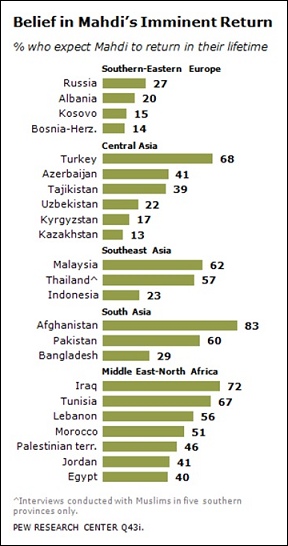
The World’s Muslims: Unity and Diversity, p. 65

.

I am Qualit, not Quant by nature, really much more interested in the workings of the imagination that in the aggregates of poll responses, so it’s a bit like pulling teeth for me to report on a Pew report — but in this case I can legitimately say “I told you so”, which massively outweighs the reluctance I might otherwise feel…

**

Recently, Pew has been including questions about the expectation of the Mahdi in some of its reports, and even Tim Furnish — who wrote the book on Mahdist movements and has long been saying we neglect them at our peril — even Tim was surprised at how widespread Mahdist expectation is, as reported in their just released The World’s Muslims: Unity and Diversity. In a post aptly titled Don’t Leave a Live (or Occulted) Mahdi Out of Your Calculations, Tim says the report contains “The most notable — indeed, strikingly important — news” in the form of “fascinating — and disturbing — data on belief in the Mahdi’s imminent (in one’s lifetime) return.”

See graphic above.

I recommend you read Tim’s analysis for the full range of his points — I won’t, for instance, be touching on what he says about Turkey — here I am going to select a couple of his key issues, and make just a point or two of my own.

**

Furnish:

Of the 23 countries whose Muslim citizens were polled, nine have majorities which expect the Mahdi in their lifetimes, with the overall average percentage at 41.8% … it is safe to extrapolate this percentage to Islam as a whole; ergo, 42% of 1.6 billion = 672 million Muslims who believe in the Mahdi’s imminent return! This is FAR greater than I had supposed.

Furnish also notes that Iran, the world’s most intensely Shi’ite nation and the one whose President has been speaking openly of Mahdist expectation, is not even included among the 23 countries Pew sampled.

Simply put, we have been blind to a very real phenomenon, and now we have a statistical alarm call to wake us up.

More subtly: there’s a difference between answering yes to the question “do you expect the Coming of X in your lifetime” and being on the edge of your seat, viewing every week as threshhold. Damian Thompson is very good on this in his book, Waiting for the Antichrist, and Stephen O’Leary in Arguing the Apocalypse suggests there’s an optimal “arousal” period — if you believe the Coming is too far away, you won’t be motivated to prepare for it quite yet, and if it’s too close it may be too late for you to do much to spread the word…

So, Pew — next time, ask a question with the opinions “in the next five to ten years” and “in my lifetime” — okay? The distinction is important, and a shift towards the shorter time-span would be highly significant.

**

Furnish again:

Despite the conventional wisdom (repeated even by Pew, in the face of their own data) that Mahdism is primarily the province of Shi`is, note that three of the four countries with the highest percentage expecting the Mahdi are majority-Sunni ones: Afghanistan (83%), Turkey (68%) and Tunisia (67%). This has ramifications, respectively, for: US policy in a country we are currently occupying; the only NATO Muslim-majority nation; and the vanguard state of the “Arab Spring.”

In his Conclusions, Furnish says:

The usual State/Defense departments’ “rational actor” approach to international relations might be quite simply irrelevant, if almost half the world’s Muslims expect the imminent return of their eschatological deliverer.

So there you have it. I discussed the “rational actor” versus Scott Atran‘s “devoted actor” in a recent post. And yes indeed, there are “ramifications for U.S. policy”…

Notably with regard to Afghanistan …

**

Here’s Furnish again:

Afghanistan is so rife with Islamic messianism because the 80% of the population that is Sunni and the 20% that is Shi`i (albeit Sevener/Isma’ili, as well as Twelver) both are in the middle of a war and occupation by a “Christian” power — which tends to ratchet up such expectations …

And again, in his Conclusions:

Afghanistan is a lost cause: over eight in ten of its people expect the Mahdi in their lifetime, and no amount of roads and clinics and girls’ schools built by the infidels will change that.

I don’t want to argue that second point in detail, although I think there’s a great deal more to life that Mahdist expectation for many who would answer “yes” to Pew’s question about expecting the Mahdi in one’s lifetime — see my comment on Damian’s book above. But how can I put it? A background Mahdist expectation can become a passionate involvement in a Mahdist movement if the right trigger comes along.

But what I find most striking here is that Afghanistan should be the country with the strongest Mahdist current out of all those Pew selected. And I’m struck not because Afghanistan has been a battlefield for so much of recent history — indeed, for so much of its history, period. I am struck because, in Al-Qaida’s recruitment narrative, supported by a number of ahadith, Afghanistan as Khorasan is the very locus from which the Mahdi’s victorious army will sweep out to conquer (finally) Jerusalem. And this too I have been posting about, eg in my discussions of Ali Soufan‘s The Black Banners and Syed Saleem Shahzad‘s Inside Al-Qaeda and the Taliban.

So the highest level of Mahdist expectation also happens to be found in an area with a potentially major role to play in an end times scenario…

**

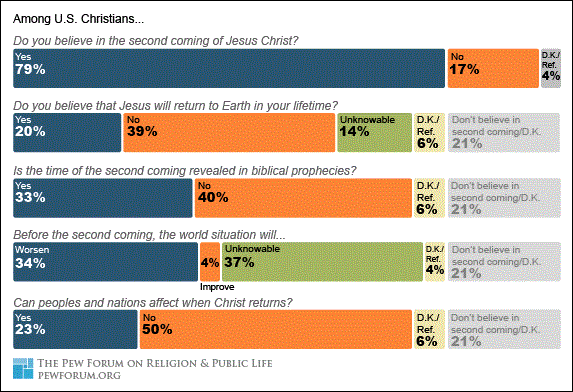
There’s at least one earlier report in which Pew raised the question of Mahdist expectation — this time tied in with both the expectation of the Caliphate, and Christian hope of the Second Coming — their 2010 report Tolerance and Tension: Islam and Christianity in Sub-Saharan Africa.

Here, for instance, we learn:

Both Christians and Muslims believe they are living in a time that will undergo momentous religious events. For example, at least half of Christians in every country with large enough samples of Christians to analyze believe that Jesus will return to earth during their lifetime, including nearly seven-in-ten Christians in the Democratic Republic of the Congo (69%).

And at least half of Muslims in 10 of the 15 countries with large enough Muslim populations to analyze say they believe that the caliphate, the golden era of Islamic rule, will be re-established in their lifetime; this belief is most common among respondents in Mozambique (69%). And in 12 of these 15 countries, roughly six-in-ten or more Muslims believe in the return of the Mahdi, the guided one who will initiate the final period before the day of resurrection and judgment, though the survey did not ask respondents whether they expect this to occur during their lifetime.

And here is the relevant data on sub-Saharan Mahdist belief. In Q51 of this poll, Muslims were asked whether they believe “in the return of the Mahdi, the guided one who will initiate the final period before the Day of Resurrection and Judgment? Here’s the table of responses:

Given the “religious fault line” of mixed conflict and amicable coexistence between Christians and Muslims running across Africa from (so to speak) Nigeria to Somalia, with Boko Haram and Al-Shabaab among the less delightful participants, keeping an eye out for signs of Mahdist “semiotic arousal” would be important here, too.

**

And “semiotic arousal” — that reminds me. Richard Landes, who coined the term, has the definitive, encyclopedic book out about all the many forms of apocalyptic, and why they’re important: Heaven on Earth: The Varieties of the Millennial Experience Essential reading, if you ask me, on a hugely neglected and no less critically important subject.

**

Finally, here’s yet another Pew graphic

— to be viewed in conjunction with this one, illustrating the ways in which belief in the Second Coming of Christ correlate with opinions about scriptures and the State of Israel:

**

Prophecy has impact, both on public opinion and on believing leaders. Jews with an expectation of the Messianic era, Christians expecting the soon Coming of Christ, and Muslims with Mahdist expectations each have their own apocalyptic scenarios, and in each case those scenarios exert some influence on policies relating to the Middle East and the Israeli-Palestinian situation in particular.

The bottom line?

Scriptural interpretation — and prophetic eschatology in particular — can no longer be assumed to be a quiet backwater topic for rabbinic students, seminarians and future mullahs to study, each in terms of their own tradition. It is now a series of conflicting drivers of current affairs — of war and peace.


Switch to our mobile site