zenpundit.com » recommended reading

Archive for the ‘recommended reading’ Category

Recommended Reading & Important Announcements

Monday, March 5th, 2012

Top Billing! Peter J. Munson –The Responsibility of Civilian Policy Advocates: Syria and R2P 

….Surely, it cannot be as bad as all that, you might say.  True.  It may not be as bad as I say, but it will surely be more messy than the glib op-ed that Anne-Marie Slaughter threw together for the New York Times last week.  CNN reports that the military is looking at using as many as 75,000 troops just to secure potential Syrian chemical weapons sites.  The realities of a Syrian intervention are far messy than Dr. Slaughter is willing to countenance in her infantile fantasy masquerading as policy prescription.  Therein lies the rub.  Dr. Slaughter is a respected policy elite and people take her ideas seriously.  Therefore, she has a responsibility to be honest and open in her advocacy with regard to the risks and complexities of her proposal.  Dr. Slaughter tweeted a few weeks ago that those outside of government could partake in one-sided advocacy, leaving policy-makers in government to sort out the details.  This is the height of irresponsibility.  Essentially, she is saying that people like her are free to sell the American people on a policy in NYT op-eds without fully disclosing the costs and complexities, leaving the unhappy recipients in government with the task of dealing with the unstated costs and risks, while public debate shaped by dishonest people like her has closed off some of their policy options.
Slaughter states that simply arming the opposition would lead to destabilizing civil war.  However, arming the Free Syrian Army to create “no-kill zones,” that is enabling the FSA to control swathes of territory just within the sovereign borders of Syria would somehow bring an end to the butchery.  Not mentioned is how the FSA would take or hold this territory against the likely violent disagreement of the regime.  We are talking about battle here.  Not potshots against regime forces, but the taking and holding of territory.  This is not just glossed over in the Slaughter plan, but completely ignored.  She speaks blithely of the use of special forces to enable the FSA, and how they could enable the FSA to cordon population centers and rid them of snipers.  What you don’t see here is the bloody battle and likely airstrikes needed to push the bulk of the regime forces away from these population centers to be cordoned.  Nor does it discuss the brutal and psychologically exhausting game of counter-sniper operations. 
Peter just gave one of the nation’s best known FP academics a USMC wire-brushing worthy of  R. Lee Ermey.
Israel, it must be said, is no friend of the Assad regime and the loathing in Damascus is mutual. Yet despite having demonstrable air superiority over Syria since at least 1986 and numerous provocations, Jerusalem has never attempted an Operation Desert Fox-style EBO campaign to grind down the Assad regime’s machinery of coercion to powder.  That fact ought to give advocates of intervention in Syria some pause.

….I have long supported the mission both in Afghanistan and Iraq, and it troubles me to no end to see that progress is mired in choosing the wrong weapons to deal with what nature, geography, and a people, who only understand the ancient pre-religious tenets of revenge and blood honor, to guide their every move; has seen our best hopes dashed on the rocks of reality. As politically in-correct as it might sound, looking back at the original strategy of surgical strikes, should have also carried the accompanied effort to risk what ever troops necessary in the beginning, too capture or kill every leader from Osama, to the entire Taliban and AQ leadership. Then make it crystal clear that any future sanctuaries would bring a rain of carpet bombing upon that region until all are gone. That, as harsh as it sounds strategy, would send a “straightforward” message in a language all Afghan’s and their allied cohorts understand, and have used to settle disputes for millenniums. An old friend and mentor, whose military and historical credentials are as deep as the sea, predicted the outcome the US is currently experiencing and a decade ago, suggested the most politically in-correct path, would have resulted in surgically cutting out the cancer, much like we rely on radiation and surgery as proven tools. Then following up with check-ups and changes in behavior to keep the cancer from returning. Finally, if the cancer of terrorism returns, more surgery, and if needed, doses of radiation to kill those dangerous cells.

The National Interest (Gian Gentile)Realities of Syrian Intervention 

….This scenario sounds utterly practicable as part of a theory conjured up in the comfort of the ivory tower. But in practice, Western military technology cannot stop messy civil wars in foreign lands. Ending the internal conflict in Syria and producing a peaceful aftermath would entail a long-term American commitment to armed nation building. The wars in Iraq and Afghanistan should have made this clear. Armed nation building isn’t done in eight or eleven years but eighty or a hundred years beyond.

But here is where good strategy should kick in. Good strategy might and probably should discern that in these kinds of civil wars, considering U.S. security interests, using military force is not the solution. Force might be a good option if Americans were willing to stay for generations, but then strategy might also determine that a prolonged engagement is simply not worth it.

Rethinking Security –Policy and Strategy in Syria 
Slouching Towards Columbia (Robert Caruso) – Guest post: the logistics of limited intervention
CNAS (Marc Lynch) – Pressure not War 
The increasing calls for U.S. military intervention in Syria are misguided and dangerous
The Glittering Eye – Commodity Prices vs. Rights For Women 
.
SPECIAL ANNOUNCEMENTS!:
.
Infinity Journal has released it’s first Special Edition – Clausewitz and Contemporary Conflict featuring articles by Antulio Echevarria, David Kaiser, A.E. Stahl, Beatrice Heuser, Hugh Smith, Wilf Owen and Adam Elkus
.
.
Featured speakers include friends of ZP blog Dr. Steven Metz and Wilf Owen as well as Richard Armitage, Lawrence Korb and Peter Feaver.


Should I whisper, should I scream? – Abu Musab al-Suri redux, Pt 2

Thursday, March 1st, 2012

[ by Charles Cameron — typology of intelligence failures, analytic blind spot, millennial movements, prophecy as strategy, abu Musab’s end times chronology ]
.

To tie in with the first part of this double-post, let me quote Aaron Zelin again:

I’ll back that up with Jean-Pierre Filiu‘s observation that in Abu-Musab al-Suri’s reading of jihadist history, “events lead on from one another toward the appearance of the Mahdi” — and that in Abu-Musab’s own words, “We shall be alive, then, when Allah’s order comes.”

I’ll give a brief account of the chronology below. Let’s get on with this.

1.

I don’t believe that Richard Landes, my mentor at the Center for Millennial Studies, mentions Abu Musab al-Suri in his Heaven on Earth: The Varieties of the Millennial Experiences (again as with Furnish, I could be wrong) — but if there’s a single book that will convince you of the enormity of our blind spot when it comes to taking millennial movements seriously, it’s this masterwork — simply stunning.

The thrust of his book is that millennial movements have been quite deliberately overlooked twice by the grand narratives of western civilization — first by religious writers who were embarrassed by the repeated cycle of enthusiasm followed by failure of end times prophecies and retroactively marginalized the topic, and more recently by…

secular historians, determined to push religion into the background of their story, [who] were hardly interested in highlighting religious phenomena that even the ecclesiastical historians considered ridiculous.

It is to undo the damage that this two-fold blindedness has caused us that Landes writes his remarkable book, covering in extraordinarily wide-ranging scholarly detail and with insight and wit, that current in human fear and hope he terms “the most protean belief in human history: millennialism.”

2.

In other words, the “the most protean belief in human history” has been consistently disregarded for way too long by academics, pundits and experts.

Put that in the context of this trenchant paragraph from Richards Heuer‘s Psychology of Intelligence Analysis, just recently quoted and indeed highlighted by Clint Watts and John E. Brennan in their paper Capturing the Potential of Outlier Ideas in the Intelligence Community:

Major intelligence failures are usually caused by failures of analysis, not failures of collection. Relevant information is discounted, misinterpreted, ignored, rejected, or overlooked because it fails to fit a prevailing mental model or mind-set.

3.

Rejected and overlooked?

Even the Psalmist (118.22) knows the importance of what’s rejected:

The stone which the builders rejected has become the chief cornerstone.

And just in passing, I’d argue that two of the seven “outlandish, unthinkable, and wholly anomalous” outliers that Watts & Brennan offer as bulleted examples in their paper — the Khomeini and bin Laden events — would have shown up rather more prominently had a subset of analysts been tasked to keep an eye on millenialist and / or specifically mahdist movements.

4.

Very quickly, then, here are some of the recent reports regarding al-Suri from well-informed analysts which seem to pay little mind to the Mahdist strand in his strategic thinking:

  • Raff Pantucci‘s January 26, 2012 post Whither al Suri? focuses on the implications of al-Suri’s release and quotes Brynjar Lia — insightful, but no mention of Mahdism.
  • Aaron Zelin‘s February 3 Foreign Policy post on al-Suri’s release comes closest to mentioning an apocalyptic angle when he writes:

    Additionally, his lore will grow in light of an alleged vision he had this past August, which was relayed by online jihadist Jundi Dawlat al-Islam (“Soldier of the Islamic State”), a member of the important Shamukh al-Islam Arabic Forum. “I have been informed that the Shaykh [Suri] saw in the past days a vision that he will have an important role in Bilad al-Sham (Syria), we ask Allah that it becomes true,” the jihadist wrote. Suri’s release will be seen as a vindication of that vision by his supporters, and no doubt boost his influence.

    The significant role of Shams — “the apocalyptic theater par excellence” — in al-Suri’s narrative is something J-P Filiu emphasized (p. 189).

  • Bill Roggio‘s February 5 piece for Long War Journal is an excellent backgrounder as befits LWJ — but no mention of eschatological strategy there, either.
  • Jarret Brachman‘s February 6 Abu Musab al-Suri Still Matters Online at Chronus Global is a brief note, just a tip-off that al-Suri is still influential…
  • MEMRI‘s February 8, 2012 The Release of Top Al-Qaeda Military Strategist/Ideologue Abu Mus’ab Al-Suri from Syrian Prison – A Looming Threat makes no mention of al-Suri’s eschatological thinking, and neither does their more extensive report on al-Suri, Al-Qaeda Military Strategist Abu Mus’ab Al-Suri’s Teachings on Fourth-Generation Warfare (4GW), Individual Jihad and the Future of Al-Qaeda, to which their February 2012 post links.
  • And the Jamestown Foundation‘s Feb 10 piece by Murad Batal al-Shishani, Syria’s Surprising Release of Jihadi Strategist Abu Mus’ab al-Suri, in their Terrorism Monitor v 10 # 3 doesn’t mention the apocalyptic angle — and Jamestown is where I heard Ali A Allawi speak on Millenarianism, Mahdism and Terrorism: The Case of Iraq back in 2007!

    Curious…

  • Ah well, there’s always Zenpundit [vbg].

    5.

    Okay, it looks to me as though we’re still so focused on the “nizam la tanzim / system not organization” and “lone wolf / leaderless resistance” aspects of al-Suri’s work, significant as they are, that it’s easy to overlook that damned ridiculous “end times” stuff the fellow also considers important, strategically speaking.

    So for the record, here’s the chronology of future events as J-P Filiu recounts it:

    Events will unfold in the following manner: “The Arabian Peninsula will be preserved [from harm] until the destruction of Armenia, Egypt will be preserved until the destruction of the [Arabian] peninsula, Kufa will be preserved until the destruction of Egypt, the city of impiety [mad?nat al-kufr] will be conquered only after the great wars, and the Antichrist will appear only after this conquest.” The concentrically expanding path of apocalyptic devastation will then close in upon Palestine, the sanctuary of Judeo- Crusader “impiety,” where the ultimate confrontation with the Byzantines will take place in and around the city of Acre.

    Well, that’s part of it, but you should read Filiu’s pp 186-191 for a fuller account — and somebody, please send me a reliable translation of those last 100 pages of abu Musab’s Call if you have one!

    Sadly, I don’t read or speak Arabic.

    6.

    Okay, that’s it, I’ve shouted, or whispered or whatever.

    The books at the top of this post are:

    David Cook, Contemporary Muslim Apocalyptic Literature
    Timothy Furnish, Holiest Wars: Islamic Mahdis, Their Jihads, and Osama bin Laden
    Jean-Pierre Filiu, Apocalypse in Islam
    Richard Landes, Heaven on Earth: The Varieties of the Millennial Experience

    All four are worthy of your consideration.

    Should I whisper, should I scream? – Abu Musab al-Suri redux, Pt 1

    Wednesday, February 29th, 2012

    [ by Charles Cameron — abu Musab al-Suri, analytic blind spot, prophecy as strategy, redux redux redux ]
    .

    Abu Mus’ab al-Suri appears to have been released from prison recently. Speaking of which, we seem to have a blind spot.

    1.

    Here’s how an Egyptian activist who was in prison with Abu Musab in 2005 described their conversations, as reported three days ago in The Arab Digest:

    Abu Musab’s Philosophy in prison was about spreading hope, and what we have to do now to strengthen our connection to Allah; it is the strong power to restore trust in that we will prevail, and that the nation’s projects will not stop at the tyrants’ plans, and the occupation of Afghanistan. The prophet’s prophecies assures the return of Afghanistan and the rise of the black flags army from Khurasan. We will win and continue our role together till victory – May Allah relieve you Abu Musab – these words had a profound effect on our morale, they ended all of our pains in a moment when we foresee a future and our duties.

    As my analyst friend Aaron Zelin, who kindly pointed me to this extract and has himself written on al-Suri for Foreign Policy said:

    Yes indeed — Aaron is exactly right. And just to be clear on this, let me repeat myself:

    Abu Musab al-Suri is the man who “wrote the book” – the 1,500-page book – on jihad. And as you may remember, his book builds to what Jean-Pierre Filiu calls “a hundred-page apocalyptic tract” while also commenting that there is “nothing in the least rhetorical about this exercise in apocalyptic exegesis. It is meant instead as a guide for action.”

    And that black flags army from Khurasan? Those are not just any old black flags, they’re the banners of the “end times army” of the Mahdi.

    2.

    If you wrote a 1500 page book about jihad and devoted the last 100 pages to describing a set of “end times” prophecies that predicted where and in what order various battles would take place, would you have added those last hundred pages in because you had paper to spare and time to kill?

    Or would you have climaxed your book with those hundred pages because those end times prophecies were what the whole business was all about?

    And if, on the other hand, you were in the business of analyzing jihadist strategic literature with a view to understanding the jihadist enemy, would you more or less skip those last hundred pages because they’re just “repetitive theological justification” — because, let’s face it, it’s weird religious stuff?

    3.

    Abu Musab al-Suri is the man who introduced Peter Bergen to bin Laden, and of whom Bergen later wrote:

    He was tough and really smart. He seemed like a real intellectual, very conversant with history, and he had an intense seriousness of purpose. He certainly impressed me more than bin Laden.

    While he was at large prior to his capture in 2005, the FBI offered a $5 million bounty for information as to his whereabouts.

    And Abu Musab al-Suri’s 1,500 page Call to Global Islamic Resistance has been described by counter-terrorist researcher Brynjar Lia as “the most significant written source in the strategic studies literature on al-Qa’ida”.

    A source which has has a 100-page closing section which discusses “end times” hadith…

    WTF? you might well ask — WTF?

    4.

    Here’s one answer to WTT? It comes from Tim Furnish, who (unless I’ve missed it, always a possibility) doesn’t mention al-Suri in his book Holiest Wars: Islamic Mahdis, Their Jihads, and Osama bin Laden, which as you can tell from the subtitle is precisely and exactly about Mahdist warfare — but he does let us know, right in the first paragraph, why Mahdist warfare is important, telling us:

    Muslim messianic movements are to fundamentalist uprisings what nuclear weapons are to conventional ones…”

    Okay, perhaps you think Furnish is screaming — here’s something more like a whisper from J-P Filiu as to what a Mahdist movement might portend:

    An appeal to the imminence of apocalypse would provide it with an instrument of recruitment, a framework for interpreting future developments, and a way of refashioning and consolidating its own identity. In combination, these things could have far-reaching and deadly consequences.

    So. Should I shout, or should I whisper?

    5, 6, 7…

    This is getting too long, I have too much more to say, I want to tie this in with Richards Heuer and Clint Watts and the Psalms of David, so I’ll just list the books illustrated at the head of this post for your convenience now —

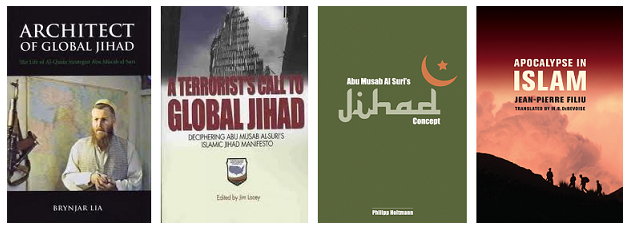
    Brynjar Lia, Architect of Global Jihad: The Life of Al Qaeda Strategist Abu Mus’ab al-Suri
    Jim Lacey, A Terrorist’s Call to Global Jihad: Deciphering Abu Musab al-Suri’s Islamic Jihad Manifesto
    Philipp Holltmann, Abu Musab Al-Suri’s Jihad Concept
    J-P Filiu, Apocalypse in Islam

    — and I’ll be back with a follow-up post tomorrow.

    Another fine voice gone, a fiery liquid, and a Lorca quote or two

    Wednesday, February 15th, 2012

    [ by Charles Cameron — Whitney Houston, RIP, Rumi, a broken reed, Federico Garcia Lorca, the duende ]
    .
    .
    Live performance — Whitney Houston singing Amazing Grace.

    *

    Blog-friend Peter J Munson just recently tweeted this quote:

    “Through the empty archway a wind of the spirit enters, blowing insistently over the heads of the dead”

    That’s from the Spanish poet Federico Garcia Lorca, from an essay of his that I remembered vividly when I heard the other day that Whitney Houston had died. I wrote, then:

    So Whitney Houston has died, far earlier than one might have wished, and the question comes up again whether some gifts essentially “demand” a life that breaks one — as though there’s a liquid inside the anger, the pain, the hurt, that must be set free for the voice to sing.

    I didn’t post that here, because it felt at the time a little too private — but Peter Munson’s quote from Lorca reminds me that I followed up that observation about the “liquid” with this:

    My sense that there might be “a liquid inside the anger, the pain, the hurt, that must be set free for the voice to sing” comes from the way her voice breaks, and breaks again, as she’s singing “a wretch like me” — from about 1’45” with the liquid finally spilling at 1’51″….

    in the Amazing Grace video above…

    *

    If you’re interested in the background to that idea of mine about the liquid, I’ll admit to two sources here — the first is Jalaluddin Rumi, who compares himself in the opening of his Masnavi with a reed, severed from its roots in the marshes to become a flute:

    “Ever since I was cut off from my reed-bed, men and women all have lamented my bewailing. I want a breast torn asunder by severance, that I may fully declare the agony of yearning. Every one who is sundered far from his origin longs to recapture the time when he was united with it. In every company I have poured forth my lament, I have consorted alike with the miserable and the happy: each became my friend out of his own surmise, none sought to discover the secret in my heart. My secret indeed is not remote from my lament, but eye and ear lack the light to perceive it. Body is not veiled from soul, nor soul from body, yet to no many is leave given to see the soul.

    As Rumi himself comments:

    This cry of the reed is fire, it is not wind; whoever possesses not this fire, let him be naught!

    My second source, echoing to us perhaps from the Cordoba of the Sufis, is Garcia Lorca, in his astounding essay, Theory and Play of the Duende — from which these paragraphs, like Peter Munson’s quote, are torn:

    Once, the Andalusian ‘Flamenco singer’ Pastora Pavon, La Niña de Los Peines, sombre Spanish genius, equal in power of fancy to Goya or Rafael el Gallo, was singing in a little tavern in Cadiz. She played with her voice of shadows, with her voice of beaten tin, with her mossy voice, she tangled it in her hair, or soaked it in manzanilla or abandoned it to dark distant briars. But, there was nothing there: it was useless. The audience remained silent.

    In the room was Ignacio Espeleta, handsome as a Roman tortoise, who was once asked: ‘Why don’t you work?’ and who replied with a smile worthy of Argantonius: ‘How should I work, if I’m from Cadiz?’

    In the room was Elvira, fiery aristocrat, whore from Seville, descended in line from Soledad Vargos, who in ’30 didn’t wish to marry with a Rothschild, because he wasn’t her equal in blood. In the room were the Floridas, whom people think are butchers, but who in reality are millennial priests who still sacrifice bulls to Geryon, and in the corner was that formidable breeder of bulls, Don Pablo Murube, with the look of a Cretan mask. Pastora Pavon finished her song in silence. Only, a little man, one of those dancing midgets who leap up suddenly from behind brandy bottles, sarcastically, in a very soft voice, said: ‘Viva, Paris!’ as if to say: ‘Here ability is not important, nor technique, nor skill. What matters here is something other.’

    Then La Niña de Los Peines got up like a madwoman, trembling like a medieval mourner, and drank, in one gulp, a huge glass of fiery spirits, and began to sing with a scorched throat, without voice, breath, colour, but…with duende. She managed to tear down the scaffolding of the song, but allow through a furious, burning duende, friend to those winds heavy with sand, that make listeners tear at their clothes with the same rhythm as the Negroes of the Antilles in their rite, huddled before the statue of Santa Bárbara.

    La Niña de Los Peines had to tear apart her voice, because she knew experts were listening, who demanded not form but the marrow of form, pure music with a body lean enough to float on air. She had to rob herself of skill and safety: that is to say, banish her Muse, and be helpless, so her duende might come, and deign to struggle with her at close quarters. And how she sang! Her voice no longer at play, her voice a jet of blood, worthy of her pain and her sincerity, opened like a ten-fingered hand as in the feet, nailed there but storm-filled, of a Christ by Juan de Juni.

    Perhaps we could say that Houston’s inspiration was a duende-haunted angel…

    *

    Another live performance a few years later… the solo:

    *

    Pondering these things, and thinking of that “liquid” I mentioned, my friend William Benzon quoted Lena Horne to me, as reported by David Craig in On Performing:

    And then when they killed [Robert] Kennedy and Martin Luther King, it seemed like a floodgate had opened. There had been a lot of deaths in my own family. … and when I say, I was different. I began to “listen” to what I was doing and thinking. I listened to the audience. Even to the quiet. I had never listened to it before. … I was different because I was letting something in. The tone was developing differently. I could do what I wanted with it. I could soften it. I wasn’t afraid to show the emotion. I went straight for what I thought the songwriter had felt at a particular moment because he must have felt what I’d been feeling or else I couldn’t have read that lyric, I couldn’t have understood what he was saying. And I used my regretfulness and my cynicism. But even my cynicism had become not so much that as … logic. Yes, life is shit. Yes, people listen in different ways. some nights they’re unhappy at something that has happened to them. OK. I can feel that knot of resistance. OK. That’s where I’m going to work to. … And the second “eight” would be different than the first because the first was feeling it out and the second would change because I could come in “to my mood.” … It developed out of this relaxation … a tone that was softer, more liquid.

    *

    My life had no troubles while I was listening to those tracks.

    The Human Face of War, by Jim Storr, in paperback

    Tuesday, February 14th, 2012

    [by J. Scott Shipman]

    The Human Face of War, by Jim Storr

    This extraordinary book is now available in paperback for considerably less than the original $100 price tag.

    This book has been reviewed twice at zenpundit:

    Zen wrote the first review here.

    I followed up with a dust-off of a long review written just after reading, find that here.

    This is a very important book and strongly recommended.

    ADDENDUM:

    Zen here – I am intruding on Scott’s post to add my strong endorsement. If you are serious about strategy, particularly if you are a member of the armed forces with responsibility for operational planning or unit leadership,  The Human Face of War by Colonel Storr is on the short list of must-read books. It no longer costs a zillion dollars, so go buy it.


    Switch to our mobile site