zenpundit.com » islamist

Archive for the ‘islamist’ Category

Black Banners in Sydney 2: on flags and their meanings

Monday, December 22nd, 2014

[ by Charles Cameron — the history and dwindling significance of a sign ]
.
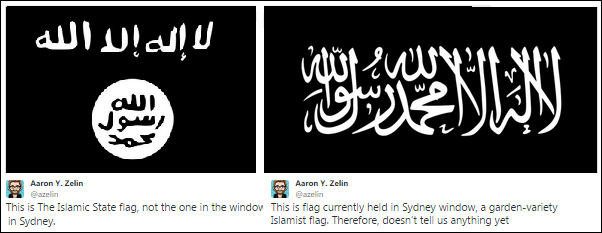
two flags

**

In my previous post in this series, Black Banners in Sydney 1: a DoubleQuote in the Wild from Ardeet, I wrote:

The flag in the image from the Lindt cafe is not in fact the Daesh / Islamic State flag, and indeed the hostage-taker appears to have asked for a genuine Daesh / IS flag as one of his demands. The flag shown is a black flag containing the Shahada or Islamic profession of faith in white, and black flags in Islam have a history as war flags dating back to the time of the Prophet himself.

The banners are black, and there are implications.

**

First, the black banner was the Prophet’s flag, the raya.

The Islamic Imagery Project at West Point’s Combating Terrorism Center lists “Black Flag” under the heading “Warfare Motifs“, saying:

The Black Flag (al-raya) traces its roots to the very beginning of Islam. It was the battle (jihad) flag of the Prophet Muhammad, carried into battle by many of his companions, including his nephew ‘Ali ibn Abi Talib. The flag regained prominence in the 8th century with its use by the leader of the Abbasid revolution, Abu Muslim, who led a revolt against the Umayyad clan and its Caliphate. The Umayyads, the ruling establishment of the Islamic world at the time, were seen as greedy, gluttonous, and religiously wayward leaders. The Abbasid revolution, then, was aimed at installing a new, more properly Islamic ruling house that would keep orthodox Islam at the center of its regime. Since then, the image of the black flag has been used as a symbol of religious revolt and battle (i.e. jihad). In Shiite belief, the black flag also evokes expectations about the afterlife. In the contemporary Islamist movement, the black flag is used to symbolize both offensive jihad and the proponents of reestablishing the Islamic Caliphate.

The Abbasids flew black banners, and were therefore known as the musawwids, or “wearers of the black”.

**

There are ahadith, considered by the scholar David Cook and others to be Abbasid forgeries, which claim that black banners from the east are a sign of the Mahdi’s coming. One such hadith reads:

If you see the black flags coming from Khurasan, join that army, even if you have to crawl over ice, for this is the army of the Caliph, the Mahdi and no one can stop that army until it reaches Jerusalem.

In Understanding Jihad, Cook writes:

Since Afghanistan, as Khurasan, has powerful resonance with many Muslims because of the messianic expectations focused on that region, this gave the globalist radical Muslims associated with al-Qa’ida under the leadership of Bin Ladin additional moral authority to proclaim jihad and call for the purification of the present Muslim governments and elites.

And as I have said before, Cook notes in his Contemporary Muslim Apocalyptic Literature that bin Laden’s mentor, Abdullah Azzam, made fresh use of this line of messianic tradition and “popularized the position of Afghanistan as the messianic precursor to the future liberation of Palestine” in his book, From Kabul to Jerusalem, while bin Laden refers to finding “a safe base in Khurasan, high in the peaks of the Hindu Kush” in his 1996 Declaration of Jihad.

**

There are many variants on the black flag, some of them carrying the Shahada or proclamation of faith, some decorated with the Prophet’s seal, some identifying particular jihadist factions. And while AQ in particular has capitalized on the hadith for recruitment as Ali Soufan detailed in his book The Black Banners, the breakaway “caliphate” use of black banners has been so prominently reported in the media that what used to be termed “the Al-Qaida flag” is now often called “the ISIS” (or “Islamic State”) flag.

It is against that somewhat confused background that we must understand Man Haron Monis’ demand, once he realized that the black flag with Shahada he was forcing hostages to hold in the window of the Lindt café was not the “right” black flag, that he be brought an “Islamic State” black flag – presumably the one with the Prophet’s seal, which had in fact been known as the “Al-Qaeda flag” before Daesh / IS took it up.

I once asked the American jihadist Omar Hammami, late of Al-Shabaab – who used that same black flag with Shahada and Prophetic seal in Somalia – whether their choice of flag referred only to Muhammad’s banner, or to the “black banners of Khorasan” ahadith also? – to which he replied:

the raayah is something general in religion regardless of color, but obviously those hadiths influenced black choice

**

I have been harping on the “end times” and specifically Mahdist significance of black banners in the contemporary context for seven years now, and lamenting that so little mention is made of the black banners’ apocalyptic connotations.

For the Islamic State / Daesh, there is no need to question its apocalyptic significance – all five issues to date of their magazine Dabiq have focused on the great “end times” battle to be fought at Dabiq in Syria – a name to compare with Har Megiddo, where the battle of Armageddon will be fought in the equivalent Christian “end times” narrative.

But for some demented guy taking hostages in a café in Sydney?

**

It now appears to me that the “meme” of black flags simply meaning “jihadist” is now so wide-spread, that the apocalyptic resonances may no longer be intended when someone picks up such a flag – or photographs it in some new context —

— no more so than the sign of a Che Guevara poster in a college dorm betokens a serious adherent to Marxist revolution.
Of the Omnipotence of the Americans and Russians

Saturday, December 20th, 2014

[ by Charles Cameron — or it may be time treat the newfangled term “omnimpotence” as a valid theological descriptor for the hubris manifested by “great powers” ]
.

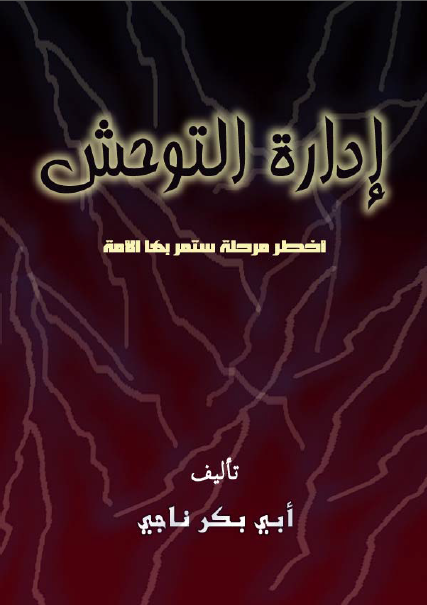
Management of Savagery cover 427

**

Abu Bakr Naji makes an interesting point about hubris in his jihadist dissertation, The Management of Savagery (cover image above), which I was thumbing through today:

Therefore, the two superpowers must resort to using a deceptive media halo which portrays these powers as non-coercive and world-encompassing, able to reach into every earth and heaven as if they possess the power of the Creator of creation.

But the interesting thing that happened is that these two superpowers believed, for a time, their media deception: that they are actually a power capable of completely controlling any place in the entire world, and that (this power) bears the characteristics of the power of the Creator.

**

You know Parkinson’s Law, that “work expands to fill the time available for its completion”. It’s one specific instance of the more general saying “Nature abhors a vacuum” — and as always, if there’s one instance of a more general rule, there are liabke to be others.

I’d like to suggest that Abu Bakr Naji may be onto something: that when the idea of an omnipotent deity vanishes (“appears vacuous” or is no longer taken with any depth of seriousness), whatever power is sufficiently well-placed for that purpose is liable to fill the vacuum with its own sense of, well, omnipotence.

This omnipotence of a superpower (or powers — Naji refers to two “poles” in his treatise, the US and Russia) may not be clothed in such a religious term as “omnipotence” — but it can still carry with it the idea of a quasi-divine aegis, as in the concept of American exceptionalism, the “shining light on a hill” able to illuminate the rest of the world.

Thinking America is the sole remaining superpower, Russia having lost its claim to that status at the end of the Cold War, clearly has enough support in practical reality to make it very easy for us to blur the distinction between “omnipotence” and “superpower” — with much of the theological resonance of the former term remaining as a halo, to use Naji’s term, about the latter.

From a psychiatric point of view, this is the very nature of hubris — an overweening or excessive confidence or pride — of the sort that Carl Jung, interestingly enough, would term “inflation” — a sense of power that puffs itself up beyond its realistic limits to fill the vacuum made available by the absence of a recognition of God as an authentically omnipotent higher power.

And we know what happens to over-extended balloons, bubbles, and the like…

**

It is only too easy for us to be so “rational” that we overlook the “irrational” or frankly “magical” aspects of our thinking — but the gap between supposed “realism” and reality may be a crucial one, and one which Naji sees from a distance more clearly than do we who are within it.

A most curious YouTube quotation

Tuesday, December 16th, 2014

[ by Charles Cameron — total clash or bizarre agreement? Sydney hostage-taker Man Haron Monis quoted Christian apologist David Wood video on his Twitter feed ]
.

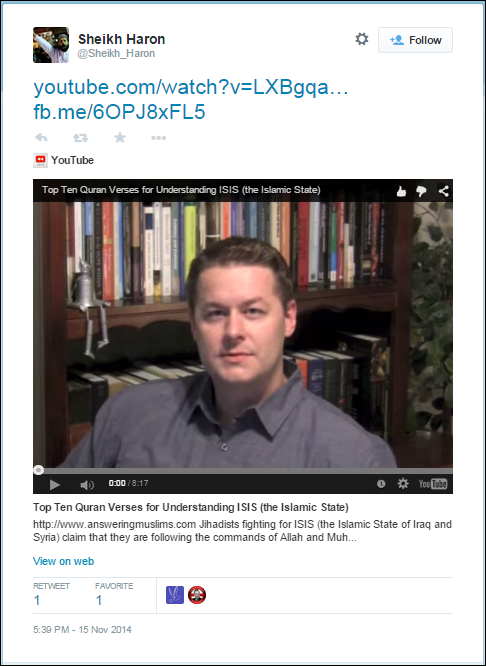
I am really not sure quite what to make of this. Sheikh Haron, aka Man Haron Monis, the disturbed ex-Shia convert to “Islam” who was the Sydney “hostage-taker” had a Twitter-feed, still up as I was researching this piece, which included this tweet:

**

Somewhat to my amazement, Haron is posting a video by the Christian apologist David Wood of Acts 17 Apologetics — a gentleman I’ve run across before, strongly opposed to Islam. Here’s the video in question, as featured on the Acts 17 Apologetics YouTube channel

Is Haron quoting Wood like this because he agrees (??!!) with Wood’s analysis of IS in terms of Quranic injunctions — or to show how disdainfully opposed to Islam, western views or Christian apologetics “really are”? — perhaps even both simultaneously?

No matter how you read Haron’s use of Wood’s video, or the various versions of the two Abrahamic faiths under discussion, the appearance of a Christian apologeticist on Haron’s website should give us pause for thought.

For an insight into Wood himself, the redemptive bio on the Moral Apologetics website under the title On Psychopathy and Moral Apologetics is worth your attention.

**

In case Haron’s feed gets taken down — I’m amazed it hasn’t been taken down already — here is a screen cap of that tweet:

Sheikh Haron's tweet

For more on Haron’s online presence, see Zack Beauchamp quoting Daveed Gartenstein-Ross in Sydney hostage taker Man Haron Monis pledged allegiance to ISIS on his website

No compulsion in religion

Wednesday, December 10th, 2014

[ by Charles Cameron — is Daesh the exception that proves the rule? ]
.

Qur’an 2. 256:

Let there be no compulsion in religion: Truth stands out clear from Error

Jottings 12: KSM’s “non-violence” refers to preaching, not fighting

Tuesday, February 18th, 2014

[ by Charles Cameron — not an aha! but a d’oh! moment ]
.


.

This, from the Huffington Post last month:

The mastermind of the Sept. 11, 2001, terrorist attacks now says that the use of violence to spread Islam is forbidden by the Quran, a major shift away from the more militaristic view he had put forward previously.

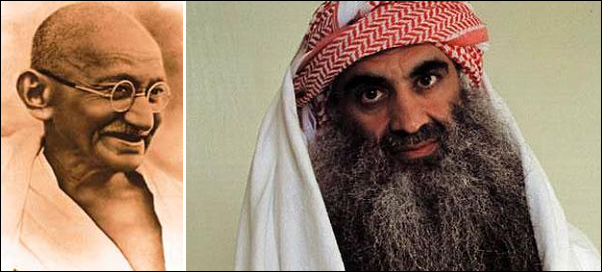
Khalid Sheikh Mohammed’s thinking is detailed in a first-of-its-kind 36-page manifesto obtained by The Huffington Post. In a departure from his previous stance, which led the Guantanamo Bay prisoner to tell a military commission, “it would have been the greatest religious duty to fight you over your infidelity,” KSM, as he’s known in intelligence circles, instead seeks to convert the court to Islam through persuasion and theological reflection, going so far as to argue that “The Holy Quran forbids us to use force as a means ofconverting” and that reaching “truth and reality never comes by muscles and force but by using the mind and wisdom.”

I saw various versions of this tale — from the LA TimesKhalid Shaikh Mohammed issues ‘nonviolence’ manifesto:

The Koran, Mohammed wrote, “forbids us to use force as a means of converting” others, and “truth and reality never comes by muscles and force but by using the mind and wisdom.” Those statements clash with his earlier braggadocio in saying he plotted the Sept. 11 attacks and personally beheaded Wall Street Journal reporter Daniel Pearl, and in calling for young Muslims around the world to embrace violence.

— and from Andrew Cohen, explaining in The Atlantic why the manifesto may have been made available in the first place:

Perhaps the feds welcome Mohammed’s shifting interpretation of the Quran, which he now says prohibits violence as a means of spreading Islam.

However, I very much doubt that’s what’s going on.

**

The true meaning of KSM’s writing may be a little different from the reading given to it by the press. Here’s an actual quotation from the manifesto:

It is my religious duty in dealing with any non-Muslims to invite them to embrace Islam.

The Counter Jihad gets this bit right, I think, in a post titled KSM’s Prison Communiqués Part II: Wartime Religion of Peace Propaganda:

In point of fact, Islamic law teaches that, before waging offensive jihad, Muslims must first invite nonbelievers to accept the truth of Islam. Doctrinally, this summons to Islam is a necessary precondition to waging violent jihad. There are numerous examples of bin Laden and Zawahiri (bin Laden’s deputy and now the leader of al Qaeda) issuing public statements calling on infidels to accept Islam.

It’s a one-two sequence. Before engaging in acts of war, the jihadist must first make a peaceful and indeed graciously phrased invitation to convert to Islam… in the words of the Qur’an, 16.125:

Invite (all) to the Way of thy Lord with wisdom and beautiful preaching; and argue with them in ways that are best and most gracious: for thy Lord knoweth best, who have strayed from His Path, and who receive guidance. Q 16.125

**

The result, in the case of KSM’s manifesto, is an appeal that blends Murray Gell-Mann‘s quarks…

Everything that turns in the universe, from the smallest quarks to the largest supernovas are worshipping God, just as Muslims in Mecca circulate around the Kaba, counterclockwise. If you have Mecca TV channel just look for one hour how people from all around the world travel in circles like any electron or moon or earth or sun or any star or galaxy does. Try to record the picture for 15 minutes and then fast forward the picture then repeat it again, then ask yourself who told Abraham (PBUH) and these people a thousand years ago to imitate the laws of the Universe and nature. The answer will be He Who created these trillions of galaxies and human beings and made ?xed laws for all, but granted humans free will in order to test them.

— with the fifth century AD Neoplatonism of Proclus Lycaeus:

Just as in the dialectic of love we start from sensuous beauties to rise until we encounter the unique principle of all beauty and all ideas, so the adepts of hieratic science take as their starting point the things of appearance and the sympathies they manifest among themselves and with the invisible powers. Observing that all things form a whole, they laid the foundations of hieratic science, wondering at the first realities and admiring in them the latest comers as well as the very first among beings; in heaven, terrestrial things according both to a causal and to a celestial mode and on earth heavenly things in a terrestrial state….

What other reason can we give for the fact that the heliotrope follows in its movement the movement of the sun and the selenotrope the movement of the moon, forming a procession within the limits of their power, behind the torches of the universe? For, in truth, each thing prays according to the rank it occupies in nature, and sings the praises of the leader of the divine series to which it belongs, a spiritual or rational or physical or sensuous praise; for the heliotrope moves to the extent that it is free to move, and in its rotation, if we could hear the sound of the air buffeted by its movement, we should be aware that it is a hymn to its king, such as it is within the power of a plant to sing…

**

Interestingly enough, KSM also quotes Matthew 5.44-45a:

But I say unto you, Love your enemies, bless them that curse you, do good to them that hate you, and pray for them which despitefully use you, and persecute you; That ye may be the children of your Father which is in heaven…

— and in a letter to Rory Green, a British Christian who had written inviting him to repentance and faith in Jesus Christ, he responds:

I appreciate your deep concern regarding my worldly and hereafter life … You asked me to repent from my sins. For your own information, I never stop.

**

Let’s just say, it pays to peer beneath the surface.


Switch to our mobile site