zenpundit.com » suicide bombing

Archive for the ‘suicide bombing’ Category

Ashura: the Passion of Husayn

Sunday, November 25th, 2012

[ by Charles Cameron — today’s solemn commemorations in Iraq, Afghanistan, Pakistan and India in comparative religious perspective ]
.

I was listening to Mozart‘s Requiem last night, and it is rich in grief shot through with glory. That’s the thing about mourning celebrations in which death is accompanied by the “sure and certain hope of the Resurrection into eternal life”.
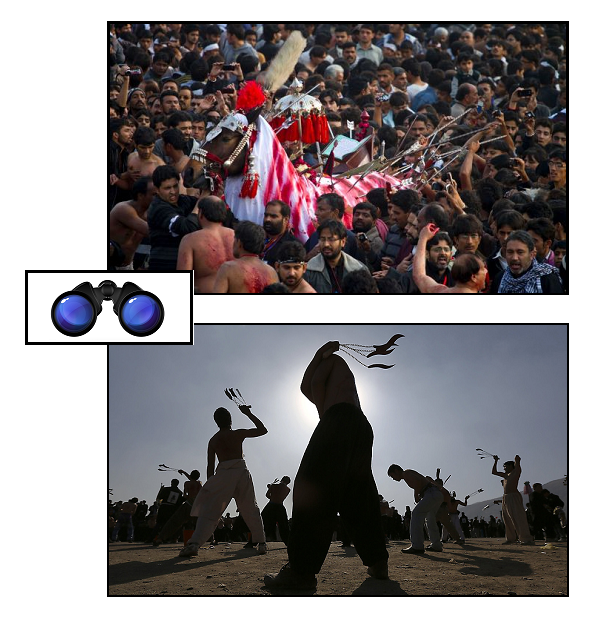
One such observance is found in Shia Islam, and falls this year on the 25th of November — today. It is the day of Ashura, the 10th day of Muharram in the Islamic calendar, and its epicenter is at Karbala in Iraq. As the saying goes:

Every day is Ashura and every land is Karbala.

For the Shia, Ashura commemorates the martyrdom of Husayn, grandson of the Prophet, at the Battle of Karbala, when he refused to give allegiance to the Umayyad caliph Yazid. Husayn’s martyrdom is dramatized in Ta’zieh, passion plays, giving us a hint that the martyrdom of Husayn at Ashura figures in the devotional life of the Shia much as the passion and death of Christ figures within Christianity, both in passion plays such as that at Oberammergau and in Catholic rituals such as the Stations of the Cross. This may seem a far-fetched analogy to some of my readers, but both deaths are viewed as redemptive. As another saying has it:

A single tear shed for Husayn washes away a hundred sins.

**

As you can see depicted in the lower panel above, Shiite mourning can include flagellation with chained blades, not something that sits easily with most westerners — yet as Roy Mottahedeh has said (quoted in SA Hayder, Reliving Karbala: Martyrdom in South Asian Memory):

Self-mutilation in emulation of the “passion” of heroes who are human yet divine is no stranger to the West: flagellants who whipped themselves both in penance and in remembrance of the scourging and crucifixion of Jesus appeared in almost every western European country in the Middle Ages…

The upper panel above depicts Husayn’s horse, riderless and bloody, and can perhaps give us some sense of the dark ceremonial beauty of the occasion for those whose grief transcends time and unites them in aspiration with Husayn himself — their flagellation attesting to their wish that they themselves could have stood beside him on that day so long ago, standing for truth against an army of injustice.

**

Their grief may be trans-temporal, but the possibility of dying for their faith persists to this day, for Sunni militants of the jihadist sort view Ashura differently — primarily as a day of fasting first performed by Moses and continued by Muhammad — and detest the breakaway sect of the Shia as rafidun, heretics.

In Iraq, Ashura there has seen millions of pilgrims visiting Karbala this year, with comparatively little violence:

Millions of Shiites flooded the Iraqi shrine city of Karbala on Sunday for the peak of Ashura rituals, which have been largely spared the attacks that struck pilgrims in past years. A bomb wounded 10 pilgrims in Diyala province, north of Baghdad, but it was the first such attack since a car bomb against pilgrims killed three people on November 17.

Farther afield, what the Pakstani police describe as a “major terror plot to attack the Muharram processions in Karachi” was avoided this year when “large amounts of explosive material, two suicide jackets and grenades” were confiscated during a raid, with the Minister for Religious Affairs declaring that the Tehreek-e-Taliban were behind the plots. Elsewhere in Pakistan:

At least five persons were killed and over 70 others injured on Sunday when a Shia procession was targeted with a bomb at Dera Ismail Khan in Pakistan’s restive northwest, the second such attack in the city in as many days.

Meanwhile in Kabul:

For the past week, the Afghan capital has been draped with black cloth arches and festooned with huge colored banners. Mournful, pounding chants pour from loudspeakers across the city, filling the air with slow martial intensity.

The dramatic display is all part of Muharram and the 10-day Shiite festival that commemorates the slaying of Imam Hussein, a 7th-century holy figure and early champion of Islam. But it is also a symbol of the growing religious and political freedom that Afghanistan’s long-ostracized Shiites have had in the past decade.

That’s from a Washington Post piece yesterday titled Afghan’s Shiite minority fears a return to old ostracism — and the next two paragraphs bear out the title:

Now, as Western military forces prepare to leave the country by 2014, Afghan Shiites, most of whom are from the Hazara ethnic minority, fear that their window of opportunity may slam shut again, leaving larger rival ethnic groups as well as Taliban insurgents, who are radical Sunni Muslims, dominating power.

“Everything we have achieved, our ability to come out and participate in society, has been in the shade of the international community and forces,” said Mohammed Alizada, a Hazara Shiite who was elected to parliament in 2009. “We are very concerned that once they leave, the fundamentalists will reemerge, ethnic issues will return, and we will lose what we have gained.”

Tribal politics, sectarian issues, the impending departure of US forces, the Taliban, cross-border alliances — and the sheer power of devotion — all these are intricately intertwined in today’s Afghanistan and its future. We may do well to understand something of the meaning of this day of Ashura, in our own calendar, 25th November 2012.

**

Annemarie Schimmel, the great Harvard scholar of Islamic mysticism, has a fine essay on the poetry of Ashura, encompassing both Sunni and (strongly Shia-influenced) Sufi traditions, Karbala and the Imam Husayn in Persian and Indo-Muslim literature. The mindset is very different from contemporary secular westernism, seeing death itself — and the grief that accompanies it — as a prelude to resurrection, and thus part of the timeless love-play of God with those who love him:

In having his beloved suffer, the divine Beloved seems to show his coquetry, trying and examining their faith and love, and thus even the most cruel manifestations of the battle in which the ‘youthful heroes’, as Shah Latif calls them, are enmeshed, are signs of divine love.

The earth trembles, shakes; the skies are in uproar;
This is not a war, this is the manifestation of Love.

The poet knows that affliction is a special gift for the friends of God, Those who are afflicted most are the prophets, then the saints, then the others in degrees’, and so he continues:

The Friend kills the darlings, the lovers are slain,
For the elect friends He prepares difficulties.
God, the Eternal, without need what He wants, He does.

**

The spirit here is not too far from that of the Greek philosopher Plotinus, who wrote in his Enneads [III.ii.15]:

Men directing their weapons against each other- under doom of death yet neatly lined up to fight as in the pyrrhic sword-dances of their sport- this is enough to tell us that all human intentions are but play, that death is nothing terrible, that to die in a war or in a fight is but to taste a little beforehand what old age has in store, to go away earlier and come back the sooner.

together with that of the early Christian Father, Origen, who wrote [De Martyrio, 39]:

And let each of us remember how many times we have been in danger of an ordinary death, and then let us ask ourselves whether we have not been preserved for something better, for the baptism in blood which washes away our sins and allows us to take our place at the heavenly altar together with all the companions of our warfare.

**

In India, indeed, the martyrdom of Husayn takes on an interfaith character in some places, as Hindus and Christians join Muslims in Ashura commemorations, as Naim Naqvi relates:

One can observe the richness and beauty of the diversity of Indian Culture at the occasion of Muharram. Since the martyrdom of Imam Hussain, Muharram ceremonies are observed all over the world including India. Hindus take part in them with great reverence and devotion. The tragedy of Karbala has become the harbinger for interfaith understanding in the Indian sub-continent. Participation of Hindus in the mourning rituals of Imam Hussain has been a feature of Hinduism for centuries in large parts of India. Hindus, Sikhs, Jains and even Christians observe Muharram. In the city of Varanasi which is the holiest city for Hindus many Hindu families participate in Muharram processions.

Describing the participation of one such Hindu family in Orissa, we read:

District police chief Lalit Das said Padhihary family has been doing this every year for the last 338 years, adding other local Hindu families also participate in the procession.

Muslims said it reflected the perfect harmony between the two communities in the area.

“Ground Hog Day” Afghanistan Style — Lara Logan Shining Light Where Needed

Wednesday, October 10th, 2012

[by J. Scott Shipman]

This is worth the 20 minutes. Strategy without clarity, isn’t. There is no clarity or strategy to our current problems in Afghanistan.

“We have killed all the slow and stupid ones. But that means the ones that are left are totally dedicated.” Ambassador Ryan Crocker

Cross posted at To Be or To Do.
H/T Feral Jundi at Facebook.

It’s an abomination!

Saturday, July 21st, 2012

[ by Charles Cameron — the perils of adding scriptures to scripture, tearing or burning them — and flags, paper money too ]
.


.

It may be that the last time you used the word abominable it was in relation to a snowman. It’s not a word that’s frequently on my tongue, I have to admit, but an Israeli MK apparently used it — or it’s Hebrew equivalent — to describe the New Testament, which he was in the process of ripping up.
.


.

Shades of Pastor Jones burning a copy of the Quran!

**

The thing is, when you have a sacred scripture it’s delimited, it’s hands-off! And if someone else comes along and adds a slim volume or two, it’s an abomination, almost by definition, sight unseen.

Thus the New Testament is an abomination to Knesset member Michael Ben Ari, according to YNet:

“This abominable book (the New Testament) galvanized the murder of millions of Jews during the Inquisition and during auto da fe instances,” Ben Ari said adding that “Sending the book to MK’s is a provocation. There is no doubt that this book and all it represents belongs in the garbage can of history.”

And please note, I am definitely not suggesting that Ben Ari is representative of all Jews — nor, for that matter, Pastor J. Grant Swank of all Christians. Yet from Swank’s perspective, the Tanakh and New Testament are scriptures, but, and I’m quote him:

Obama’s so-called holy writ is the abominable Koran.

The Qur’an is a later scripture, neh?

And Swank’s tirade gets better. Still speaking of the President of the United States, he continues:

His hope for eternity is unknown; but if he becomes a suicide bomber for Allah, he will be guaranteed pronto a score of virgins for everlasting. His hope for the present seems to be his reliance upon Islam’s Koran furthered by his clandestine support of Islam World Rule via czars and a shadow government given to overthrowing our Republic.

And then on the other side of the political aisle there’s Mitt Romney‘s Latter-day scripture, The Book of Mormon, which bills itself as Another Testament of Jesus Christ. It too has been considered an abomination.

I don’t know if people still use the word much when talking about the Book of Mormon, it’s considerably less controversial these days than the Qur’an — but abominable was what Arthur Cleveland Coxe called it in his 1855 Sermons on doctrine and duty, writing of Joseph Smith:

an obscure and illiterate individual, in our great West, was busily forging the abominable “Book of Mormon,” which, fourteen months later, he foisted into the world…

People really don’t like other people making add-ons to their scriptures, do they?

**

Scriptures — and flags.

Look, I weep for a religion some of whose adherents kill when their scripture is burned or defiled, and I am glad for a religion that condemns such killings. As you might expect, there are tearers and burners in all three Abrahamic religions, and all three religions have those who object to such tearings and burnings.

And yes, the ratios of religiously-provoked modes of destruction vary across religions and across centuries…

**

But what of flags?

I raise the issue because a fellow in Pakistan who manufactures flags for burning, Mamoon-ur-Rasheed, was in the news recently, and made this point:

Isn’t flag burning positive, compared to American atrocities? And also compared to the Taliban? We’re not attacking mosques. … We’re not targeting American embassies. We’re not killing anyone. Nor are we flying drones around, we’re just burning flags, mere pieces of cloth, and then we’re done. It’s over.

Setting aside Rasheed’s political opinion, Matthew Wallin at American Security Project asks the right questions in the security context:

Is it really over after the deed is done? Does anger against the United States dissipate? What do people do after they have gone home after a flag burning?

A key question to answer is: how much of these protests are translating into actual violence? This is an element that must be understood to determine if flag burning is simply a form of protest, or if those involved are planning more sinister actions. We must also seek to understand to what degree these protests endanger traditional diplomacy efforts and the challenges faced by members of the Pakistani government attempting to pursue diplomatic cooperation with the United States. If they are harmless expressions of anger and frustration, we have an obligation to understand this.

But that’s really just the beginning of a much wider-ranging discussion, philosophically speaking, which Rasheed’s comments also address:

what’s the relation of a symbolic object to the reality is symbolizes? If a flag is hurt, does it hurt the United States? If a Bible is burned, does it hurt Christianity? God?

If the word “spider” was an actual, live spider, arachnophobes couldn’t read the rest of this sentence… Is Picasso’s signature on a two dollar check worth as much as his signature on a check for a thousand bucks? Come to that, when paper money goes up in smoke when a house catches fire, where does the value go?

And yet, and yet, we are very attached to our flags, our scriptures — and our money.

**

The poet Coleridge in his Statesman’s Manual suggests:

On the other hand, a Symbol is characterized by a translucence of the Special in the Individual or of the General in the Especial or of the Universal in the General. Above all by the translucence of the Eternal through and in the Temporal. It always partakes of the Reality it renders intelligible; and while it enunciates the whole, abides itself as a living part in that Unity, of which it is the representative.

So. Do we find this translucence in our scriptures, in our flags, in our money, in our fellow humans — in the world around us?

Two notes suggestive of the significance of ritual

Saturday, March 31st, 2012

[ by Charles Cameron — Castro asks the Pope about it, suicide bombers don’t get any — ritual ]
.

I have been promising to write about ritual for some time now, and meanwhile other things have intervened…

Two recent news stories, however, remind us that ritual is not as insignificant or even passé as our non-depth-psychological, a-comparative-religious, un-cultural-anthropological secular mindset might lead us to believe…

1.

Let’s start with Pope Benedict XVI. He’s known to be a bit of a stickler for decent ritual, having penned the major papal exhortation Sacramentum Caritatis, the “motu proprio” Apostolic Letter Summorum Pontificum, and, as Cardinal Ratzinger, the book The Spirit of the Liturgy.

Fidel Castro, on the other hand, is more interested in politics than piety, or so the story goes – and was excommunicated in 1962.

So what happens when Benedict XVI (Episcopus Romae) meets Fidel Castro, (Presidente, retired)? Apparently, it’s Fidel who quizzes Benedict about his work…

During his March 29 meeting with Pope Benedict XVI, Fidel Castro questioned the Pope about reforms in the Latin liturgy, and asked for books that would help him understand changes in the Church, the Vatican has disclosed.

That’s interesting, and a wee bit provocative of thought…

2.

The other incident that caught my eye was a piece by Ashfaq Yusufzai on Central Asia Online headed Suicide bombers receive no death rituals, with the sub-header Scholars say bombers are the most unfortunate of people:

Suicide bombers who believe they will go to paradise are mistaken, ulema scholars say. “The suicide bombers are the most unfortunate people on the surface of the earth, as they are neither bathed nor buried, unlike undisgraced Muslims,” said Maulana Aminullah Shah in Par Hoti Mardan. Shah, a prayer leader in Mohallah New Islamabad, Par Hoti, Mardan, said he felt sorry for Rehmanullah, a 17-year-old suicide bomber who attacked Afghan and coalition forces last September and was buried without a funeral prayer.

And from the same article:

Ajmal Shah, a prayer leader in Daudzai, Peshawar, is blunt about the importance of those rituals. “The act of suicide bombing is condemnable. All those blowing themselves up and killing innocent Muslims wouldn’t find a place in paradise as they had been promised by their trainers,” he said of the promises the Taliban use to lure teenage boys into becoming suicide bombers.

*

Ritual. Oh, I know — “we moderns” like to think of it as outmoded, tedious, repetitious, dry as dust…

But it reaches those it reaches, it digs deep into them, it has them by the heart.

The Said Symphony: Meditation / moves 10 and 11

Sunday, June 26th, 2011

[ by Charles Cameron – extended analytic game on Israeli-Palestinian conflict — continuing ]

Meditation part 1 / Move 10

.

What to say? There are two sides to the game, darkness and light, and the light encompasses the darkness, and the darkness threatens the light.

I promised a meditation on the state of the game, and it comes in the form of two moves: Move 10: Piano Lesson, by Haim Watzman, addresses the light, and my sense that the game is as much a gift to me as a gift from me to you, while Move 11: Auschwitz and Theodor Adorno raises the darkest question of all, whether art can still function in situations as terrible as those where humans hate to the fullest extent of their powers.
____________________________________________________________________________________________

Move 10: Piano Lesson, by Haim Watzman

move-010.gif

Move content:

The content of this move is Haim Watzman‘s story Piano Lesson which comes from his Necessary Stories series, on the South Jerusalem blog he shares with my friend and colleague Gershom Gorenberg. It concerns young Felix Mendelssohn, the grandson of the rabbinic scholar Moses Mendelssohn, composer – and the man who revived Bach‘s St Matthew Passion after it had lapsed into obscurity for a century or so.

Links claimed:

With Wagner, in complete refutation of the latter’s opinions about Judaism and musicianship – Watzman’s story opens with the words:

I am impressed. You play like a Jew, Felix. What I mean by that is that you have Johann Sebastian Bach in your heart as well as in your fingertips…

contains this more detailed assertion:

This piece you have played so beautifully for me this morning, the Partita No. 5 in G Major, can only be played properly, in our falscherleuchtung age, this time of false enlightenment, by a person of Jewish sensibility. Please do not interrupt me. At your age you are to listen to your elders first. After you listen you may disagree, you may do whatever you want. But first you must listen.

Sebastian Bach was a devout Lutheran, true, but he wrote Jewish music. I do not say this simply to embellish the repute of my ancestral people. The nation Israel needs no trills. I say this after long years of study and performance of Bach’s music, during which I have come to know this remarkable man. Better, I hazard to say, than his own sons did.

What is Jewish about the music? To see that, you have to know music. Which, of course you know. You also have to know what Judaism is. Which, thanks to my niece, you do not. This is scandalous. The grandson of the great Moses Mendelssohn knows nothing of his own people’s special relationship with God.

and closes with:

Remind me to show you the “St. Matthew Passion.” It is such wonderfully Jewish music!

Comment:

I read this story a day or two after completing moves 8 (Wagner) and 9 (Golgotha) and posting the game thus far to Zenpundit, and was astonished and delighted to find that a mind and heart in Jerusalem – friend of a friend – was touching on the same territory: the relationship of music, especially that of Bach, and Judaism.

But not only does Watzman deftly refute Wagner’s position on Judaism and music as presented in move 8, he also specifically discusses the contrapuntal aspect in both music and religious understanding, and the power of dissonance at times to work towards resolution.

This he accomplishes through a discussion of the two “laws” of Judaism, and the complexities of their musical relationship with one another:

I kept working on the piece and the morning prior to the performance I had my epiphany. Here, let me play it for you.

So where is the stress? Yes, here. And here too. At the end of the melodic line. And at the end of the harmonic progression. Which do not coincide.

You see, the underlying harmonics here are the Torah, the Written Law. And the melody playing above it is the Oral Law. The melody would be hollow, meaningless without the underlying harmony, and the underlying harmony would be incomplete and useless without the melody above it.

The simple-minded might think that the two laws should coincide. What good is a God if his message is not clear?

Yet it is the lack of clarity, the occasional dissonance, the unsynchronized phrases that move us forward, that propel us toward the final resolution. And that final tonic itself sends us off into new melodic and harmonic firmaments, from which we again return to our G major chord. One idea begins before the previous idea has been completed. As when you interrupt your Great Aunt Sara.

There is thus an uncanny melodic line here, running from Said through Bach, Gould, Wagner, to Watzman.

said-watzman.gif

Whatever I am doing here – and it feels at times quite lonely, I am not sure how many people will find this game an easy work to follow – in reading Watzman’s tale of Felix Mendelssohn I felt again my kinship with what has been termed the “invisible cloud of witnesses”…

Indeed, my sense of the gracious synchronicity involved in my stumbling across this particular story of Watzman’s at this particular time can only deepen as Watzman concludes his story – and I my move – with this rendition of the Bach Partita No. 5 in G major BWV 829, played by one Glenn Gould

____________________________________________________________________________________________

Meditation part 2 / Move 11

If the first part of this meditation relates to the game <as a whole, and to the fabric of grace of which, it seems, the universe as a whole is woven, this second part addresses the sense — as bitterly merciless to those who suffer it as grace is merciful to those who receive it — that the fabric of grace is itself picked at and torn by humans, in danger at any point (and perhaps in this moment more than most) of unravelling.

In my personal perspective, I should no more ignore the threat than ignore the grace — for love extends itself in compassion to the one, even as it extends in gratitude to the other.

____________________________________________________________________________________________

Move 11: Auschwitz and Theodor Adorno

move-011.gif

Move content:
Theodor Adorno famously said: “To write a poem after Auschwitz is barbaric.”

*

Think of this move as a sort of metaphysical black hole, an anti-game.

To expand on this idea a little: Adorno was a musical advisor to Thomas Mann while Mann was writing his novel Doctor Faustus — a copy of which he inscribed to his friend Hermann Hesse with the words “To Hermann Hesse, this glass bead game with black beads, from his friend Thomas Mann, Pacific Palisades, January 15, 1948” – featuring a composer named Adrian Leverkuhn, whose intention in his final work was to retract — cancel, annul — Beethoven‘s Ninth Symphony, and in particular its Ode to Joy with his own oratorio, The Lamentation of Doctor Faustus.

 “I find,” he said, “that it is not to be.”
“What, Adrian, is not to be?”
“The good and the noble, what we call the human, although it is good, and noble. What human beings have fought for and stormed citadels, what the ecstatics exultantly announced — that is not to be. It will be taken back. I will take it back.”
“I don’t quite understand, dear man. What will you take back?”
“The Ninth Symphony,” he replied.

Herbert Marcuse — another modernist philosopher of the left — is quite clear on the power of this Faustian attempt, which he approves as liberating us from “illusion” and indeed “making us see the things which we do not see or are not allowed to see, speak and hear a language which we do not hear and do not speak and are not allowed to hear and to speak”:

The present situation of art is, in my view, perhaps most clearly expressed in Thomas Mann’s demand that one must revoke the Ninth Symphony. One must revoke the Ninth Symphony not only because it is wrong and false (we cannot and should not sing an ode to joy, not even as promise), but also because it is there and is true in its own right. It stands in our universe as the justification of that ‘illusion’ which is no longer justifiable.

Links claimed:

To Wagner, because the mythology of blood and race which he promulgated so stirred one Adolf Hitler that the latter carried out the Shoah, in face of which Adorno finds poetry – hence Orpheus and the muses — speechless.

To Golgotha, because Christ is banished and beaten from the city, Jerusalem, whose name is The Abode of Peace — because there is no more despairing cry than his cry at Golgotha: “My God, My God, why hast Thou forsaken Me?” — because the Descent of Mercy in human form is then brutally executed as a common criminal – because the very veil that protects the holy of holies in the JerusalemTemple is then torn asunder, as his body is broken – because all this marks the darkest moment in the Christian narrative – and because such desolation, felt by the Marys gathered at the foot of the cross, is nowhere so closely mapped in the history of the arts as by the silence of poetry and the arts before atrocity.

And to Watzman, because despite the Shoah — the Golgotha of my civilization and Hesse’s and Bach’s — and despite Adorno, there is poetry in his voice — an Israeli voice, speaking after Auschwitz, in an Israeli State, in Jerusalem.

Comment:

As I was setting out the ground-rules for this game, my friend Lexington Green made what I’d like to call “the essential objection”. He wrote:

Pals send their teenagers to be suicide bombers. That is beyond dissonant. There is no symphony where one group of musicians is committed to a relentless campaign of murder and terror. Said was using this as one more way of playing make-believe, and claiming moral equivalence. In other words, it was a sophisticated move in an elaborate scheme to help disarm his opponents so his fellow Palestinians could kill them.

There is another point of view, which sees the Israelis enforcing a mutant form of apartheid with attendant horrors on an occupied population – indeed, I have Israeli friends who hold some version of this view — but Lex’s point is crucial:

There is no symphony where one group of musicians is committed to a relentless campaign of murder and terror.

This cuts to the heart of the work, as it cuts to the heart of our world. It is, in essence, the issue of theodicy, and which Lex’s permission I am addressing it in this meditation, within the work itself …

My linking of the cry of Golgotha –“My God, My God, why hast Thou forsaken Me?” – with the cry of Adorno – “To write a poem after Auschwitz is barbaric” – is my presentation of the most godforsaken of despair of which we are humanly capable, and I present it within that opposite extremity of human possibility represented by Bach’s motto which I invoked earlier, Soli Deo Gloria.

It is precisely in the context of free will that both possibilities arise, and theodicy becomes an issue. Here, then, is the relationship of darkness to light as described by St John in the Prologue to his gospel:

the light shines in the dark, darkness does not blot it out.

I can say no fairer than that.

____________________________________________________________________________________________

Conclusion:

Oliver Sacks in Musicophilia tells the story of a Manhattan psychiatrist who lived immediately opposite the Twin Towers, and whose otherwise rich interior musical life went blank for months after he witnessed the 9-11 attacks:

My internal life was dominated by a dense and silent pall, as if an entire mode of existence were in an airless vacuum. Music, even the usual internal listening of especially beloved works, had been muted…

“Music”, the psychiatrist said, “finally returned as a part of life for and in me” after an absence of several months. The first music to return was Bach‘s Goldberg Variations.

Again, I must admit it was by no skill of mine but some grace of god or muse that I stumbled on Sacks’ book today, while searching my cramped and overflowing shelves for something else entirely.

There are, it seems true, periods of silence in the arts, while we absorb horrors of our human doing.

There is also a return from those horrors to the arts — even Marcuse admits this — and as forgiveness, mercy and compassion alike claim, to that great possibility, “a happy issue out of all our afflictions”.

Or so the mystics tell the realists — and time grinds all to dust.

[ next ]


Switch to our mobile site