zenpundit.com » cognition

Archive for the ‘cognition’ Category

Knowledge Expertise as a Springboard instead of a Cage

Saturday, January 5th, 2008

Steve DeAngelis had an excellent and timely post on the cognitive diversity involved in the creative process of innovation, working off an article in The New York Times, Innovative Minds Don’t Think Alike:
The Curse of Knowledge

“There is a lot of denial when it comes to the curse of knowledge. Nobody likes to admit that they are incapable of thinking out of the box. Entrepreneurs pride themselves on being able to envision the “next big thing.” Designers and inventors are always looking for better ways to do things. The good ones have learned tricks that help them break down the walls of knowledge. According to Rae-Dupree psychologists have conducted experiments that demonstrate that a person’s first instinct is to think about old things rather than new things. That’s not really surprising since we can only think about what we know.

‘Elizabeth Newton, a psychologist, conducted an experiment on the curse of knowledge while working on her doctorate at Stanford in 1990. She gave one set of people, called ‘tappers,’ a list of commonly known songs from which to choose. Their task was to rap their knuckles on a tabletop to the rhythm of the chosen tune as they thought about it in their heads. A second set of people, called ‘listeners,’ were asked to name the songs. Before the experiment began, the tappers were asked how often they believed that the listeners would name the songs correctly. On average, tappers expected listeners to get it right about half the time. In the end, however, listeners guessed only 3 of 120 songs tapped out, or 2.5 percent. The tappers were astounded. The song was so clear in their minds; how could the listeners not ‘hear’ it in their taps?’

….Rae-Dupree notes that there are ways to “exorcise the curse.” I have written about one of those ways before. Frans Johansson calls it “The Medici Effect” in his book of the same name. He argues in favor of creating a space in which people from diverse fields of expertise can get together to exchange ideas. The Medici’s, of course, were a wealthy and powerful Italian family who played an important role in the Renaissance. The family’s wealth permitted it to support artists, philosophers, theologians, and scientists, whose combined intellect helped burst the historical pall known as the Dark Ages. Getting people with different knowledge bases together means that none of them can remain within the walls of their own knowledge domain for long. As a result, good ideas normally emerge”

Read the rest here.

Acquiring disciplinary expertise typically takes approximately a minimum of 7-10 years for the student to master enough depth of knowledge and requisite skill-sets to become an expert practitioner. In many fields, notably pure mathematics, theoretical physics and musical composition, this period of early mastery is often the most fruitful in terms of significant contributions of new discoveries or the kinds of innovations that Mihaly Csikszentmihalyi and Howard Gardner consider to be “Big C” creativity. Einstein’s papers on Relativity or Newton’s early exposition of the Laws of Motion being the great historical examples of paradigm-shifting innovators. If a practitioner remains entirely in that field for their career, cultivating an ever greater and rarefied depth of knowledge ( and thus having fewer true peers and more disciples) further contributions are likely to be of the “tweaking” and “critiquing” variety. Useful but not nearly as satisfying as the grand “breakthrough” moment.

I suspect that the reason for this decline in major creativity has to do with two realities of expertise:

First, the analytical-reductionist emphasis on vertical thinking; cognitively, for an acknowledged expert, there is a great deal more time spent on mere data retrieval, interpretation within accepted frames and scanning patterns for consistency than there is original problem solving, questioning premises, speculating, imaginative brainstorming, analyzing anomalies and thinking analogically. The latter are too often the tools of the novice, the student, the child, the layman trying to grasp in the process of learning what  they do not yet fully understand. Too often these powerful ( though tiring and time consuming) cognitive skills are set aside in favor of operating on “autopilot” once the student has achieved mastery. Unless consciously practiced, the hard thinking tends to stop when one is constantly confronted by the routine.

Secondly, disciplinary fields, like all forms of collective human endeavor generate their own cultures with accepted norms, rituals, in-group terminology, orthodoxies, implicit and explicit rule-sets, authoritative hierarchies, politics, and peer presssures. As one gains seniority it becomes harder and harder to rock the boat because challenging one’s peers brings professional risk, social ostracism and conflict while validating the community’s beliefs yields rewards, advancement and praise. A phenomenon of human nature that has been observed by thinkers as disparate as Thorstein Veblen, Thomas Kuhn and Howard Bloom. Vested interests are irrational in their own defense. It is here that knowledge can be come a “curse” and expertise a form of incompetency or blindness to the larger picture ( “educated incapacity” in Herman Kahn’s terminology).

The answer to this problem requires actively determining how we will think about our knowledge. Steve pointed to cultivating “the Medici Effect” of multidisciplinary interaction in his post, a highly effective practice for organizations who want a work force rich in “intellectual catalysts”. To this, I would add another important set of variables: freedom and time. Seemingly non-productive activities, when we are “fooling around” appear to permit an indirect processing of information that leads to a burst of insight about the problem we have failed to consciously solve ( the “idea came to me in the shower” effect). Time needs to be set aside to explore possibilities with acceptance that not all on them are going to pan out ( Frans Johnansson covers these points at length in The Medici Effect). Permitting employees autonomy strikes at the power and culture of American middle-level management, which is why inculcating such practices often founder, even when introduced support of organizational leaders ( “leadership” and “management” are entirely different outlooks) due to the passive or active resistance of those whose position or status in the organization depends upon exercising control.

On the individual level, novelty is an important stimulus toward horizontal thinking. New concepts and experiences stoke our curiousity and “wake” our brains out of the usual, habitual, patterns in which we operate. Attention levels increase as we begin to operate at the beginning of the learning curve and start to recognize parallels and connections between old and new knowledge. We can also make deliberate choices to think “outside the box’ by voluntarily changing our position, perspective and scale, reversing our premises, engaging in counterfactual thought experiments and other lateral thinking exercises. In this way, we are more likely to be behaving metacognitively, aware of both our own thinking and more alert to the nature of the information that we are receiving.

We have something of a paradoxical situation. An untrained mind, looking at a field with “new eyes” is the one most likely to notice that which has eluded the expert of great experience but is least able to make use of, or even assess critically, the importance of their insights. A trained, disciplinary, mind has the capacity to extrapolate/interpolate, practically apply new insights or think consiliently with great effect but is the mind least likely to have any insights that could conflict with the major tenets of their disciplinary worldview.

Having the best of both worlds means avoiding either-or choices in cognition in favor of both. Analytical-reductionism and Synthesis-consilience have to be regarded by serious thinkers as tools of equal value. Imagination and vision should be as important to the genetic microbiologist or physical chemist as it is to the artist but they should be regarded as a complement to the scientific method and logical, critical, analysis, not as a substitute. Looking for alternative choices to a course of action should be valued as highly as correctly identifying the likeliest outcome of the action. We can embrace intellectual curiousity and shun “paralysis by analysis”.

Crossposted at Chicago Boyz.
Marxist Gorillas and Chimpanzee Capitalists?

Wednesday, January 2nd, 2008

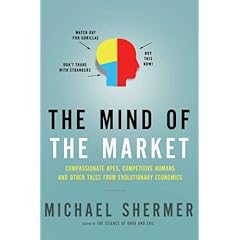
Caught my eye today: The Mind of the Market: Compassionate Apes, Competitive Humans and other Tales From Evolutionary Economics by Michael Shermer.  A premise that intuitively makes sense to me ( and therefore, I’ll have to read it with a critical eye).

Going to have to pick this one up.


Robb on Radical Privatization

Saturday, December 29th, 2007

John Robb puts on his futurist hat and engages in some imaginative scenario thinking (PDF) over at Global Guerillas. Note John’s comment:

“The goal of this brief is to get people thinking about the future in a way that helps them make decisions today.”

John has the methodology right. Most experts, habituated to the over-use of analytical thinking, will try to nit-pick scenarios like these to death from the inception , either reflexively or intentionally in order to avoid having to reexamine cherished ideological assumptions, instead of engaging in the thought experiment. This is the major cultural-cognitive reason bueaucracies and academic institutions are notoriously poor at thinking outside the box or anticipating anything other than directly linear outcomes of policies. 

Analytical-reductionism was a reasonable enough epsitemological approach for the 19th and 20th centuries of the “Second Wave”, “Mass Man”  industrial-bureaucratic nation-states. It’s not enough for the more heterogeneous, alinear, high-velocity, “complex networks as evolving ecologies” of the 21st century. We need other cognitive tools in our kit alongside analysis.

Dr. James Flynn on the Flynn Effect

Tuesday, December 4th, 2007

One of the well-documented aspects regarding IQ testing on which you can safely make broad generalizations, is that aggregate mean IQ scores  have been rising. Not just here in America or in advanced countries but everywhere (though at different rates), rich or poor, free or unfree, north or south. Moreover, to the extent to which we can assemble reliable and valid psychometric records, this societal increase in mean IQ, known as “The Flynn Effect” after researcher James Flynn, has been going on for about a century.

At the same time that mean IQ has increased, the results of standardized testing of k-12 students at the national level has not reflected this improvement, at least not proportionately; seniors and some parents are also prone to make the anecdotal observation that children today simply aren’t as proficient at many practical kinds of problem solving as they were many decades ago. How can these  phenomena be reconciled ?

Flynn now argues the change is due to the increasing complexity and stimulation of the modern social evironment – children are getting better at certain kinds of thinking (which impacts IQ scores) demanded by their environment but other kinds of cognitive skills are falling into disuse:

By reverse-engineering the pattern of improvement in IQ tests, you can tell how mental priorities have changed over the century. It turns out that we, far more than our recent ancestors, take seriously the ability to find abstract similarities between objects (Question: how are dogs and rabbits alike? Answer: they are both mammals). And we are better at applying logic to finding abstract patterns, as in Raven’s Progressive Matrices.

“At that point I began to get excited”, says Flynn, “because I began to feel that I was bridging the gulf between our minds and the minds of our ancestors. We weren’t more intelligent than they, but we had learnt to apply our intelligence to a new set of problems. We had detached logic from the concrete, we were willing to deal with the hypothetical, and we thought the world was a place to be classified and understood scientifically rather than to be manipulated.

….There is still the puzzle of how environmental differences can be so weak when we compare individuals born at the same time, but so strong over time. The key, which Flynn attributes to fruitful discussions with his collaborator, William Dickens, an economist at the Brookings Institution in Flynn’s home town of Washington, DC, lies in the observation that superior genes cause superior performance by co-opting superior environments.

….Everything falls into place with the observation that, for the first time in human history, some people’s superior mental abilities are making superior mental environments available to everyone. Humans are social animals. The most important part of the environment that created your mind is other people’s minds. Before the 20th century, only the privileged had easy access to ideas. Now, when one person thinks something worthwhile, we can all think it and that thought changes all of us.

….The Flynn effect is not a story of pure gains. There are signs that children are missing concrete experiences that help develop some mental abilities. Michael Shayer, a psychologist at King’s College, London, has spent most of his working life studying the foundations of mathematical ability. In 1976 he tested children on their understanding of volume and shape, an understanding thought by many to underlie all future mathematical ability. When he repeated the tests in 2003, 11-year-olds performed only as well as eight-year-olds had done 30 years earlier. “

In the words of Aristotle – ” We are what we frequently do”. Or more practically, students, on average, will get better at what they spend time doing, including cognitive behaviors.

I’m not sure this hypothesis decisively knocks a hole in the important role of heritability on IQ, given the mounds of evidence in it’s favor, but Flynn is certainly proposing a reasonable explanation for the scattershot outcomes of “the Flynn Effect”. Nor is it true that ” this is the first time in history” everyone is benefiting from superior environments created by a few. That has always been the case and there is a proper name for it – ” civilization”. What is different today is the greater magnitude of scale, accelerated velocity and connectivity of such superior environments due to globalization and the information revolution.

I’d like to hear Dan of tdaxp  weigh in here.

ADDENDUM:

Herrick of Gene Expression already has with “10 Questions for James Flynn

The Cognition of a Society of Visual Imagery

Tuesday, November 27th, 2007

My friend Dave Schuler had a very thoughtful post at The Glittering Eye , one that contemplates a quiet paradigmatic shift that may be taking place within society today. It’s one of those posts that merits being read in its entirety because excerpting it, as I will do here nonetheless for the benefit of the slothful, shortchanges the argument:

The Visual Imagery Society

“Until about five thousand years ago, the primary method of communication among our species, the method by which we did what Alfred Korzybski characterized as “time binding”-storing and transmitting information, was speech. When you wanted to know something, you asked someone. When you wanted to give information to other people, you spoke to them. Around five thousand years ago we developed an additional method of storing and transmitting information: writing.

….However, writing also had some disadvantages over the spoken word. It was expensive both in materials and in the investment in education and, although practically everybody learns to speak, not everybody could or did learn to read and write….Speech, obviously, has never vanished but it was supplanted by writing as the primary means of communication in any number of fields including mathematics, philosophy, and, at least to some degree, business. History, by definition, is written.

Almost 150 years ago we began to develop the technology to transmit and store first writing then speech. And a little more than 100 years ago we began to store and then transmit visual imagery…..I wonder if there are signs that visual imagery is supplanting the written word, at least in certain areas, the written word just as the written word supplanted the spoken word in some fields….The transition from an oral society to a literate one had implications that extended far beyond just the means of communication or the costs of transportation for an unexpected reason: literacy reorders consciousness.

….Will a transition to a visual imagery society result in an analogous reordering of consciousness to that of the transition from oral to literate? I think there’s reason to believe that there is, it’s happening now, and the visual imagery society resembles the oral society more than the literate society that it supplants.

….I’ll conclude this speculation with questions rather than answers.

  • Is visual imagery overtaking the written word as the dominant form of communication, especially for communicating new knowledge?
  • If so, what are the cognitive implications of the change?
  • What are the social and political implications of the change in cognitive behavior? “

While I made a number of comments at The Glittering Eye, Dave was particularly interested in the cognitive aspects and I infer from his post that he views the trend toward – hmmm – ” Visualcy” with alarm and I would like to address that aspect here.

Increasing proliferation of visual content in the media as a percentage of net data transmission carries real risks because the visual medium is exceedingly powerful in a neurolearning sense and affect a diverse span of cognitive activity . Where simplification and sophistry took a great deal of time to diffuse through the population by word of mouth or in text, visuals in broadcast or digital format are virtually instantaneous and tend to be accepted in a cognitively passive state by the audience, in the sense of bypassing rigorous and critical analysis. Dave is correct here when he points out the dangers of the modality and liability toward abuse, distortion or manipulation.

On the other hand, visualization media need not be passive. It can easily be both active and  interactive as well as an efficient method of transmission of valid data and the interactivity can be intentionally structured to require and enhance critical thinking. Unfortunately, that effort to create cognitive tools lags behind the power and range of our aesthetic tools to create the images themselves. What Dave is asking for is an effort in futurism but I’m not certain the present moment is a valid baseline given the speed with which new technologies are emerging and evolving.

To answer Dave’s first question, I think visual imagery is overtaking the written word, given that Americans reportedly watch about 8 hours of TV a day on average and newspapers are dying off for lack of new readers –  though I think it is unlikely in the case of academic or scientific definitions of ” new knowledge”, where peer-review journals still rule. I also will grant Dave that a visually-oriented society, at the intellectual level of current television programming, trending toward celebreality shows and infotainment “news” is one sliding toward an anarchic mob – and not a very bright mob at that – one easily swayed by charismatic demagogues and charlatans but more likely, simply uninterested in their own governance. A dystopian Brave New World of sheep-like proles of limited attention who can articulate their interests, much less press them, only with the greatest difficulty.  It’s not a vision that I find appealing.

However, I think that a visual imagery society can probably develop along the same continuum of conceptual complexity that characterized previous eras of oral tradition and the written word. Not all ancient Greeks sat with rapt attention through recitations Homer and the Romans scrawled scatalogical graffitti that would make a Marine sergeant blush more frequently than they wrote like Ovid or spoke like Cicero. Except for scholars of the mundane, we’re much more cognizant of the great cultural achievments of past civilizations than we are of their versions of bathroom humor, comic books and trashy romance novels.

Bright people will always be attracted to complexity, abstraction and depth regardless of the medium and are better placed to weigh the relative value of their choices; the less intelligent will gravitate to simpler fare and will be oblivious to what they are missing. The rub is the demographic segment of the population who have the intellectual potential, which goes wasted for lack of stimulation and engagement in serious thought. If we took greater effort as a nation to invest in and repair a declining system of public education we would have far less to fear in a future society that was more reliant upon visual imagery.


Switch to our mobile site

