zenpundit.com » youtube

Archive for the ‘youtube’ Category

Sunday surprise 10: Bach and Laibach

Sunday, November 17th, 2013

[ by Charles Cameron — Slovenian electronic-industrial group Laibach tackles pone of Bach’s late, greatest works ]
.

Here’s Glenn Gould playing Contrapunctus XIV from Johann Sebastian Bach‘s Art of Fugue, complete with the hum that seems to generate itself from his immersion in the music:

And here by way of comparison and contrast, is the Laibach — “music wing of the Neue Slowenische Kunst (NSK) art collective” — interpretation of that same piece:

For my money, Laibach does a far more interesting job of “electronicizing” Bach than Wendy Carlos ever did, all those many years ago.

For my money too, there’s the complete Laibach Art of Fugue on CD on its way to me courtesy of Amazon.

Myanmar between Woolwich and Al-Aqsa 2: graphical innovation

Wednesday, October 23rd, 2013

[ by Charles Cameron — in which jihadis utilize the graphical technique known as kinetic typography for what may be the first time — follow on to part 1: interfaith hatred ]
.

**

Today the Combating Terrorism Center at West Point notified their mailing list of the launch of their Militant Imagery Project online. It’s a very helpful resource, covering much of the same issues as Artur Beifuss & Francesco Trivini Bellini, Branding Terror: The Logotypes and Iconography of Insurgent Groups and Terrorist Organizations and Asiem El Difraoui, The Jihad of Images — which I discussed briefly in Jottings 7: Two for the iconography of terror a while back.

The CTC explains:

The use of propaganda and imagery by terrorist groups has long been an understudied dimension of the broader field of political violence. This project explores the use of imagery and visual themes by militant groups, focusing largely on jihadist media production. Jihadist organizations and individuals inspired by their message are prolific producers and distributors of visual propaganda, and their efforts have expanded exponentially online. However, these images frequently utilize themes which can be inscrutable to those not familiar with the sub-culture. It is our hope that this project will provide academics, practitioners, and students with a basic contextual understanding of the ideas these images convey before they turn to the larger questions of why they are employed, how they work, and what responses they may elicit.

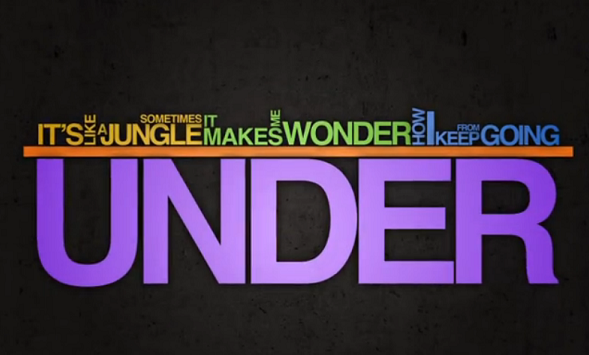
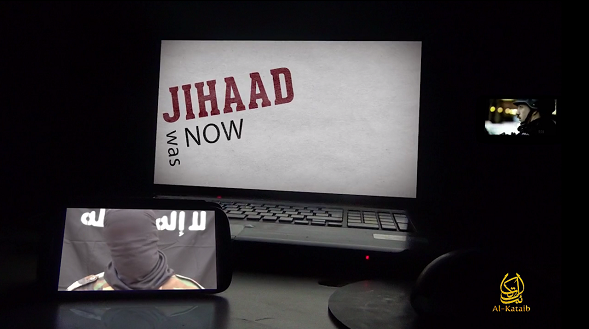
It is in that spirit that I would point you to the following three screengrabs from the Al-Shabaab video I discussed in my previous post…

**

Imagine the images tilting and changing, as the words spoken on the soundtrack are gradually spelled out typographically on screen in this sequence:

Jihad was now global. Jihad in the West — Madrid — London — Paris — Boston — Jihad was now coming home to the West, And it was making a dramatic entrance… WOOLWICH ATTACK

Here are the screengrabs:

**

These three screengrabs illustrate what may well be the first use of the technology called “kinetic typography” or more simply “moving text” in jihadist propaganda. Somali news outlet Harar24‘s Editorials team claim it’s a first, writing:

It is not unusual for jihadi videos to be laden with high graphics and effects. However Al-Shabaab this time used a never technique never adopted before in any jihadi videos, kinetic typography.

The best way to investigate kinetic typography in depth is via Marco Papale‘s video site, the Kinetic typography Channel on Vimeo.

**

I don’t intend to embed the Shabaab piece itself, but here for your further illumination is the Grandmaster Flash sample rom which the screengrab at the top of this post was taken, in full:

That’s kinetic typography!

Myanmar between Woolwich and Al-Aqsa 1: interfaith hatred

Wednesday, October 23rd, 2013

[ by Charles Cameron — in which jihadis take on Jews, Christians, Muslims and Buddhists, quite an interfaith haul for hatred ]
.

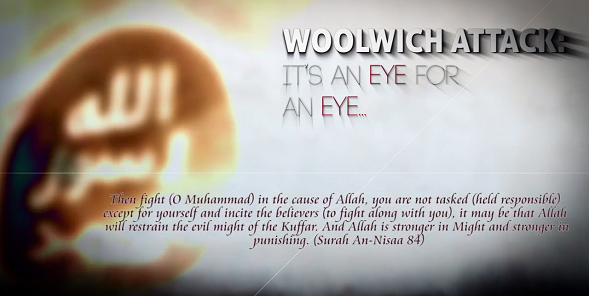
Aaron Zelin at Jihadology posted an hour-long video entitled Woolwich Attack a week or so ago, and I found it particularly interesting on two accounts: first, that it makes a multi-faith attack that includes Buddhism in its catalogue of enemies of Islam, and second, that it uses an innovative feature of modern digital typography. Here, I’ll concentrate on the first. Here’s the video’s title:
**

Christianity as a target is well represented in the form of Dr Justin Welby, the recently-appointed Archbishop of Canterbury:

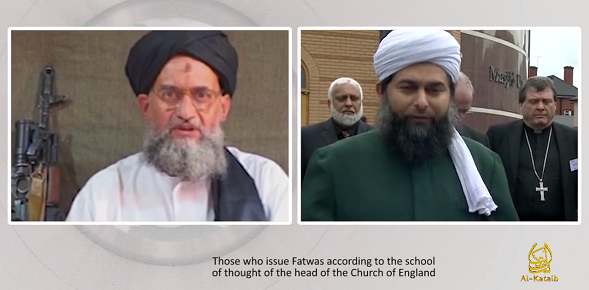
Notice also the lower of these two screengrabs, this one showing Ayman al-Zawahiri (left) berating a leading Muslim spokesman in the UK, Ibrahim Mogra of the Muslim Council of Britain (right), for speaking at the same event as the Archbishop. The damning subtitle suggests he’s one of those “who issue Fatwas according to the school of thought of the head of the Church of England”.

**

It wasn’t the attack on Christians or fellow Muslims that caught my eye, though, but the unexpected presence of the monk Wirathu, the rhetorical leader of Myanmar’s recent Buddhist rioting against Burmese Muslims. I’d seen his face on Time magazine and elsewhere, but it came as a bit of a shock here in a jihadist video — I’d filed him and his 969 movement under “Buddhism” rather than “Islam” in my mental listing of violent movements with religious underpinnings.
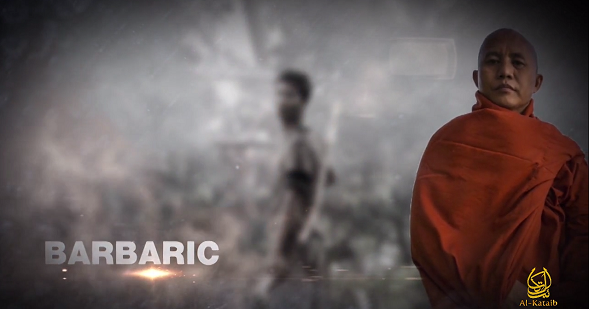
Ugly, ugly.

**

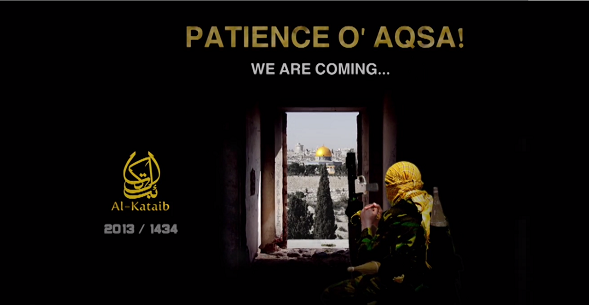
Finally, no invitation to jihad these days is complete without its mention of the al-Aqsa mosque and Jerusalem — and it is here that Judaism comes in for attack. Consider these two screengrabs:

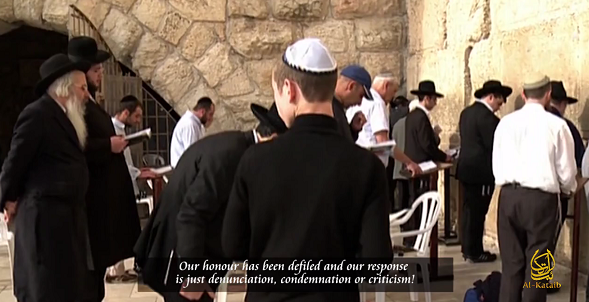
**

The video closes, significantly, with a long shot of the Dome of the Rock through a window…
Yesterday my friend William Benzon made a post titled On Describing a Painting which began:

Harvard art historian Jennifer Roberts bills her article thus: The Power of Patience: Teaching students the value of deceleration and immersive attention. OK. But I take a different lesson from it, one about one of my current hobby horses: description. Roberts focuses on an 18th Century painting by John Singleton Copley, A Boy with a Flying Squirrel. Her point is that the more you look at the painting, the more you notice and hence the more you can note in a written description. She asks her students to spend a full three hours with a single painting.

Of her own experience with that painting she observes:

It took me nine minutes to notice that the shape of the boy’s ear precisely echoes that of the ruff along the squirrel’s belly—and that Copley was making some kind of connection between the animal and the human body and the sensory capacities of each. It was 21 minutes before I registered the fact that the fingers holding the chain exactly span the diameter of the water glass beneath them. It took a good 45 minutes before I realized that the seemingly random folds and wrinkles in the background curtain are actually perfect copies of the shapes of the boy’s ear and eye, as if Copley had imagined those sensory organs distributing or imprinting themselves on the surface behind him. And so on.

She begins her next paragraph: “What this exercise shows students is that just because you have looked at something doesn’t mean that you have seen it.”

Looking at that final screengrab with this in mind, I see a close correlation between the golden Dome that focuses our attention on the Noble Sanctuary / Temple Mount, and the round, yellow-gold keffiyeh of the jihadist observing it through his window — “making some kind of connection between” them, to echo the words of Harvard’s Elizabeth Cary Agassiz Professor of the Humanities…

It’s a skilled and meaning-filled use of the medium.

**

In my second post in this series, I’ll point to a significant development in graphics and technology introduced in this video.
Sunday surprise 9: surreal art imitates real life?

Sunday, October 20th, 2013

[ by Charles Cameron — my semi-official idiocy to cap the week ]
.

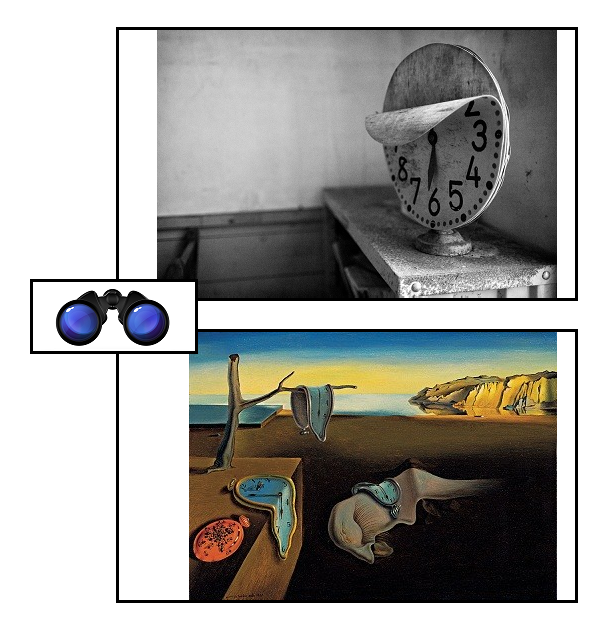
Here, surreal art imitates real life — ahead of time, and or much later.

**

Sources:

  • Tokyo Times, An abandoned and atmospheric Japanese school in the mountains
  • Salvador Dali, The Persistence of Memory

  • A tip of the hat to Bryan Alexander of Infcult
  • **

    Footnote:

    Time itself is a curious business, and the question of its “reality” comes up from time to time. Physicist Sean Carroll talked about it a while back on the pompously named Closer to Truth series, and makes some interesting points. I have to say, though, that I wasn’t overwhelmed — Carroll may be the equivalent of Hawking when it comes to physics, but the equivalent of Wittgenstein when it comes to philosophy he has yet to prove himself.

    But then of course we have never seen Wittgenstein talking off the cuff on YouTube: my sense is that this was a wise decision on his part — although many of the slips of paper on which he typed the aphorisms that go to make up his Zettel might well have been Tweeted, give or take a century.

    Twitter’s immense fan-base does include thousands — and likely hundreds of thousands — of folks who would follow a Witty Wittgenstein twitter-feed among it’s half-billion (2012 estimate) users if wittgenstein were alive and tweeting… Indeed, the entirely posthumous Wittgenstein Tweets feed has more than 4,000 followers, and you might care to join them — although the quotes in the tweets are more than 60 years old at time of tweeting. My own preference for a philosophical feed, btw, runs to Kim Kierkegaardashian.

    But it’s Sunday, we were talking surrealism, and I digress.

    And a little child shall lead them…

    Monday, October 14th, 2013

    [ by Charles Cameron — on two viral videos of children ]
    .

    Malala Yousafzai has been in many hearts and minds recently, and deservedly so. Her speech before the United Nations Youth Assembly, like her John Stewart interview, went viral on YouTube– here’s a version that has the grace to include her opening invocation of the Name of God:

    Thinking idly about her the other day I was reminded of anither video of a schoolchild that went viral just a few months ago — this one the more off-the-cuff speech of a boy, Ali Ahmed, interviewed on the street. He’s twelve, Malala spoke at the UN on her sixteenth birthday, but he testifies eloquently to Malala’s point by his own obvious clarity and intelligence:

    I think it’s worth holding these two video clips in mind together, the young woman and the young man, she almost fatally wounded and now recovered, he happening to be at the right spot on the right moment to be interviewed, her words reaching us directly in her fluent English, his coming to us only via sub-titles, as in an art-house “foreign” movie… If she has eclipsed him, let us remember him again.

    The intelligence, the clarity. the education. And how many thousands more must there be, unviral and unsung, but no less intelligent?

    **

    Unless ye become as little children, saith the Gospel, and a little child shall lead them, saith the Prophet.


    Switch to our mobile site