zenpundit.com » youtube

Archive for the ‘youtube’ Category

Khorasan to al-Quds and the Ghazwa-e-Hind

Tuesday, April 2nd, 2013

[ by Charles Cameron — expecting the unexpected — transcribing Bill Roggio on “something that everyone is overlooking” and Ambassador Haqqani on “one of the unwritten books it has been my desire to write” ]
.

I’ve talked about the “Black Banners” hadith and the Mahdi‘s victorious army marching from (roughly) Afghanistan to Jerusalem more than once, and perhaps less frequently, the other prong of the jihad, the Ghazwa-e-Hind, which flows from Pakistan into India. In the video that follows, Bill Roggio of the Long War Journal talks with Husain Haqqani, one-time Pakistani Ambassador to the US — and both have some striking things to say.

We pick up the conversation close to the end of the first half of a two-tape session at the Foundation for the Defense of Democracies — and I’ve provided a transcript after the video, for easier quotation and annotation.

**

BILL ROGGIO:

One of Al-Qaida’s propaganda since it took a beating in Iraq was, that they made the Khorasan, which is an old Islamic empire basically in central Asia and South Asia, they said that this is where we are going to beat them, and once we win in the Khorasan, we’re going to move towards the Levant. So this has become a key part of AQ’s propaganda. What do we think is going to happen when we lose in Afghanistan, when the second superpower loses? That is going to be a huge recruiting boom for foreign terrorists operating in Afghanistan. I think this is something that everyone is overlooking as we’re running for the doors in Afghanistan.

That’s a pretty powerful prediction, though prediction itself is a high risk enterprise. And it bears repeating that the Khorasan hadith is explicitly an “end times” prophecy. Ambassador Haqqani then doubles up on Bill Roggio’s concern, adding in the Ghazwa-e-Hind, which he describes as both “famous” and “the final, biggest war between good and evil and between Islam and kufr”…

A lot of people make fun of the Pakistani analyst and Youtube personality, Zaid Hamid, who seems to be the main public proponent of the Ghazwa — take a look here to see a wild sampler! — which is why I find Ambassador Haqqani’s response particularly impactful.

HUSAIN HAQQANI:

You know, there are days when I think I should have stayed in the scholarship business and written some of that stuff I was writing at that time. This was one of the things, even before Iraq, I had pointed out. For example, bin Laden had given a statement at that time about Americans being the new Mongols, and nobody could understand what he was talking about, and I said he’s talking about the 1258 conquest of Baghdad, and he’s playing on Islamic history and Islamic mythology.

And so Khorasan was an important element in that because, if you remember, the Abbasids rose to power through Khorasan, because that was an important element, they overthrew the Umayyads based on the argument that there is a hadith – which in my opinion is of relatively weak significance, but I am taking off my hat of a theologian since I never completed my religious training – but anyway, they used that, that there is a hadith, that the people from Khorasan will come and save the people of the Levant or whatever. And so that was used, and that was used again, and that has been part of the Al-Qaeda thing.

And then the other part is this famous Ghazwa-e-Hind, and the Pakistani groups use it – actually, just as jihad is the war, a holy war or war for religious purposes, ghazwa is a battle — and there is ostensibly a saying of prophet Muhammad that before the end times, the final, biggest war between good and evil and between Islam and kufr is going to take place in Hind, which is India, which is the land east of the river Indus.

So Khorasan takes care of what is today Afghanistan and some parts of central Asia, and all of that – it means a lot to people who believe in it, these end times prophecies etcetera. So one of the unwritten books it has been my desire to write, I wrote a piece on it once, an article I think, which said, that, you know, Americans pay a lot of attention to their own end time prophecies, but getting into that whole theater, they have totally neglected this.

And so far as recruitment is concerned I am totally agreeing with you, that failure in Afghanistan is going to be a big boon for both. The TTP — the Tehrik-i-Taliban Pakistan — and the Pakistani groups are going to start saying, Right, now is the time to start recruiting, and fighting in that famous Ghazwa-e-Hind –let’s get ready for that. And the Arab groups are going to say, Ah, salvation is coming by joining up with the folks who are fighting in Khorasan.

And both those fronts are going to be a source of a lot of problems.

Increased jihadist recruitment, and India as a second major front for the jihad — that’s quite a left lead and right cross combo…

**

Do you recall the opening of Aldous Huxley‘s final novel, Island?

“Attention,” a voice began to call, and it was as though an oboe had suddenly become articulate. “Attention,” it repeated in the same high, nasal monotone. “Attention.”

Chavez and the Second Coming?

Sunday, March 10th, 2013

[ by Charles Cameron — the final, astounding, Messianic-Mahdist word goes to Hugo Chavez! caught on video! ]
.


.

We now know, thanks to VOA and the Atlantic, this much:

The death of Venezuelan leader Hugo Chavez has prompted eulogies from around the world, but few of the messages have been as eccentric as the second-coming predicted by Iran’s president.

And as if returning to Earth alone was not enough, President Mahmud Ahmadinejad says Chavez will do so alongside some esteemed company.

“I have no doubt that he [Chavez] will return alongside Jesus Christ and the Mahdi [the Hidden Imam] to establish peace and justice in the world,” Ahmadinejad wrote in an emotional condolence message posted on his personal website. The Mahdi is a revered figure among Shi’ite Muslims, many of whom believe he will return to save humanity.

Not surprisingly, as reported by Reuters, these remarks drew rebukes from some senior Iranian clergy:

“The terms Mr Ahmadinejad used to describe the Venezuelan president are not appropriate for us,” the semi-official Mehr news agency quoted Ghorbanali Dorri Najafabadi, a cleric and a senior member of the Assembly of Experts, as saying.

“One can naturally send a diplomatic letter without getting into religious discussions,” hardline Friday prayer leader Ahmad Khatami was quoted as saying by Iranian media, adding that he believed Ahmadinejad’s decision to do so was wrong.

According to the parliamentary news agency ICANA, lawmaker Mohammad Taqi Rahbar said on Thursday Ahmadinejad’s comments were “certainly wrong and exaggerated”.

**

Dr Timothy Furnish attributes this sort of blurring of theological categories to what he terms “ecumenical messianism” — for some quick context see his comments on the Lutheran Witness site. I’d suggest that is not just a fleeting idea but an area we should look into in some depth, if only because I myself was struck by an earlier incarnation of much the same idea, as expressed by the late Ayatollah Muhammad Baqir al-Sadr, who is quoted as having said:

The Mahdi is not an embodiment of the Islamic belief but he is also the symbol of an aspiration cherished by mankind irrespective of its divergent religious doctrines. He is also the crystallization of an instructive inspiration through which all people, regardless of their religious affiliations, have learnt to await a day when heavenly missions, with all their implications, will achieve their final goal and the tiring march of humanity across history will culminate satisfactory in peace and tranquility. This consciousness of the expected future has not been confined to those who believe in the supernatural phenomenon but has also been reflected in the ideologies and cult which totally deny the existence of what is imperceptible. For example, the dialectical materialism which interprets history on the basis of contradiction believes that a day will come when all contradictions will disappear and complete peace and tranquility will prevail.

In light of that quote, Ahmadinejad‘s interest in Hugo Chavez seems a little less far-fetched.

**

Okay, I’m no expert, but I do try to keep more or less on top of the swirling currents of contemporary Mahdism, which is from my POV understudied — and when studied in haste, often misunderstood — but I swear I never saw this one coming.

A further hat tip to Tim Furnish, then, for pointing us to this Iranian news report of a speech by Hugo Chavez himself in Masshad… the holy city in Iran where Imam Reza was martyred, indeed whose very name, mah-shahd, means “place of martyrdom”.. way back in 2009.

The Messiah [Jesus] and the Mahdi are not dead, they are alive and well and will soon return to spread justice over all the world. This afternoon Imam Khameini told us that as long as we two Presidents are united in our hearts and minds, as long as we pursue the same humanistic deeds together, and as long as we continue seeking justice, the Mahdi and the Messiah will emerge very soon. Therefore, we must struggle so that his holiness the Mahdi and the Messiah emerge to spread justice all over the world.

Dr Furnish’s Iranian source is Mehr News. I wonder if the Venezuelan press thrashed about it much, or whether they thought it was just diplo small talk?

I poked around the web a bit, and this looks to be a tape of a similar interview:

Whoah!

Sherlock Holmes, Hannibal Lector and Simonides

Sunday, March 3rd, 2013

[ by Charles Cameron — the art of memory, with a sidelong glance at swans, typhoid and theodicy ]
.

Thomas Harris (and by extension Hannibal Lector) has been interested in memory palaces for a long time. We can begin to infer this this because Lector describes his hobby in Red Dragon (1981) and again in Silence of the Lambs (1988):

So — church collapses?

**

As you can tell from that last comment in the Silence of the Lambs quote — to my mind the most brilliant presentation of the problem of theodicy for our day — if there’s a God worth defending, it has to be a God who allows sparrows to fall, typhoid to accompany swans in the vast ecology of existence, churches to collapse on worshipers, and “bad things to happen to good people” from time to time.

And such things, specifically including collapses of religious buildings atop worshipers, do indeed happen in fact as well as fiction.

And they don’t only happen to Christians, either… Bon is the shamanistic religious tradition of Tibet, prior to — and later, somewhat assimilated by — Buddhism

**

The thing is, when I read that Hannibal Lector collected church collapses, it not only made me start to take note of them myself, it also made me think of Simonides. As Frances Yates tells us in her book, The Art of Memory:

At a banquet given by a nobleman of Thessaly named Scopas, the poet Simonides of Ceos chanted a lyric poem in honour of his host but including a passage in praise of Castor and Pollux. Scopas meanly told the poet that he would only pay him halfthe sum agreed upon for the panegyric and that he must obtain the balance from the twin gods to whom he had devoted half the poem. A little later, a message was brought in to Simonides that two young men were waiting outside who wished to see him. He rose from the banquet and went out but could find no one. During his absence the roof of the banqueting hall fell in, crushing Scopas and all the guests to death beneath the ruins; the corpses were so mangled that the relatives who came to take them away for burial were unable to identify them. But Simonides remembered the places at which they had been sitting at the table and was therefore able to indicate to the relatives which were their dead. The invisible callers, Castor and Pollux, had handsomely paid for their share in the panegyric by drawing Simonides away from the banquet just before the crash. And this experience suggested to the poet the principles of the art of memory of which he is said to have been the inventor. Noting that it was through his memory of the places at which the guests had been sitting that he had been able to identify the bodies, he realised that orderly arrangement is essential for good memory.

And by way of reinforcing my Lector-Simonides conjecture, Lector certainly had a remarkable interest in memory, as we learn from his dialogue with Clarice Starling:

“Did you do the drawings on your walls, Doctor?”
“Do you think I called in a decorator?”
“The one over the sink is a European city?”
“It’s Florence. That’s the Palazzo Vecchio and the Duomo, seen from the Belvedere.”
“Did you do it from memory, all the detail?”
“Memory, Officer Starling, is what I have instead of a view.”

A belvedere, from the Italian, is “a structure (as a cupola or a summerhouse) designed to command a view” — and a beautiful view at that. Belvedere is also, ironically, the name of the town in Ohio where Buffalo Bill, Lector’s serial killer ex-patient, lives…

**

So it didn’t surprise me to discover that in Hannibal (1999), the book that follows Silence, this brilliant man who as we have seen collects church collapses and has an exquisite memory in place of a view, is revealed as a practitioner of Simonides’ art:

The memory palace was a mnemonic system well known to ancient scholars and much information was preserved in them through the Dark Ages while Vandals burned the books. Like scholars before him, Dr. Lecter stores an enormous amount of information keyed to objects in his thousand rooms, but unlike the ancients, Dr.Lecter has a second purpose for his palace; sometimes he lives there. He has passed years among its exquisite collections, while his body lay bound on a violent ward with screams buzzing the steel bars like hell’s own harp.

Hannibal Lecter’s palace is vast, even by medieval standards. Translated to the tangible world it would rival the Topkapi Palace in Istanbul for size and complexity.

We catch up to him as the swift slippers of his mind pass from the foyer into the Great Hall of the Seasons. The palace is built according to the rules discovered by Simonides of Ceos and elaborated by Cicero four hundred years later; it is airy, high-ceilinged, furnished with objects and tableaux that are vivid, striking, sometimes shocking and absurd, and often beautiful. The displays are well spaced and well lighted like those of a great museum. But the walls are not the neutral colors of museum walls. Like Giotto, Dr. Lecter has frescoed the walls of his mind.

Brilliant. And a delight, years later, to have my hunch connecting the church collapses and prison cell with only memory for a view with Simonides and the Art of Memory confirmed by the third book and film in the series…

You’ll note, btw, that the Lector (caveat lector) of the first two books has now become Lecter in alignment with the films starring Anthony Hopkins.

**

I love symmetries, so let’s move from the most monstrous criminal mind in literature, to the greatest detective…

Sherlock Holmes — in his latest television incarnation — builds memory palaces of a sort, though I’m not sure Simonides would recognize them.

I’m posting the clip from the series here to honor my son Emlyn, with whom I have been watching the series…

**

And then there’s the Jesuit whose use of the Art is explored in Jonathan Spence‘s The Memory Palace of Matteo Ricci:

In 1596 Matteo Ricci taught the Chinese how to build a memory palace. He told them that the size of the palace would depend on how much they wanted to remember: the most ambitious construction would consist of several hundred buildings of all shapes and sizes, “the more there are the better it will be,” said Ricci, thought he added that one did not have to build on a gradiose scale right away. One coul create modest palaces, or one could build less dramatic structures such as a temple compound, a cluster of government offices, a public hostel, or a merchants’s meeting lodge. If one wished to begin on a still smaller scale, then one could erect a simple reception hall, a pavilion, or a studio. And if one wanted an intimate space one could use just the corner of a pavilion, or an altar in a temple, or even such a homely object as a wardrobe or a divan.

You’ll note that in this early example of virtual reality as an pedagogical technology, Ricci doesn’t start with the easy stuff, the single wardrobe or divan — he begins with “the most ambitious construction”…

Enough for now. When I want to talk about in a follow up post is detail… the crucial importance of detail.

Mindlessness and Mindfulness

Tuesday, January 22nd, 2013

In the midst of writing a lengthy post, it may eventually become my longest, about Socrates.

There’s no assurance that volume will equate with importance – most likely, the opposite. The post began as a book review and then grew to two books, then I reversed course and started over; it has been unusually slow going because the subject matter has forced me to stop periodically and uncomfortably rethink my assumptions – and then pick up new books. In one sense, there’s no hurry. After all, Socrates will still be just as relevant or not when I finish blogging about him than when I began. On the other hand, the spirit of our times calls out for Socrates’ techne logon, his “craftsmanship of reason”, so I keep plugging away at it.

The flip side to this intense focus has been an increasing desire for a little mindless entertainment. So, I started watching Sons of Anarchy of my iPad, Season One. So far, It’s fun:

The theme and setting is interesting and the characters and plot are generally more credulity-stretching than even The Soprano’s in their twilight seasons, but Sons of Anarchy fills the bill in terms of entertainment.Boardwalk Empire, is also supposed to be very good, even better, but one at a time.

What do you use as a diversion?

Form is insight: a musical experiment

Monday, October 22nd, 2012

[ by Charles Cameron — here’s a musical experiment from the book / project i seem to be writing, which offers a grand slam intro to contemplative and artistic approaches to creative thinking, and hence a fresh angle on intelligence ]
.

It looks very much as though I’ve been beginning to write parts of let’s call it “a book” for a while here on Zenpundit. I laid out the overall topic and approach as I see it in my previous post, but here I would like to launch into it mid-stream, with a musical experiment to explore the mind’s capabilities. I’ll explain why, later.

**


.

**

Okay, here’s the experiment.

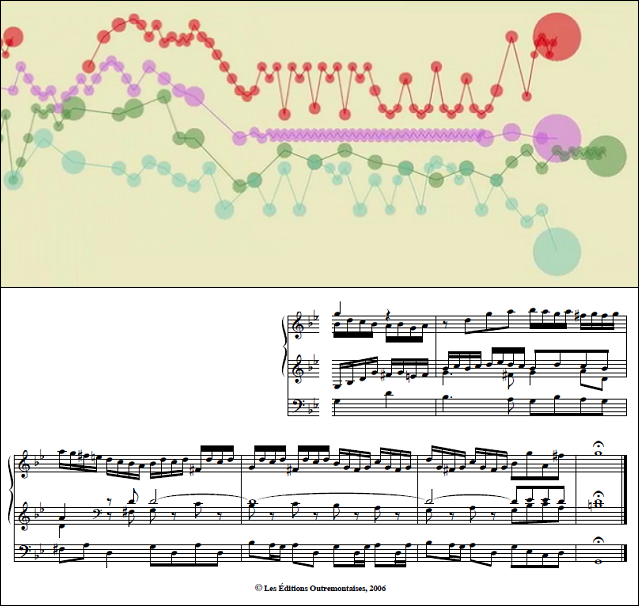
I invite you to listen to a short piece by JS Bach on YouTube. This will take roughly three and a half minutes of your time, the piece of music itself is one of the glories of the classical tradition, I’ve chosen the video because of the terrific graphics that accompany and illuminate the music, there will be some rock and ragtime to follow for those whose tastes go those ways — and I must ask you to pay very special attention while watching and listening to the video.

Before you do that, however, I’d like you to take a look at the image at the top of this post, which shows you the ending of the piece both as the video graphics present it, and in the musical notation or “score” an organist would read. The graphics are terrific because they allow the untrained eye to follow the threads of the different melodies or “voices” as Bach braids them together. The work is his “Little Fugue” in G minor, which you can find indexed in his collected works as “BWV 578”.

Here’s how I’d like you to pay attention during the piece:

As you listen to the performance on video, I’d like you to follow the colored lines of the melodies as they move along in the video graphic, and listen carefully to hear how many of the lines of sound you can actually follow distinctly in your mind. At the beginning there’s only one “voice” – only one line of melody – so your task is easy. If you are used to listening to music of one sort or another, you’ll almost certainly be able to track, more or less, some kind of thumping bass line and some kind of melody rising above it – two voices.

Can you manage three? four or more?

If you’re a musician you may still find the graphics — and the exercise – illuminating, but you might prefer to make the same experiment with a version of the piece played by Robert Köbler on a Silbemann organ, accompanied on video by the score..

Here’s the video — see how many voices you can hear and track:

**

How did you do? How many voices could you follow at one time?

And why am I bothering to as you to do this, and then talking so much about it? After all, you may already know everything I’m saying and more, or you may simply not care that much about such things.

Here’s why: the project is about creativity and intelligence.

It’s about how to apply forms of creativity that are generally found in the arts and humanities — and in the world’s contemplative traditions — to the questions that arise for every bright human as we face the exhilarating challenging and terrifyingly complex world around us.

It’s about understanding complexity, in the way the Intelligence Community needs to understand complexity, and business leadership, and our scientists and technicians, and the congregants at our synagogues, churches, mosques and temples, and, well, all the bright people everywhere — disillusioned, or fresh and rarin’ to go.

**

Complex problems often require some sort of recognition and resolution of several or many distinct and sometimes conflicting voices, points of view, concerns or vectors.. which may shift in intensity and direction as the situation evolves.

In musical terminology, any music that includes two or more distinct melodic lines or “voices” playing together simultaneously is polyphonic — from the Greek for “many voices”. Counterpoint — from the Latin for a point that counters another point — is the artful way in which composers can “work” two or more melodic lines together, so they clash at times, resolve, and harmonize.

The fugue — the particular contrapuntal form Bach uses in the piece you just heard — imposes even tighter constraints on the composer, and can elicit even greater creative inspiration as a result — as many of Bach’s, Mozart‘s, Beethoven‘s and others’ greatest works testify..

**

I imagine you can see that the many voices of polyphony — voices in counterpoint, that at times clash and are in need of resolution and harmony — have their equivalents in the complex multi-stakeholder problems, clashing points of view and need for constructive resolutions that creative artists, intelligence analysts, strategy, policy and decision makers, and anyone who wants to keep aware of the shifting currents of our strange and complicated times all need to take into account.

So polyphonic, and specifically contrapuntal, thinking, can be extended way beyond the realm of music — as Hermann Hesse suggested in his greatest novel, Glenn Gould tried to demonstrate in his “contrapuntal radio” pieces, and Edward Said understood when he characterized the Israeli-Palestinian issue in these words:

When you think about it, when you think about Jew and Palestinian not separately, but as part of a symphony, there is something magnificently imposing about it. A very rich, also very tragic, also in many ways desperate history of extremes — opposites in the Hegelian sense — that is yet to receive its due. So what you are faced with is a kind of sublime grandeur of a series of tragedies, of losses, of sacrifices, of pain that would take the brain of a Bach to figure out.

The “book” may turn out to be a DVD, or a workshop, at this point who knows? Whatever format it winds up it takes, it will teach contrapuntal thinking — using examples drawn from world culture and contemporary geopolitics — as a radical alternative methodology, complementary to but very different from our current analytic methods. It will be a text in the cross-disciplinary, associative, lateral or horizontal equivalent of the kind of disciplinary, siloed, linear or vertical thinking that our increasingly specialized culture has trained us in —

and which we need to supplement, if we are to have the mental flexibility to see and make the creative leaps our times require of us.

For more on this, see also my Feb 2011 post (at least I’m reasonably consistent over time) A HipBone approach to analysis VI: from Cairo to Bach.

**

God only knows how many voices there are in Bob Dylan‘s song Sad Eyed Lady of the Lowlands, or Eric Clapton‘s Have you ever loved a woman from the 2004 Crossroads Guitar Festival – the principle’s the same, but we don’t (yet) have the graphics to allow your eye to follow what the musicians are doing — and there are solos, and sidemen.

Each musician has at least one voice, its melodies and its silences, to present – and sometimes several, as we saw with the Bach organ piece. And together the individual musicians add up to an ensemble, each with an awareness of the others’ voices and a concentration on their own.

And for an insight into the varieties of organ mastery, compare Billy Preston‘s amazing solo starting at 9’33” on the Clapton piece, Al Kooper‘s organ work on Dylan’s Sad Eyed Lady, and Ton Koopman‘s rendering of the same Little Fugue BWV 578 we started with – where at times you can watch Koopman’s fingers on the keys or feet on the pedals, for yet another way of visualizing the intricate interweavings of this glorious music.

**

Glenn Gould had an amazing mind: for your enjoyment, here’s a version of his own fugue, aptly entitled So You Want To Write a Fugue? — with a similar graphical display to help you follow along with the interweaving lines of melody…

It’s serious, and it’s hilarious too! Or maybe you’d prefer Scott Joplin? Either way, enjoy:

Glenn Gould:

Scott Joplin, Euphonic Sounds, a Syncopated Novelty:


Switch to our mobile site