zenpundit.com » science

Archive for the ‘science’ Category

Forensic Paleo-Anthropology and the Last Man

Tuesday, May 5th, 2009

forensic.jpg

THE FIRST EUROPEAN – NOT ENTIRELY HOMO SAPIENS SAPIENS – 35,000 BC

A British forensic scientist, Dr. Richard Neaves, has recreated the head of one of the earliest modern human ( some differences in brain case and teeth)  hunter-gathers from fossil remains, in the same manner of reconstructing the identity of homicide victims.

His recreation offers a tantalising glimpse into life before the dawn of civilisation. It also shows the close links between the first European settlers and their immediate African ancestors. To sculpt the head, Mr Neave called on his years of experience recreating the appearance of murder victims as well as using careful measurements of bone. It was made for the BBC2 series The Incredible Human Journey. This will follow the evolution of humans from the cradle of Africa to the waves of migrations that saw Homo sapiens colonise the globe.

….’Richard creates skulls of much more recent humans and he’s used to looking at differences between populations. ‘He said the skull doesn’t look European or Asian or African. It looks like a mixture of all of them. ‘That’s probably what you’d expect of someone among the earliest populations to come to Europe

As with the example of Kennewick Man, efforts at forensic paleo-anthropogy shatter modern racial assumptions regarding our earliest ancestors, regardless of whether those assumptions emanate from archaic stereotypes or modern PC ideology. Kennewick Man bore little or no resemblance to Amerinidian tribal groups that he long preceded, and Native American activists responded to the startling archaeological find  by attempting to have the remains seized, scientific analysis of them banned and the site bulldozed. The “First European”in turn, looks nothing like the Aryan mythology of the Nazis or 19th century European racialist agitators. Instead, he appears somewhat like an Africanized Yul Brynner.

These reconstructions demolish our casual, self-referentially anachronistic, projections of our own demographic groups backward in time. We want to see ourselves in the people “back then” just like we wish to imagine that kind of continuity in a far-flung future. I’m dubous that we will look like “us” 100,00 or 250,00 years in the future and wonder if such a  people will even acknowledge their kinship with us any more than we do with Homo Habilis.

Chet Richards: Review of The Scientific Way of Warfare

Monday, April 20th, 2009

Dr. Chet Richards has a methodical review up at DNI on Antoine Bousquet’s new book The Scientific Way of Warfare: Order and Chaos on the Battlefields of Modernity:

The Scientific Way of Warfare

….Bousquet opens with and ultimately answers the question of “does network-centric warfare (NCW) work?” To reach his conclusion, he proposes four “regimes” in the application of science to modern warfare:

  1. Mechanism, whose “key technology” was the clock, whose scientific framework was Newtonian, and whose military format was what we’d call first generation warfare — line, column, conformance, regularity
  2. Thermodynamics, characterized by engines, whose framework included entropy, energy, and probability, and whose military paradigm was 2GW (Bousquet does not use the generations of war model)
  3. Cybernetics — computers — whose scientific concepts included “negentropy,” negative feedback, homeostasis and whose military model would be modern 2GW, with heavy top-down, real time command and control
  4. Chaoplexity, where networks reign, whose framework is built upon the new sciences of non-linearity, complexity, chaos, and self-organization, and where warfare is conducted by decentralized cells, teams, or swarms — what we would call both 3GW and 4GW (p. 30)

Subsequent chapters take the reader on a tour of these ideas in turn, exploring their evolution as scientific patterns and their influence on the warfare of their, and subsequent, eras. So the chapter on mechanistic warfare introduces Vauban, close-order drill, and culminates in Frederick the Great’s Clockwork Army. The next chapter, Thermodynamic Warfare, concludes with Clausewitz, which is a stretch, of course, since the great Prussian died in 1831, some 20 years before the first publications in that discipline. But with liberal interpretation of the massive text of On War, passages can be found that seem like precursors of the Second Law. Bousquet does point out that these interpretations were not made in Clausewitz’s day but were retrofitted by later analysts and generals, including as he also notes, John Boyd.

Read the rest here. Good stuff!

Excess Complexity is the Route to Extinction

Friday, April 10th, 2009


Nassim Nicholas Taleb, author of The Black Swan: The Impact of the Highly Improbable and Fooled by Randomness: The Hidden Role of Chance in Life and in the Markets, had an op-ed in FT.com entitled “Ten principles for a Black Swan-proof world” (Hat tip to John Robb and Pundita). Taleb was addressing the global economic crisis, but I was particularly drawn to Taleb’s fifth principle, which has a more general implication:

5. Counter-balance complexity with simplicity. Complexity from globalisation and highly networked economic life needs to be countered by simplicity in financial products. The complex economy is already a form of leverage: the leverage of efficiency. Such systems survive thanks to slack and redundancy; adding debt produces wild and dangerous gyrations and leaves no room for error. Capitalism cannot avoid fads and bubbles: equity bubbles (as in 2000) have proved to be mild; debt bubbles are vicious.

Taleb has encapsulated many important concepts very well here. Up to a certain point, increasing complexity represents a advantage for an evolving system (biological, financial, physical etc.) by increasing efficiency through adding specialization, interconnection, diversification, redundancy and checks for mitigation of risks. Complexity, in the earlier part of a development curve can add to a system’s overall resiliency – to a point.

Superfluous complexity, that which goes beyond the minimum required for additional gains in systemic efficiency or productivity, is a net drag on the system, an economic waste, a source of friction, a cancer,  a useless eater of resources and the earliest sign of the system’s inevitable decay. Worse, excess complexity represents an increasing probability of systemic failure by multiplying the number of variables involved in the normal process of the system. There are more things that can go wrong and more choke points where a catastrophic failure can occur. Increasing the degree of complexity moves the system away from simplicity and reliability and toward chaos and the creativity of emergent properties, but like an ice skater seeking ever greater range, go too far and the ice will crack under one’s feet.

This is an effect familiar to engineers and scientists but one that appears to escape the majority of politicians, corporate executives and economists. My co-blogger at Chicago Boyz, Shannon Love,  took GE to task for trying to get on the Federal dole by advocating needlessly complicating the nation’s power grid:

If Your Grid Had a Brain

GE is advertising to build political support for Obama’s plan to purchase billions of dollars of GE tech in order to make the power grid “smart”.  After all, who would want a “dumb” anything when they could have a “smart” something? 

The reason we should keep things dumb is that in engineering the word “dumb” has a different connotation. In engineering, “dumb” means simple and reliable. 

Increasing complexity in any networked system increases possible points of failure. Worse, the more interconnected the system, i.e., the more any single component affects any other randomly selected component in the system, the faster point-failures spread to the entire system. Power grids are massively interconnected. Every blackout starts with a seemingly trivial problem that, like a pebble failing on a mountain side, triggers an avalanche of failure. 

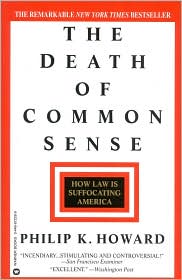
In the social and political domain, back in the 1990’s Philip K. Howard wrote a book called The Death of Common Sense: How Law is Suffocating America in which he detailed example after example of how the overlawyering of regulatory systems in America by an emerging and hyper-aggressive legal class was producing neither restraint on government abuses nor fine-tuned social outcomes but instead created a state of paralyzed rigidity, risk aversion, perverse incentives and general dysfunction; in other words, chaos instead of order.

The Obama-ites in the White House are not “socialists” ( at least not most of them) but there is a great love of liberal-minded technocracy there, and a seemingly boundless self-confidence in the ability of high-minded, upper-middle class, progressive, wonks and lawyers from the “good schools” (or investment houses – in some cases, both) to micromanage not just our lives for us, or even the United States of America but the global economy itself. Sort of a Superempowered Oligarchy of Good Feelings.

The ancient Greeks had a word for that: hubris. More importantly, the Obama-ites are wrong here – adding endless amounts of regulatory complexity is not going to give them the kind of granular control or positive returns that they seek to obtain from the system. Counterintuitively, they should be radically simplifying where and to the degree they safely can instead.

CIA Clandestine Operatives: Horizontal Thinkers or Just in Need of Ritalin?

Friday, March 20th, 2009

Jeff Stein of Spy Talk had a fascinating interview with Dr. David Charney, a CIA psychiatrist specializing in treating professional spooks. The whole article is interesting but the following caught my eye:

….But for case officers at the tip of the CIA’s spear, he said, the problem tends to be A.D.D., Adult Attention Deficit Disorder
“They seem to be highly functional A.D.D.’s,” Charney said. “You might think a person with ADD can’t tie their shoelaces, but quite the opposite.” To them, “boredom equals death,” 
Charney says, not really joking. 

“They’re energetic, restless, people who have to physically keep moving. Lock them to a desk, and they can’t deal with it. They can’t stand to be bored…” 

But A.D.D. can be an asset, too.  “They have the ability to absorb things from 360 degrees,” Charney marvels. 

“Contrast that with people who are linear, like your book-keeper or accountant, who chug along in a channel and get things done by going from one thing to another. But A.D.D. minds tend to be very synthetic. They reach out and pull things out of the air, or through other persons who are not linked in any way. They see patterns that other people don’t see. They can gather together unusual elements and bring them together into a whole that is a brilliant synthesis of things that would be lost on other people.  

“They have a sensitivity to ambient thoughts going on that a good case officer needs to pick up, little nuances, little hues, little things said that let you know if the agent you’ve recruited is telling the truth, or which is partly the truth … which buttons to push to manage the person, how to absorb material and put it into a whole. And the good ones have that ability.”

This is classic horizontal thinking with an emphasis on connections, patterns and synthesis driven by an internal “restlessness” – the kind of persona seen in such disparate occupations as fighter pilots, inventors, physicists and artists. There has long been a comparative and to an extent correlative association of ADHD or “hyperactivity” with creativity, high levels of intelligence and depression though of course not everyone with ADHD is creative, intellectually gifted, depressed or working for an intelligence agency. The correlation though has also been noted in MRI brain scan studies of children so it would appear to have a physiological basis that might explain why the CIA needs to have its own psychiatrists for reasons beyond the stress generated by a career in intelligence work – self-selection bias in people who apply to become employees.

(Hat tip to….one of my twitteramigos….I can’t find the tweet, damn it!) 

Intersecting Emerging Tech and Society – Juan Enriquez

Tuesday, March 3rd, 2009

This is good, once you get past the pedestrian observations about the economic crisis:


Switch to our mobile site