zenpundit.com » blogosphere

Archive for the ‘blogosphere’ Category

Grand Blog Tarkin’s Hoth Symposium

Wednesday, February 20th, 2013

Grand Blog Tarkin is hosting a symposium on the Battle of Hoth. Sparked by WIRED magazine’s original debate begun by Spencer Ackerman, Grand blog Tarkin’s Symposium features some of the finest sci-fi war nerd speculation from keen strategic thinkers from the blogosphere and Twitter.  Oh, yeah, I am participating as well, thanks to Kelsey Atherton.

Here are some excerpts and their authors:

Hoth Symposium Comes Home 

Dunkirk-on-Ice by Graham Jenkins

In 1940, French historian Marcel Bloch wrote a slim volume entitled Strange Defeat, on the incomprehensible defeat of the superior French Army at the hands of the Wehrmacht. 60 years later, Ernest May wrote the complementary version in Strange Victory, an account of the improbable German success in defeating France. Many have written on the utter failure of the Imperial Navy to successfully crush the Rebellion once and for all at the Battle of Hoth, but few have bothered to explore the rather unlikely escape the Rebels made from their icy fortress. “How did they not lose?” Contrary to Spencer Ackerman’s view, the Alliance was faced with dire options and chose mostly the best available.

Ackerman critiques the Alliance for keeping virtually all of their key military players in the same location at Echo Base, but ignores the value of face-to-face, instantaneous communication among Rebel leaders. Collaboration is key to any successful insurgency, and while distributed cells might have a better chance of survival, they still require a core group to perform key coordination and planning functions. This is most effectively provided through close, personal cooperation…. 

The Battle of Hoth and Grand Strategy by Mark Safranski

The key to understanding the Battle of Hoth is not in tactical minutia on the icy surface of the planet, nor in confused imperial strategic objectives or even in the quixotic leadership of Lord Vader, but in grand strategy. As a self-contained polity facing no external foes and only a scattered and poorly armed insurgency, the greatest potential threat to the Empire’s two-man Sith regime would likely emerge from the ranks of the imperial military itself. It was not that the Galactic Empire could not have fielded a vast, overwhelmingly powerful and incomparably competent armada against the Rebellion, it was that Darth Sidious did not dare to do so…..

May the Tech Be With You by Shlok Vaidya

The Star Wars world is a bleak one. Aside from the standard strata of humans, the aristocrats like Leia to the paupers like Solo, there exists a more distinct separation. The Force-enabled and the not. Able to summon electricity from thin air, jump great heights, wield weapons of light, it is no surprise that the Empire is run by those able to use the Force. Or that the Rebel Alliance, filled with battle-hardened veterans who fought day in and day out, for days, months, years in some of the most challenging environments the universe has to offer, suddenly promote the Force-empowered Luke Skywalker despite his lack of combat experience.

In a world where a wave of a hand can change minds, it is hard to say technology matters. But as the Battle of Hoth demonstrates, it invariably does. That particular engagement was an exercise in terrible technology decision making. Tanks with weapons that don’t rotate, raised onto legs reminiscent of ostriches, and move with all the finesse of an overweight wampa. Laser blasts that detonate on impact without consistent grouping. A lack of even basic infrared overlays on a ice-covered planet. The Empire’s foot-soldiers, otherwise decent men pulled from their homes and families to wage war in forsaken lands, were abandoned to the tools provided by the lowest bidder. Minor modifications could have addressed a vulnerability to harpoons. Major platform changes could have wiped out the rebel force in minutes…..

Hoth Symposium Comes Home 2: Late Registration

Let’s Cut the Imperial Fleet Some Slack by Brett Friedman

It’s difficult to tell from the original three movies, but the Imperial Fleet is a very new organization. Their operational and strategic missteps make much more sense in this light. A galactic fleet cannot be built in a day. Although we see a Star Destroyer at the end Revenge of the Sith, a fleet is comprised of more than just ships. Doctrine, tradition, staff work, planning processes, and institutional experience are just as important as the ships themselves. Even though decades elapse between Revenge of the Sith and The Empire Strikes Back, it was just not enough time for the Imperial Fleet to become an elite force.

The Battle of Hoth occurs twenty-two years after Palpatine seized power.The first expeditionary operation conducted by the US Navy after their formative battles during the American Revolution occurred between 1801-1805, twenty six years after its formation. Both of these conflicts were waged against non-state actors by very new nations. Although the First Barbary War was successful for the American Fleet(thanks to a few Marines) there was an embarrassing mistake. The USS Philadelphia was run aground and captured, along with its entire crew, without a fight. Additionally the expeditionary force had to depend on third party support from the Kingdom of the Two Sicilies. Presuming that years in the Star Wars galaxy are identical to our own, the two young fleets had a similar amount of time to develop. The Imperial Fleet that we see in Empire, while presumably leavened with clone-veterans from its formative battles, just did not have the know-how to conduct counterinsurgency on a galactic scale. The tactical and strategic situation that the fleet faced at Hoth was, to them, a new one…..

Missed Opportunity: Rieekan’s Failure at Hoth by Mike Forbes

The conventional wisdom regarding the Battle of Hoth is that it was a major Imperial victory, described in terms of the Rebels as the massively overmatched ragtag band scattering before the unstoppable Imperial juggernaut. Thecontrary wisdom of sci-fi strategists focuses both on the tactical blunders made by the Imperial force, and thestrategic factors that influenced the decision-making of key leaders. Both narratives are wrong. The Rebel Alliance was anything but a ragged insurgent mob; they were a well-equipped and well-organized hybrid threat# at the time. The Battle of Hoth should have been a decisive victory for the Rebels, perhaps even as significant as the Battle of Yavin had been. The Imperial forces bungled what should have been a fairly simple HVT capture or kill mission, their staggering incompetence playing right to the Rebels’ strengths. However, the Alliance only managed to scrape by with a strategic draw due to their failure to take advantage of key opportunities during the battle to strike a massive blow to the Imperial fleet and the Empire’s key leadership. Hoth was also not a total tactical failure for the Empire; in fact they managed to pull off a partial victory, since Echo Base was indeed reduced to rubble, and the Rebels lost a large amount of materiel in the process of their hasty withdrawal under fire. The Imperial forces managed to salvage a partial success out of what by all rights should have been a crushing defeat, thanks to the even greater failures of their Rebel opponents, in particular the criminal negligence of General Rieekan….

 

Elkus on Policy Relevance

Monday, February 18th, 2013

Intriguing and vigorously argued piece by Adam over at Abu Muqawama

Relevant to Policy?

Are we in a 1914 scenario in East Asia? How often do guerrillas succeed? Did counterterrorism law erode national sovereignty? These are just a few of the important questions that political science has some bearing on. Yet barely a couple months goes by without an op-ed decrying political science’s alleged lack of relevance to the outside world.

Political scientists are frequently told their research is too arcane, mathematical, and self-involved to be of possible value to anyone in Washington dealing with real-world policy problems. There’s a grain of truth here. As international political economy whiz Kindred Winecoff observes, political scientists need to make a better “elevator pitch.” But here’s the problem: at the end of the day, there is a difference between what Max Weber dubbed science as a vocation and the subjective policy lessons we can take from our study. Part of that gap is reflected in the difficulties that people with purely policy interests inevitably encounter in PhD programs.

From my own (minor) experience so far, it is grueling, necessitates the assimilation of difficult methodologies, and involves having to think about intellectual questions that many people would regard as hopelessly arcane. Even a good PhD program that directly tackles policy questions will likely demand the student grapple with questions of esoteric theory and method. And not all research that tackles highly abstract questions is policy-irrelevant. Highly technical analysis of game theory and economics generated useful policy applications form the World War II convoy system to nuclear strategy and wargaming.

All of these advances began from the desire to grapple with difficult questions to produce knowledge, something many critics of political science research do not acknowledge. Take Greg Ferenstein, who penned an article supporting Eric Cantor’s call to defund the NSF. His gripe is familiar. Political science is obscuratist, hyper-mathematical, and disconnected from the policy world. Political scientists don’t do enough to make their research accessible to policymakers. Ferenstein wants a political science that his mother-in-law can understand, and he thinks starving academia of resources will motivate hungry researchers to do better. So is modern political science irrelevant to policy needs?

Contra Ferenstein, policymakers have thrown substantial $$ at the kind of research he regards as navel-gazing arcana. The RAND Corporation got a lot of mileage using what Ferenstein derides as “clever mathematical models” during the Cold War.  I’m not sure that Jay Ulfelder, who worked for the intelligence community-funded Political Instability Task Force, would agree that his quantitative forecasting methodologies must pass a mother-in-law test to be valuable. And when New York University’s game theory guru Bruce Bueno De Mesquita speaks, the CIA listens. Drew Conway, a man that could easily teach a computer programming course just as well as poli-sci 101, gives invited talks at West Point on analyzing terrorist networks. I don’t think Ulfelder, Mesquita, or Conway have sleepless nights pondering the relevance of their research to the govermment!

Read the rest here 

As an aside, I have found Ulfelder’s posts on his research or comments on the field at Dart Throwing Chimp to be very useful and worth reading.


Mali: the wider context, the right now and the longue durée

Tuesday, January 22nd, 2013

[ By Charles Cameron — cross-tagging some useful resources from natsec bloggers with another from a bright historian friend ]
.


.

Daveed Gartenstein-Ross‘s Globe and Mail piece The War’s in Mali, But the Danger is International from almost a week ago gave a global context to the conflict, while his more recent Al Qaeda in the Islamic Maghreb and Al Qaeda’s Senior Leadership on Gunpowder & Lead addresses the issue of relations between AQIM and AQ senior leadership.

Zeroing in, we have a 4-part series on the jihadist actors in Mali from Andrew Lebovich, posting on Jihadica:

  • Primer on Jihadi Players in Algeria and Mali, Pt. 1: AQIM
  • Primer on Jihadi Players in Algeria and Mali, Pt. 2: Belmokhtar & Those Who Sign with Blood
  • Primer on Jihadi Players in Algeria and Mali, Pt. 3: Movement for Tawhid and Jihad in West Africa
  • — and there’s one more in the series still to come which has now been posted:

  • Primer on Jihadi Players in Algeria and Mali, Pt. 4 (Final): Ansar al-Din
  • **

    And by way of cross-fertilization of immediacy with history, here’s the key Mali para from The Slightly-More-Longue Duree by my friend, Swarthmore historian Tim Burke, on Easily Distracted:

    I would never for a moment want to fall back on a pure restatement of ibn Khaldun’s famous interpretation of the history of northern Africa (and the world) and say, “See, this is just pastoralist nomads versus settled agriculturalists and city-dwellers”. But there is a much more specific history that has considerable depth and antiquity to it that involves relationships between Berber-speaking Tuareg pastoralists, Fulani pastoralists, and the settled agricultural societies of the Niger River; between North African states and Sahelian states; between cities and their rural hinterlands; between Islamic cultures and non-Islamic ones. That all matters not just as contemporary sociology but as deep and structurally recurrent history, as a series of patterns and concepts that can be consciously recited by contemporary combatants but that also can be the structural priors of how they mobilize for and imagine conflicts.

    Tim’s conclusion:

    To talk about deeper histories is not to explain current conflicts as destiny, or to put aside a whole host of material, economic, geopolitical and cultural issues with much more immediate explanatory weight. But somehow I feel as if we have to give people struggling to understand what’s happening (and what to do about it) the permission to consider all of the history, as well as the guidance to help them to weigh its importance in context.

    Two pebbles in the pond of thought

    Saturday, January 12th, 2013

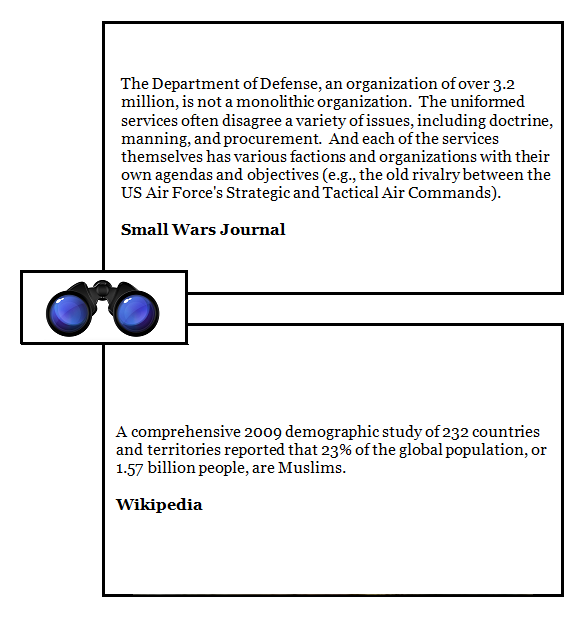
    [ by Charles Cameron — regarding the idea that Islam might be monolithic as well as monotheistic, and more generally, the patterns created when concentric ripples intersect ]
    .


    .

    Drop these two pebbles into the pond of thought, and watch the ripples as they intersect, overlap, enhance one another, cancel each other out and continue…

    **

    It may seem obvious that Islam is not, and could not possibly be, a monolithic entity — but I want to suggest something more than that fairly basic fact.

    I want to suggest that just as we have all enjoyed watching the way concentric ripples fan out from the place where a pebble — or a raindrop — hits a pond, and the fascinating ways win which two or more such ripples intersect —

    — in much the same way, it can be fascinating — and often illuminating — to watch the way in which ripples of thought in the thought pond intersect.

    In fact, that’s the basic “move” behind all creativity.

    **

    My sources for the two quotes above:

    Small Wars Journal, Disruptive thinking
    Wikipedia, Islam

    My sources for the two images above:

    Doodles and jots, ripple effects
    David Armano on “ripples of influence”

    Islamism, 1912 and 1922

    Saturday, January 5th, 2013

    [ by Charles Cameron — intriguing uses of the terms Islamism and brotherhood in US newspapers a century ago, also the Ahmadiyya ]
    .


    .

    Here are the opening paragraphs of a fascinating article in the Ogden Standard Examiner, June 1922, titled Trying To Make Christian America Mohammedan. Marisa Urgo pointed to it in a tweet yesterday, with the comment “Reads like some blogs I know. I kid you not…” I noted it because it contained the word “Islamism” – surely an early use of that term? – and found much of interest when I read it more carefully this morning:

    The Christian people of America are spending millions of dollars every year in the effort to spread the gospel of Christ all over the earth and convert the people of every nation under the sun to Christianity.

    And while this tremendous outlay is being made to maintain thousands of devoted missionaries in foreign lands, one of the world’s other great religions is making a determined effort to gain a foothold in Christian America.

    The leaders of Mohammedanism, not content with the 227,000,000 or more adherents that faith now has in Turkey, India and other countries, are turning their attention to the United States and Canada, with the hope of making both those nations strongholds of Islamism.

    They aim to make their picturesque mosques and the towers from which the muezzins issue their calls to prayer as numerous as our churches, and when that day arrives they are confident it will not be long before the crescent will overshadow the cross and a great majority of Americans will be following the precepts laid down in the Koran.

    To the millions of American Christians who have so long looked eagerly forward to the time when the cross shall be supreme in every land and the people of the whole world shall have become followers of Christ the plan to win this continent to the faith of the “Infidel Turk” will seem a thing unbelievable. But there is no doubt about its being actually well under way or that it is being pressed with all the fanatical zeal for which the Mohammedans are noted.

    **

    The article as a whole is about the Ahmadis, followers of a nineteenth century Mahdi claimant, Mirza Ghulam Ahmad — and we should note what Wikipedia calls “the Ahmadiyya concept of Jihad in a peaceful format”:

    The Ahmadiyya Muslim Community believes that God sent Ahmad, like Jesus, to end religious wars, condemn bloodshed and reinstitute morality, justice and peace. They believe that he divested Islam of fanatical beliefs and practices by championing what is in their view, Islam’s true and essential teachings as practised by the Prophet Muhammad.

    For this and various other reasons, the Ahmadis have been widely considered non-Muslim by orthodox Sunni and Shi’a, and notably persecuted, see for example Attackers Hit Mosques of Islamic Sect in Pakistan.

    The article also includes a hypothetical question and answer between Jesus and a US customs official, when the former attempts to enter the US from India. While not as fine a work of literature as Dostoevsky‘s Grand Inquisitor, it has its Life of Bryan moments…

    **

    On early uses of the term Islamism – I haven’t consulted OED, which would probably be wise, but Marisa Urgo also pointed to a use of the same term in a 1912 New York Sun piece, Rallying to Defend Islam:

    But Islamism is even more than a faith, it is brotherhood…


    Switch to our mobile site

