zenpundit.com » africa

Archive for the ‘africa’ Category

Introducing Urb.Im

Tuesday, July 31st, 2012

[ by Charles Cameron — my new job, solutions-oriented thinking / writing about urban poverty in 6 cities ]
.

http://zenpundit.com/?attachment_id=12052

Mapping Kibera, Nairobi

.

Yesterday was my first day at work on my new job with Urb.Im:

The urb.im network is a global community working for just and inclusive cities. It connects practitioners in six cities and throughout the world to establish an international community of practice and learning, sharing ideas and experiences in order to innovate, replicate, and scale working solutions to the problem of urban poverty. urb.im is a project of Dallant Networks and the Ford Foundation.

The six cities we’re focusing on are Mumbai, Rio, Lagos, Mexico DF, Nairobi and Jakarta — and we are strongly solutions-oriented.

**

I imagine there will be considerable overlap between the diverse interests of those who follow Zenpundit and the specific cities and issues I’ll be working with at Urb.Im — so this is both a news bulletin about my new employment (suggesting I’ll now be focusing my attention on a new problem and solution set), and an invite to ZP readers to steer me towards relevant materials (eg via hipbonegamer on Twitter), and to join in the discussions at Urb.Im as appropriate.

One of my ambitions is to get some significant cross-website conversations going, so that the widest array of bright minds and good hearts gets together to spark new ideas and possibilities, and put existing resources on the map for all interested parties…

**

And speaking of mapping

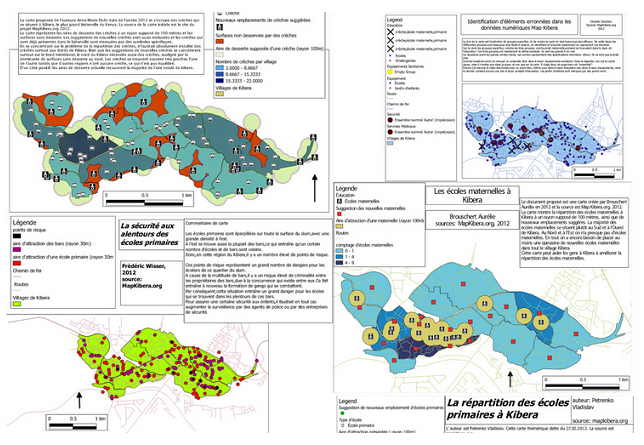
The illustration above is of a map of schools in Kibera, Nairobi, one of the largest informal settlements in the world — mapping both problem areas and available solutions is a key element in the kind of work we’ll be doing. For more details on mapping Kibera, see this Urb.Im page, and to download and enlarge the Kibera education-map image, go here.

No compulsion in religion

Thursday, July 26th, 2012

[ by Charles Cameron — conversion by force, the Qur’an — and a question about space travel ]
.

Under the header, Africa: ‘Christians Must Convert’ Says Islamist Group, the Catholic Information Service for Africa reported recently:

Islamist militants have claimed responsibility for the deaths of more than 50 people in north-central Nigeria – and called on the country’s Christians to convert to Islam. Boko Haram spokesman Abu Qaqa issued a statement that the Islamist group carried out the attacks on more than a dozen villages last weekend (June 30 – July 1) and said it will continue to attack the country’s Christians.

According to the statement: “Christians in Nigeria should accept Islam, that is true religion, or they will never have peace.”

“We do not regard them as trusted Christians as some illiterates are campaigning because it was Christians that first declared war on Muslims with the support of government.”

Violence in Plateau state last weekend was blamed on members of the predominantly Muslim Fulani ethnic group, which attacked Christian tribes in the region in March 2010 due to political and social tensions. According to a Red Cross statement issued late Sunday (July 1), aid workers counted 58 dead – but other estimates place the number higher. Press Trust of India reporters stationed in the capital Abuja stated that 135 people were killed.

In the statement Boko Haram thanked God for the massacre: “We praise God in this war for Prophet Mohammed, we thank Allah for the successful attack in Plateau state on Christians and security men”.

Speaking to Aid to the Church in Need last month, Bishop Martin Igwe Uzoukwu Minna said: “If we have to die for Christ, we will die for Christ, but why should we be forced to make the choice?”

**

Sheikh Sâmî al-Mâjid, professor at al-Imâm Islamic University, Riyadh, finds the answer quite simply set forth in the Qur’an:

Allah says: “Let there be no compulsion in religion. Truth has been made clear from error. Whoever rejects false worship and believes in Allah has grasped the most trustworthy handhold that never breaks. And Allah hears and knows all things.” [Sûrah al-Baqarah: 256]

He then comments:

One of the fundamental truths established by the sacred texts is that no one can be compelled to accept Islam. It is the duty of Muslims to establish the proof of Islam to the people so that truth can be made clear from falsehood. After that, whoever wishes to accept Islam may do so and whoever wishes to continue upon unbelief may do so. No one should be threatened or harmed in any way if he does not wish to accept Islam.

This verse is decisive in establishing that each person has the right to make his or her own choice about embracing Islam. There is other equally decisive evidence in the Qur’an, among which are the following verses:

Allah says: “If it had been your Lord’s will, all of the people on Earth would have believed. Would you then compel the people so to have them believe?” [Sûrah Yûnus: 99]

Allah says: “So if they dispute with you, say ‘I have submitted my whole self to Allah, and so have those who follow me.’ And say to the People of the Scripture and to the unlearned: ‘Do you also submit yourselves?’ If they do, then they are on right guidance. But if they turn away, your duty is only to convey the Message. And in Allah’s sight are all of His servants.” [Sûrah Âl `Imrân: 20]

Allah says: “The Messenger’s duty is but to proclaim the Message.” [Sûrah al-Mâ’idah: 99]

It is important to note that these last two verses were revealed in Madinah. This is significant, since it shows that the ruling they gave was not just contingent on the Muslims being in Mecca in a state of weakness, but is valid for all time.

**

We humans do seem to like imposing our own views on others, though, don’t we? And religion is a brilliant playground for that sort of thing.

If God had planted different the religions on different planets, do you think we’d have mastered space travel by now?

Mali: a tale of two tweets

Tuesday, July 3rd, 2012

[ by Charles Cameron — Timbuctu, Bamiyan, iconoclasm, dissolution of the monasteries, conceptual mapping, ethics, aesthetics, Venice ]
.

credit: Alidade, see below


.

Zen called the Ansar al-Din “The Taliban of the Mahgreb” today, pointing to an article on the destruction of the Bamiyan Buddhas, and that’s an equation of a sort: destruction of the Sufi shrines in Mali compares with and in some ways equates to destruction of the Buddhas of Bamiyan.

The similarity lies in the destruction by Islamic zealots of images considered idolatrous — and as Curtis reminded us, a Chritian expression of the same concept also motivated the Iconoclastic movement in Orthodoxy.

To some extent, the dissolution of the monasteries in Henry‘s England under Thomas Cromwell carries a similar resonance.

Which brings me to two tweets I received in my Twitterfeed today.

**

Here’s Tweet Number One, as Dr Seuss might have said:

And Tweet Number Two:

**

Between the two of them, and with an eye to Zen’s remark, I get the idea that there’s a style of mental mapping that I can just about see out of the corner of my eye — a mapping that would interest me if I could figure out more about how to take it from being implicit and verbal and make it graphical and visible.

In this mapping, we would lay out the manner in which things presumed equal are treated differently.

I suspect the mapping might initially look something like the graphic at the head of this post — which I’ve borrowed from the materials on an interesting “Co-Revolutionary War Game” devised by Alidade in 2003 or thereabouts.

**

Arguably the publication of blasphemous cartoons of the Prophet upsets many Muslims more than does the destruction of Sufi shrines. Likewise, the publication of Salman Rushdie‘s Satanic Verses upsets many Muslims more than does the fatwa calling for Rushdie’s death. The burning of Qur’ans seems to upset many Afghans more than the deaths of nine Afghan children… And likewise, the loss of human lives in Mali seemingly pales in comparison to the loss of the Timbuctu shrines of saints in the eyes of the western press.

Throw in the Bamiyan Buddhas, and you have a first cluster of data-points that might be mapped in terms of public outrage — Christian, Buddhist, Muslim, cultural, political. the peaks and valleys will differ according to the perspectives chosen, and mapping the differences too would be of considerable interest.

**

The question has become something of a classic among ethicists, I believe: whether to rescue an unknown human child — who may if saved, as they say, grow into a Mao or a Michelangelo — or a great masterpiece of painting, if both are swirling past you in the same Venetian flood…

My instinct is with the child, but oh! — my temptation goes towards the painting…

Boko Haram: religious vs social war

Wednesday, June 27th, 2012

[ by Charles Cameron — follow up to Taliban: religiosity vs pragmatism ]
.

Sen. Ita Solomon Enang, Chairman of Nigeria’s Senate Committee on Business and Rules, recently responded to a press question about Boko Haram, in an interview published under the curious title, Boko Haram war more religious than social — Engang:

Q: Previously you said Boko Haram attacks were not targeted at Christians but with the consistent attacks on worshippers in churches, have you not changed your mind and how do you think this problem can be dealt with?

A: Unfortunately, I held a position that it is not a religious war in the past. But my position on that is becoming shaky because when people now blatantly take guns to churches and aim at unarmed worshippers, kill them and go away; or they take a bomb to the church and detonate it there, I would say this is like a jihad and I think we should stop behaving like ostriches. I think that the sooner we accept it as a religious war, the better we will be able to handle it.

**

I keep circling around this central point. Much of interest and concern in today’s world revolves around the manner in which politics and religion are separable, braided together, or inseparable…


image credit: Christian Mercat, under GNU license v 1.2 — see documentation.

What does it mean for a war to be a religious war, or — to avoid the complexities that defining war bring into the picture while substituting the equivalent complexities attendant on the word violence — for violence to be religious violence?

  • Do both sides have to fight a religious war for it to be religious?
  • Can individuals perform acts of religious violence within a war that is not itself religious?

In some ways the issue parallels the one raised by Zen today in a quote from Colin Gray:

It is not sensible to categorize wars according to the believed predominant combat style of one of the belligerents. Guerrilla-style warfare is potentially universal and, on the historical evidence, for excellent reasons has been a favored military method of the weaker combatant eternally. There are no such historical phenomena as guerrilla wars. Rather, there have been countless wars wherein guerrilla tactics have been employed, sometimes by both sides. To define a war according to a tactical style is about as foolish as definition according to weaponry. For example, it is not conducive of understanding to conceive of tank warfare when the subject of interest is warfare with tanks and so forth, typically, if not quite always, in the context of combined arms.

Zen’s response to Gray:

Gray is correct that many wars partake of a blend of tactical fighting styles or that most wars are better defined (or at least should be in terms of causation) by their political character. That said, a specific fighting style sometimes is a definitive descriptive characteristic of a war, particularly if a dominant tactical style explains one side’s consistent comparative advantage (ex. the Macedonian phalanx vs. the Persians) in battle and some of the resultant choices which were forced upon the adversary.

**

We have a sort of Venn-diagram-in-words possibility: religiopolitical — but it’s really little more than a sop to the fact that religion and politics are at time closely woven. The religiosity of voiolence, and for that matter the violence of religiosity — these are things that wax and wane, shifting sands — they don’t always stay still long enough for us to box them in words, to reify them, to treat them as easily discernible and manipulable mental objects.

That said, to paraphrase Zen, “a specific religious style sometimes is a definitive descriptive characteristic of a war…”

Our understanding may be shifting and nuanced, but the briefs and executive summaries that decision-makers receive, the soundbites they articulate (can one articulate a soundbite?), and the headlines that preach their doctrines to the wide world — these use a given word or they don’t.

Let me turn that around: the briefs and executive summaries that decision-makers receive, the soundbites they articulate, and the headlines that preach their doctrines to the wide world inevitably either use a given word, or they don’t. And yet a realistic understanding of the given situation will be no less inevitably shifting and nuanced…

I feel very timid dipping a toe into Boyd in present company, but a fighter-pilot is a one-person observer, orienter, decider and actor, no? with a loop measured in fractions of seconds, not months? — whereas between intelligence gathering, strategic orientation, policy-making, and diplomatic or military action there are a multitude of communications channels — many of which function as shears that trim nuance down to the nub.

I suspect that questions like “is this a religious war?” and “is this guerrilla war?” carry (at a minimum) book-length subtleties with them, and wind up all too often with answers which are either yes or no, one or zero.

**

It’s all a bit like asking, “what game is this war we’re playing?”

One senior US official in Iraq was quoted by Anthony Cordesman as saying:

the current situation is like playing three dimensional chess in the dark while someone is shooting at you.

Tom Barnett, in The Pentagon’s New Map:

It is not chess but something closer to soccer. The ball is always moving, and substitutions are constantly changing the composition of both your team and your enemy’s. But worse still, your political leadership’s definition of the “problem” you are trying to solve keeps changing, making your attempts to keep score almost meaningless. You want to know what today’s definition of the problem is? Try reading the op-ed pages; you will have plenty to choose from.

John Arquilla and David Ronfeldt:

Major transformations are thus coming in the nature of adversaries, in the type of threats they may pose and in how conflicts can be waged. Information-age threats are likely to be more diffuse, dispersed, multidimensional nonlinear and ambiguous than industrial-age threats. Metaphorically, then, future conflicts may resemble the Oriental game of Go more than the Western game of chess. The conflict spectrum will be remolded from end to end by these dynamics.

As I noted recently, Alasdair MacIntyre wrote, about the complexity of contemporary life in general:

Not one game is being played, but several, and, if the game metaphor may be stretched further, the problem about real life is that moving one’s knight to QB3 may always be replied to by a lob over the net

When it comes time to think, there are only so many metaphor-boxes to fit your nuances into. You pays your money, and you takes your choice.

Leah Farrall posts on culling elephants and AQ

Tuesday, June 5th, 2012

[ by Charles Cameron — Abu Yahya al-Libi, targeted killings, impact on terrorism ]
.


.

My (ex, late, respected) father-in-law Donald Atwell-Zoll co-wrote the book on Managing Elephants, so I suppose you could say it’s a matter of family interest. In any case, I thought these were pretty neat opening paras from an LA Times article a while back, with a dateline from S Africa:

Some teenagers are raising hell in the untamed bush here, tormenting the wild animals and giving tourists a terrible fright.

Such rowdiness may sound typical for adolescents, except these delinquents are running amok in one of South Africa’s most popular game reserves. They have killed rhinos. They have charged cars of safari-goers. And to make matters worse, they are elephant-sized — well, to be precise, they are elephants.

That’s the problem, here’s what they figured out:

“There appears to be a discipline problem among the young elephant bulls,” said Douw Grobler, veterinarian at Kruger National Park, where many of the elephants at Pilanesberg once lived. “There is a missing link in the elephant population at Pilanesberg. There is a need for the presence of adult elephant bulls. They act as the disciplinarians.”

Okay, got that? Let’s get down to business.

*

Today my twitterfeed briefly buzzed with speculation that Abu Yahya al-Libi had been targeted and killed in a drone strike. The tweets were pleasantly sprinkled with humor — but when the talk got serious, sometimes enthusiasm got the better of caution.

Daveed Gartenstein-Ross, level-headed as usual, was among those to make it clear that the initial reports — including an anonymous US official confirmation — of al-Libi’s deaths came with no guarantee of accuracy. But he also noted his willingness to rethink his picture of the overall continuing strength of AQ if al-Libi does in fact turn out to have been killed. With, say, confirmation from an official AQ media channel.

Aby Yahya al-Libi is certainly a significant figure in AQ, as Jarret Brachman‘s many posts and Foreign Policy piece on the man attest. His one sentence summary:

If true, a cataclysmic blow to the future of al-Qaida’s General Command.

But it was Leah Farrall who (IMO) got the bigger picture. And in doing so, she was reminded of those young elephants going on the rampage, and the “need for the presence of adult elephant bulls” to calm them down and give them some discipline.

From Leah’s blog entry, Some quick thoughts on reports Abu Yahya al-Libi has been killed, then:

First, I’ll believe it when al Qaeda acknowledges it.

This of course won’t stop the chest beating celebrating his killing.

And if he has in fact been killed, I wonder if those who think this is a victory (and those supporting the strategy of extrajudicial killings more generally) have given ample thought to the fact that he along with others who have been assassinated were actually a moderating force within a far more virulent current that has taken hold in the milieu. And yes, given his teachings I do note a certain irony in this, but sadly, it’s true.

What is coming next is a generation whose ideological positions are more virulent and who owing to the removal of older figures with clout, are less likely to be amenable to restraining their actions. And contrary to popular belief, actions have been restrained. Attacks have thus far been used strategically rather than indiscriminately. Just take a look at AQ’s history and its documents and this is blatantly clear.

Leah continues — I’ve made only a minor cut between paras here —

I’m working on a more detailed, research driven piece on this. But in the meantime, the best way of summing up the consequences of a strategy of killing off leadership instead of using a criminal justice approach lies with what happened in a wildlife sanctuary in South Africa many years ago.

A culling program was implemented to kill off all the older generation elephants owing to overcrowding. Juveniles were spared. However, without the presence of the older elephants they then proceeded to go on rampages, killing other animals and causing such havoc that the rangers thought they’d have to cull them too. Until that is, someone chanced upon the idea of bringing in older elephants from another wildlife park, who ended up bringing the juveniles into line and enforcing discipline, something that had been missing since the cull of the older generation.

Right now you’re probably scoffing at this. Scoff away, because this example has come up time and time again in conversations I’ve had with folks who know this milieu very well because they’ve lived in it. Along with it has been concern expressed for the future, for what will happen when authoritative voices who can restrain the actions of those left and, importantly, those newer folks still seeking to join the cause, no longer exist. When indiscriminate becomes the norm.

So before anyone goes off celebrating another “number” in the death count, it is worthwhile remembering there will be consequences from this short sighted and reactionary path chosen to deal with threat…

*

It’s not hard to find evidence of that “moderating force within a far more virulent current” that Leah mentions.

From West Point’s Combating Terrorism Center alone, we’ve had the recent Letters from Abbottabad: Bin Ladin Sidelined? with bin Laden expressing displeasure at Faisal Shahzad having broken his citizenship oath in attempting to attack the United States, and warning Yemeni leaders against using Americans who have taken the oath in that way.

Even more recently, in her comments on Fadil Harun’s memoirs, Beware of Imitators: Al-Qa`ida through the Lens of its Confidential Secretary, Nelly Lahoud discusses what she calls “a jus in bello-like framework devised by [AQ’s] Legal Committee”, noting:

The spirit driving Harun’s manuscript is the desire to produce a corrective history of al-Qa`ida distinguishing it from jihadi groups acting in its name. He believed that unlike al-Qa`ida, many jihadi groups have deviated from the true path of jihad. In his opinion they lack a sound ideological worldview and many of their operations, particularly those which involved resorting to “tatarrus” (i.e., the use of non-combatants as human shields), are in breach of what he deems to be “lawful jihad.” He therefore decided “to write about al-Qa`ida… to make clear to everyone the sincerity and uprightness of its path with respect to jihad and other religious, worldly and political issues.”

and further:

it is evident that Harun’s sentiments were not isolated. The internal communication between a number of well-known al-Qa`ida figures [gathered at Abbottabad and recently released to CTC] indicate that they too were alarmed by the conduct of regional jihadi groups and their indiscriminate attacks against civilians. Bin Ladin in particular was distressed by their conduct and, like Harun, was dismayed by their irresponsible understanding of “tatarrus,” which led to the unnecessary deaths of civilians and tainted the reputation of the jihadis.

So there you have it: the older bull elephants don’t like the undisciplined ways of the youngsters…

And what do we do? We cull the ones who are calling for restraint…

*

How does Leah conclude her analysis? You’ll remember she said, “there will be consequences from this short sighted and reactionary path”? Here are her almost-final words — and whether you agree fully with her analysis or not, they are words to be considered seriously by those rethinking strategy and making policy decisions:

These consequences will not play out in areas where extrajudicial killings take place, but in indiscriminate attacks in capital cities in the west. I wonder then how those who advocate the current policy plan to deal with this and the implications it will pose for the social contract.


Switch to our mobile site

