zenpundit.com » john boyd

Archive for the ‘john boyd’ Category

Perception Pyramid vs. OODA Loop

Friday, November 7th, 2008

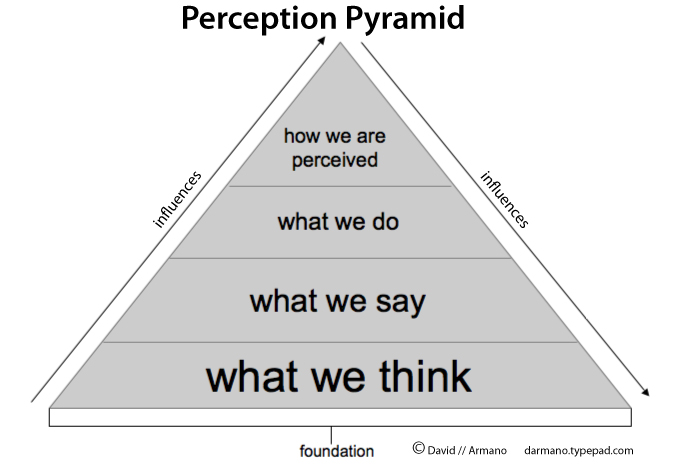
Design guru David Armano had a graphic up that was intriguing from a psychological point of view:
armano.jpg

My instant impression on seeing Armano’s visual was a reminder from Western philosophy and Eastern religion:

“We are what we frequently do” – Aristotle

“What we think, we become” – Buddha

The second impression from the graphic was it’s simultaneous representation as both a feedback loop and a hierarchy. As a hierarchy, I’m not certain I would put “what we say” as a more fundamental tier than “what we do” as Armano did.  Actions would appear to be less subjective as events occuring in time and space than words but words moreso than the perceptions of others which we can neither control nor reliably audit, yet they very much influence us, as Armano suggests.

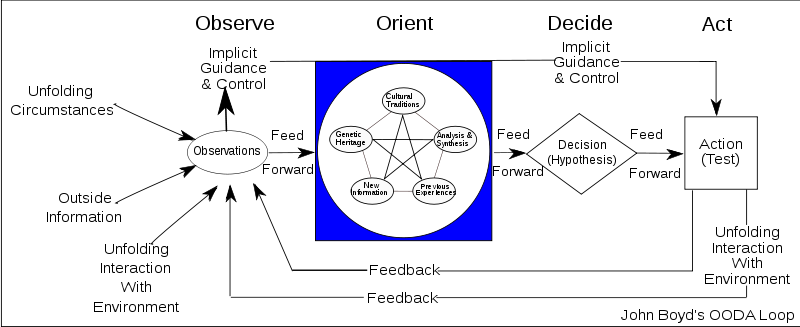
Compare the flow of information/action in Armano’s pyramidical graphic with John Boyd’s OODA Loop:
ooda.png

Boyd’s conception is not hierarchical or sequential, though many people view OODA as a deliberative step by step process, running through it in such a manner instead would slow the cycle considerably. Armano’s consideration of the perceptions of others would be important to Boyd as “outside information” and “unfolding interaction with environment”. It would address the mental and moral levels of conflict and competition

  • Mental (against individuals and groups): surprise, deception, shock, and ambiguity
  • Moral (against groups): menace, uncertainty and mistrust, resulting in disintegration of cohesion and the moral fragmentation of the opponent into many non-cooperative centers of gravity, which pumps up friction.

It would also measure our ability to attract support from or positively influence third parties or allies.

Interested in any thoughts the readership might have on the comparison or from any of my numerous co-authors….

John Robb to Keynote Boyd 2008

Wednesday, October 8th, 2008

John Robb is going to be the keynote speaker at the Boyd 2008 Conference on Prince Edward Island.

A great choice. Robb as most of you know, is the author of Brave New War: The Next Stage of Terrorism and the End of Globalization and is currently working on a book on “Resilient Communities”, one of the conference themes. Here is the conference agenda:

Situation* Energy – Peak Oil and its effect on our economy and our way of life is now a reality. The end of the big car, of suburbia, of cheap food, of maybe global trade, of how cities are designed are all on the table now. We can also see that paying for oil has also led to a shift of power from the US to other places. We are at full fiscal and financial stretch and it is going to get worse so long as we depend on oil and we do nothing to change how we live.

* Credit – We can now see that the Mortgage Crisis is not a “normal” correction but may include a complete shut down of the other mainstay of our way of life cheap and easy credit. Our financial system is on life support. Again, we are at full fiscal, financial and social stretch. The credit of our country is in question.

* Food – Food across the world seems finally to have hit some Malthusian limit perhaps affected by the end of Cheap Oil and by unstable weather – Not only is energy rising in costs but so is food. Both are also subject to shortages or even to being not available at all – much of the world is becoming a tinder box. Imbalances in water will increase the tension.

* Weather – It’s not just the hurricanes but too much rain or not enough is stretching communities to the limit.

* Conflict – With these forces building, so is the potential and the reality of conflict. This is the time for adventures such as Georgia or possibly Taiwan? This is the time for finding another to blame for domestic failure Pakistan/India? This is also a time when the US is at full system overstretch where its capacity to intervene or help is now in question.

* A transition in business models – The end of the “Ford Model” of get big and get central as the main value creator in business or in services – All who operate this model seem terminally ill. Millions are going to become unemployed as the shift to a more networked model takes place.

* Vulnerability in key infrastructure – Our oil/gas systems are a hurricane away from failure. The grid, a bad storm away. Our food delivery systems depend on a just in time system that also depends on nothing going wrong. The chances of being without food and power for a long period of time are now very high. There is no resiliency in these key areas.

* The end of the state – An aware person can see that the state can do little to help in any of these areas of tension. Not only is the larger state helpless or even worse, but so are the smaller states. Looking to the “father” used to work but post Katrina seems not to. So as we go to the polls this fall, many of us wonder if there are any ways at all that we can influence our destiny.

* The power of the legacy systems – The systems that are failing still have the power and the means to fight off a direct attack. They have the money and they have co-opted the political machinery. This includes the Pentagon, Big Oil, Big Auto, Big Food etc. Merely having the right ideas will not be enough.

Review: Jeremy Young at Progressive Historians

Monday, October 6th, 2008

Jeremy Young, primus inter pares at Progressive Historians, posted up with compliments and constructive criticism in his review of  The John Boyd Roundtable :

Quick Thoughts on The John Boyd Roundtable

….First, let’s start with the obvious and most critical point: this book originated on a blog, more specifically as a blog roundtable. As such, the very fact that it’s made it into print is a significant leap forward for academic bloggers across boydbook.jpgthe net, and one we should cheer enthusiastically. Further, it’s clear from reading the book that the roundtable turned up considerable new insights….

….The only real problem I have with the book has to do with something that I think is only an issue because of the translation from blog to book. The John Boyd Roundtable is a book about another book by Frans Osinga, which is in turn a book about a military thinker, John Boyd. That’s a lot of moving parts to convey to a lay reader (which I most certainly am in the field of military history), and unlike on a blog, where you can simply link to Osinga’s book or to a Wikipedia profile of Boyd, all the connections need to be spelled out in the text itself. I didn’t get quite enough of this with regard to either Boyd or Osinga….

Read the rest here.

Review: Information Dissemination

Thursday, October 2nd, 2008

Galrahn, the master of all things maritime, penned a very positive review of of The John Boyd Roundtable over at Information Dissemination :

Disciples of Strategy and Disciples of a Strategist

I am not an expert on John Boyd, but as a JCL on the subject, I intend to catch up. There is a small group of thinkers whom, since I began blogging, I visit daily to learn from. I call these bloggers mentors, and although I can find myself in disagreement as I browse daily, I also always find myself thinking on the subject matter. Can’t beat that!

Four of these mentors (Thomas Wade, Daniel Abbott, Mark Safranski, and Dr. Thomas Barnett who wrote the foreword) recently published a book with Nimble Books called The John Boyd Roundtable: Debating Science, Strategy, and War. A book about a roundtable? Yep, and after I purchased the book from Amazon.com this evening I decided to go ahead and blog on the subject.

I find John Boyd interesting, and I’ve read enough of the general information to know that I should do research, but it wasn’t until I sat down and read all the way through this conversation over at the Small Wars Journal that I decided to give in and buy the book. In particular, this comment from a less than enthusiastic commenter is what sucked me in.

Indeed, the most irritating thing about Boyd’s work is that he left us next to nothing. Those briefs are hollow shells without his verbiage (“speaker notes”) behind it. Or even the man behind it, as he could handle questions quite well. There’s no body of work that he’s written. So we rely on “the disciples” to interpret him and expand upon what he said. Christ wrote not a single book of the Bible and we know of him through his disciples and the interpreters ever since. Yup, the religious aspects really do appear to apply here.

People’s frustration (“What’s the big deal?”) is certainly relevant and germane because–to those well-read in the art of war–we read Boyd’s interpreters and shrug our shoulders. So what? Don’t we all know that? Didn’t we all know that? Like I said, if you don’t have the kind of itch that Boyd’s ideas were meant to scratch, he doesn’t do much for you.

A military strategist who has published briefs I can read? Am I really supposed to believe the Air Force has had a modern strategist? Oh, you mean they ignored him? Now you have my attention… j/k.

Much thanks to Galrahn for his kind words! Read the rest here.

Debating John Boyd

Sunday, September 28th, 2008

At the Small Wars Council. A thread of great intellectual vigor sparked by CavGuy reacting to the review by Sam Liles of The John Boyd Roundtable:

Here’s a snippet of my post there:

There’s been a discussion if Boyd merits being called “the greatest” or a “great” strategist or theorist. I think it’s fair to say that Boyd himself would never have put forth such a claim of that kind or wasted time worrying about what people thought of him or whether he made a more significant contribution to the study of war than Colin Gray or Carl boyd31.jpgvon Clausewitz. Boyd was more interested in learning, teaching and discussing conflict (moreso than just “war”) and were he alive, I’m certain Boyd would be delighted with the Small Wars Council and the endless opportunities here for discussion and reflection.

Was he “great”, much less “greatest” ? In his briefs, Boyd was trying to shift the paradigm of American military culture away from linear, analytical-reductionist, mechanistic, deterministic, Newtonian-Taylorist, conceptions that resulted in rote application of attrition-based tactics toward more fluid, alinear, creative -synthesist thinking and holistic consideration of strategy. Give the man his due, in his time these were radical arguments for a Pentagon where the senior brass of the U.S. Army had reacted to the defeat in Vietnam by purging the lessons learned of COIN from the institutional memory of the Defense Department.


Switch to our mobile site

