zenpundit.com » john boyd

Archive for the ‘john boyd’ Category

Foreword

Friday, September 26th, 2008

Tom Barnett posted up on his foreword to  The John Boyd Roundtable: Debating Science, Strategy, and War:

…To truly think in grand strategic terms is hard because, in order to communicate concepts to the universe of relevant players, one needs a sort of “middleware” language able to traverse domains far and beyond the most obvious one of warfare. As America heads deeper into this age of globalization-a global order fundamentally of our creating-our need for such bridging lexicons skyrockets. In a networked age, everything connects to everything else, so most of what constitutes strategic thinking nowadays is really just the arbitraging of solid thinking regarding the dynamics of competition, leveraging the surplus of conceptual understanding in one realm to raise such understanding in others….

Read the rest here.

Barnett and Boyd shared a teaching modality, “the brief”. Here’s a head to head comparison:

Colonel John Boyd:

Dr. Thomas P.M. Barnett:

Getting it: Pundita on John Boyd

Wednesday, September 24th, 2008

I’d like to thank Pundita  for her marvelous review. Not because it was laudatory, though that aspect is much appreciated but because she was not, prior to reading The John Boyd Roundtable , particularly familiar with the theories of Colonel John Boyd beyond a few passing references. She instantly “got it” and drew a wonderful analogy in her piece with one of Boyd’s contemporaries who also thought deeply about conflict. This is exactly what we had hoped the book would do – be a gateway to insight:

Colonel John Boyd and the revolution within

The book is the perfect gift for friends and relatives who complain that you spend too much time on the blogosphere. The Roundtable book arose from a cooperative effort by bloggers from a variety of disciplines and who analyze what is arguably the best book ever written on Boyd’s ideas — Colonel Frans Osinga’s Science, Strategy and War: The Strategic Theory of John Boyd.Because this era is one of unrestricted warfare you can’t really understand the times unless you understand something of Boyd’s thinking and contributions to military strategy. So the book reflects the blogosphere at its most useful because Boyd’s ideas can be difficult to approach, even for those versed in military history.

…Boyd’s Thunder and Lightning shop profoundly influenced the U.S. military’s approach to warfare. He died at the age of 70, a year before al Qaeda’s one-two punch in 1998 against U.S. embassies officially launched the era of unrestricted warfare.The U.S. government’s lumbering and wholly ineffective response to the attacks underscored that the “business as usual” mindset in Washington had confined Boyd’s ideas to narrow parameters. It took almost four years of the U.S. military stumbling around in Iraq before men steeped in Boyd’s ideas were finally let loose on the situation.

I venture that John Boyd was the closest the modern U.S. military ever came to Bruce Lee’s view. But as with Lee it was easier to understand Boyd in person — in Boyd’s case, in marathon lecture sessions and the give-and-take of dialogue and debate.

…The ideas couldn’t be approached from the comfortable armchair of the intellect; they had to be wrestled with in the alchemy of personal transformation, through pushing the boundaries of one’s experience, instincts, and knowledge.This process helped develop some great military thinkers but also limited the applicability of Boyd’s ideas. If there’s one thing that the top military command and its funders don’t like to hear it’s the words, “It depends.”

Read the review in full here.

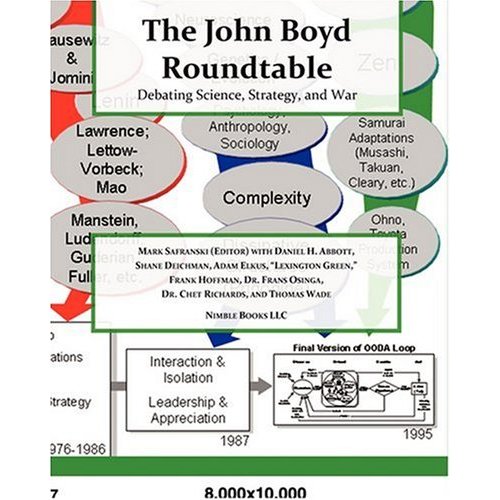
NEW BOOK – The John Boyd Roundtable: Debating Science, Strategy and War

Monday, September 22nd, 2008

boydbook2.jpg

        The John Boyd Roundtable: Debating Science, Strategy, and War

This post has been a long time coming.

A while back, we had a a symposium at Chicago Boyz to discuss and debate the superb book Science, Strategy and War: The Strategic Theory of John Boyd by Colonel Frans Osinga ( Softcover edition available here). It was a great discussion from which I learned far more about  the ideas of the iconoclastic military theorist John Boyd than I had ever previously considered. Not everyone involved was an admirer of John Boyd, a few were initially skeptical and we had one certified critic ( though I had tried to recruit several more). Overall, it was the kind of exchange that makes the blogosphere special as a medium when it is at it’s intellectual best.

Shortly thereafter, via Dan of tdaxp I was approached by the publisher of Nimble Books, W.F. Zimmerman, who happened to be a military history buff and who was interested in working our loose online discussion of Dr. Osinga’s prodigious tome into a book. Initially, I was somewhat dubious but I warmed to the project at the urging of tdaxp and Lexington Green, and agreed to serve as the Editor and “herder of cats” in a project that would involve a large number of contributors with very different backgrounds and some fairly dense and esoteric material on strategic theory to digest and make comprehensible to a general reader.

A wonderful experience.

We had an excellent roster of contributors for The John Boyd Roundtable: Debating Science, Strategy, and WarDr. Chet Richards, Daniel Abbott, Shane Deichman, Frank Hoffman, Adam Elkus, Lexington Green, Thomas Wade and Dr. Frans Osinga, who contributed several essays. Dr. Thomas Barnett sets the intellectual tone in the foreword after which the authors brought a wide range of professional perspectives to bear – cognitive psychology, military history, physics, strategy, journalism and, of course, blogging – in a series of articles that tried to explain the essence and dimensions of John Boyd’s contribution to strategic thought.  Hopefully, we succeeded in creating an interesting and useful primer but the readers will be the ultimate judges, free to dispute our conclusions and offer contending arguments of their own.

I’d like to think that Colonel Boyd would have wanted it that way.
Boyd 2008

Thursday, September 18th, 2008

Although my own chances of being able to swing attending this event have grown dim due to schedule conflicts and professional obligations, I nevertheless wanted to give a warm endorsement to Boyd 2008. The conference the previous year was outstanding and the agenda this year looks to be cutting edge:

Boyd Conference Details Dec 6-7

What – There is an opportunity to hold a short, intense seminar on the applicability of Boyd’s ideas, particularly operating inside the OODA loop and grand strategy (sustaining our own morale and attracting the uncommitted), on the weekend of December 6-7 at the University of Prince Edward Island, Charlottetown, PEI. Canada!

Purpose – The theme would be applying these ideas to conflict in the post-Iraq era, and more specifically to the types of diffused, networked, “open source” armed conflicts that some have called “fifth generation warfare.”


We are also interested in exploring solutions, such as the role of “resilient communities” (RC), for countering them. As Oil and food prices have climbed and the mortgage crisis has grown, the need to think more about Resilient Communities has become more urgent. We may have to re-invent our world!

We envision this as a working seminar to help shape the policy agenda in the first year of the new administration.

So we’re looking for a couple dozen attendees, all of whom would either make short presentations on their areas of interest or participate in panel discussions and working groups.

We also hope that the participants will leave with their own agenda items – to improve resilience within their organizations or to prepare articles and opeds on these subjects in the months after the seminar.

There is also a Boyd Blog in operation.

Homage to Col. John Boyd in AFJ

Thursday, July 24th, 2008

The Armed Forces Journal has an article by Col. Michael Wyly that relates Boyd’s ethic to professionalism:

 In praise of mavericks

Robert Gates felt called upon to prompt uniformed officers accordingly when he addressed Air War College students at Maxwell-Gunter Air Force Base in April. His speech was more than a prompt; it was an inspiration. “The Armed Forces will need principled, creative, reform-minded leaders” who “want to do something, not be somebody,” Gates said.

The secretary continued by quoting Air Force Col. John Boyd: “If you decide to do something, you may not get promoted, and you may not get good assignments, and you certainly will not be a favorite of your superiors. But you won’t have to compromise yourself.”

For a defense secretary to quote a maverick colonel who left the Air Force as a pariah was a bold and risky step. But like the fighter pilot he quoted, he turned into the fight by describing Boyd as “brilliant” in his abilities “to overcome bureaucratic resistance and institutional hostility.” The secretary referred to Boyd as “a historical exemplar,” tracing his impact on our military from 30-year-old captain through to his continued intellectual contributions after retiring in 1975. And he praised Boyd for more than his intellect. He championed his character, quoting the colonel, who said, “One day you will take a fork in the road. … If you go [one] way, you can be somebody. You will have to make compromises and you will have to turn your back on your friends. But you will be a member of the club and you will get promoted and get good assignments. Or you can go [the other] way and you can do something – something for your country and for your Air Force and for yourself.”

….It was during the European Renaissance that the professional class emerged and defined itself. It was during the Renaissance that the birthright nobility began to give way to a society led by persons respected for their merits – for what they did instead of who they were. Each profession had standards for entry, they professed something, and their study of it was daily, continual and life-long. They served their society. Medicine, law, the clergy and military leadership became during the 15th and 16th centuries – and still stand as – the classically defined professions. When we speak of a professional ball player or a professional musician, we are corrupting the term, for it means far more than getting a paycheck for what you do. A profession must be applied for and joined after being accepted, and its moral standards are as important as its philosophy.

Read the rest here.

Blogfriend Smitten Eagle has also discussed military professionalism here.


Switch to our mobile site