zenpundit.com » 21st century

Archive for the ‘21st century’ Category

Israel’s Half-Mad Genius of Mil-Theory

Saturday, February 14th, 2009

Just read this profile of Dr. (Gen.) Shimon Naveh, via Soob via Ubiwar.

….Naveh describes his last and perhaps most important military-academic project, OTRI, as a chronicle of failure. “It was a failure of the group and also my personal failure, but in a far deeper sense it was the IDF’s failure. The IDF has not recovered because it doesn’t have the ability, unless it undergoes a revolution.”Naveh, who established OTRI together with Brigadier General (res.) Dov Tamari, draws on imagery from the world of construction to explain the project. “We wanted to create an intermediate level between the master craftsman, the tiling artisan or the electrician, who is the equivalent of the battalion or brigade commander, and the entrepreneur or the strategist, the counterpart of the high commander, who wants to change the world, but lacks knowledge in construction.”Between the two levels, he continues, is the architect/commander-in-chief, whose role is “to enable the system to understand what the problem is, define it and interpret it through engineers.” In the absence of this link, he maintains, armies find themselves unable to implement their strategic planning by tactical means. “Entrepreneurs and master craftsmen cannot communicate,” he says.Already in his first book, “The Operational Art,” published in 2001 and based on his doctoral dissertation, he described the level of the military architect: “The intermediate level is the great invention of the Russians. [The military architects] occupy the middle, and make it possible for the other fields, from politics to the killers, to understand, plan and learn.”

An interesting and to me well constructed analogy by General Naveh that rings true to me from what I know of the Soviet history. Naveh perfectly describes the peculair adaptive requirements forced on the Red Army by the nature of the Soviet political system, especially as it existed under Stalin from the time of the Great Terror forward ( 1936 -1953). Stalin wiped out much of his senior military leadership of the Red Army during the Yezhovschina in 1937 and decimated the junior officer corps to boot, leaving it thoroughly demoralized and rigidly shackled to political comissars who were, like the military commanders, completely paralyzed with fear ( the Red Navy officer corps was basically exterminated en masse).

When Operation Barbarossa commenced in June, 1941, the dramatic Soviet collapse in the face of the Nazi onslaught was due in part to Stalin’s maniacal insistence that Germany was not going to attack and that assertions to the contrary were evidence of “wrecking” and “provocation” – crimes liable to get one immediately shot. Even a high ranking NKVD official, Dekanazov, whom Stalin made ambassador to Berlin, was personally threatened by Stalin for daring to warn the Soviet dictator about Hitler’s imminent attack.
That being said, Stalin quickly realized during the 1941 retreat that he had debilitated his own army by decapitating it and his own judgment as supreme warlord was no substitute at the front lines for what Naveh terms “operational art”. Stalin the entrepreneur-grand strategist needed competent military architects like Zhukov and Rossokovsky to plug the gap with the craftsmen and Stalin not only promoted and protected them, he tolerated their dissent from his own military judgment and sometimes yielded to their concerns. Very much unlike Hitler who could seldom abide criticism or deviation from his general officers or learn from them. Stalin improved as a war leader from interaction with his generals; Hitler did not and if anything grew worse over time – as did the Wehrmacht’s tactical-strategic disconnect.

The above anecdote represents the rich level of depth behind Naveh’s offhand and seemingly disjointed references. There’s a lot of meat there behind the dots Naveh is connecting but the uninitiated will have to be willing to dig deep. I’m cool toward Naveh’s reliance upon French postmodernism but I admire the breadth of his capability as a horizontal thinker and theorist. However, Naveh needs an “architect” of his own to translate for him and make his complex ideas more readily comprehensible to the mainstream. I will wager that few Majors or Lt. Colonels, be they U.S. Army, IDF or Russian, read much Focault these days.

ADDENDUM:

The SWJ had an interview with Dr. Naveh on his theory of Systematic Operational Design in 2007

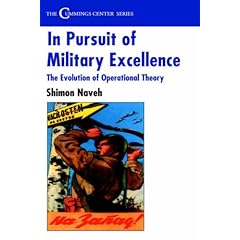
Dr. Naveh’s book is In Pursuit of Military Excellence: The Evolution of Operational Theory (Cummings Center Series)

Joint Force Quarterly (via Findarticle) -“Operational art

Jerusalem Post – “Column One: Halutz’s Stalinist moment

Why the NSC Structure Matters – and When it Does Not

Tuesday, February 10th, 2009

J. at Armchair Generalist gets a big hat tip for his post Reforming the National Security Council that pointed to this WaPo article on the interview of National Security Adviser, Gen. James Jones.  The new APNSA opines on the coming of a “strong” NSC process for the Obama administration:

….The result will be a “dramatically different” NSC from that of the Bush administration or any of its predecessors since the forum was established after World War II to advise the president on diplomatic and military matters, according to national security adviser James L. Jones, who described the changes in an interview. “The world that we live in has changed so dramatically in this decade that organizations that were created to meet a certain set of criteria no longer are terribly useful,” he said.

….”The whole concept of what constitutes the membership of the national security community — which, historically has been, let’s face it, the Defense Department, the NSC itself and a little bit of the State Department, to the exclusion perhaps of the Energy Department, Commerce Department and Treasury, all the law enforcement agencies, the Drug Enforcement Administration, all of those things — especially in the moment we’re currently in, has got to embrace a broader membership,” he said

New NSC directorates will deal with such department-spanning 21st-century issues as cybersecurity, energy, climate change, nation-building and infrastructure. Many of the functions of the Homeland Security Council, established as a separate White House entity by President Bush after the terrorist attacks of Sept. 11, 2001, may be subsumed into the expanded NSC, although it is still undetermined whether elements of the HSC will remain as a separate body within the White House.

Presidents rarely get the national security process they want but they usually get what they deserve by default of their own unwillingness to  police their subordinates when they stray from the blueprint laid out in their first NSC-drafted executive order – usually titled PDD-1 or NSDD-1 ( “Presidential Decision Directive”, “National Security Decision Directive”). When a Henry Kissinger, or a Zbigniew Brzezinski or a Dick Cheney “grab power” from whomever is supposed to have it, you can be certain that these coups have implicit presidential approval.

 It is unusual that such a directive has not already been issued by the Obama administration, if the WaPo article is correct. Normally, this is a new president’s first (or one of the first) executive order that the transition team prepares in case the administration begins with a national security crisis. If that has not happened yet it’s a troublesome sign but I will give the Obama administration credit for attempting to create a new structure outside conventional Cold War and statutory arrangements for the NSC. That is long overdue, as is some hard thinking about what role the NSC should play in crafting national strategy and policy.

Presidents need an NSC Adviser and staff to do three things, not all of which are compatible:

1. Be an “honest broker” and coordinator between State, Defense and the IC on behalf of the POTUS ( Scowcroft Model).

2. Critically evaluate the policy options provided to the POTUS by Cabinet bureaucracies and offer creative alternatives (Kissinger Model).

3. Act as the “enforcer” and monitor to make certain presidential policy is being implemented and identify those who are obstacles, free-lancers and bureaucratic sabotuers for reprimand or removal (Sherman Adams/H.R. Haldeman* Model).

* Adams and Haldeman were WH Chiefs of Staff who were the designated and much feared “enforcers” of their administrations. One of Reagan’s numerous APNSAs, Judge Clark, was concerned with enforcing Reagan’s ideological line in foreign policy but he is too obscure a figure and his tenure too short to serve as an effective example.


One is easy. Two are difficult but common enough. Success at three is virtually unknown.

A president who is himself a product of the establishment consensus – a George Bush, Sr. or a Dwight Eisenhower– is looking for a National Security Adviser who is an honest broker and staffs his NSC with military and foreign service officers, with a sprinkling of CIA and DIA veterans. They will expect obedience from State and the Pentagon but as their policy choices coincide with Beltway conventional wisdom, they get it most of the time anyway.

A president who comes to Washington as an “outsider” in some fashion or as a “change agent” – a Richard Nixon, Jimmy Carter, Ronald Reagan or Bill Clinton– will pick a National Security Adviser who will build a staff of what one national security scholar has called a “team of academic superstars” who will aid the president in taking control of American foreign policy. Clashes between the White House and the career bureaucracy will be frequent and increasingly vicious, particularly with State, though in the Bush II administration that role was played by the senior managers of the CIA.

Some presidents have a dysfunctional NSC process – a category that includes John F. KennedyRonald Reagan, Bill Clinton and George W. Bush – where the inmates take over the asylum and free-lancing by deputy assistant secretaries reigns supreme. Both Kennedy and Clinton strongly resisted a formal NSC decision making structure for their administration that would inhibit their ability to “pop in” to offices, chat up whomever and issue snap decisions. While this stance flowed from their desire to keep their options open and remain free of “handling” by their own staffers, it ultimately led to chaos and dangerously amateurish improvising during crisis moments.  Reagan and Bush II by contrast had formal structures in place but undermined them overtly ( Reagan in NSDD-2) or covertly ( Bush in letting his Vice-President operate a shadow mini-me NSC of his own). In Reagan’s case, this was aggravated by an unwillingness to fire anyone, no matter how much the rat-bastard deserved it, and a general distaste for confrontation.

Unless a president supports his NSC adviser down the line, the bureaucracies will do as they please to the point of making his administration’s top officials into laughingstocks. While you might not know it from the State Department’s current broken down condition, it was historically amongst the very worst offenders in this regard ( though both the Pentagon and Langley could rise to the occasion), regularly abusing the interagency process and blatantly defying presidential instructions. Give Foggy Bottom strategic planning, USAID or Public Diplomacy and they will let these nascent “competitors” wither on the vine.

The problem largely is that the State Department is filled with bright and talented but fairly insular individuals who imagine themselves more capable and informed and ultimately deserving of authority than the guy actually sitting in the Oval Office who was elected by the American people or any of his appointees. They need a strong hand at SecState and consistent follow-up by the NSC; and if given these conditions, State can perform amazing feats of diplomacy for a president. Absent that, State can create great friction for an administration.

The Obama administration is setting itself up for a very “strong” NSC process. Jones and Chief of Staff Emanuel are a potent combination and Defense, State and the CIA all have been given major political heavyweights as principals. Moreover, Jones appears to be in sync with Robert Gates as to the need for imaginative “new thinking” in national security affairs ( maybe we should send him this). However all the potential on paper in the world, at this stage of the game, means nothing.

It ultimately comes down to the President of the United States. What does he want ?

Selil Blog: Google is Evil

Monday, February 9th, 2009

Sam wages a different kind of cyberwar:

Evil Google: What you don’t know just might hurt you

Google as a company has a policy”You can make money without doing evil“, but the question is with a corner on the search market of the Internet and rolling out a variety of tools is that motto even possible to uphold. In a dictatorial and autocratic world where the span of the Internet crosses international borders can Google even claim to be “nice”.

To make our case that you may be in grave jeopardy up to and including national security consider this. What if the government bound by law not to gather personal information about citizens (Privacy Act 1974 could instead just purchase a large volume of information about citizens. Just such a deal was made by the government to purchase what it could not gather from ChoicePoint. Of course, ChoicePoint is the company that also sold records and personal identification information to Nigerian scam artists. Also, ChoicePoint is not above purportedly acting in an illegal manner as a corporation. We as individuals though think we have nothing to hide. That might be the case if the rest of the world was as ethical as we think we are.

And Sam has more:

….When challenged by this argument the luddites among us will of course say they do not even use GMAIL so therefore they are safe from the minions and Googliers. Of course they are right up until Google actually started taking pictures in our back yards. There is nothing like having our private lives instantiated on the web for the entire world to peruse.  You may have no expectation of privacy, but the recording of events, without your knowledge is a violation of your privacy. An argument that can be fought by different nations from different cultures. Do not worry though. Google was more than willing to violate peoples property rights to impact their privacy rights as they sought to record things they should not have had access too. One aspect is that regardless of how you feel about the technologies privacy aspects these same tools can be used by terrorists to impact national security . Of course when you have a satellite partially purchased by and used to assist the United States Central Intelligence Agency. Of course Google Earth can look down on our back yards behind our fences we erect for privacy to peer into our lives without our knowledge .

Read the rest here.

With governmental units trying to find all kinds of reasons to acquire records our DNA, we may soon see our own unique genomic code being used in massive databases to the financial benefit everyone else who can pay for the aggregation of data and to our own disadvantage. Corporations and government bureaucrats using such information (or misusing it, leaking it, altering it, deleting some of it) to make life-altering decisions for individuals or groups, most likely in secret, without notification or review. Can’t happen? Think about the shenanigans that can be inflicted (and are) upon critics and political opponents with the data already at the government’s disposal by vindictive idiots with access .

Does that worry you ?

The Great Game

Saturday, February 7th, 2009


Dr. Nexon on Russian moves in Central Asia.

Google as an Evolutionary Force

Wednesday, February 4th, 2009

Two recent Google related items in the news.

Google and Nasa back new school for futurists

Google and Nasa are throwing their weight behind a new school for futurists in Silicon Valley to prepare scientists for an era when machines become cleverer than people.

The new institution, known as “Singularity University”, is to be headed by Ray Kurzweil, whose predictions about the

exponential pace of technological change have made him a controversial figure in technology circles.

Google and Nasa’s backing demonstrates the growing mainstream acceptance of Mr Kurzweil’s views, which include a claim that before the middle of this century artificial intelligence will outstrip human beings, ushering in a new era of civilisation.

To be housed at Nasa’s Ames Research Center, a stone’s-throw from the Googleplex, the Singularity University will offer courses on biotechnology, nano-technology and artificial intelligence.

The so-called “singularity” is a theorised period of rapid technological progress in the near future. Mr Kurzweil, an American inventor, popularised the term in his 2005 book “The Singularity is Near”.

Proponents say that during the singularity, machines will be able to improve themselves using artificial intelligence and that smarter-than-human computers will solve problems including energy scarcity, climate change and hunger.

Yet many critics call the singularity dangerous. Some worry that a malicious artificial intelligence might annihilate the human race….

As much as I am inclined to point to the shortcomings of social scientists and my fellow historians, this “Google U.” could use a few of them, plus a philosopher or two, artist and humanities types, just to create some cognitive divergence.

Drs. Fernette and Brock EideGoogle is Changing Your Brain

Neurons that fire together, wire together, so if you are reading this post, chances are you already have a Google brain. Opposing viewpoints about whether having a Google brain is a good thing or bad thing are discussed in Discover magazine’s Google is Making Us Smarter and Atlantic Monthly’s Is Google Making Us Stupid?.

….From a brain-based perspective, our bias is that expertise often comes at a cost. As more brain resources get devoted to particular tasks, others shrink and weaken.

First the PROS: Google learning…

Read the rest here.

The Eide Neurolearning Blog is a “must read” blog for me and ha been for some time. I’ve read their book as well.

Google has become a culture-shaping force and a global 800 lb gorilla of the infosphere. Tweaking their algorithims determines intellectual perceptions – what if Google chose to “mold” searches for long term, strategic, political outcomes? Or corporate self-interest? 

Search dominance is kind of like determining who gets to use the alphabet circa 500 BC. Google’s founders have – wisely in my view – tried not to arouse the jealousy of nation-states or advertise too loudly the degree of soft power the company has acquired, pushing forward their impressive financial position as the easy, ” throw-away”, target for political darts from critics and positioning themselves in P.R. vis-a-vis Microsoft, another “villain” corporation in some quarters.

Very smart.


Switch to our mobile site

