zenpundit.com » art

Archive for the ‘art’ Category

Thy game be won?

Wednesday, February 27th, 2013

[ by Charles Cameron — a theology of little things, sports and wars included ]
.

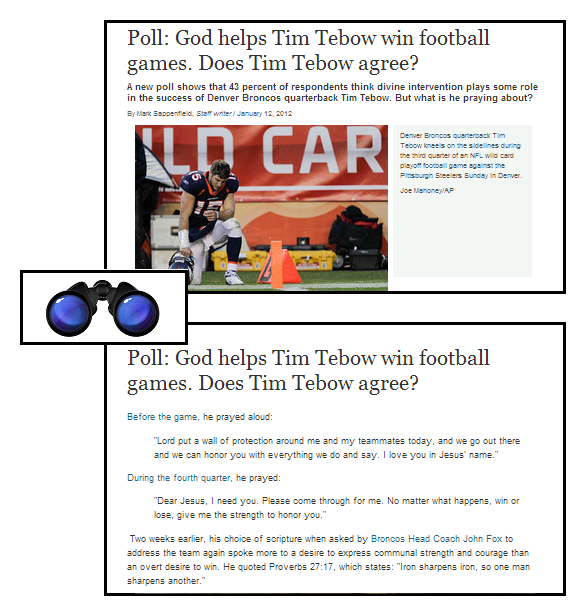
Let’s start with Tim Tebow, and phrase the issue this post raises as a question:
**

The headline of a TMZ post, God Is Saving the Broncos … Says Colorado Pastor, clearly suggests that God takes sides in sporting events.

Pastor Wayne Hanson — who runs Summit Church in Castle Rock, CO where Tim’s dad often speaks — tells TMZ God is actively intervening in Denver Broncos football games … and aiding Tim on the field because of his strong faith.

Hanson tells us, “It’s not luck. Luck isn’t winning 6 games in a row. It’s favor. God’s favor.”

Pastor Hanson adds, “God has blessed his hard work.”

We asked Hanson if Tebow would be winning games if he wasn’t such a strong believer — and the pastor replied, “No, of course not.”

**

Tebow himself, if I’m reading my news correctly, realizes that his God might have as much to teach by having a sports team lose as by having it win, hence his prayer as quoted above — “no matter, win or lose…”

And that level of subtlety would also be present in the sports theology of Notre Dame, if (once again) I’m not mistaken:

The team is unapologetically Catholic. Before every game, the Fighting Irish participate in a Mass overseen by one of the team’s two appointed Catholic priests, a tradition dating back to the 1920s. At the end of that ceremony, each player receives a priest-blessed medal devoted to a Catholic saint—a different saint every game for four years. Also during the pregame Mass, players can kiss a reliquary containing two splinters that Notre Dame believes came from the cross of Jesus. “Most of the non-Catholic players are Christian, so when you tell them these splinters came from the actual cross of Jesus they are humbled to reverence,” Doyle says.

**

I appreciate that combination of prayer for what one hopes and surrender to what happens, it’s way less heavy handed than supposing you can gauge Divine Providence by the results at the end of a game — or a war.

One Huffington Post writer was moved to ask: If Tim Tebow Were Muslim, Would America Still Love Him?

That’s an interesting question, roughly analogous to “If Tim Tebow had a losing streak, would America still love him? And God?

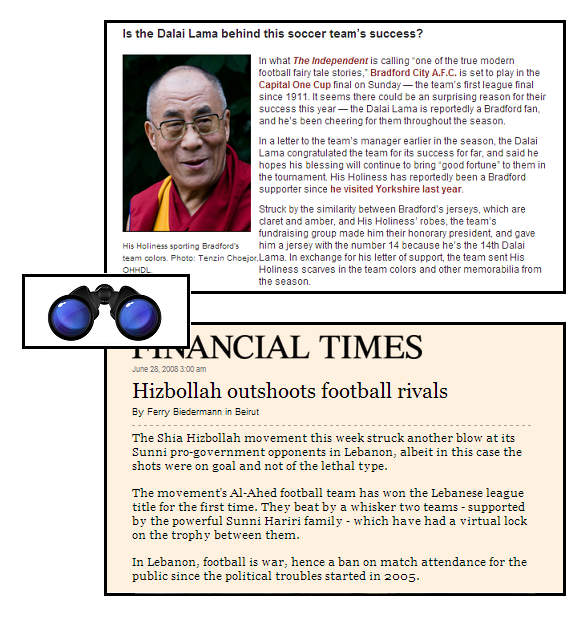
And if God does routinely show preference for one team over another by granting them victory, what are we to make of these two examples?
**

It seems the universe scales quite happily from tens of billions of years (or more) to femtoseconds (or less), and from almost a hundred billion light years (or more) to the Planck length (and I’m not so sure about less) — and my own tiny worm of a lifeline has given me “experiences” of a car rolling over a center divider and landing upside down, some moments of breathtaking beauty, times of bordeom, rapid eruptions of anger, the rock of early electric Dylan and the Baroque of Bach’s Matthew Passion. And I have causally picked my nose, almost without knowing I was doing it.

Who’s to say a God, ground of being, Great Mystery Power, or simple unaided universe can’t “purposefully” do Big Bangs and enormous time lags while gasses and galaxies and solar systems are formed and dissolve, flashes of lightning, inspiration and insemination, reproductions sexual and asexual, lives long and short, painting by El Greco and Vermeer, horrible puns and ugly Oscar ceremonies, mu mesons and mitochondria, prayers answered, hung up on in disgust, or unheard on account of it’s the Lord’s Day of Rest — grasses, feedlots, cows, milk, beef, methane…?

Depending, of course, on your definition of “purposefully” — since the purpose may be no more and no less than the unfolding of what is.

Whatever it is (or isn’t) that encompasses all this, it’s in little things as surely as big ones — and thumb wrestling, too. So there you have it: my theology of little things.

The great scientific art-grab

Wednesday, February 20th, 2013

[ by Charles Cameron — a poet’s rant against the hubris of scientists and the poverty of so much of what passes for art ]
.

Gorgeous. And fascinating.

**

I’d like to begin by saying beauty is not the same as prettiness any more than joy is the same as fun or truth than popular opinion. In fact I have an aphorism:

if you shoot for beauty, you’re liable to hit prettiness; if you want to achieve beauty, shoot for truth.

Okay? The beautiful can be grotesque, utterly normal, joyously peaceful, extremely violent, or simply gorgeous — and be beautiful in each case.

Having said that, I’d also like to say that the world, the universe in all it immense scope and scale and variety and possibility, isn’t “science” or “art” — we find science in exploring it one way, find art in exploring it another.

And when scientists want to impress, they often do it by choosing elements of beauty in what science has recorded of a universe that is neither science nor art but seamlessly filled to the brim with both — by appealing to our aesthetic taste, to the “art” side of our being, while claiming the result is science.

**

Case in point:

The graphic above, from the I fucking love science photo timeline on FaceBook, which comes with the caption:

Caddisfly larvae build protective cases using materials found in their environment. Artist Hubert Duprat supplied them with gold leaf and precious stones. This is what they created.

Did you get that? It’s from a site that bills itself I fucking love science that specializes in presenting, how can I make this simple, nature’s art. It’s the recognition of beauty that makes this site so wonderful — and in this particular case, the work of Artist Hubert Duprat.

**

I’ve been working with jewelry recently, and as you can see from this image of a Hematite “Tricubi” necklace by Bernd Wolf, the influence goes both ways.

**

What is beauty? And why does science as an institution so often want to claim what properly belongs in the realm of art? Or is science, perhaps, an art or cluster of arts? I’m tired of these ceaseless wranglings between two supposedly opposing cultures.

Paul Dirac:

I think that there is a moral to this story, namely that it is more important to have beauty in one’s equations that to have them fit experiment.

As art, the jewel-like protective cases those caddisfly larvae make are simply beautiful. The fact that they make them is fascinating.

Stereocognition, intelligence and the movies

Wednesday, February 20th, 2013

[ by Charles Cameron — Zero Dark Thirty & Manhunt, fact and fiction, that old saw about who it is that gets to write history, thence onwards to theology & the arts, von Balthasar & Tolkien, winding up watching UK & US versions of House of Cards with son David ]
.

How’s this for stereoscopy?

**

You may know I’m preoccupied with the notion of extending the stereo concept — using twin sources to add a depth dimension to one’s perception — from stereophonic audition and stereoscopic vision to stereocognition more generally.

Nada Bakos‘ image above shows a cinema in which documentary and fictional versions of the story of the hunt for bin Laden are playing simultaneously. The fiction, Kathryn Bigelow‘s Zero Dark Thirty, I saw a couple of days ago, and neither I nor son Emlyn, 17, were terribly enthused: the Camp Chapman scene was the one that touched me most deeply.

I’ll no doubt want to see both films, but it’s Greg Barker’s documentary, Manhunter, that will interest me the most, the more factual of the two. And yet that’s curious in and of itself, because as a poet I’m usually interested in the mythic and imaginative as much as or more than the “merely” factual, and I tend to think of the movies as providing a mythology for our times.

Okay, let me give you the two quotes that get to the heart of my sensibilities about fact and fiction at the movies.

What, after all, happens in a movie theater after the lights dim and the curtain rises? F Scott Fitzgerald tells us what happens in the mogul’s screening room, but it’s the same with us peons, isn’t it?

Dreams hung in fragments at the far end of the room, suffered analysis, passed — to be dreamed in crowds or else discarded.

And I’m also with the poet Kathleen Raine, who said:

Myth, when a real event may be the enactment of a myth, is the truth of the fact and not the other way around…

So where does that leave me?

Right now, it leaves me feeling that in the case of these two filmic treatments of the same “true story” — and no doubt many others — history will likely be “written” by the entertainment makers, not the documentarists. Paradoxically, a sad thought.

But let’s go beyond that.

**

I said I’m preoccupied with the notion of using twin sources to add a depth dimension to perception — from stereophonic audition and stereoscopic vision to stereocognition more generally. Another way to say that is that I’m interested in figuring out how to think contrapuntally, and how to score contrapuntal thought — thought which holds two or more potentially conflicting concepts in mind simultaneously, so as to arrive at a deeper understanding than one perspective alone can provide…

I’ve talked about these modes of stereoscopic / contrapuntal cognition before, in posts such as Form is insight: a musical experiment and Silent reading, silent thinking, bifocal glasses, and I’m always delighted when I run across a new very bright thinker (Glenn Gould, Edward Said [Power, Politics, and Culture p. 447}, Wm Blake) playing with these ideas — today it’s the late theologian Hans Urs von Balthasar in his book Truth Is Symphonic: Aspects of Christian Pluralism, who speaks of “the entire polyphony of revelation”, suggests that:

In his revelation, God performs a symphony, and it is impossible to say which is richer: the seamless genius of his composition or the polyphonous orchestra of Creation that he has prepared to play it

and states that “Even eternal Truth itself is symphonic.” The only stronger statement I know of concerning the contrapuntal nature of the world from within the Catholic tradition is JRR Tolkien‘s extraordinary short masterpiece of a creation myth, The Music of the Ainur [scroll down at link], with which he begins the Silmarillion.

So the contrapuntal idea is present in theology, as well as the arts…

**

Stereoscopy, counterpoint.

I’ve been watching the TV series, House of Cards, with my fourteen-year old, David — we’ve now seen the whole first series of the UK version together, and the beginning of the US version, and it’s fascinating to notice the differences.

Frank Underwood (Kevin Spacey):

Francis Urquhart (Ian Richardson):

See both shows, form your own conclusions…

And their source?

Now I shall have to watch Richard III with David, too.

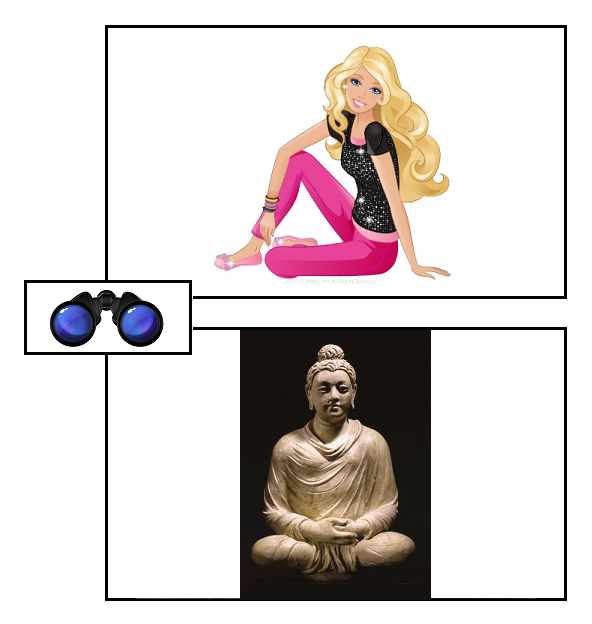
The Buddha, the Barbie, and Walter Benjamin

Sunday, February 17th, 2013

[ by Charles Cameron — iconoclasm, Iranian style ]
.

From AP today:

Iran confiscates Buddha statues from shops.

TEHRAN, Iran (AP) – An Iranian newspaper is reporting that government authorities are confiscating Buddha statues from shops in Tehran to stop the promotion of Buddhism in the country.

Sunday’s report by the independent Arman daily quotes Saeed Jaberi Ansari, an official for the protection of Iran’s cultural heritage, as saying that authorities will not permit a specific belief to be promoted through such statues.

Ansari called the Buddha statues symbols of “cultural invasion.”

He did not elaborate on how many have been confiscated so far, but said more would be seized from shops.

Iran has long fought against items, such as Barbie dolls and Simpsons cartoon characters, to defuse Western influence, but this appears to be the first time that Iranian authorities are showing an opposition to symbols from the East.

**

Walter Benjamin, very much apropos, in The Work of Art in the Age of Mechanical Reproduction:

The uniqueness of a work of art is inseparable from its being imbedded in the fabric of tradition. This tradition itself is thoroughly alive and extremely changeable. An ancient statue of Venus, for example, stood in a different traditional context with the Greeks, who made it an object of veneration, than with the clerics of the Middle Ages, who viewed it as an ominous idol. Both of them, however, were equally confronted with its uniqueness, that is, its aura. Originally the contextual integration of art in tradition found its expression in the cult. We know that the earliest art works originated in the service of a ritual – first the magical, then the religious kind. It is significant that the existence of the work of art with reference to its aura is never entirely separated from its ritual function. In other words, the unique value of the “authentic” work of art has its basis in ritual, the location of its original use value. This ritualistic basis, however remote, is still recognizable as secularized ritual even in the most profane forms of the cult of beauty. The secular cult of beauty, developed during the Renaissance and prevailing for three centuries, clearly showed that ritualistic basis in its decline and the first deep crisis which befell it.

**

Sources:

Barbie Sitting Acrylic Cut Out
Buddha, seated

Talk about interlocking nightmares…

Friday, February 8th, 2013

[ by Charles Cameron — when the world doesn’t divide quite so nicely into us and them ]
.

Artist credit: Toby Hazel, for link see below
Nah, not nightmarish, dreamlike abstract Interlocking Figures

**

Today, let’s talk about interlocking nightmares…

Consider the tugs and tensions in this article by Iranian-Israeli Middle East analyst Meir Javedanfar, which appeared in Al Monitor about a week ago titled Iran, Israel and Their Red Lines Over Syria. I’ll just quote you the tail end of the piece:

Syria’s WMD stockpile falling into the hands of al-Qaeda is a red line which Iran and its adversaries in Syria must draw together, and make sure that Al Qaeda does not cross that.

If al-Qaeda does persistently try and the only other viable option to avoid this scenario is to transfer Syria’s WMD to Iran, than the West may have no option but to accept. That is an infinitely better scenario than al-Qaeda getting its hands on such a weapons. Al-Qaeda is a suicidal non-state actor with nothing to lose by using such weapons, however the opposite is true about Iran. As unpleasant as it may be, this is one scenario which the West should not draw a red line around.

**

Insights?

** ** **

Image source:

Toby Hazel, Interlocking Figures


Switch to our mobile site