zenpundit.com » art

Archive for the ‘art’ Category

Simultaneity II: the pictorial eye

Wednesday, April 11th, 2012

[ by Charles Cameron — when sequence becomes simultaneous, the pictorial eye, rethinking thinking, continuing from Simul I ]
.

What better day to begin writing this second post on simultaneity than the day on which Google celebrated the birthday of Eadweard Muybridge with a Google Doodle — not that I’ll get the post finished within those same 24 hours!

The film — sequence of frames? stills? which would you call it? — that Muybridge took of a horse, used in that Google Doodle [view it in motion, here], is celebrated as showing beyond a doubt that when galloping, all four of a horse’s hooves may be in the air at the same time.

But is it — Muybridge’s work product — sequential, ie a film, or simultaneous, ie the presentation of many moments at one time?

That question gets to the heart of an issue that all narrative faces, as we shall see. First, the pictorial side of things.

*

Hans Memling‘s Passion of Christ (above) tells the gospel narrative, from Christ’s entry into Jerusalem and the Last Supper through his crucifixion, entombment and resurrection to his appearances in Emmaus and by the sea of Galilee in one canvas, much as Bach’s Matthew Passion [link is to Harnoncourt video] tells major portions of the same narrative in three hours of unfolding musical drama.

*

David Hockney has recently been working on forms of what I can only call “asynchronous synchrony” — as exemplified here:
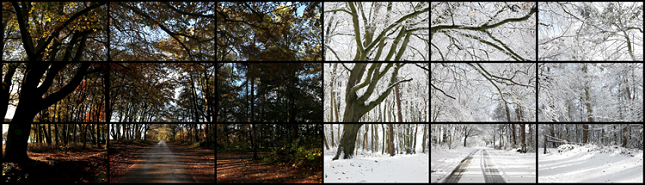

Stills from Woldgate 7 November 2010 11:30 AM (left) and Woldgate 26 November 2010 11 AM (right). Credit: ©David Hockney

This image comes from a fascinating article describing Hockney’s current work by Martin Gayford, titled The Mind’s Eye, which you can find in MIT’s Technology Review, Sept/Oct 2011:

We are watching 18 screens showing high-definition images captured by nine cameras. Each camera was set at a different angle, and many were set at different exposures. In some cases, the images were filmed a few seconds apart, so the viewer is looking, simultaneously, at two different points in time. The result is a moving collage, a sight that has never quite been seen before. But what the cameras are pointing at is so ordinary that most of us would drive past it with scarcely a glance.

As with the Muybridge video above, “the viewer is looking, simultaneously, at different points in time”. Here Hockney does this with video cameras — but he achieves something of the same effect of time-displacement with still photos, too, as you can see in his brilliant portrait of the sculptor Henry Moore, hosted on the British Council’s Venice Biennale site.

Here is Gayford’s concluding paragraph, tying Hockney’s work into the larger context of our need for multiple frames of reference:

“Don’t we need people who can see things from different points of view?” Hockney asks. “Lots of artists, and all kinds of artists. They look at life from another angle.” Certainly, that is precisely what David Hockney is doing, and has always done. And yes, we do need it.

*
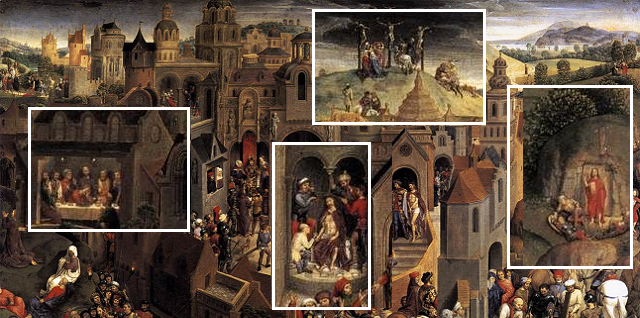
Memling again — and here I have enlarged and “framed” four of the 23 scenes from the passion of Christ which he has incorporated in the one painting: the Last Supper, the Crowning with Thorns, the Crucifixion, the Resurrection — Thursday evening through Sunday, and from life to death and back again.

*

It was Holy Week for Christians just last week, so perhaps you will forgive my having been preoccupied with images of the passion during the season set aside for such meditations — but what I want to point out to you is timeless, and indeed brings the transcendent into the everyday. Let’s take a look at a Hitchcock film next, then, and see how a contemporary videographer Jeff Desom has remixed the already Hockney-like Rear Window [link to IMDb] to create his own time-lapse telling of the tale [link to Vimeo], from which I took this screen-grab:

*

Time-lapse — simultaneity? The philosopher Alfred North Whitehead once wrote:

The communion of saints is a great and inspiring assemblage, but it has only one possible hall of meeting, and that is the present; and the mere lapse of time through which any particular group of saints must travel to reach that meeting-place, makes very little difference.

And so it is with this other Memling painting — and many others like it, by artists old and new:
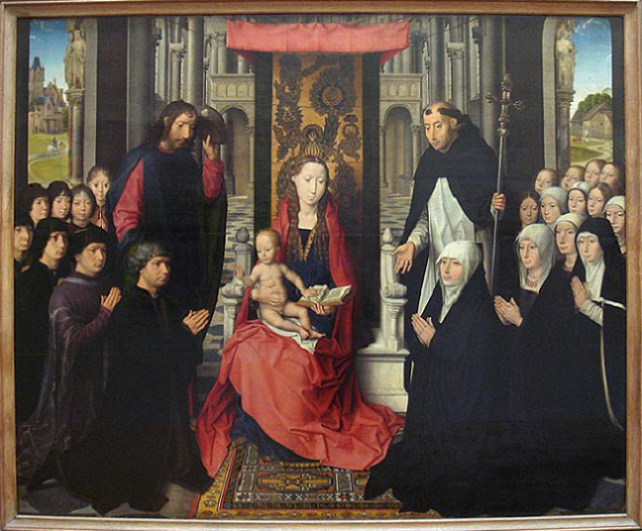
Here we see the Virgin Mary and Christ child with Saints Dominic and James — there’s an eleven centuries gap right there, St Dominic lived from 1170 – 1221, more than a millennium after Christ — and Memling has St Dominic presenting his patron, the spice trader Jacques Floreins with his family to Christ, circa 1490. With everyone dressed in late 15th-century fashions…

Whitehead — co-author with Bertie Russell of Principia Mathematica — see how amazing this is? — could have been thinking of Memling: “the mere lapse of time through which any particular group of saints must travel to reach that meeting-place, makes very little difference”.

*

Coming up next: how this affects our understanding of story.

____________________________________________________________________________

For an understanding of the setup David Hockney uses for his multiple-video takes, see here and specifically this and this. For the setup used by Jeff Desom in his Rear Window remix, see here and specifically this.

Of the real and the imaginal

Monday, April 9th, 2012

[ by Charles Cameron — from sight to vision? ]
.

*

Which of these two images — the photo above, the MC Escher print below — calls you closer? Which takes you deeper?

*

And which draws you closer here — the MC Escher print above, or the Tenniel illustration for Alice, below? Which carries you deeper?

Where does the realistic end, and the imaginal begin?

*

Marina Warner writes in the introduction to her recently reviewed book, Stranger Magic:

The faculties of imagination — dream, projection, fantasy — are bound up with the faculties of reasoning and essential to making the leap beyond the known into the unknown. At one pole (myth), magic is associated with poetic truth, at another (the history of science) with inquiry and speculation. It was bound up with understanding physical forces in nature and led to technical ingenuity and discoveries. Magical thinking structures the processes of imagination, and imagining something can and sometimes must precede the fact or the act; it has shaped many features of Western civilization. But its influence has been constantly disavowed since the Enlightenment and its action and effects consequently misunderstood.

*

For the brilliant juxtaposition of images in the upper pair, I am grateful to http://www.giovis.com/atrani.htm, with an h/t to http://www.log24.com.

Simultaneity I: the palimpsest

Sunday, April 8th, 2012

[ by Charles Cameron — simultaneity in art, life, theology, war and thought ]
.

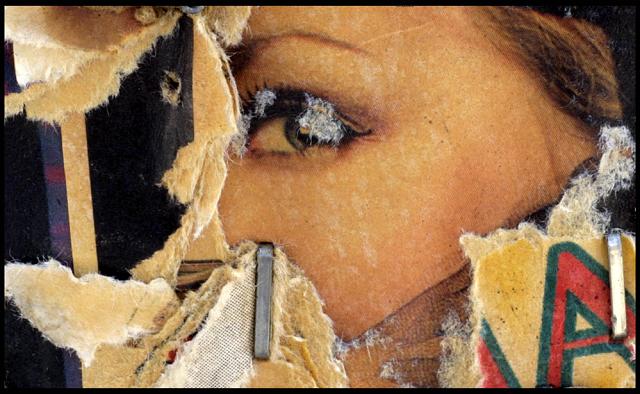
We rip up the past to make room for the present, we staple the present onto the past, we lose much of the meaning our words and images once had in fragments, snatches and colors…


image credit: MR McDonald

Even the staples eventually rust.

*

Still the past can at times be seen in the present, as earlier writing can still be seen in a palimpsest.

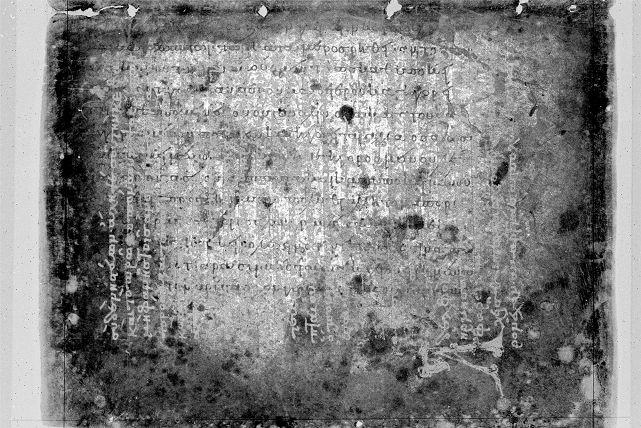
The Archimedes Palimpsest is [and I paraphrase] a Byzantine euchologion or prayer book manuscript, thought to have been completed by April 1229, and probably made in Jerusalem. Much of the parchment the scribes used in making the prayer book came from a earlier book of works by Archimedes, including his “On Floating Bodies” – a treatise of which no other copy survives. It seems the Archimedes manuscript dates back to tenth century Constantinople.


image credit: Archimedes Palimpsest Project

Erase Constantinople from your parchment, cut it and rotate it 90°, and you can build Jerusalem in its place. Peer deeply into prayer using multispectral imaging several hundred years later — and you may find combinatorial mathematics dating back more than two millennia…

What you are seeing in this image above is the workings of a mind two centuries BCE, transcribed in the tenth century CE, and made visible beneath and through other writing from the thirteenth, by twenty-first century tech.

So it is that Archimedes speaks to us today.

*

A palimpsest, then, is a layering of time on time, and the world we walk and talk in is itself a palimpsest.


image credit: MR McDonald

The enduring, you might say, can be seen through the transient — the zebra crossing through the snow.

*

To see two times at once — to see history, accurately or otherwise, as a metaphor for today — is to see simultaneously.

As in Sergey Larenkov‘s celebrated photos, in which World War II and the present day coexist:


image credit: Larenkov, Wrecked tank “Tiger” in Tiergarten park

[ edited to add: Larenkov takes black and white photos from WW II, shoots the same scene in color from the same position today, and masterfully stitches them together digitally to create an image that allows the ghost of the past to seen in the present — brilliant! ]

Here again, as in the magically surreal sculptures of Nancy Fouts, we see the power of mapping one thing onto a kindred other of which Koestler wrote.

*

To tie all this back into the question of Which world is more vivid? This, or the next?Stanley Hauerwas in his book, War and the American Difference: Theological Reflections on Violence and National Identity, suggests:

There is another world that is more real than a world determined by war: the world that has been redeemed by Christ.

He then clarifies his intent in saying:

The statement that there is a world without war in a war-determined world is an eschatological remark. Christians live in two ages in which, as Oliver O’Donovan puts it, “the passing age of the principalities and powers has overlapped with the coming age of God’s kingdom.” O’Donovan calls this the “doctrine of the Two” because it expresses the Christian conviction that Christ has triumphed over the rulers of this age by making the rule of God triumphantly present in the mission of the church. Accordingly the church is not at liberty to withdraw from the world but must undertake its mission in the confident hope of success.

*

Indeed, both Christianity and Zen would say that the greatest palimpsest is the palimpsest in which the transient circumstances of one’s life can all but obliterate the imperishable truth that underlies them — a palimpsest whose deepest layers may be read not with x-rays but by insight.

Christ lived in two times, or more accurately, time and eternity — to him the palimpsest was transparent, and thus he spoke (in John 8:58) what I suspect are the most profound five words in the Gospels:

Before Abraham was, I am.

Happy Easter!

Having eyes to see…

Saturday, March 31st, 2012

[ by Charles Cameron — looking through the eyes of tech, math, art, flies, and intelligence ]
.

Imaging the winds and the waters

I’ve been raising questions about the varieties of ways of seeing here — asking whether guardian angels can be more than guys on night watch and if so what that “more” means, invoking William Blake’s fourfold vision [see move 4], and so forth. And I tend to emphasize the visionary over against the material.

I thought I’d do something different this time, and show you two views of the world that science brings us, that we couldn’t have seen half a century ago unless you were Theodore von Kármán (below, upper image)…

let alone a century ago, unless you were Vincent van Gogh (lower image).

*

In descending order, these four images are:

  • the winds over a portion of the Americas, as depicted by Fernanda Viégas and Martin Wattenberg a few days ago, see also their current live feed
  • a NASA image drawn from the Goddard Scientific Visualization Studio‘s Perpetual Ocean animation, hi-res Gulf Stream image
  • a diagram of a Kármán vortex street, from Arthur E. Bryson, Jr., Demetri P. Telionis, “Kármán vortex street,” in AccessScience, ©McGraw-Hill Companies, 2008
  • and Vincent van Gogh, Starry Night, in the Museum of Modern Art, New York.

The gentleman in the meditation goggles — he calls them “eye-bags” — featured in the “mini-SPECS” section of the Winds and Waters SPECS is my friend David Woolley, who alerted me to these simulations on his Just think of it blog today. David, btw, is the fellow who designed and wrote PLATO Notes, the first permanent, general-purpose online conferencing system, back in 1973.

The eyes features in the “mini-SPECS” of the Kármán / van Gogh SPECS are a fly’s “compound” eyes — “compound meaning that each eye has hundreds of facets (ommatidia or simple eyes).

*

And that’s the point, isn’t it?

We as the human community have many eyes, many perspectives — the visionary, the technological, the abstract, the photographic, the artistic, the consensus, the minority opinion — such as that of Mr Justice Douglas in Sierra Club vs Morton, perhaps? …

Our intelligence — our intel too — should build on a rich and wide array of ways of seeing. After all…

… unless the above is just a recruitment slogan.

More “night watch” than “guardian angels” perhaps?

Thursday, March 29th, 2012

[ by Charles Cameronguardian angels, really? — or a surface use of in-depth terminology? ]
.

.
Just two days ago I posted Quantity and Quality: angelic hosts at Badr and / or Armageddon, and noted in a comment that “the Counterinsurgency Manual, FM 3-24 makes no mention of angels” — whereas “Brigadier Malik’s Qur’anic Concept of War does.

1.

Has someone in ISAF been reading ZP? Two days later, we have this AP report:

U.S. military commanders in Afghanistan have assigned “guardian angels” — troops that watch over their comrades even as they sleep — and have ordered a series of other increased security measures to protect troops against possible attacks by rogue Afghans.

A bit further down, we read:

According to the senior military official, the so-called guardian angels provide an extra layer of security, watching over the troops as they sleep, exercise or go about other daily activities.

Allen noted that the Afghans also have taken some similar steps to provide guards for their own forces.

2.

Just for the record, that’s not quite what I had in mind.

Specifically — and only half-joking — it’s an instance of what Sri Krishna Prem termed “the degradation of spiritual concepts” in his Yoga of the Bhagavat Gita (original Penguin edition, p. xxv. if my notes are to be believed):

There is a law, which may be termed the law of the degradation of spiritual concepts, by which terms originally used by Seers to express levels of supernormal spiritual experience become in the hands of later and purely scholastic exponents terms for elements in purely normal mental life.

Or as TS Eliot puts it in Burnt Norton: V (in Four Quartets):

Words strain,
Crack and sometimes break, under the burden,
Under the tension, slip, slide, perish,
Decay with imprecision, will not stay in place,
Will not stay still.

3.

Where does the idea of a guardian angel come from — and what did it mean before it meant some poor sod who’s on night watch?

4.

Anyway.

Best night watch ever? Rembrandt‘s, in the Rijksmuseum in Amsterdam:

The brilliant Peter Greenaway has made two quirky films [link to Amazon boxed set] about the painting. Wikipedia describes them well enough that I’ll simply use their phrasing:

The Night Watch is the subject of a 2007 film by director Peter Greenaway called Nightwatching, in which the film posits a conspiracy within the musketeer regiment of Frans Banning Cocq and Willem van Ruytenburch, and suggests that Rembrandt may have immortalized a conspiracy theory using subtle allegory in his group portrait of the regiment, subverting what was to have been a highly prestigious commission for both painter and subject. His 2008 film Rembrandt’s J’Accuse is a sequel or follow-on, and covers the same idea, using extremely detailed analysis of the compositional elements in the painting…

I was certainly richly educated and entertained by both films — and am a great admirer of his The Draughtsman’s Contract — but not quite convinced.

________________________________________________________________________________________

h/t @peterjmunson.


Switch to our mobile site