zenpundit.com » elections

Archive for the ‘elections’ Category

The Republican Party: A Strategic View

Thursday, November 8th, 2012

Generally, I eschew writing about partisan politics, but like everyone else in America – and possibly a plurality of the planet – today the election was a topic of discussion, deconstruction and debate for me.  President Obama and his supporters are reveling in their victory, Republicans and conservatives are organizing circular firing squads, but the good news for America is that the election was fair, free and unmarred by the kind of bitter partisan dispute we saw in 2000. The country has sufficient serious problems and is deeply divided enough without having that cross to bear again.

Some Democrats seem to believe the President has won, if not a “landslide’, at least a crushing victory in squeaking by Governor Mitt Romney. While that belief may be delusional, it is the GOP that is clearly in trouble despite winning nearly half the popular vote and is positioning itself to implode in an ideological civil war.

Some of the more intelligent or interesting reactions I read came from historian Ron Radosh, political scientist Dan Nexon,  conservative wonk Bruno Behrend,  blogger Dave Schuler and the NRO Corner, which had a mixture of teeth-gnashing and cold-eyed realism.

What should the once great Republican Party do?

Admit they have a problem – that a majority of Americans find the GOP to be angry, scary and a little bit nuts:

Chris Christie is not why Romney lost. MSM liberal bias, though real enough and sometimes nasty, did not stop the elections of Richard Nixon, Ronald Reagan, George H.W. Bush or George W. Bush (including the two greatest electoral landslides in American history). Even Romney, though he carries his share of blame as standard bearer for an unsuccessful campaign, is not the whole reason millions of Hispanics and women who previously voted for George W. Bush and John McCain, voted to re-elect Barack Obama.

It wasn’t Mitt Romney (who incidentally, I am no fan of) who decided to spout off  in the midst of a national campaign season about idiocies like “legitimate rape”, the Big Bang theory being from ” the pit of Hell”, that Obama is secretly a Muslim or advocating laws where the government can forcibly ram an ultrasound wand into a woman’s vagina. Really, where did that last bright idea come from – Communist China?

The problem is the Republican Party and mainstream conservatives tolerate and support the presence of angry, misogynistic, ignorant crackpots who scare away normal people. The GOP needs to recall  a lesson from Bill Buckley instead of letting the nuts set themselves up as the arbiters of what is “conservative”.

Focus on the key numbers of American democracy – 51%, 60 % and 270:

Sectarian purity is something best left for Church – at the polling booth you need a majority.

While it is the duty of the opposition party to oppose and Obama is going to give Republicans many ideas or actions worth fervent opposition in his second term, being against something is only part of the equation if the goal is to “win”. The other part is offering a positive alternative or constructive vision that diminishes your opponent while advancing your own cause – a “noble philosophy” that attracts the uncommitted, pumps of the resolve of your allies and demoralizes and daunts your adversaries. A philosophy that builds expanding, winning, governing, coalitions
.

An optimistic, inclusive, compelling narrative that makes people proud. Political music for the soul.

.

People want, pretty desperately, to buy into a positive vision that offers a great future for the country and their children that says America’s best days are yet to come. That the United States is the preeminent force for Good in the world and should unreservedly remain so. Obama cannot offer that vision and, with some exceptions, neither will his party. The GOP needs to be not just “a” but “THE” middle-class party – the party of strivers and upward social mobility, personal achievement, rising living standards for everyone and freedom. A Party that is attractive because what Republicans are for and what they do, not just what they are against. Or whom.

.

The GOP should be the natural political home of Latinos, Asians, Jews and Catholics but it isn’t. It should remember small business and entrepreneurs when voting for garbage like Sarbanes-Oxley or Federal bailouts for crony capitalists, not just when they need them at the ballot box. The truth is, given the state of the economy, Obama’s mediocre record and empty campaign, Romney should have crested toward a Reaganesque 1984 electoral landslide but he did not.

.

The Republican Party needs to change it’s current course or lose the game

Graphical footnotes, 2: the mourning after

Thursday, November 8th, 2012

[ by Charles Cameron — an example of the “serpent bites own serpent self” paradox from the 2012 election ]
.

This is offered as a footnote to my earlier post on self-referential aka recursive paradoxes. It is the bottom ten percent, at full width, of the mourning band Pamela Geller put on her Atlas Shrugs 2000 site when she learned of President Obama’s victory in the 2012 Presidential election.


.

For the record, I do not endorse Ms Geller’s entirely negative view of Islam — a vast and vastly diverse world religion with a long and storied history — nor for that matter her commentary on the election —

UPDATE: Obama won. And America, land of the free, home of the brave, died tonight.

nor the header for the post that consisted entirely of the graphic above — with the black extending an unremitting nine more times the height shown here:

THE DAY AFTER AMERICA

To be blunt: methinks the lady jumpeth shark.

**

What does interest me more than a little is the self-reflexive paradox with which she phrases her insight that America just killed itself — an example of the kind of paradox I was talking about in my post Numbers by the numbers: one.

The Person / Position Paradox: once more, with avatars

Saturday, October 6th, 2012

[ by Charles Cameron — a follow up to my previous post — and it’s not religion that’s the alternate reality this time, but games ]
.


.

I just posted a long and potentially contentious post about what I called a person / position paradox: that of the member of the US House Committee on Science, Space and Technology and chairman of the US House Science Subcommittee on Investigations and Oversight, Rep. Paul Broun MD (R-GA), who said recently:

that stuff I was taught about evolution and embryology and the Big Bang Theory, all that is lies straight from the pit of Hell…

And he meant it.

**

Well, while I was writing that post, this little gem (above) crossed my bows (ht Paxsims) — so perhaps you’ll permit me to poke a little fun at a member of the other US political party.

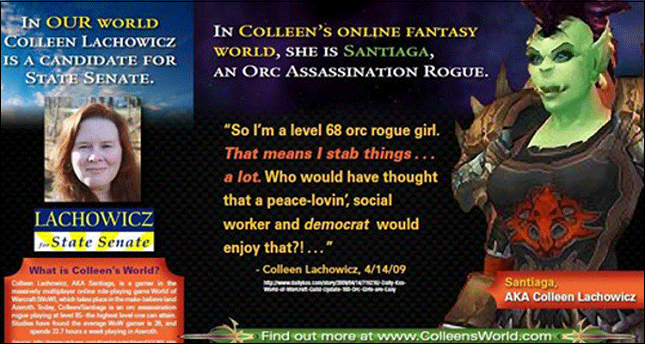
It seems that Colleen Lachowicz, Democratic candidate for the Maine State Semnate, is also Santiaga, Orc Assassination Rogue in the game-world, World of Warcraft.

Questions arising:

Does that make her more representative or less?
what about the fact that she plays at level 68?
is that a representative level to play at?
and an Orc Assassination Rogue? really?
or is she just a candidate who happens to be a gamer?

The image above comes from the Maine GOP, btw.

**

To look at this minor contretemps from another angle: how far are we from religion, here in the land of Orcs?

The great literary critic Northrop Frye in his Anatomy of Criticism writes of:

great art using popular forms, as Shakespeare does in his last period, or as the Bible does when it ends with a fairy tale about a damsel in distress, a hero killing dragons, a wicked witch, and a wonderful city glittering with jewels.

Frye is not knocking Revelation here, though one might at first think he is: he’s assigning it to a literary genre, as one might assign the Psalms to poetry, Kings and Chronicles to history, or the Gospels and Acts of the Apostles to biography. The Epistles, after all, are already classified as epistolary works. And — give the man a break — he’s also placing it in the same realm of great art as Shakespeare.

How far, then, do you suppose CS LewisNarnia — or Tolkien‘s Middle Earth, with its Elven folk Firstborn of the Children of Ilúvatar — might be from the World where Colleen is an Orc?

**

How much room can we concede to imagination in our “real world”?

And Dante‘s voyage took him through the three realms of Inferno, Purgatorio and Paradiso, didn’t it, and according to the Apostles Creed, Christ’s Harrowing of Hell took place between his death and resurrection.

So my next question would be:

When will we build and play the games of Paradise?

The Twilight War—a review

Monday, July 23rd, 2012

[by J. Scott Shipman]

The Twilight War, The Secret History of America’s Thirty-year Conflict with Iran, by David Crist

When President Obama made a heartfelt opening, a smug Iranian leadership viewed it as a ruse or the gesture of a weak leader. Iran spurned him. Obama fell back on sanctions and CENTCOM; Iran fell back into its comfortable bed of terrorism and warmongering. Soon it may no longer be twilight; the light is dimming, and night may well be approaching at long last. [emphasis added]

Thus concludes senior government historian David Crist’s The Twilight War, and be assured Crist’s language is not hyperbole. Crist masterfully details the tumult of U.S.-Iranian relations from the Carter administration to present day. Using recently released and unclassified archived data from principals directly involved in shaping and making American foreign policy, Crist provides the reader an up-front view of “how the sausage is made;” and, as with sausage, the view often isn’t pretty for either side. Crist’s access wasn’t limited to U.S. policy makers, as he conducted interviews with principles on the other side as well, for instance, he had secret meetings/interviews with pro-Iranian Lebanese officials in south Beirut. In all, Crist estimated he interviewed over “four hundred individuals in the United States and overseas.”

Crist begins his story with the Shah of Iran in the last days of his leadership, as popular sentiment was turning against both his regime, as well as his American enablers. He reveals the Carter administration’s fleeting notion of military intervention following the fall of the Shah, and includes details how the clerics reigned in professional Iranian military members, purging the “unreconstructed royalists.” From the start, the U.S. learned how difficult, if indeed impossible, relations were going to be with the new Iranian leadership. One State Department report summed up the situation:

It is clear that we are dealing with an outlook that differs fundamentally from our own, and a chaotic internal situation. Our character, our society are based on optimism—a long history of strength and success, the possibility of equality, the protection of institutions, enshrined in a constitution, the belief in our ability to control our own destiny. Iran, on the other hand has a long and painful history of foreign invasions, occupations, and domination. Their outlook is a function of this history and the solace most Iranians have found in Shi’a Islam. They place a premium on survival. They are manipulative, fatalistic, suspicious, and xenophobic.

While I am certain the writer of this report was not intending to be prophetic, as it turns out this paragraph captures the essence of our conflict. Each American president has thought himself equal to the challenge and each has thus far failed.

The Twilight War includes the birth of Hezbollah, accounts of the Marine barracks bombing in 1983 (from the men who were there), and the details of the Kuwaiti request for American protection of their tanker fleet from the Iranians. From this decision, the U.S. committed military force to protect Middle East oil—a difficult and at times, contentious decision. This decision resulted in continued sporadic confrontations between the U.S. and Iranian forces in the Persian Gulf.

Crist’s book is an illustration writ-large of a book previously reviewed here at Zenpundit.com; Derek Leebaert’s Magic and Mayhem, The Delusions of American Foreign Policy—as both “magic” and “mayhem” figure large in our on-going relationship with Iran. Most U.S. administrations when dealing with Iran came to rely on the “magic, ” and often divorced, or worse, ignored the realities.

At 572 pages, the fast paced narrative is a must read for anyone wanting insight into the origins and issues that remain in the ongoing U.S.-Iran conflict. The Twilight War is exhaustively sourced.  Crist says in the Notes his book was twenty-years in the making and it shows. Further, this book comes with excellent maps, so keeping up with the geography is made easier.

Tom Ricks said, “this is the foreign policy book of the year, perhaps many years,” and Ricks may be right. The Twilight War is an important and timely book on a vital topic, and comes with my strongest recommendation.

Postscript:

A copy of The Twilight War was provided to this reviewer by the publisher.

Morsi and the Socratic gadfly wannabe

Thursday, June 28th, 2012

[ by Charles Cameron — comparing presidential candidates, here and there ]
.

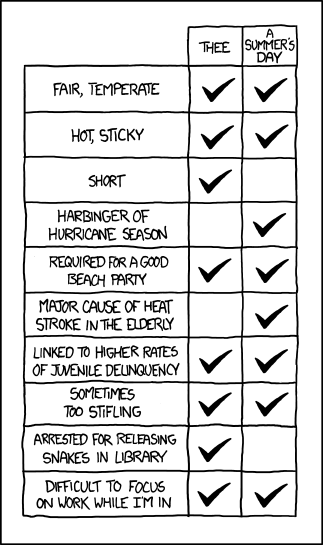
The ability to compare and contrast is an amazing business — you can get online tutorials in how to do it, and it even shows up in xkcd:

Compare and contrast is a basic human activity, in fact, closely allied with choice, and IMO can be crafted into a very powerful engine for understanding — if we first clear away the tangle of other thoughts with which we generally surround it, focus in on it, and use it to probe our assumptions and generate our creative insights…

**

In that spirit, then, let me pose my compare and contrast question for the day.

Compare and contrast:

The first quote presents one of Mr. Morsi‘s actual statements — hand-picked for scary — and there’s even a MEMRI video clip to prove it. The second is admittedly far more vague; it’s from a New York Times piece assessing and guessing at Mr. Romney’s likely foreign policy, which doesn’t actually quote him in any detail — instead, it lays out the basis for current speculation.

What I’m really trying to get at here, though, is how we read Mr. Morsi’s words — and my quote regarding Mr. Romney is in this instance mostly a foil, a way to suggest that at home, we don’t imagine what a candidate says is necessarily what he intends.

So my question, really, boils down to this: how ready would you be to agree that Mr. Morsi may have been making election promises in the full knowledge that he could not, would not, or might not even wish to keep them?

**

Different people will put different weights on Mr. Morsi’s campaign statements and those of Mr. Romney. There may be some interesting patterns to be found in the demographics of those differences.

I for one certainly don’t imagine that both Mr. Romney and Mr. Morsi would keep all their campaign promises to the letter if elected — but then neither do I imagine they would necessarily both deviate from their promises to the same extent under the pressures they, respectively, are under. And as I have indicated, I expect that different outside observers will bring different assumptions and expectations to their evaluations of the likely degree to which each of these men will / would if elected adhere to or deviate from their promises.

The pressures and constraints the two men find themselves under will differ — their respective most basic fears and ideals will very likely differ considerably, too.

And we ourselves, to the extent that we compare and contrast them, will do so from different angles — and come to different conclusions…

**

So: realistically and without prejudgment, how would we compare and contrast the element of what the NYT writer nicely called “political rhetoric” in these two cases?

How seriously should we take Mr. Morsi’s calls for shariah, for jihad, for “our most lofty aspiration” — death for the sake of Allah?


Switch to our mobile site