zenpundit.com » turkey

Archive for the ‘turkey’ Category

Thanksgiving and Kasab: pardon and penalty

Thursday, November 22nd, 2012

[ by Charles Cameron — i suppose this is about the state’s claim to a monopoly of violence, seen from both ends ]
.

I don’t want to go too far with this one, and I’ll start with the turkey and pardon, because pardon and forgiveness and thanksgiving all fit together and might as well be celebrated at this season — but as you’ll see, pardon has its dark side, even if it takes an anthropologist named Magnus Fiskesjö and his pamphlet titled The Thanksgiving Turkey Pardon, the Death of Teddy’s Bear, and the Sovereign Exception of Guantánamo to point it out:
.

But around the same time a turkey gets a reprieve in the US, a terrorist in India gets the death penalty.

I think it’s important to remember the Mumbai atrocities of 2008,and of which Ajmal Kasab (depicted below, and recently deceased) was the sole surviving perpetrator — if for no other reason than because he’s considered a martyr by some, and will be avenged.

But first, let me wish a Happy Thanksgiving! to all Zenpundit’s American readers, and good wishes to all others.

**

The problem with martyrdom… is that it’s a force-multiplier. Okay when the force is purely spiritual, not so much when it runs to violence and terror…

photo credit: Outlook India

Retired Indian intelligence chief Bahukutumbi Raman, whose tweets I often follow to articles on his Raman’s strategic analysis blog, warned us all:

Before the execution of Ajmal Kasab, the Pakistani terrorist of the Lashkar-e-Toiba (LET), who had participated in the 26/11 terrorist strikes in Mumbai, at Pune on the morning of November 21, 2012, our security agencies must have examined the likelihood of retaliation by jihadi terrorists in Pakistan and India and strengthened security precautions to prevent retaliatory attacks.

The LET and the organisations associated with it would want a quick retaliation.

And then he went into detail

Sure enough, Reuters then tells us:

Pakistan’s Taliban movement threatened on Thursday to attack Indian targets to avenge the country’s execution of Mohammad Ajmal Kasab, the lone survivor of the militant squad responsible for a rampage through Mumbai that killed 166 people in 2008. Kasab was hanged on Wednesday amid great secrecy, underscoring the political sensitivity of the November 26, 2008, massacre, which still casts a pall over relations between nuclear-armed rivals Pakistan and India.

“We have decided to target Indians to avenge the killing of Ajmal Kasab,” said Taliban spokesman Ehsanullah Ehsan by telephone from an undisclosed location.

**

In the course of the coronation liturgy for Queen Elizabeth II, the words justice and mercy crop up quite often — justly and justice 8 times, and merciful and mercy 28. It appears to be a sovereign’s right and obligation to administer both, and during the ceremonial they are brought together as a symbolic pair.

The Sceptre with the Cross is given into her right hand, with the words:

Receive the Royal Sceptre, the ensign of kingly power and justice

while the Rod with the Dove is given into her left hand, with the words:

Receive the Rod of equity and mercy.
Be so merciful that you be not too remiss,
so execute justice that you forget not mercy.
Punish the wicked, protect and cherish the just,
and lead your people in the way wherein they should go.

Justice is only fair: it seems, however, that it should be tempered with mercy.

**

Let me simply add that my own preference would be to have remitted the death penalty in Kasab’s case, and given him a life term in which to think about the lives he took. As for the turkey — happy stuffings!

I remember too, today, my friend and mentor Wallace Black Elk, and his wife, Grace Spotted Eagle. It was Wallace who — at least once — said:

They called us “Indians” when they came, so we have a nickname. But we are Earth people, we are original. When they come here, I welcome them with open arms, give them a turkey dinner, corn, and all the vegetables, all the greens.

Because this is a land of abundance…

Of miraculous births and abominations

Friday, September 28th, 2012

[ by Charles Cameron — magical religion, the amnesia of the rationalists, a brief mention of poetry and a touch of Tillich ]
.

As you know, I’m interested in the clashing of worldviews. Yesterday, Teju Cole posted a tweet with a quick mention of apocalypse that caught my eye:

There’s a whole lot going on here, and it takes a neat combo of crabwise and linear thinking to get at it all.

But first, a brief and hopefully unnecessary note to our gentle readers:

Take a look at the tweet above, and if you don’t want to peer more deeply into the murky tabloid worlds of strange births, miracles and abominations that it touches on, don’t read the rest. This post may be gross enough in parts, or so absurd-sounding that you want to drop the whole thing and read something else.

As I see it, it’s also interesting and informative — fascinating even — besides being potentially quease-making. But seriously, if you’d rather skip that kind of thing, please don’t leave right away, just go to the very last section and read the two quotes from Paul Tillich. Thanks.

**

Still with me? Good…

For starters, we can compare these two stories, located about two weeks apart, and described as happening in two Nigerian states: Edo and Jigawa:

It would be easy to dismiss them both as Weekly World News style fabrications, like WWN’s Werewolf Sues Airline Over Flight Delay — but that would miss the point: they’re believed.

**

Restricting ourselves from the moment to half-goat, half-human combos, we can then compare a human birth narrative with a narrative of a goat birth:

The same story? A completely different event? Or human memory, playing its strange tricks?

Note that the two tales are now three years apart, and while one is reportedly from Nigeria, the other is from Zimbabwe.

**

In that last telling, we saw one local explanation for strange — dare I call them paranormal — events of this kind: a curse.

Let’s explore that idea a bit further. The same report quoted above went on to say:

A belief in ghosts is still alive and well in the region and the creature was taken as a sign of evil – perhaps even witchcraft. But local Governor Jason Machaya (56) is sure, that it was a half-man, half-goat hybrid which was the result of bestiality: “A grown man was responsible for this.”

So there’s another possibility. The next paragraph offers yet another:

Doctors, however say that it would be a biological impossibility.

Score one for the scientific worldview.

**

It may be a gossip and conspiracy mag invention, or an old wives’ tale, or the result of a curse, or witchcraft — which could include the local medical tradition — or, as with the horse birth, a miracle — what else?

It could be archetypal…

It could be Pan, the erotic satyr-god of Greek myth and James Stephens‘ delightful tale, The Crock of Gold, or the hideous demon of the occultist Eliphas Levi — the god of the old cult becoming a demon in the new, as they so often do —

— in this case also giving us the portmanteau word pandemonium

**

But there’s one final possibility, and it’s the one that Teju Cole presented us with the first nine of his 140 characters:

end times

I want to give that one time to settle in, because almost all end times predictions involve “signs of the times” that show the world going to hell in a hand-basket, with (eg) family values upended, the sacred profaned, lies usurping truth, and so forth.

I don’t believe this is by any means limited to Islam, but I’ll give an Islamic example as it comes to hand. One of the major signs of the coming of the Qiyama (Last Day, Day of Judgment, Day of Resurrection) is as follows:

After the night of three nights, the following morning the sun will rise in the west. People’s repentance will not be accepted after this incident.

Compare this, from the Christian New Testament, Matthew 24.29:

Immediately after the tribulation of those days shall the sun be darkened, and the moon shall not give her light, and the stars shall fall from heaven, and the powers of the heavens shall be shaken.

**

Women in church giving birth to horses, goats or women giving birth to half-human, half-goats… The story crops up again in Turkey as reported on January 14th, 2010:

A sheep gave birth to a dead lamb with a human-like face. The lamb was born in a village not far from the city of Izmir, Turkey. Erhan Elibol, a vet, performed a caesarean on the animal to take the lamb out, but was horrified to see that the features of the lamb’s snout bore a striking resemblance to a human face. “I’ve seen mutations with cows and sheep before. I’ve seen a one-eyed calf, a two-headed calf, a five-legged calf. But when I saw this youngster I could not believe my eyes. His mother could not deliver him so I had to help the animal,” the 29-year-old veterinary said.

And again with the religious language — the picture accompanying the article carries the caption:

An Abomination of Nature or a Mutation Caused by Blind Industrialization?

Abomination, a word for the utterly unnatural, is another term found in connection with end times thinking. And industrialization? Perhaps that’s one version of the modernist end times…

**

A few things to note here in closing:

Indigenous religious beliefs and practices in many parts of the world include magical aspects that may seem shocking, absurd or distasteful to rational modern western sensibilities. Some of these beliefs and practices are deeply ingrained, and missionary churches have not infrequently carried some of them into their own structures, there being no clear dividing line between “culture” and “religion”. Churches which place an emphasis on miraculous healings as proofs of renewal in the Spirit are particularly prone to this kind of seepage.

The “rational modern western” sensibility I mentioned above, however, is so utterly out of touch with such matters that it treats them as jokes, lampoons them in the tabloids, and otherwise tends to ignore them.

Strongly held beliefs – what I referred to in Waco in Pakistan using Tillich’s term as “ultimate concerns” – are “facts on the ground” that we ignore at our peril.

Poetry — not flabby cherubic verses in greetings cards but the dedicated study of poetic tradition — contains an antidote.

**

Man, like every living being, is concerned about many things, above all about those which condition his very existence, such as food and shelter. But man, in contrast to other living beings, has spiritual concerns – cognitive, aesthetic, social, political. Some of them are urgent, often extremely urgent, and each of them as well as the vital concerns can claim ultimacy for a human life or the life of a group. If it claims ultimacy it demands the total surrender of him who accepts this claim, and it promises total fulfillment even if all other claims have to be subjected to it or rejected in its name.

and again:

It transcends both the drives of the nonrational unconsciousness and the structures of the rational conscious

Both quotes are from chapter 1, What Faith Is, of Paul Tillich‘s Dynamics of Faith.

Lang, Francona et socii on an Israeli strike

Sunday, September 23rd, 2012

[ by Charles Cameron — a quick recap of Col. Lang & Lt. Col. Francona on the realities of an Israeli strike on Iranian facilities, 2006-2012 — and the recent WaPo trilogy ]
.

Nuclear and missile sites, 2008, credit: Stratfor

.
I posted here a while ago about what happens when “religious leaders talk of wiping nations off the map” — quoting the Iranian Ayatollah Khamenei and the Shas Rabbi Ovaida Yosef — and unobtrusively included the question:

Do the logistics back the rhetoric up?

Or so I thought.

**

Srikanth R of the Takshashila Cyber Strategy Studies team picked up on that supposedly unobtrusive question, though, so maybe it wasn’t so unobtrusive.

The thing is, it’s a solid, material, practical, down to earth realist’s question… and behind it, behind my dropping it into that post, is a memory of Col. Pat Lang, the blogger at Sic Semper Tyrannis, pointing his readers to that question quite a while back, in the form of a post by his one-time DIA deputy, Rick Francona back in 2006. Any “intelligence” in my question is strictly theirs.

I thought then, and I think now, that logistical considerations are as important as potential messianic-mahdist echo-chambers or statements by Israeli intelligence figures or American Chairman of the Joint Chiefs to bear in mind when considering the potential for an Israeli attack on Iran.

This is not an area that I consider myself informed about, so I thought I’d check back and see what Lang and Francona have had to say on the issue over the intervening years…

**

Rick Francona: flight routes, 2006

**

Here are a bunch of other places where Lang, Francona et socii discuss such matters, in what I believe is a sequence by date:

http://francona.blogspot.com/2006/03/iran-israels-air-strike-options.html
http://francona.blogspot.com/2008/06/iran-israels-air-strike-options-update.html
http://turcopolier.typepad.com/sic_semper_tyrannis/2008/06/overflight-clea.html
http://turcopolier.typepad.com/sic_semper_tyrannis/2008/09/ask-the-iraqi-g.html
http://turcopolier.typepad.com/sic_semper_tyrannis/2009/05/sounds-like-a-plan-iranisrael.html
http://turcopolier.typepad.com/sic_semper_tyrannis/2009/05/haaretz-article-on-iranian-realities.html
http://turcopolier.typepad.com/sic_semper_tyrannis/2010/11/israeli-planning-considerations-harper.html
http://turcopolier.typepad.com/sic_semper_tyrannis/2012/02/can_israel_stri.html
http://turcopolier.typepad.com/sic_semper_tyrannis/2012/04/an-israeli-iran-war-what-would-it-look-like-by-richard-sale.html
http://turcopolier.typepad.com/sic_semper_tyrannis/2012/08/yaalon.html

**

From that last URL, here’s the most recent map in the series:

**

And is that all?

Over the last few days the Washington Post has published a three-part “essay” on an Israeli strike on Iranian nuclear facilities. I’ve already quoted from David Ignatius‘ contribution in a comment on ZP, but that was about a different aspect of the thing. Here are links to the three parts:

Azadeh Moaveni, What if Israel bombed Iran? The view from Tehran
Anat Berko, If Israel bombed Iran, what would life in Tel Aviv be like?
David Ignatius, Lessons from an Iranian war game

**

Again, let me emphasize that I don’t know about logistics, but that I suspect Col. Lang does. You might think three points of view was enough to get a decent overview of the situation. You might believe that a war game conducted by a cluster of intelligent specialists would be enough…

Just for the record, Col. Lang obviously still thinks we’re missing the point. This is from his Sic Semper Tyrannis blog, today:

A general defect of the thing is the complete ignorance reflected of the actual limitations of distances, weapons, numbers of aircraft and missiles, Iranian air defenses, the lack of any recovery air fields between Israeli bases and the targets or SAR capability for the attacking Israeli force. Basic military knowledge of the situation is ignored in the manner common in politico-military strategic war games. In these “games” any reference to actual limitations are airily waved off as not germane. In this essay it is suggested that one option is for the US to “shoot down’ the attacking Israeli force before it passes beyond Iraq. The Joe Biden character angrily says that this is not an option. He is correct but not for the reason implied. In fact, since the completion of the US withdrawal from Iraq the US has no ability to do such a thing and neither do the Iraqis. The nearest USAF assets are in the Gulf or Turkey and the nearest US Navy assets are where the carriers may be. Look at the distances.

**

Comments?

So many browser tabs, so little time

Thursday, August 16th, 2012

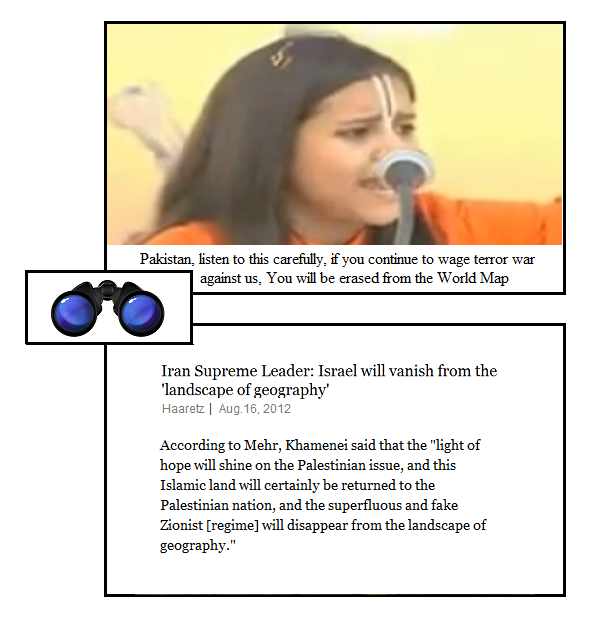
[ by Charles Cameron — Hindutva vs Ghazwa-e-Hind, India vs Pakistan, battle of the girl orators, flags flying in the other guy’s capital, Zaid Hamid, erased from the map, what have I missed? ]
.

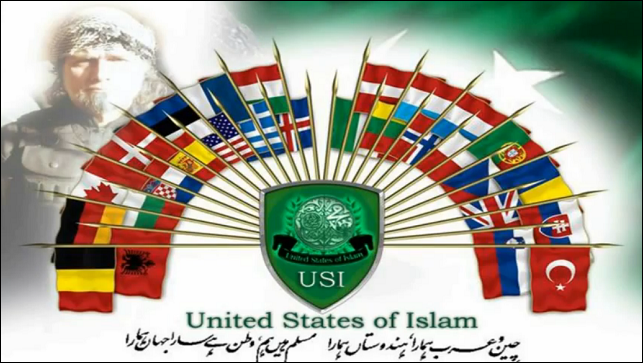
For starters, when I saw the blurry headlines under 13-year-old Sadhwi Balika Saraswati‘s speech to a Vishwa Hindu Parishad gathering, I wasn’t sure whether to pair her speech with Zaid Hamid‘s image of the Pakistani flag flying over Delhi’s Red Fort:

or with the Ayatollah Khamenei‘s recent statement about the “fake” Zionist regime disappearing from the “landscape of geography”:

I mean, there are parallels there, and differences, in each case.

**

And then, when I did a little more digging, all hell broke metaphorically loose, and I couldn’t get enough tabs on my browser to hold all the videos I seemed to want to check out.

I’ve combed through my history and sorted things out now, so I can point you, for starters, to:

13 yr old Hindu girl speaks out against Anti-India forces at a VHP rally — a Youtube video of the relevant part of her speech with English subtitles. You can read a transcript of the speech — missing all the excitement — here. And to give you an idea of its (relative) popularity, one YouTube version of this speech without subtitles, has had 410,535 views, with 1,503 likes and 1,589 dislikes, while another has had 200,964 views, with 801 likes and 491 dislikes… Bear in mind, though, that the Indian population exceeds one billion.

A Pakistani girl replies to 13 yr old Hindu girl who spoke against pakistan — sadly, no subtitles here, but at least it’s a response from someone of roughly equivalent age..

Reply to bajrangdal’s girl by Zaid Hamid which is also interesting, as he’s the spokes-guy for the Ghazwa-e-Hind idea…

**

Which in turn brought me back to thinking once again about the Ghazwa, and:

Ghazwa-e-Hind is our destiny — Zaid Hamid himself addressing the topic (posted this month) — “and we invite the Muslims from Afghanistan, Iran, Turkey and the rest of the Muslim world to come and join us in the fulfilment of this most fascinating destiny which awaits us now: recapturing of India.”

Ghazwa-e-Hind Hadith Explaination — the picture is very blurry , is that our old friend Sheikh Imran Hosein, perhaps? — and

Ghazwa-e-Hind By Dr Israr Ahmed

**

I’m afraid Zaid Hamid wouldn’t be satisfied with India alone, though:

That’s him, top left, overseeing everything.

Oh, and for good measure, here’s a humorous response to Hamid, zaid hamid latest about india — featuring a barking dog.

**

Look, I don’t think Pakistan is about to capture India, or vice versa, any time soon.

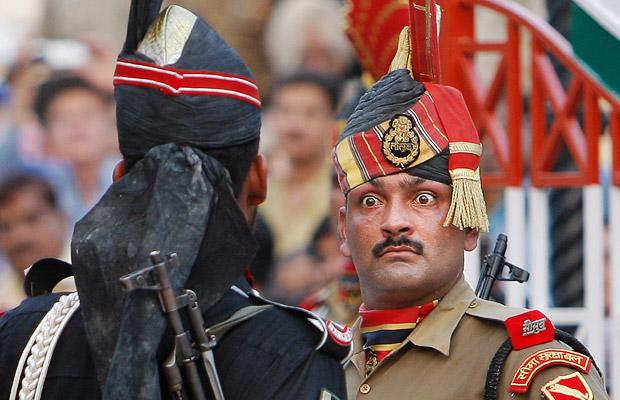
If the two countries feel the need to face off, I hope they will limit themselves to a little ritual drama and some fierce stares, and they do every day in the border ceremonial at Wagah:

Beyond that, I’m an advocate for conflict-resolution and peace-making.

What I do think is that undercurrents of the kind found in the incendiary rhetoric of both sides are worth the attention of analysts.

Pew on the prevalence of Mahdism — take heed!

Sunday, August 12th, 2012

[ by Charles “told you so” Cameron — Pew figures for Mahdist expectation, also the Second Coming, Israel, and the potential influence of apocalyptic ideation on foreign policy ]
.

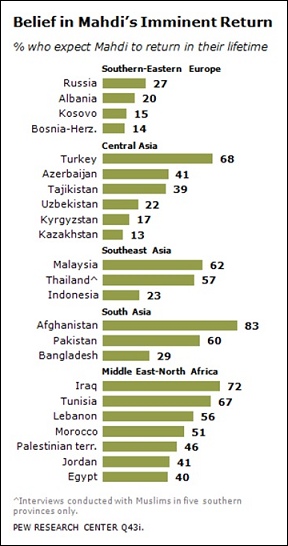
The World’s Muslims: Unity and Diversity, p. 65

.

I am Qualit, not Quant by nature, really much more interested in the workings of the imagination that in the aggregates of poll responses, so it’s a bit like pulling teeth for me to report on a Pew report — but in this case I can legitimately say “I told you so”, which massively outweighs the reluctance I might otherwise feel…

**

Recently, Pew has been including questions about the expectation of the Mahdi in some of its reports, and even Tim Furnish — who wrote the book on Mahdist movements and has long been saying we neglect them at our peril — even Tim was surprised at how widespread Mahdist expectation is, as reported in their just released The World’s Muslims: Unity and Diversity. In a post aptly titled Don’t Leave a Live (or Occulted) Mahdi Out of Your Calculations, Tim says the report contains “The most notable — indeed, strikingly important — news” in the form of “fascinating — and disturbing — data on belief in the Mahdi’s imminent (in one’s lifetime) return.”

See graphic above.

I recommend you read Tim’s analysis for the full range of his points — I won’t, for instance, be touching on what he says about Turkey — here I am going to select a couple of his key issues, and make just a point or two of my own.

**

Furnish:

Of the 23 countries whose Muslim citizens were polled, nine have majorities which expect the Mahdi in their lifetimes, with the overall average percentage at 41.8% … it is safe to extrapolate this percentage to Islam as a whole; ergo, 42% of 1.6 billion = 672 million Muslims who believe in the Mahdi’s imminent return! This is FAR greater than I had supposed.

Furnish also notes that Iran, the world’s most intensely Shi’ite nation and the one whose President has been speaking openly of Mahdist expectation, is not even included among the 23 countries Pew sampled.

Simply put, we have been blind to a very real phenomenon, and now we have a statistical alarm call to wake us up.

More subtly: there’s a difference between answering yes to the question “do you expect the Coming of X in your lifetime” and being on the edge of your seat, viewing every week as threshhold. Damian Thompson is very good on this in his book, Waiting for the Antichrist, and Stephen O’Leary in Arguing the Apocalypse suggests there’s an optimal “arousal” period — if you believe the Coming is too far away, you won’t be motivated to prepare for it quite yet, and if it’s too close it may be too late for you to do much to spread the word…

So, Pew — next time, ask a question with the opinions “in the next five to ten years” and “in my lifetime” — okay? The distinction is important, and a shift towards the shorter time-span would be highly significant.

**

Furnish again:

Despite the conventional wisdom (repeated even by Pew, in the face of their own data) that Mahdism is primarily the province of Shi`is, note that three of the four countries with the highest percentage expecting the Mahdi are majority-Sunni ones: Afghanistan (83%), Turkey (68%) and Tunisia (67%). This has ramifications, respectively, for: US policy in a country we are currently occupying; the only NATO Muslim-majority nation; and the vanguard state of the “Arab Spring.”

In his Conclusions, Furnish says:

The usual State/Defense departments’ “rational actor” approach to international relations might be quite simply irrelevant, if almost half the world’s Muslims expect the imminent return of their eschatological deliverer.

So there you have it. I discussed the “rational actor” versus Scott Atran‘s “devoted actor” in a recent post. And yes indeed, there are “ramifications for U.S. policy”…

Notably with regard to Afghanistan …

**

Here’s Furnish again:

Afghanistan is so rife with Islamic messianism because the 80% of the population that is Sunni and the 20% that is Shi`i (albeit Sevener/Isma’ili, as well as Twelver) both are in the middle of a war and occupation by a “Christian” power — which tends to ratchet up such expectations …

And again, in his Conclusions:

Afghanistan is a lost cause: over eight in ten of its people expect the Mahdi in their lifetime, and no amount of roads and clinics and girls’ schools built by the infidels will change that.

I don’t want to argue that second point in detail, although I think there’s a great deal more to life that Mahdist expectation for many who would answer “yes” to Pew’s question about expecting the Mahdi in one’s lifetime — see my comment on Damian’s book above. But how can I put it? A background Mahdist expectation can become a passionate involvement in a Mahdist movement if the right trigger comes along.

But what I find most striking here is that Afghanistan should be the country with the strongest Mahdist current out of all those Pew selected. And I’m struck not because Afghanistan has been a battlefield for so much of recent history — indeed, for so much of its history, period. I am struck because, in Al-Qaida’s recruitment narrative, supported by a number of ahadith, Afghanistan as Khorasan is the very locus from which the Mahdi’s victorious army will sweep out to conquer (finally) Jerusalem. And this too I have been posting about, eg in my discussions of Ali Soufan‘s The Black Banners and Syed Saleem Shahzad‘s Inside Al-Qaeda and the Taliban.

So the highest level of Mahdist expectation also happens to be found in an area with a potentially major role to play in an end times scenario…

**

There’s at least one earlier report in which Pew raised the question of Mahdist expectation — this time tied in with both the expectation of the Caliphate, and Christian hope of the Second Coming — their 2010 report Tolerance and Tension: Islam and Christianity in Sub-Saharan Africa.

Here, for instance, we learn:

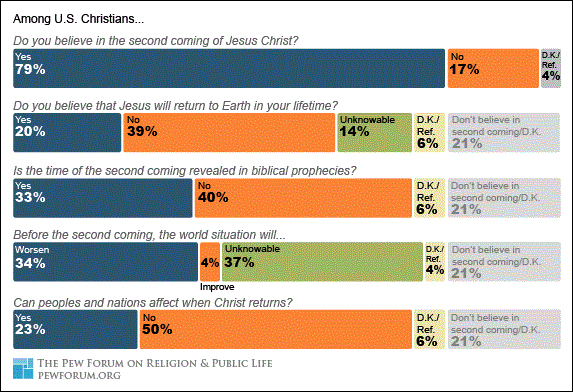
Both Christians and Muslims believe they are living in a time that will undergo momentous religious events. For example, at least half of Christians in every country with large enough samples of Christians to analyze believe that Jesus will return to earth during their lifetime, including nearly seven-in-ten Christians in the Democratic Republic of the Congo (69%).

And at least half of Muslims in 10 of the 15 countries with large enough Muslim populations to analyze say they believe that the caliphate, the golden era of Islamic rule, will be re-established in their lifetime; this belief is most common among respondents in Mozambique (69%). And in 12 of these 15 countries, roughly six-in-ten or more Muslims believe in the return of the Mahdi, the guided one who will initiate the final period before the day of resurrection and judgment, though the survey did not ask respondents whether they expect this to occur during their lifetime.

And here is the relevant data on sub-Saharan Mahdist belief. In Q51 of this poll, Muslims were asked whether they believe “in the return of the Mahdi, the guided one who will initiate the final period before the Day of Resurrection and Judgment? Here’s the table of responses:

Given the “religious fault line” of mixed conflict and amicable coexistence between Christians and Muslims running across Africa from (so to speak) Nigeria to Somalia, with Boko Haram and Al-Shabaab among the less delightful participants, keeping an eye out for signs of Mahdist “semiotic arousal” would be important here, too.

**

And “semiotic arousal” — that reminds me. Richard Landes, who coined the term, has the definitive, encyclopedic book out about all the many forms of apocalyptic, and why they’re important: Heaven on Earth: The Varieties of the Millennial Experience Essential reading, if you ask me, on a hugely neglected and no less critically important subject.

**

Finally, here’s yet another Pew graphic

— to be viewed in conjunction with this one, illustrating the ways in which belief in the Second Coming of Christ correlate with opinions about scriptures and the State of Israel:

**

Prophecy has impact, both on public opinion and on believing leaders. Jews with an expectation of the Messianic era, Christians expecting the soon Coming of Christ, and Muslims with Mahdist expectations each have their own apocalyptic scenarios, and in each case those scenarios exert some influence on policies relating to the Middle East and the Israeli-Palestinian situation in particular.

The bottom line?

Scriptural interpretation — and prophetic eschatology in particular — can no longer be assumed to be a quiet backwater topic for rabbinic students, seminarians and future mullahs to study, each in terms of their own tradition. It is now a series of conflicting drivers of current affairs — of war and peace.


Switch to our mobile site