zenpundit.com » pakistan

Archive for the ‘pakistan’ Category

Waco in Pakistan

Monday, September 24th, 2012

[ by Charles Cameron — on the way not listening sometimes leads to trouble, the importance of ultimate concerns, and a remarkable remark by M. Morsi ]
.

It’s happening again, this time in Pakistan.

Nicholas Kristof‘s NYR op-ed a day or two ago, Exploiting the Prophet, included one particularly interesting little quote that set me thinking – and my friend Bryan Alexander noted it too. Kristof was talking about how people in Muslim countries with little or no tradition of free speech sometimes “have an addled view of how the United States handles blasphemy” and commented, almost as an aside:

A Pakistani imam, Abdul Wahid Qasmi, once told me that President Bill Clinton burned to death scores of Americans for criticizing Jesus. If America can execute blasphemers, he said, why can’t Pakistan?

I challenged him, and he plucked an Urdu-language book off his shelf, thumbed through it, and began reading triumphantly about the 1993 raid on David Koresh’s cult in Waco, Tex.

That’s absurd, preposterous. Perfectly understandable. And dangerous.

**

Here’s a description of how Americans listened to al-Qaida, drawn from Benjamin and Simon’s book, The Age of Sacred Terror, p. 159:

So much of what was heard from al-Qaeda after the attacks sounded to Americans like gibberish that many chords of the apocalypse were missed.

According, that is, to two senior members of President Clinton‘s National Security Council charged with counterterrorism, jihadist “chords of the apocalypse” were missed because they sounded like “gibberish”.

When I read that, I couldn’t help but recall the label given by FBI field agents to attempts by David Koresh to engage them in a discussion of the Book of Revelation, which for him was a roadmap of the very events he was living through — the FBI’s siege of Mount Carmel in Waco, TX.

Here’s a quote from the abstract of Robert Agne and Karen Tracy‘s analysis, ‘Bible Babble’: Naming the Interactional Trouble at Waco, published in Discourse Studies (v 3 # 3, 269-294):

A frustrating yet persistent aspect for the FBI negotiators was the Davidians’ talk about the Bible and their religious beliefs, what agents dismissively described as ‘Bible babble’.

So:

Does it matter if one group of people persists in misunderstanding the religious positions of another in high-tension disputes?

In the case of Waco, it may indeed have contributed to the tragic outcome.

In this study, we analyze several exchanges between Koresh and one of the FBI agents. The analysis shows how the FBI’s identifying their problem as ‘Bible babble’ contributed to the negotiation failure.

**

There are other parallels that can be drawn between the Branch Davidians and their worldview, and al-Qaida and theirs — parallels that may have significance wherever there is a clash in which the “irrational” religious discourse of an (often apocalyptically inclined) “other” is easily brushed off by our own “more rational” mindset.

According to conflict resolution scholar Jayne Seminaire Docherty, writing in Learning Lessons from Waco (p. 99):

During the Waco negotiations, the Mount Carmel residents invited the FBI negotiators to choose God’s law over man’s law.

Compare al-Qaida, as seen in two excerpts from Michael Scheuer‘s Al-Qaeda’s Completed Warning Cycle – Ready to attack? published by the Jamestown Foundation in Terrorism Focus (v 2 #5, 2005):

After 9/11, bin Laden received sharp criticisms from Islamist scholars that dealt with the al-Qaeda chief’s failure to satisfy several religious requirements pertinent to waging war. The critique focused on three items: (1) insufficient warning; (2) failure to offer Americans a chance to convert to Islam; and (3) inadequate religious authorization to kill so many people. Bin Laden accepted these criticisms and in mid-2002 began a series of speeches and actions to remedy the shortcomings and satisfy his Islamist critics before again attacking in the United States.

Parallel to the warnings, bin Laden on two occasions since 2002 asked Americans to convert to Islam as the means of terminating the war al-Qaeda is waging against the United States. “We call you to Islam,” bin Laden said on both occasions, addressing himself to President Bush – as the leader of the American people – and asking him to lead his countrymen to Islam. He also offered to serve as guide and teacher for the American people, urging them to “follow the right path” to Islam. “I am an honest adviser to you.” bin Laden concluded, “I urge you to seek the joy of life and the after life…. I urge you to become Muslims….” (Al-Jazeera 6 Oct 02; Waaqiah.com, 26 Oct 02)

**

The Davidian invitation to the FBI interlocutors to talk Revelation — like the AQ invitation to President Bush and all America to convert to Islam — may seem a foredoomed invitation, but it’s one that at the very least situates one side of the conflict in the territory of “ultimate concerns”. Thus Docherty continues:

The negotiators resisted these invitations as situationally inappropriate conversion efforts. The Branch Davidians, they said, were disrupting the “real” negotiations with their proselytizing. However, for the Mount Carmel residents, proselytizing was the truly important business at hand. With the Second Coming looming on the horizon, all else was trivial by comparison, even the task of peacefully resolving the barricade standoff.

What is ultimate and what is, strictly by comparison, trivial?

One of the most significant answers to that question was given by Muhammad Morsi when he said recently:

To God, the attack on a person to Allah is bigger an attack on the Kaaba.

I still have a post or two in me concerning the ugly video clip and the far uglier riots it triggered, and in one of them I’d like to explore that remarkable remark of Morsi’s — deploring the killing of Ambassador Stevens — and supporting texts from the Qur’an, hadith and the writings of the late Egyptian cleric Sheikh Ghazali.
The symmetry: Charlie Hebdo

Saturday, September 22nd, 2012

[ by Charles Cameron — my apologies for an earlier incomplete draft, quickly withdrawn — first of two, on loose cannonry and mirror imagery — second will deal with recent events in Benghazi ]
.


.

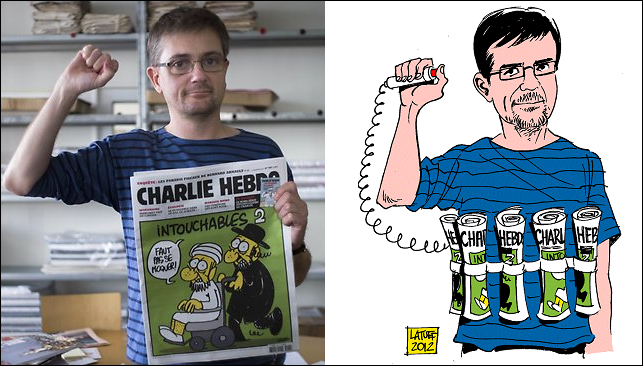
Charlie Hebdo recently published some cartoons featuring the prophet…

Okay, I’m always on about symmetry.

I posted a piece titled Messianic symmetries on ZP a while back, noting that both Ahmadinejad and Netanyahu can be viewed as exercising “leadership that makes decisions out of messianic feelings” — the quote comes from an unimpressed ex-Shin Beth director describing Bibi; Ahmadinejad makes the case for his own Mahdist leabings quite well himself.

Symmetry seems like an important analytic category to me, either because it’s there in the build of the world, or because it’s there in the build of the mind. Either way, I think we should take careful notice of symmetries.

Asymmetries I’ll talk about in my next post.

**

What about the cartoon above, right? It’s clearly based on the photo above, left, which shows Stéphane Charbonnier, the editor of Charlie Hebdo, holding his magazine with its offensive cartoons / vindication of free speech. And the suggestion is clear that he’s some kind of suicide bomber.

But who is he blowing up, exactly? Himself, and perhaps his staff and anyone else who happens to be within a few yards of his office at the time? France, Europe, the western world — the world itself? And how much irony should we read into the cartoon portrait?

They may have learned the technique from the Tamil Tigers, but these days, in the immediate wake of widespread rioting over the video clip and in the context of someone publishing cartoons that satirize the prophet, it’s clearly Islamist suicide bombers who provide the model for the cartoon of the cartoonist above.

Tit for tat? An eye for an eye? You’re just setting yourself up for a fatwa like Salman Rushdie?

**

Incendiary rhetoric on one side leads to incendiary behavior on the other, validating the incendiary rhetoric and making the escalation to incendiary behavior all the more probable.

Some of the incendiary rhetoric has its origin in holy books, which also preach peace.

There are Coptic Christians utterly blindsided by the virulence of the video, attributed to one of their number. There are Libyan Muslims utterly blindsided by the virulence of the attack on the US Embassy, attributed to some of their own.

**

I want to focus not on the specifics of the topic, but on the symmetry.

One writer, observing the partition of India and Pakistan, wrote:

The rioters brought the train to a stop. Those who belonged to the other religion were methodically picked out and slaughtered. After it was all over, those who remained were treated to a feast of milk, custard pies and fresh fruit.

Before the train moved off, the leader of the assassins made a small farewell speech: “Dear brothers and sisters, since we were not sure about the time of your train’s arrival, regretfully we were not able to offer you anything better than this most modest hospitality. We would have liked to have done more.”

Commenting on this paragraph, Ali Sethi wrote recently in the New Yorker:

That is all there is: murder—methodical and quick—followed by a feast and an ingratiating speech. Note the withholding of tags: we don’t know the location of the massacre or the religion of the killers. All we have is a spurt of base instincts.

The point here is that whenever you see a symmetry of opposites, it’s worth considering that symmetry in the abstract, as well as weighing the particular issues that drive your own side or the other.

That, I’d suggest, is one of the implications of that Paul van Riper remark I’m fond of quoting:

What we tend to do is look toward the enemy. We’re only looking one way: from us to them. But the good commanders take two other views. They mentally move forward and look back to themselves. They look from the enemy back to the friendly, and they try to imagine how the enemy might attack them. The third is to get a bird’s-eye view, a top-down view, where you take the whole scene in. The amateur looks one way; the professional looks at least three different ways.

**

I am concerned about hatred, simmering here, boiling over there. I am concerned about what sparks hatred, and what fans it. What I want to draw your attention to here, though, is the process by which one hatred fuels abother, the process of mirror imaging.

Mark Juergensmeyer, a terrific scholar of religion who has published on topics ranging from Gandhi‘s nonviolence to the violence of religionists who consider themselves sanctioned by the scriptures of various religions, makes the point in a recent Religion Dispatches post thus:

The US-based Islamophobes behind the insulting and amateurish video “The Innocence of Muslims,” and those behind the violent protests it allegedly caused around the Muslim world, are kindred hatemongers. Both are extremists with a political agenda, and both want to use this incident to discredit the legitimacy of the moderate governments in power in their respective countries. There is a symbiotic relationship between the strident protesters and the bigoted filmmakers; each needs the other.

We are in a hall of incendiary mirrors, with plenty of kindling: in my view, we should avoid playing with matches.

**

Thank God, there are also asymmetries.

In a companion post, I’ll take a look at recent, very promising events in Benghazi (h/t to Pundita for a pointer to this particular article), the not particularly unsurprising but unwelcome attitude of a Pakistani minister, and the imbalances that go along with the dangerous balances I’ve discussed in this post.

**

Oh, and let me digress…

I won the Divinity essay prize back in my schooldays at Wellington College, and received my chosen prize book, the Liber Usualis with its glorious collection of Gregorian Chants, from the then Minister of Defence, John Profumo, MP. Not long thereafter, it was discovered that he pillow talked with one Christine Keeler, a night lady of class, who also pillow talked with the Russian defence attaché. And the story was broken, week by glorious week, by the British satirical magazine, Private Eye.

Which I consequently have an affection for, after all these years. And I tell you this, because Charlie Hebdo, or Weekly Chuck as we might call it over here is, I’d suggest, a plausible latter-day French rough equivalent of Private Eye.

I don’t really like our guys posting inflammatory materials, you see, but I also have an affection for freedom of speech — and for magazines with a satirical bite, too…

So sue me, I contain multitudes.

Of a fault line, and of the Qibla

Tuesday, August 28th, 2012

[ by Charles Cameron — Sunni and Shia, Mecca and Qom, Saudi and Iran and the balances between them, with special attention to Mecca — and sideways comparisons with Las Vegas and Somoza’s Nicaragua ]
.

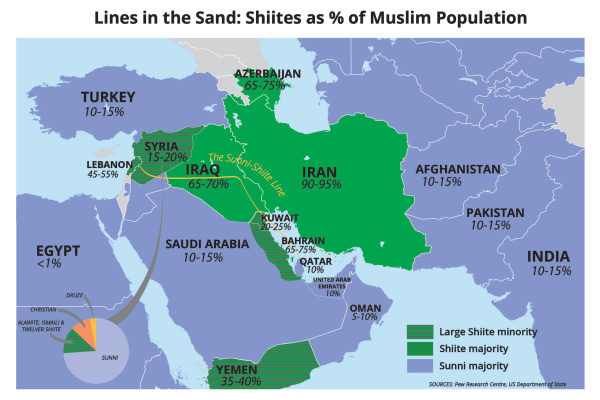
Consider this map:


.

It was ZenMeister who pointed me today, via Notes from Thermopylae, to Stephen Crittenden and his Global Mail piece, The Clash Within Civilisations: How The Sunni-Shiite Divide Cleaves The Middle East, from which the map above is taken. Crittenden writes:

There is a dangerous 2,000-kilometre fault line running through the Middle East between Beirut and Bahrain via Damascus and Baghdad, which marks the present line of demarcation between the two main branches of Islam, Sunni and Shiite.

The 1,300-year-old schism between Sunnis and Shiites was caused not by a theological dispute (those came later), but by rival clans in Muhammad’s tribe, the Quraysh, squabbling over the succession after his death in 632 AD.

Mostly the “Sunni-Shia Line” lies dormant, and ordinary Sunnis and Shiites live out their separate lives, side-by-side in relative harmony. In Lebanon and Iraq it has not been uncommon for Sunnis and Shiites to intermarry. But the Line is still always there, just below the surface, and it has recently re-emerged as the most significant factor reshaping geopolitical relationships in the Middle East, a region where religion and politics are always inextricably intertwined.

**

Suppose it, at least for now. And in that context, consider as a counterweight to all the talk about Iran, two fascinating pieces by the Pakistani novelist Maniza Naqvi.

Naqvi’s piece The Remit of Fear in 3 Quarks Daily today is worth reading — you may be interested in any one or more of her various critiques of the House of Saud:

I fear the perverse purchase of petrodollars from Saudi Arabia: the twin ideologies of Salafism and Islamophobia. …

[ … ]

I fear to imagine a county which produces no art, film, theater, song or dance. Yet such is the country created by the State of Saudi Arabia. I fear the reasons which cause 16 million citizens most of whom are not Saud in Saudi Arabia to remain silently compliant. The bulk of this population is under the age of 25 and disempowered and is ruled absolutely by old men who do not tolerate dissent or diversity of opinion. I fear the mindset that treats women as blots and clots to be erased or managed.

There’s plenty of food for thought there, not least about Pakistan:

I fear that the people unlearned and illiterate impressed by influence and the purchasing power of Saudi Arabia might be confused and unable to distinguish the House of Saud as being apart from the origin and the authors of Islam. I fear that this may be the case for Pakistan where matters are so far gone that if the father of the Nation, Mohammad Ali Jinnah were alive today he would not be able to go about freely for fear of being shot to death for being a Shi’a.

My own interest, as usual, draws me to the religious drivers at work and their impact:

I fear that after thirty years of petrodollar bonanzas and propaganda, Muslims are unable to delink Islam from the House of Saud. There are 5000 Saud and in comparison there are 1.2 billion Muslims all over the world. A majority of whom, for a myriad of reasons including illiteracy, poverty and sudden wealth are unable to resist or protest against the Saudi influence upon them. I fear that the populations of the world are unable to resist, protest and fight against the privatization of all that is their sacred to them: their lands where they grow their food, to the places where they congregate and live, to their own thoughts and even their bodies.

**

But you should read too her linked critique of the remaking of Mecca, The Architects of the War on Islam, from August 6th:

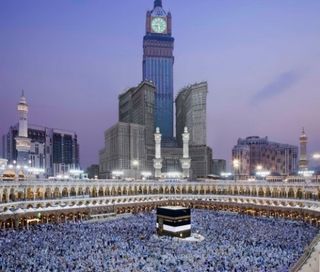
This is addressed to Muslims who think that Islam is under attack: They are right. Just take a look at the images of the House that Abraham built, the Ka’aba and see how progresses that ancient attack. Just look at the transformation of the environs of the Ka’aba and the Haram Shareef into a garish resort rivaling Las Vegas or Atlantic City.

Just look, at the transformation of the sacred environs of the Haram Shareef into a shopping mall and Disney world–to understand the war on Islam and who is responsible for waging it. Just look at this and see how Islam has been trafficked as though it were a bonded slave, dressed up in bells and baubles to be whipped and sold in the marketplace.

**

Note finally her remarks, in today’s piece, on fear and silence:

Much is at stake if people are not silent. Much is at stake if people remain silent.

[ … ]

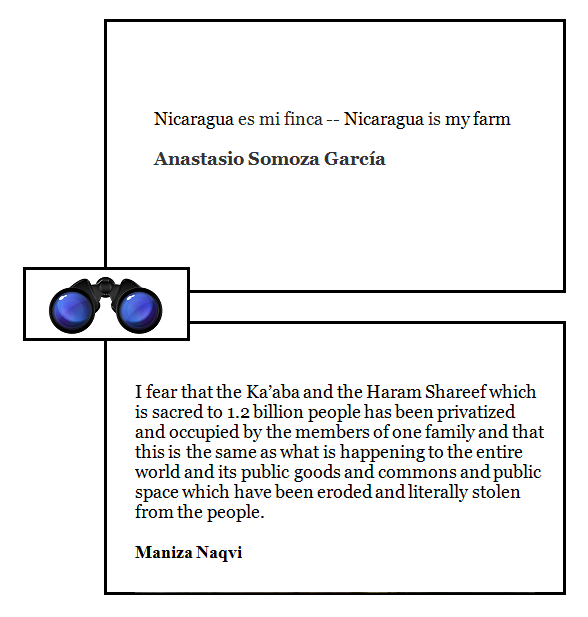
I fear that Haj and the Ka’aba, a central principal of Islam, sacred to 1.2 billion people have been privatized, by an estimated 5000 people belonging to one family. Why? How is the privatization of the Ka’aba different from the wholesale seizure and privatization of the commons and public lands and spaces all over the world? I fear that the Ka’aba and the Haram Shareef which is sacred to 1.2 billion people has been privatized and occupied by the members of one family and that this is the same as what is happening to the entire world and its public goods and commons and public space which have been eroded and literally stolen from the people.

And now you can see, too, why I am reminded of Somoza and his farm, Nicaragua:

With this profound difference: that the Ka’aba is the Qibla, the point of orientation to which all Muslim prayer turns, as others orient their prayers towards Jerusalem.

Pakistan’s Strategic Mummery

Saturday, August 18th, 2012

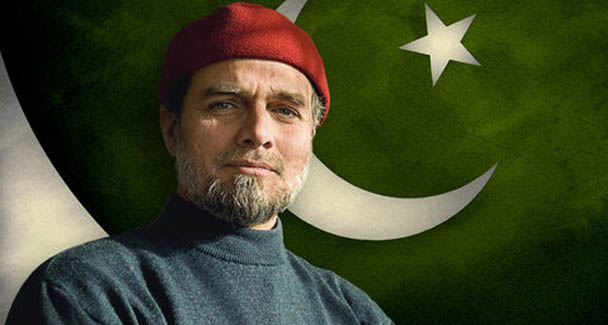
A while back, Charles Cameron had a post on the Ghazwa E Hind that served as my introduction to an oddball Pakistani agitator named  Zaid Hamid The colorful Mr. Hamid seems to be Pakistan’s fully militarized version of Glenn Beck fused with an Islamist George Friedman, with perhaps an astrologer and Rip Taylor thrown in for good measure. In discussing this figure, ZP commenter Omar offered:

….But this clown has serious backers. The deep state systematically uses these clowns to prepare the “information space” for their plans. ..and they are not kidding around. 

Zaid Hamid made a recent appearance in another post by Charles, so I felt inspired to look at him more closely and discovered that Hamid, who has a fondness for 4GW verbiage, has his own think tank, Brasstacks which publishes “geostrategic analysis”, largely about alleged “Hindu Zionist” (?) conspiracies to destroy Pakistan. These papers are fascinating, in a car-crash sort of way, much like a political intelligence letter from the LaRouchies. There is also a blog by Hamid, where his latest post remarkably declares Pakistan’s late dictator, the ruthless General Zia ul-Haq, a “shaheed”.

My question, since Hamid appears to stir controversy and criticism within Pakistan, is what is his real level of influence in Paskistani society? Comments welcome.

So many browser tabs, so little time

Thursday, August 16th, 2012

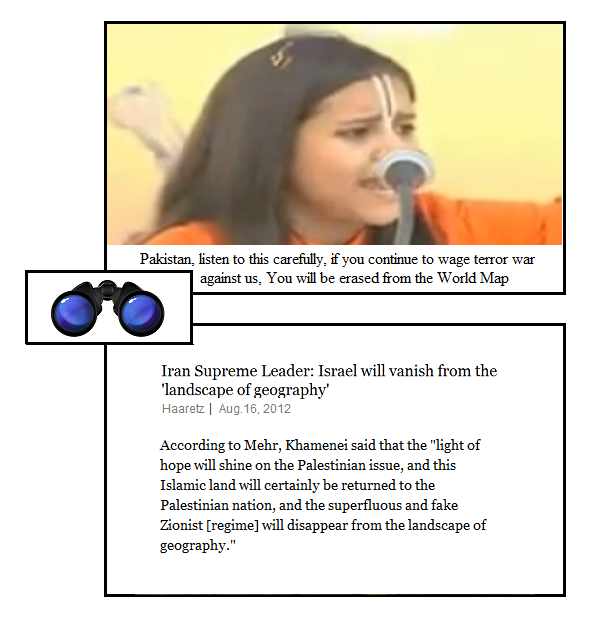
[ by Charles Cameron — Hindutva vs Ghazwa-e-Hind, India vs Pakistan, battle of the girl orators, flags flying in the other guy’s capital, Zaid Hamid, erased from the map, what have I missed? ]
.

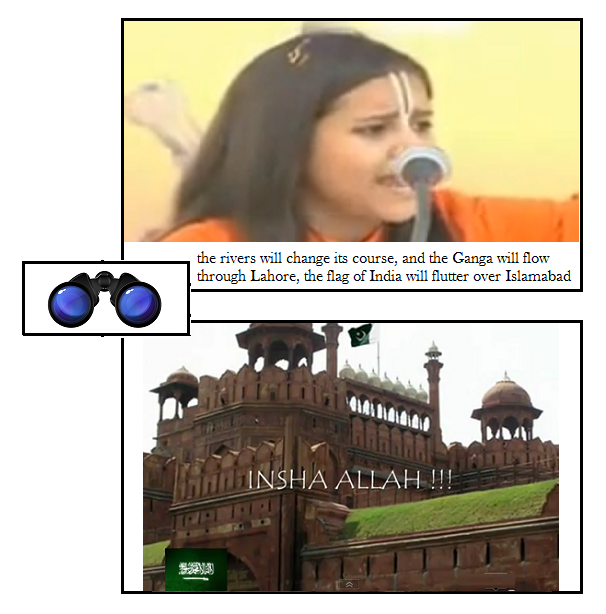
For starters, when I saw the blurry headlines under 13-year-old Sadhwi Balika Saraswati‘s speech to a Vishwa Hindu Parishad gathering, I wasn’t sure whether to pair her speech with Zaid Hamid‘s image of the Pakistani flag flying over Delhi’s Red Fort:

or with the Ayatollah Khamenei‘s recent statement about the “fake” Zionist regime disappearing from the “landscape of geography”:

I mean, there are parallels there, and differences, in each case.

**

And then, when I did a little more digging, all hell broke metaphorically loose, and I couldn’t get enough tabs on my browser to hold all the videos I seemed to want to check out.

I’ve combed through my history and sorted things out now, so I can point you, for starters, to:

13 yr old Hindu girl speaks out against Anti-India forces at a VHP rally — a Youtube video of the relevant part of her speech with English subtitles. You can read a transcript of the speech — missing all the excitement — here. And to give you an idea of its (relative) popularity, one YouTube version of this speech without subtitles, has had 410,535 views, with 1,503 likes and 1,589 dislikes, while another has had 200,964 views, with 801 likes and 491 dislikes… Bear in mind, though, that the Indian population exceeds one billion.

A Pakistani girl replies to 13 yr old Hindu girl who spoke against pakistan — sadly, no subtitles here, but at least it’s a response from someone of roughly equivalent age..

Reply to bajrangdal’s girl by Zaid Hamid which is also interesting, as he’s the spokes-guy for the Ghazwa-e-Hind idea…

**

Which in turn brought me back to thinking once again about the Ghazwa, and:

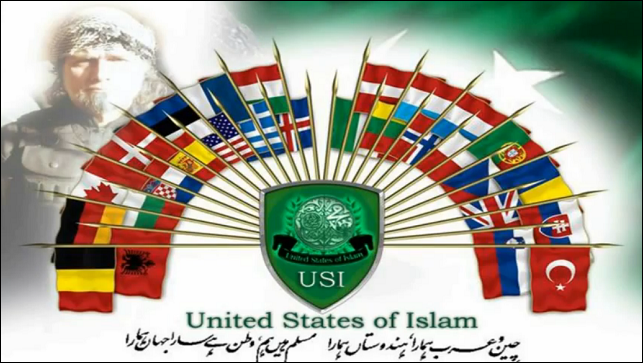
Ghazwa-e-Hind is our destiny — Zaid Hamid himself addressing the topic (posted this month) — “and we invite the Muslims from Afghanistan, Iran, Turkey and the rest of the Muslim world to come and join us in the fulfilment of this most fascinating destiny which awaits us now: recapturing of India.”

Ghazwa-e-Hind Hadith Explaination — the picture is very blurry , is that our old friend Sheikh Imran Hosein, perhaps? — and

Ghazwa-e-Hind By Dr Israr Ahmed

**

I’m afraid Zaid Hamid wouldn’t be satisfied with India alone, though:

That’s him, top left, overseeing everything.

Oh, and for good measure, here’s a humorous response to Hamid, zaid hamid latest about india — featuring a barking dog.

**

Look, I don’t think Pakistan is about to capture India, or vice versa, any time soon.

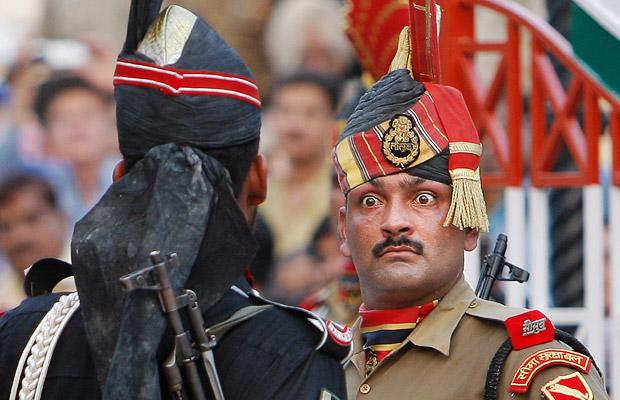
If the two countries feel the need to face off, I hope they will limit themselves to a little ritual drama and some fierce stares, and they do every day in the border ceremonial at Wagah:

Beyond that, I’m an advocate for conflict-resolution and peace-making.

What I do think is that undercurrents of the kind found in the incendiary rhetoric of both sides are worth the attention of analysts.


Switch to our mobile site