zenpundit.com » A.E.

Archive for the ‘A.E.’ Category

Elkus on the Troubled History of Raiding

Tuesday, May 10th, 2011


Adam reminds us that punitive raiding is not by itself a substitute for clear strategies or coherent policies in a well-written piece posted at The Atlantic Monthly :

From Romans to SEALs, a Troubled History of Raiding

The Osama bin Laden raid has been hailed as the centerpiece of a new style of “collaborative” warfare that leverages intelligence fusion and networked interagency teams to focus precision force on America’s enemies. Collaborative warfare, while impressive, is only the latest and greatest in a genre of military operation that dates back thousands of years: the punitive raid. From the days of the Roman Empire through Sunday’s raid in Abottabad, Pakistan, governments have relied on punitive raids and manhunts to eliminate challengers to state power without resorting to costly, large-scale occupations. 

But a look at the history and evolution of punitive raiding reveals that it is not a substitute for sound strategy — and can be far more costly than policymakers might suspect and may have political costs that outweigh the strategic benefits. Punitive raids — whether they consist of a large column of raiders advancing by horseback or an airmobile squad of commandos about to drop into an enemy cross-border haven — have always been deceptively appealing as low-cost alternatives…

Read the rest here.

Grand Strategy as Co-Evolution: Being and Becoming

Tuesday, December 21st, 2010

“Our form of government does not enter into rivalry with the institutions of others. Our government does not copy our neighbors’, but is an example to them. It is true that we are called a democracy, for the administration is in the hands of the many and not of the few. But while there exists equal justice to all and alike in their private disputes, the claim of excellence is also recognized; and when a citizen is in any way distinguished, he is preferred to the public service, not as a matter of privilege, but as the reward of merit.” – Pericles, The Funeral Oration

“The President of the United States of America and the Prime Minister, Mr. Churchill, representing His Majesty’s Government in the United Kingdom, being met together, deem it right to make known certain common principles in the national policies of their respective countries on which they base their hopes for a better future for the world.”

– The Atlantic Charter, 1941

Adam Elkus, at Rethinking Security, makes an important point about grand strategy not requiring a great enemy:

Building a Strategy for Chaos?

….The short answer is that grand strategy isn’t something that requires an clear and equal enemy to create. But since grand strategy is something that involves a long time line, a substantially more broad subject area than war strategy, and the utilization of resources in peacetime, it makes more sense to visualize it less as an explicit plan than a collection of practices sustained over a long period of time. The policy of “offshore balancing” which Churchill mentions in this speech is one of those sets of practices. 

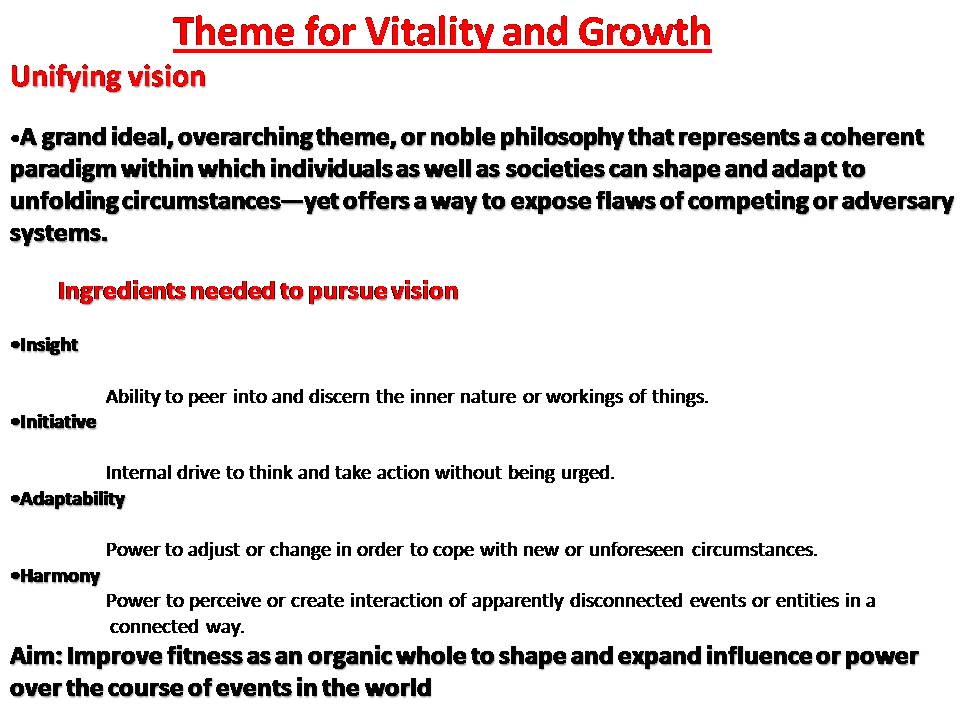
Boyd is commonly misunderstood as a tactically obsessed jet pilot whose insights mainly relate to cycling through a decision cycle faster than the opponent. But the importance of his writings to grand strategy is undeniable. His stress on the importance of forming organizations creative and efficient enough to “destroy and create” perceptions of the external environment, increase our own connectivity and degrade that of our opponents, and the importance of establishing a “pattern for vitality and growth” all point to aspects of strategic design that focus less on marshalling resources against a specific opponent than developing a basic strategic template that can remixed for various situations under a process of “plug and play.”  

In his post, Adam references Colonel John Boyd’s “Theme for Vitality and Growth” from his brief, Patterns of Conflict:
themeforvitality.jpg

Adam went on to make an insightful observation:

The problem is that as societies grow both more structurally and interactively complex, this process grows much more difficult. That is what The Collapse of Complex Societies is about–how, if we view civilizations as computing mechanisms, how growth makes it more difficult to carry out the basic process of response to changing external conditions that is an essential part of data-processing. Moreover, even in eras of relative simplicity, the ability to aggregate enough information together to form a grand strategic design was exceedingly rare for individuals and more difficult for governments than success stories such as 19th century Prussia might indicate

Read the rest here.

I would like to extrapolate Adam’s argument about the difficulty imposed by complexity several steps further.

In considering grand strategy, historically, except for the Romans during their golden age, state actors, even vast empires like the Soviet Union or Great Britain, never approximated a closed system that could operate without reference to rivals who could potentially present an existential threat, singly or in combination. While the Pax Romana represents the rare outcome of a successful grand strategy, most great powers wrestled with imposing their will on both their rivals – but also on the geopolitical environment or “system” in which they operated.

What do I mean by the “system”? The explicit and implicit cultural and diplomatic rule-sets; the “rules of the game” by which powers interacted; the geoeconomic structures and patterns that were larger than any particular political entity and imposed constraints upon them, even the chance-based variables of natural resources and technological level which had a determining effect upon formulation of policy and strategy. The relationship between the architect of a grand strategy, his rivals and the world in which all were forced to operate consisted of a multiple variable feedback loop, not a diktat with a binary set of possible results.

I woud now like to make two points. 

First, to use an analogy from the biological sciences, grand strategy enunciated by a great power is a process of geopolitical co-evolution. There is an effort in grand strategy to impose over time one’s political will upon others to shape the “battlespace”, the sphere of influence, the hegemonic dominion to a state of affairs favorable to the state actor. Often, this is done by military force in times of crisis but over the long term, economic and diplomatic factors, all of DIME really, weigh heavily on the outcome. The process is never a one way street, even for actors who are considered to be largely triumphant. It is coevolutionary. If you gaze into the abyss, the abyss will gaze into you.

The early Roman republicans, much less Cato the Younger, would have been viscerally appalled by the Empire of Late Antiquity with its’ Teutonic Masters of the Horse in place of citizen- Praetors and Imperators. The Founding Fathers would be amazed by the condign dominance of the United States as a global titan but dismayed by the truckling servility, the lack of economic independence and the sheepish passivity of Americans whose citizenship is largely nominal. Ancient Chinese sages might feel much the same about hybrid capitalist-communist China of 2010.

Secondly, sustaining the national or group identity is a critical component of grand strategy that makes it a different, more expressly political/cultural  exercise than crafting strategy as Clausewitzians use the term as being driven by policy. Grand strategy should guide policy formulation because it is not just a set of concrete structural ends, or a laundry list of “vital interests” but a constructive, values-laden, attractive, motivating, civilizational narrative. An ideal or cultural identity for which men and societies are willing to go to war, to stand, fight and die. As Thomas P.M. Barnett once put it, for a “Future worth creating“. Grand strategy is a defiant clarion call of civilizational supremacy, marshalling those who will fight for that which is not, but could be.

But if you gain the whole world, while losing oneself, have you won? Or lost?

A victorious grand strategy shapes others while preserving – or expanding the reach of – the core identity of cultural-political community engaged in the struggle for autonomy for itself  and dominion over the environment. Some changes though are inevitable despite the best of intentions. Exercising power carries with it a price and the piper must be paid.

Following Boyd, the more attractive our vision, the “noble philosophy” we offer up to others and the more consistently we practice that which we preach, the greater our reach while remaining true to ourselves – thus demoralizing our adversaries. The more we trade on our souls, compromise our principles, turn away from threats and contradict our professed ideals, the less we have. Power is useful but it is transient. The exercise sweet, but the cost dear.

Power runs through our fingers like water. What did we give for it? What did we gain? Who are we now?

That is grand strategy.

Working…..

Wednesday, December 15th, 2010


On a sizable post. Adam was the catalyst.

Unfortunately, I have reached the stage of life, or perhaps it is simply the season of the year, when my time is increasingly fractionated by competing claims. This may take a few days. Grasping at something fundamental and clarity will be important.

Elkus on Boyd 2010

Wednesday, October 20th, 2010


My amigo, Adam Elkus has a short recap of Boyd 2010 at Rethinking Security:

Boyd Recap

So, my head is still spinning from Boyd 2010. I went with Alex of i-Con and a mutual friend, and met up with Fred Leland, Don Vandergriff, J. Scott Shipman, SAIC’s Isaac Russell, and Bruce I. Gudmunsson. In addition to the many great talks, we also had some sushi at Quantico and hit up the Officer’s Club. I also drained the Quantico bookstore, which has a much larger selection then the stuff I bought three years ago. A capsule account follows, for those who might have missed my Twitter updates.

Biographer Robert Coram opened up at 0915 with a short and touching introduction regarding Boyd’s life, with acolyte Ray Leopold telling some more amusing anecdotes. Don Vandergriff gave a great update about his progress in trying to alter the Army’s training and personnel system, and Jim Hasik looked at defense procurement. Paul van Riper gave the keynote speech. Riper gave a rather beautiful address about the philosophy of science, the military’s misunderstanding of complex systems, and the need for operational doctrine that fits better with human experience. As Shipman pointed out to me in an aside, van Riper’s points were very similar to those recently made by J.S. Storr in his book The Human Face of War.….

Read the rest here.

Grand Strategy and Morality

Saturday, August 21st, 2010

Adam Elkus had two brief but thoughtful posts on grand strategy at Rethinking Security that I woulld like to highlight and use as a foil to promote further discussion. I encourage you to read both in full:

Basil Liddell-Hart, Grand Strategy, and Modern Grand Strategy

….This, however, is not the understanding of “grand strategy” we have today. Starting with Edward Luttwak’s Grand Strategy of the Roman Empire (Luttwak has written a new book about the Byzantine Empire), grand strategy has been used in books to refer to the overall method of a state for producing security for itself or making itself powerful. Paul Kennedy’s edited compilation Grand Strategies in War and Peace and Rise and Fall of the Great Powers explicitly uses this framework. The William Murray and MacGregor Knox edited compilation The Making of Strategy: Rulers, States, and War also pioneered it. And the Clausewitzian Colin S. Gray has written a great deal on grand strategy as well.

So, what to say? First, the better works on the subject do not treat grand strategies as linear plans but a coherent or at least related set of practices over a long period of time. This is a good approach to take, as it emphasizes that rulers did not instinctively seek to craft a Seldon Foundation-esque master plan for eternity but discovered, through trial and error, a set of practices, ideas, and concepts of operations that worked for a given period of time. Perhaps a very important question (and one that has been alluded to) is what kinds of political cultures tend to produce these sets of practices, and whether they are imposed top-down, generated in a mixed fashion, or come emergently from below

and:

Strategy and “Strategy”

Diplomatic historian Walter McDougall recently wrote this:

The most a wise statesman can do is imagine his ship of state on an infinite sea, with no port behind and no destination ahead, his sole responsibility being to weather the storms certain to come, and keep the ship on an even keel so long as he has the bridge.

I write this after an interesting Twitter conversation with Gunslinger of Ink Spots, which he later excerpted in his own reflections on strategy in America. Gunslinger points out a recurring dynamic. The upper layer of policy and strategy is thin and operational art, the solid bottom foundation, is filling in the void. The problem, however, is that operational art provides a narrow viewpoint to see the world. It is good as a cognitive ordering device for some things, but poor for others. When we try to use it as a strategic device, it magnifies our confusion because the blurs outside of our finely tuned vision are all the more distressing, frightening, and alien to us

Adam is right. Operational excellence is strongly desirable but by itself, insufficient. It is a sword, not a map. Still less is it a crystal ball or moral code. 

Grand strategy is not, in my view, simply just “strategy” on a larger scale and with a longer time line. Strategy is an instrumental activity that unifies ends, ways and means. While grand strategy subsumes that aspect, it also provides ordinary strategy with a moral purpose, perhaps even in some instances, an identity.  Grand strategy explains not just “how” and “for what”, but “why we fight” and imparts to a society the supreme confidence in itself to sustain the will to prevail, even in the face of horrific sacrifice. Grand strategy brings into harmony our complex military and political objectives with the cherished, mythic narrative of a “good society” we conceive ourselves to be, reducing “friction”, “pumping up” our resolve and demoralizing our enemies. Grand strategy is constructive and energizing.

A simple but profound moral argument is a critical element of a grand strategy, to a great extent, it frames the subsequent political and military objectives for which war is waged. Here is one example:

….We hold these truths to be self-evident, that all men are created equal, that they are endowed by their Creator with certain unalienable Rights, that among these are Life, Liberty and the pursuit of Happiness. – That to secure these rights, Governments are instituted among Men, deriving their just powers from the consent of the governed, – That whenever any Form of Government becomes destructive of these ends, it is the Right of the People to alter or to abolish it, and to institute new Government, laying its foundation on such principles and organizing its powers in such form, as to them shall seem most likely to effect their Safety and Happiness. Prudence, indeed, will dictate that Governments long established should not be changed for light and transient causes; and accordingly all experience hath shewn that mankind are more disposed to suffer, while evils are sufferable than to right themselves by abolishing the forms to which they are accustomed. But when a long train of abuses and usurpations, pursuing invariably the same Object evinces a design to reduce them under absolute Despotism, it is their right, it is their duty, to throw off such Government, and to provide new Guards for their future security

Or another:

….I would say to the House, as I said to those who have joined this government: “I have nothing to offer but blood, toil, tears and sweat.”

We have before us an ordeal of the most grievous kind. We have before us many, many long months of struggle and of suffering. You ask, what is our policy? I can say: It is to wage war, by sea, land and air, with all our might and with all the strength that God can give us; to wage war against a monstrous tyranny, never surpassed in the dark, lamentable catalogue of human crime. That is our policy. You ask, what is our aim?

I can answer in one word: It is victory, victory at all costs, victory in spite of all terror, victory, however long and hard the road may be; for without victory, there is no survival. Let that be realised; no survival for the British Empire, no survival for all that the British Empire has stood for, no survival for the urge and impulse of the ages, that mankind will move forward towards its goal. But I take up my task with buoyancy and hope. I feel sure that our cause will not be suffered to fail among men. At this time I feel entitled to claim the aid of all, and I say, “come then, let us go forward together with our united strength.”

War is not a game of chess. Without a moral purpose – an Atlantic Charter, a Gettysburg Address, Pope Urban II’s sermon, the Funeral Oration of Pericles – to lend sanction to strategy, a war effort is hamstrung and civil society is left unengaged, perhaps indifferent or even hostile to military action. In the American Civil War, there was a world of difference between the morale and determination of Union states of 1861-1862 and that of late 1864-1865. This turnaround was not solely due to Generals Grant and Sherman, the former of whom was being castigated in the newspapers as a “butcher” up almost until the moment where he was deified in victory, the change pivoted on the Emancipation Proclamation and the Gettysburg Address which welded battlefield sacrifice to a higher cause.

Naturally, actions that violate the moral purpose – of the grand strategy or a society’s sense of self – are incredibly, incredibly, damaging. This is why Abu Ghraib was utterly devastating to the American war effort in Iraq. Or why accusations or evidence of high treason are bitterly divisive. They contradict the entire raison d’etre for having a strategy and paralyze a society politically, energizing competing centers of gravity while giving heart to the enemy.

Oddly, highly sophisticated American leaders seem to be blind to this but Osama bin Laden, fanatical and ignorant in his half-baked, obscurantist understanding of Salafi Islam, is keenly aware. His entire “fatwa” declaring al Qaida’s jihad on America, despite being riddled with lies, is a painstaking plea to his fellow Muslims as to the righteousness of his cause, the worthiness of his objectives and the iniquity of the American infidels. Osama may be an evil barbarian, but Bin Laden has far more clarity of purpose and moral certitude  than many USG senior leaders who cannot bring themselves to say who the enemies are that United States is fighting and why ( other than “9/11” – which is like saying we fought Nazi Germany because of Pearl Harbor). Too often they have an indecent haste to cut checks to governments who are allied to our enemies

They are halfhearted and timid in America’s cause while our foes brandish their convictions like they were AK-47’s.


Switch to our mobile site