zenpundit.com » Epistemology

Archive for the ‘Epistemology’ Category

Diplomatic History and IR

Tuesday, June 2nd, 2009

 Social scientist and eminent IR scholar Robert Jervis gave an interesting keynote speech to the H-Diplo Conference on the relationship between diplomatic history and IR.

International Politics and Diplomatic History: Fruitful Differences” (PDF)

….We both want to explain international history. When I said this at Williams, Randy Schweller objected that IR scholars seek to develop and test theories rather than to explain events. I do not entirely disagree with him, but would reply that although we have differences in our stance towards facts and generalizations, IR scholars want to develop theories that are not only parsimonious and rooted in general social science, but that shed light on (i.e., explain at least in part) events and patterns in international history.
There are important differences in style, aesthetics, and approaches, and my brief remarks can hardly do justice to all
of them. But a minor point may be worth making at the start. It seems to many of us in IR that historians are gluttons for punishment, and we marvel at their linguistic competence and ability to penetrate and synthesize enormous amounts of material. Years ago I was talking to my good friend Bob Dallek about whether he was going to take a break now that he had finished the enormous effort of producing his two-volume biography of Lyndon Johnson. He said he had originally planned to, “but I just learned that they are opening a million new pages of material on Kennedy and I just can’t resist.” Most of us in IR would have a quite a different reaction, but we are very glad that Bob and his colleague produce such books.

There is a perhaps associated difference between the scholars in their stance toward facts. I do not want to get into the difficult and important question of what exactly we mean by facts, whether they can exist independently of our interpretations, and related issues of epistemology and ontology. But for all the debate, everyone agrees both that facts do not speak for themselves and that not all interpretations have equal claims on our beliefs. That said, Schweller’s point is relevant here. IR scholars generally seek theories of some generality and in pursuit of them the field has provided license to do some but not unlimited injustice to facts and individual cases. There is no easy way to sum up community norms here, and I will just say that while IR scholars cannot give the facts the third degree to get them to tell us what we need for our theories, we can rough them up a bit. We should be aware of what we are doing, however, and alert our readers of this, taking special care to point them to alternative interpretations. Since we are often painting in broader strokes and looking for ways to explain a great deal with a relatively few factors and relationships, we can utilize understandings of history that simplify and trim it. In this way, IR scholars have something in common with postmodernists in our willingness to draw on interpretations that we know are partial and contested

Read the rest here.

I am no IR or polisci guy but my intellectual predispositions have always been more speculative or predictive than most historians are comfortable with, while being too historical in my argumentation to be even close to IR. Therefore, any effort to close the gap between these cognate fields is welcome from my perspective.
“Socionomic” Futurism at Futurejacked

Friday, January 2nd, 2009

Flagg707 has a speculative post at Futurejacked that I think most readers hear will find stimulating and fun to read:

Socionomic Trendspotting for 2009

A Continued Surge in Magical Thinking

Socionomics posits that during waves of positive social mood, “practical thinking” is dominant over “magical thinking,” and a belief in science and reason dominates. During waves of negative social mood the magical thinking, with its distrust (if not hatred of) reason and science rises to a dominant position in the mass social “mind.”

My personal interpretation of this is that magical thinking actually begins to manifest during the fifth wave of a postive mood surge – where faith and hope outstrips a reasoned evaluation of the economic “fundamentals” and continues into the waves of negative mood. Either way, we can expect a lot of anti-science and anti-rationality types of behavior to explode in politics and in university settings. Hopefully it won’t go as negative as it did in Kampuchea, but we are dealing with a downturn of historic proportions, so keep in mind that herds of humans are capable of staying irrational for very, very long periods of time.

….Expect a Wave of Independence Movements

I thought this would be a more dominant theme during 2008 than it turned out to be, with only Kosovo shearing off from Serbia and, at the very end of the year, the Ruthenians declaring independence in Ukraine. As Abkhazia and Ossetia were already de facto independent from Georgia, I won’t count them. I doubt 2009 will be as calm.

Socionomics holds that during times of negative mood factionialism increases and the various “tribes” that make up a country turn towards their subgroup and away from the idea of an inclusive and tolerant society. This is the stuff of independence movements, of civil wars, of hollow states and of a return to primary loyalties.

Read the rest here.

Perception Pyramid vs. OODA Loop

Friday, November 7th, 2008

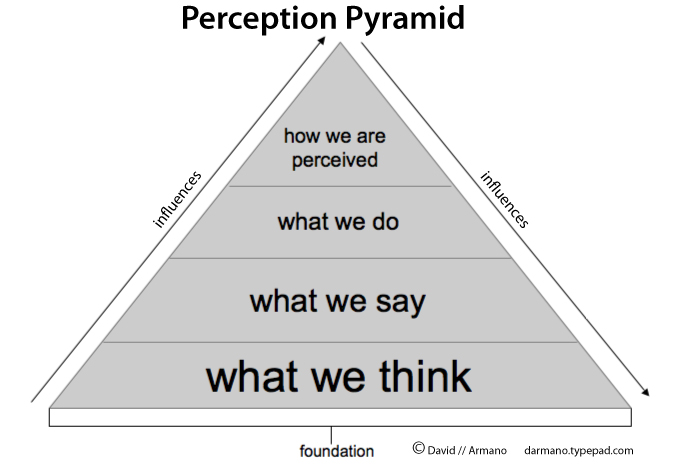
Design guru David Armano had a graphic up that was intriguing from a psychological point of view:

armano.jpg

My instant impression on seeing Armano’s visual was a reminder from Western philosophy and Eastern religion:

“We are what we frequently do” – Aristotle

“What we think, we become” – Buddha

The second impression from the graphic was it’s simultaneous representation as both a feedback loop and a hierarchy. As a hierarchy, I’m not certain I would put “what we say” as a more fundamental tier than “what we do” as Armano did.  Actions would appear to be less subjective as events occuring in time and space than words but words moreso than the perceptions of others which we can neither control nor reliably audit, yet they very much influence us, as Armano suggests.

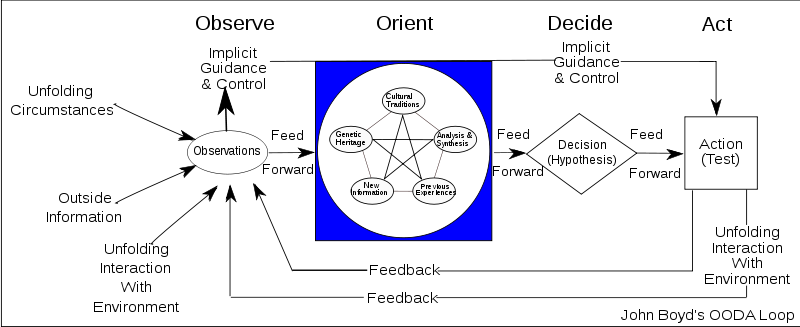
Compare the flow of information/action in Armano’s pyramidical graphic with John Boyd’s OODA Loop:

ooda.png

Boyd’s conception is not hierarchical or sequential, though many people view OODA as a deliberative step by step process, running through it in such a manner instead would slow the cycle considerably. Armano’s consideration of the perceptions of others would be important to Boyd as “outside information” and “unfolding interaction with environment”. It would address the mental and moral levels of conflict and competition

  • Mental (against individuals and groups): surprise, deception, shock, and ambiguity
  • Moral (against groups): menace, uncertainty and mistrust, resulting in disintegration of cohesion and the moral fragmentation of the opponent into many non-cooperative centers of gravity, which pumps up friction.

It would also measure our ability to attract support from or positively influence third parties or allies.

Interested in any thoughts the readership might have on the comparison or from any of my numerous co-authors….

Extending the Discussions

Sunday, May 4th, 2008

This is the great thing about blogging – the times when other people pick up where you had left off and turbocharge the conversation with their own posts. Some of the best kind of P2P feedback around. Here Younghusband and Lexington Green carry the ball downfield in two different threads. Both posts should be read in full but here are snippets and links:

Coming Anarchy -“History vs. the Future

….A brief glance shows a gap in the qualitative area reflected in your comment that “History is a craft, not a science.” However, futurism is also about the “craft” of qualitative analysis as well, so the two are not necessary diametric. One common aspect of both fields is the philosophic, specifically the epistimelogical consequences (once again I would like to do a double-take at the term “discrete facts”) and the eternal quest to pare down bias. This is an area that I think could be explored more. If you know any good journal articles about this let me know.

Moving on, I would like to challenge one of your statements: “The problem with futurists is that their predictions are all too frequently in error.”

Error denotes precision. Futurists are in the forecasting business not the prediction business. If a futurist constructs a number of variant scenarios, none of which exactly fit the present conditions, but are able to be used to inform decision-making, where is the error? The fact that the scenarios could be drawn upon for guidance makes the futurist a success. Qualifying uncertainty is a key aspect of forecasting, one that is often overlooked by the public. Hey, we all can’t be fans of Sherman Kent

Younghusband is right – the best Futurism involves forecasting and work with intriguing scenarios of reasonable internal validity and the attempt to nail down hard predictions ( frequently demanded by journalists and politicians) often fails because the greater attempt at precision increases the probability of error. Scenarios are tools for guidance, they reduce our “surprise” through mental rehearsals and the extension of our anticipation of possibilities ( Taleb would say turning some black swans into gray ones).

Regarding “discrete facts”, it would have been more accurate for me to have written to say “primary source documentary evidence that is generally regarded as factual support for the narrative itself” by historians as opposed to “speculation” regarding motivations, plausibility, nuances inferred from the documents by the historian. Note that the content of the documents themselves may be decidedly non-factual or fantastic but for historians, what matters in terms of “fact” is that  they represent evidence of what was considered at the time.

Chicago Boyz – “Academia’s Jihad Against Military History: Further Thoughts

A good recent piece on this issue which Zen did not link to is Military Histories Old and New: A Reintroduction by the excellent military historian Robert M. Citino. Citino’s essay was published in the American Historical Review, the flagship journal of the American Historical Association, which modestly describes itself as the major historical journal in the United States. Hence, Citino’s article is a case for the defense, made by a very qualified military historian, in the main forum of the profession.

….Citino concludes his essay by virtually imploring the rest of the profession:

Despite these problems, which no doubt promise to be contentious, military historians today are doing enough good work, based on exciting and innovative approaches, to re-engage the attention of historians in any number of areas. My final advice to my professional colleagues and friends in the broader discipline? Try something genuinely daring, even countercultural, in terms of today’s academy. Read some military history.

There is something grotesquely wrong when the author of many numerous top-quality works feels he has to grovel before his peers. Unfortunately for him, he has to live and function in a shark-tank of political correctness and ideological hostility. I wish him well.


I wish Citino well too, however it’s a quest that I fear is straight out of Cervantes and this example cited by Lex demonstrates how parlous the state of affairs for military history in academia has become. More effectively than my post had done. Lex’s post has stirred some excellent feedback as well as a possible solution from Smitten Eagle in the comments section.

On Historians and Futurists

Sunday, May 4th, 2008

My esteemed blogfriend of longstanding, Sir Younghusband of Coming Anarchy, took issue with my remarks in the previous post and commented ( seconded by ubiwar):

“Historians and futurists use complementary methodologies …”In my experience futurists and historians are at one another’s throats over methodology. I would like to compare these methodologies in more detail. Can you elaborate on what you mean?

There is a clash of professional cultures and perspectives between academic historians and futurists, no argument. That’s why I used the term “complementary” in the previous post – the respective methodologies are divergent enough to remediate the weaknesses of the other for those thinkers open to broadening their analytical horizons. Not everyone has the comfort zone demonstratedby Niall Ferguson and Peter Schwartz; methodologically conservative “old school” historians who disdain the skill-sets of even cognate social science fields and highly speculative futurists are quite likely to talk past one another. A shame, in my view.

To begin, it’s an epistemological error to confuse either field with physics. Futurism has strongly imaginative, insight-generative and generally “fuzzy” aspects even when rarefied computer modeling, prediction markets or mathematically advanced techniques for making probabilistic estimates are being employed  (none of which I am qualified to comment upon in depth) and as a field, it is still in the pioneering stage.  History has a longer intellectual pedigree, stretching back to Herodotus and Thucydides with the advent of modern historical techniques beginning with Leopold von Ranke and the professionalization of academia by the German university system that became the model for the Western world, particularly the noveau-riche United States of the late 19th century. Historical methodology is accepted by historians as a yardstick to measure one another’s work and is the basis for much of the nitpicking “gotcha” nature of historiagrahical criticism. Alternative methods are viewed with suspicion; it took decades for academic historians to begin giving any credence whatsoever to oral history, for example.

Ideally, historians approach a question with skepticism and attempt to fnd an explain causation within an accurate context by working backwards toward the point of origin. “Primary source” documents are privileged as evidence by which they mean certain kinds of documents, preferably government records and memoranda, alongside private papers, scrutinized with great care. These are supplemented by authoritative secondary material that helps the historian understand the primary sources within the accurate context of the time rather than anachronistically. These discrete facts and clues are then reinterpreted by the historian in the form of a comprehensible narrative that does not deviate from the evidentiary trail. History is a craft, not a science.

Naturally, historical methodology, which seeks to demonstrate the verifiable, is an approach with the potential for generating enormous lacunae. Government officials do not always put their most sensitive discussions or actions on paper or destroy such documents after the fact (ex.- both Beria and Khrushchev ransacked Stalin’s private archive after the dictator’s death). Even when such papers exist, they are seldom readily accessible or are written in euphemistic, elusive, terminology or bureaucratic jargon. The unofficial, personal, relationships upon which many decisions hinge are often entirely absent from the “official” paper record as are often the human circumstances of the “deciders”. It takes superhuman detective work to fill in these kinds of blanks and a tolerance for sources of uncertain reliability ( this is a job for…a biographer! See Ron Chernow, Robert Caro etc.).

Futurists, as the term implies, look forward, rather than back. They begin with intuitive assumptions and engage in a variety of means of extrapolation ranging from ( among many)  logical-philosophical thought experiments mapped out as decision trees to the construction of imaginative but complex scenarios for “free play” exercises to building models of great mathematical rigor. Futurists scan widely for potential variables and patterns. Imagination and synthesis play a significant role in framing the initial starting point for analytical extrapolation. Futurists are t panoramic vision to the historian’s telescope ( or at times, microscope).

The problem with futurists is that their predictions are all too frequently in error, generally suffering from a bias toward dystopian outcomes, overestimation of the linear downstream effect of favored variables relative to the effects of the variable’s interaction with all other variables along with overestimating of the synchronicity of all variables (most variables are asynchronous – otherwise the human race would be in a near-constant state of catastrophe. The “perfect storm” rarely comes together). Their scenarios, in other  words,  lack the level of “friction” present in historical case studies, much less that of real life.

Futurists can inject a far greater range of possibilities to consider for causation for historians while historians can help bring greater realism to futurist scenarios. The two fields, both of which must deal with uncertainty, are ready-made for collaboration


Switch to our mobile site