[ by Charles Cameron — playing the two great games, from Caxton to Le Carré ]
.
.
Karla, the Russian spymaster in John Le Carré‘s Smiley novels, is represented as the white queen in the 2011 Tomas Alfredson / Gary Oldman film of Tinker Tailor Soldier Spy (lower panel, above).
In chess terms, that’s quite a step up for spies — pawn promoted to queen.
**
Before the digital age, in the early years of printing, way back in 1474, Thomas Caxton‘s press issued the second book ever printed in England — his Game and Playe of the Chesse — and things were subtly different. The eight pawns, for instance, differed one from another, each representing a different human type or craft, and named accordingly: “Labourer, Smith, Clerk, Merchant, Physician, Taverner, Guard and Ribald.”
It’s the Ribald (in the upper panel, above) who interests us here — for he’s the spy on the chessboard, as surely as Joshua the son of Nun and Caleb the son of Jephunneh were spies in the land of milk and honey. Caxton describes the Ribald, stationing him in front of the Rook, thus:
The rybaulders, players of dyse and of messagers and corrours ought to be sette to fore the rook/ For hit apperteyneth to the rook whiche is vicayre & lieutenant of the kynge to haue men couenable for to renne here and there for tenquyre & espie the place and cytees that myght be contrarye to the kynge/ And thys pawn that representeth thys peple ought to be formed in this maner/ he must haue the forme of a man that hath longe heeris and black and holdeth in his ryght hand a lityll monoye And in his lyfte hande thre Dyse And aboute hym a corde in stede of a gyrdell/ and ought to haue a boxe full o lettres
And what should be the appearance of such a one?
And thys pawn that representeth thys peple ought to be formed in this maner/ he must haue the forme of a man that hath longe heeris and black and holdeth in his ryght hand a lityll monoye And in his lyfte hande thre Dyse And aboute hym a corde in stede of a gyrdell/ and ought to haue a boxe full o lettres
Let’s go over that first part one more time, and make sure we understand it:
It pertains to the Rook, which is vicar and lieutenant of the King, to have men available to run hither and yon to make inquiries and spy out the place and cities that might be contrary to the King.
**
And isn’t that precisely what Moses sent Joshua and Caleb out to do, when he instructed them in Numbers 13.17-20:
Get you up this way southward, and go up into the mountain: And see the land, what it is, and the people that dwelleth therein, whether they be strong or weak, few or many; And what the land is that they dwell in, whether it be good or bad; and what cities they be that they dwell in, whether in tents, or in strong holds; And what the land is, whether it be fat or lean, whether there be wood therein, or not. And be ye of good courage, and bring of the fruit of the land.
**
Espionage has been around longer than chess: some things never change — and some things have changed significantly.
This wasn’t like the training camps of propaganda videos, with the black flag of al-Qaeda flying free in the wind. There were no racks of weapons waiting for recruits. And all the trainers had left for the religious festival of Eid.
They came home to the UK, where their families “berated” them, they were arrested, tried, found guilty and sentenced to 40 month terms in prison.
With jihad, as with so much else, you can’t always count on truth in advertising.
**
And then there’s Omar Hammami.
Even Rusty Shackleford from My Pet Jawa — “a weblog comparing Muslims to Jawas and containing criticism and satire of Islamic traditions and beliefs” — can’t help but like Omar Hammami, aka Abu Mansoor Al-Amriki, the American jihadist from Alabama who, as Wired puts it, “shoots the breeze” on Twitter “with the people whose job it is to study and even hunt people like him.” He does it with verve, even when ridiculing al-Shabab, the group he was put on the the FBI’s Most Wanted Terrorist List with a $5 million bounty for joining:
Shackleford commented, “I’ve actually become kinda fond of the guy — if that’s possible”.
Al-Shabab, however, appears to dislike him enough to have tried to assassinate him a couple of days ago, following up their failure with a major attack, results as yet unknown.
With jihad in foreign lands, apparently, you can’t even trust your fellow mujahidin to treat you better than your avowed enemies.
[ by Charles Cameron — on Margaret Thatcher’s funeral, with a brief note on her theological stance ]
.
Many of my friends in the UK detested her, many of my friends here at Zenpundit think highly of her: my interest here is to note on the day of her funeral in St Paul’s Cathedral the grace and closure which high ceremonial brings to a nation — the other side of the coin, if you will, to the vigorous and at times raucous debate which marked her time as Prime Minister in London’s House of Commons:
The Church of England understands the power of ceremonial, and the English choral tradition is among its greatest treasures. Both are on display in the video above, which makes a fine addition to those of the recent Papal and Canterbury enthronements and the Coronation of Elizabeth II, which I presented in my recent post, A tale of two cities: Rome and Canterbury.
For your convenience, today’s Order of Service can be found here.
**
As to Thatcher’s theology, I found these paragraphs from the blogger Cranmer illuminating:
Baroness Thatcher’s Christianity was grounded in the Protestant nonconformity of devout and evangelical Methodism: her conservatism was Tory in its Burkean deference to the great institutions of state but thoroughly Whiggish and libertarian after Mill in its iconoclastic challenge to the big agencies of state; in her emphasis on the ‘work ethic’ kind of Protestantism, and her patriotic belief in the national British Christian spirit and her notion of morality as the opportunity for free choice. She had what some identified as a ‘puritan streak’, espousing the values of the English suburban and provincial middle-class and aspiring skilled working-class. These contrasted with the values of the establishment élite of the Church of England, landowners, university academics, the Foreign Office and the professions.
Her writings and speeches are unequivocal in the provenance of her theo-political worldview. In Statecraft, she wrote: ‘I believe in what are often referred to as “Judaeo-Christian” values: indeed my whole political philosophy is based on them’. In the second volume The Path to Power she went further: ‘Although I have always resisted the argument that a Christian has to be a Conservative, I have never lost my conviction that there is a deep and providential harmony between the kind of political economy I favour and the insights of Christianity’.
Also useful — and also via Cranmer — come these remarks from Antonio E. Weiss, The Religious Mind of Margaret Thatcher:
Of all British Prime Ministers from Harold Macmillan to Tony Blair, Margaret Thatcher was by far the most vocal about her faith whilst in office, and the only one to draw direct and explicit parallels between her personal beliefs and her political ones. Macmillan believed that ‘a nation can[not] live without religion’, and, more personally in his official biography, he claimed that ‘I go to Communion as long as I can…I reach for the Bible whenever I can…I still find religion a great help’. For Douglas-Home, ‘Christianity was of the heart, not of the pew, a matter of private witness and personal conduct’. Wilson was brought up very much in the Nonconformist manner as a Baptist, joined the evangelical Oxford Group at university and told an interviewer in 1963 that ‘I have religious beliefs and they very much affected my political views’. Heath’s attitude to religion was more similar to Home’s, in that he did not speak openly about it – as he told James Margach in 1965: ‘It’s not a thing one talks about very much but it has a secure hold’, but when reminiscing in his memoirs, he did also claim that: ‘My Christian faith also provided foundations for my political beliefs … I was influenced by the teaching of William Temple (former Archbishop of Canterbury)’. Callaghan’s mother was ‘deeply religious and fundamentalist’. He became a Sunday school teacher in the late 1920s and although he claimed to turn away from his Baptist upbringing when his activities in the Labour Party increasingly had the ‘first charge on my energies’, he also stated in his memoirs that he owed an ‘immense debt’ to his Christian upbringing and that he had never ‘escaped its influence’. Major, on the other hand, whilst professing belief in God – ‘I do believe. I don’t pretend to understand all the complex parts of Christian theology, but I simply accept it…[I pray] in all circumstances’ – seemed to be uncomfortable with the whole issue: ‘I was mortally embarrassed to be interviewed about my religious faith on Radio 4’s Sunday programme’. And of course Tony Blair famously admitted to praying to God for guidance when preparing for the Iraq war of 2003.
**
Some further reading, including the sources quoted above:
….Mrs. Thatcher, 87, was Britain’s first female prime minister, serving for 11 years beginning in 1979. She was known as the Iron Lady, a stern Conservative who transformed Britain’s way of thinking about its economic and political life, broke union power and opened the way to far greater private ownership.
The daughter of a grocer, she was leader of Britain through its 1982 war in the Falklands and stamped her skepticism about European integration onto her country’s political landscape for decades.
Though Mrs. Thatcher had been in poor health for months, the news of her death still overwhelmed many. Within moments of the announcement by Lord Bell, Queen Elizabeth II and Prime Minister David Cameron offered tributes to what Mr. Cameron called “a great leader, a great prime minister, a great Briton.”
[ by Charles Cameron — remembering that there are two calendars, two times, the secular and the sacred, and that there’s more poetry, more depth of heart and thus intellect too, in the sacred calendar — a truth made known also to popes and monarchs ]
.
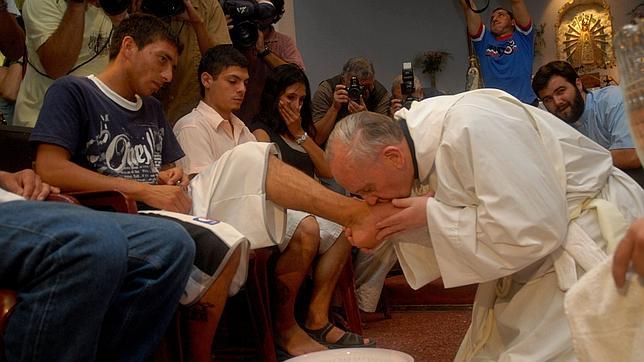
Cardinal Bergoglio, now Pope Francis, washes & kisses the feet of residents of a shelter for drug users, Maundy Thursday, 2008
.
It’s an extraordinary day, today, for myself as it happens, and more significantly for the world. Specifically, it is significant for poor and powerful alike, for it sets them in a proper relation to one another.
Today is Maundy Thursday, the day on which Christ’s Last Supper, which became and remains the prototype of the Catholic Mass, is remembered. His Last Supper would be closely followed by his crucifixion the next day, Good Friday, and resurrection on Easter Sunday.
After that final supper, Christ made a gesture which initially disturbed his close followers — he washed their feet, then instructed them to do the same.
His gesture repeats itself to this day.
**
Pope Francis, who as an archbishop had followed this practice by washing and kissing the feet of young people in drug shelters (image above) and AIDS clinics, is breaking with Vatican tradition — the pope washing the feet of priests in some major basilica in Rome — this year, by going to a youth prison today for the ceremony:
The Mass of the Lord’s Supper that Pope Francis will celebrate on Holy Thursday in the chapel of the Casal del Marmo Penitential Institute for Minors will be, by his express desire, very simple. Concelebrating with the Holy Father will be Cardinal Agostino Vallini, vicar general of the Diocese of Rome, and Fr. Gaetano Greco, chaplain of the Institute.
Around 10 girls and 40 boys will take part in the Mass. The Pope will wash the feet of 12 of them, who will be chosen from different nationalities and diverse religious confessions. The youth will also say the readings and the prayers of the faithful. Given the intimate nature of the pastoral visit, journalists will be restricted to the area outside the building and no live coverage will be transmitted.
That’s a slightly formal Vatican announcement of the occasion: “diverse religious confessions” in this case almost certainly includes Muslims and atheists or agnostics. Father Greco, the prison chaplain, is quoted as saying:
Only eight of our residents are Italian: six boys and two girls … The others are all foreigners. And most of them are Muslim. Then there are some who have no religious belief at all. Therefore many of them don’t even know who the Pope is. For this reason too, it was far from easy to explain to them the importance of the Pope’s visit.
A young Neapolitan who has been here for a while came to my help. He gathered them all together, to try to make them understand above all what the Pope’s act, which is an act of love for them, actually meant. I was upset for a moment by the first looks, that were either blank or only faintly curious about my enthusiasm. Then our friend broke the silence with that most classic of Neapolitan expressions: “Maronna mia, o Papa accà!” [good heavens! The Pope here!] and he ran his hand through his hair, his face betraying emotions mingled with happiness. At that very instant all the others, seeing his amazement, realized that it must really be something very special and began to question me. Little by little, I saw their enthusiasm growing.
Father Greco said of his young charges that the Pope’s visit “will make them see that their lives are not bound by a mistake, that forgiveness exists and that they can begin to build their lives again.”
**
This symbolic gesture, this washing of the feet, does indeed have enormous imaginative power, if we will allow it, to touch the heart and transform our behavior.
I’ve quoted this before, I know: it’s the account given by the man I know who, more than any other, prayed, lived, worked, and saw his great dream and hope accomplished in his lifetime — the overturning of the apartheid regime in S. Africa. For myself, it’s the heart of what he taught me: here, in his own words, Fr Trevor Huddleston CR describes how his own role in that drama began:
On Maundy Thursday, in the Liturgy of the Catholic Church, when the Mass of the day is ended, the priest takes a towel and girds himself with it; he takes a basin in his hands, and kneeling in front of those who have been chosen, he washes their feet and wipes them, kissing them also one by one. So he takes, momentarily, the place of his Master. The centuries are swept away, the Upper Room in the stillness of the night is all around him: “If I, your Lord and Master, have washed your feet, ye ought also to wash one another’s feet.” I have knelt in the sanctuary of our lovely church in Rosettenville and washed the feet of African students, stooping to kiss them. In this also I have known the meaning of identification. The difficulty is to carry the truth out into Johannesberg, into South Africa, into the world.
**
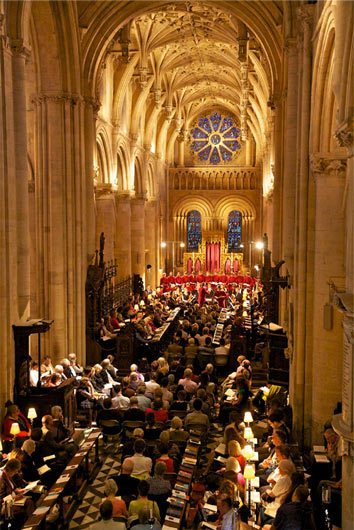
Earlier today, Queen Elizabeth II will have celebrated “the Royal Maundy” in the chapel of my old College and that of my mentor, Trevor Huddleston, at Oxford, Christ Church — our college chapel is also the cathedral of that great city.
The current Dean Of Christ Church, the Very Reverend Christopher Lewis, gave the BBC this historical detail:
The last time it happened here was in 1644 when Charles I was thrown out of London and welcomed in Oxford.
Here’s the glorious building where the ceremony will have taken place:
**
The Royal Maundy is celebrated by the monarch giving two purses to local pensioners — 83 men and 83 women this year since HM is 83 years old — a white purse containing sterling silver 1p, 2p, 3p and 4p pieces, and a red purse contained a £5 and a 50p coin commemorating the 60th anniversary of the Queen’s coronation in 1953.
Maundy Thursday commemorates the day of the Last Supper of Jesus Christ with the Apostles. The word ‘Maundy’ comes from the command or ‘mandatum’ by Christ at the Last Supper, to love one another.
The tradition of the Sovereign giving money to the poor dates from the thirteenth century. The Sovereign also used to give food and clothing, and even washed the recipients’ feet. The last monarch to do so was James II.
It’s a curious survival, the Royal Maundy, but a touching one, looking back to the days when the monarch really was expected to be a bit like a priest for the nation – acting out the great symbols of faith on behalf of everyone. …
And that’s very much what the Royal Maundy is about. What we see today is only a shadow of what used to be done hundreds of years ago, when the monarch would actually do what Jesus did at the Last Supper and wash the feet of a number of poor people. Back in the Middle Ages, this meant that the King was just doing what priests and bishops often did, not only on Maundy Thursday but on many other occasions.
They didn’t all do it because they were lovely humble people – some were, and some definitely weren’t – but because they accepted one great truth that needed repeating over and over again, the one big thing that Christianity had brought into the world of human imagination.
And that was – and is – the truth that power constantly needs to be reminded of what it’s for. Power exists, in the Church or the state or anywhere else, so that ordinary people may be treasured and looked after, especially those who don’t have the resources to look after themselves. The Bible is crystal clear that this is the standard by which the gospel of Jesus judges the powerful of this world.
Power exists, in the Church or the state or anywhere else, so that ordinary people may be treasured and looked after, especially those who don’t have the resources to look after themselves.
**
Here is the text from St John’s gospel — the gospel that focuses its attention at the symbolic level — describing the original event [John 13.1-15]:
He riseth from supper, and laid aside his garments; and took a towel, and girded himself. After that he poureth water into a bason, and began to wash the disciples’ feet, and to wipe them with the towel wherewith he was girded.
Then cometh he to Simon Peter: and Peter saith unto him, Lord, dost thou wash my feet?
Jesus answered and said unto him, What I do thou knowest not now; but thou shalt know hereafter.
Peter saith unto him, Thou shalt never wash my feet.
Jesus answered him, If I wash thee not, thou hast no part with me.
Simon Peter saith unto him, Lord, not my feet only, but also my hands and my head.
Jesus saith to him, He that is washed needeth not save to wash his feet, but is clean every whit: and ye are clean, but not all. For he knew who should betray him; therefore said he, Ye are not all clean.
So after he had washed their feet, and had taken his garments, and was set down again, he said unto them, Know ye what I have done to you? Ye call me Master and Lord: and ye say well; for so I am. If I then, your Lord and Master, have washed your feet; ye also ought to wash one another’s feet. For I have given you an example, that ye should do as I have done to you.
**
Here finally, for sheer beauty, is the great 16th century Spanish composer Tomás Luis de Victoria‘s First Lamentation for Maundy Thursday, sung by the Tallis Scholars in the chapel of Merton College, Oxford — just around the corner from Christ Church:
Zenpundit is a blog dedicated to exploring the intersections of foreign policy, history, military theory, national security,strategic thinking, futurism, cognition and a number of other esoteric pursuits.