zenpundit.com » britain

Archive for the ‘britain’ Category

The Freeland motif

Tuesday, December 11th, 2012

[ by Charles Cameron — how those first seen as liberators may later be seen as oppressors ]
.

Sir Ian Freeland

Lt-Gen Sir Ian Freeland, GBE KCB DSO

I was reading up on Ian Freeland, the husband of my mother’s first cousin and lifelong best friend, in search of some details on his role in The Troubles in Northern Ireland, and ran across his comment on liberators who become oppressors, which rang a bell or two. That was a couple of days ago, and I found the same basic pattern mentioned in a post today on Gulf News:

FWIW, Ian Freeland’s previous experiences would have been with the Mau Mau in Kenya and in Cyprus during the Makarios days.

**

So the purpose of this post would be to raise the question: how far back can we trace this observation, and what are the memorable examples (a) of people saying it, and (b) of events bearing it out?

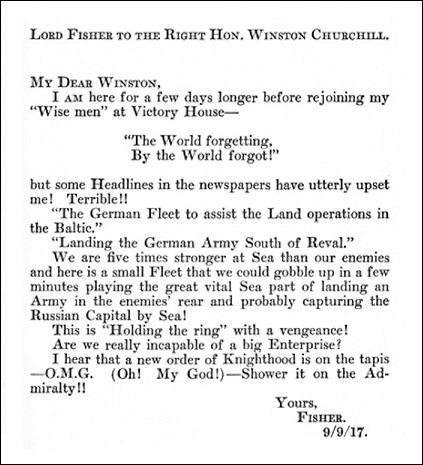
OMG! — Fisher to Churchill, 1917

Thursday, November 29th, 2012

[ by Charles Cameron — for your general amusement ]
.

Is OMG something to write after your name on your official correspondence — one of the orders of British knighthood, perhaps?

**

**

Hat-tip: Smithsonian, via Jeff Gates.

The Church of England stress-tested

Sunday, November 25th, 2012

[ by Charles Cameron — of integrity and flexibility in that most curious chameleon of a religious institution, the Church of England, of which I am still fond at a distance ]
.

.

The Church of England is run, if that’s the word, by the three houses of its General Synod, and just this week the the House of Bishops and the House of Clergy voted to approve the ordination of women bishops, while the House of Laity voted against the idea — and since all three houses have a veto, carried the day.

Be it noted that there are in fact women priests in the Church of England, and women bishops in other parts of the Anglican Communion of which the Church of England is the mother province.

In the Church of England, however, a woman is still barred from being ordained a bishop.

**

There’s a Church of England blogger I follow to catch the more conservative slant on things — he calls himself Archbishop Cranmer after a celebrated Anglican divine — and in a recent post titled Church of England remains a bit more Catholic, His Grace remarked:

The Church of England is historical and so mortal. It is a creature of continual creation; of adaptability in religio-political fluidity. It opposes immutability in theological expression, recognising that mobility is intrinsic to mortality: as believers are continually converted to God, there must be continual conversion to the nature of the Church, and those confessional bodies must be mutable, for none possesses exclusive ownership of the identity of Christ.

The Church of England was never designed to be Protestant, though it has elements of that movement within it. And it was certainly not Roman Catholic, though it drew on the strengths of that denomination to manifest the Church in a visible society. Its struggle has ever been how to permit freedom of the Spirit within ancient structures: how to put new wine into old wineskins.

This is why the Archbishop of York is right when he says there will be women bishops, because Anglicanism is a communion, and in that koinonia is toleration of mutual exclusives.

That’s an interesting formulation: toleration of mutual exclusives.

Cranmer winds up that particular post with the words:

You may hear talk of splits and schisms, but these are nothing more than the spats of human mortality. For as long as we can examine what sort of church we are and question our core principles and values, there will be discussion, debate, tears and joy. The moment we cease to disagree and hurt each other is the moment the church ceases to be church.

And that too is interesting — especially in view of St Paul‘s exhortation in Philippians 2:2:

Fulfil ye my joy, that ye be likeminded, having the same love, being of one accord, of one mind.

**

I believe Cranmer is right, and that the Church of England was indeed intended to house a variety of views, some of them tending Catholic, some tending Protestant.

But what I find most interesting here is his sense that the church quite properly opposes immutability in theological expression, recognising that mobility is intrinsic to mortality — because here we are coming very close to Christ‘s identification —

I am the way, the truth, and the life…

read in the light of Lao Tse‘s dictum —

The way that can be put into words isn’t the true Way.

**

And remembering always that CS Lewis once asked:

Is not the Tao the Word Himself, considered from a particular point of view?

and that Fr. Thomas Merton quotes with approval Dr Wu‘s “well-known Chinese translation of the New Testament” in which the Prologue to St John’s Gospel begins:

In the beginning was the Tao.

**

One other point.

A day or two after the vote in General Synod, His Grace posted an extensive excerpt from the parliamentary questions raised for Sir Tony Baldry MP to respond to, as Second Church Estates Commissioner. One such question was raised by Mrs Eleanor Laing (Epping Forest) (Con): ‘

Does he agree that when the decision-making body of the established Church deliberately sets itself against the general principles of the society that it represents, its position as the established Church must be called into question?

To my minds, that’s an extraordinary question, and in the comments section of His Grace’s blog, one D. Singh said:

Your Grace

It is written: ‘Do not be conformed to this world, but be transformed by the renewal of your mind, that by testing you may discern what is the will of God, what is good and acceptable and perfect.’

Romans 12:2

One would have thought that after the death of Dietrich Bonhoeffer at the hands of the Nazis for his unwillingness to go along with “decision-making body of the established Church” — in his case, the Lutheran Church in Germany at the time — a little more thought might need to be given before such a question was raised…

**

Oh, and somewhat amusingly, if you are inclined to be amused at such things — when Sir Tony Baldry addressed the House of Commons on the topic of women bishops — an idea whose time he clearly believed was long overdue — he was wearing the tie of London’s distinguished Garrick Club.

A private club close to London’s theatrical district, where:

‘actors and men of refinement and education might meet on equal terms’, where ‘patrons of the drama and its professors were to be brought together’, and where ‘easy intercourse was to be promoted between artists and patrons’…

Oh, and which to this day does not admit women as members.

Cross-grain thinking, 3: ASP’s Report on Climate Security

Wednesday, November 21st, 2012

[ by Charles Cameron — as Dylan sang, a change in the weather is known to be extreme ]
.

People sit at a flooded table in Piazza San Marco, Venice -- photo: Luigi Costantini / AP

.
Right at the top of Part I of the recent three-part Report on Climate Security from the American Security Project, we read this paragraph:

Climate change is real: we see its impacts every day, around the world. A melting Arctic, unprecedented droughts across the world, extreme examples of flooding, and uncontrollable wildfires are all examples of the changing climate.

That’s right, that’s right and important, that’s right, important and timely.

But you know, at heart I’m a poet. And although I’m concerned about the issues the report addresses, I can’t help thinking of climate and weather, atmosphere and wind, in a manner that crisscrosses the “interior” vs “exterior” divide.

If you lean to the scientific more than the poetic, you might want to consider what I’m talking about as an instatiation of the insight Gregory Bateson expressed in the title of his seminal book, Mind and Nature: A Necessary Unity.

**

Let me lean to the poetry-side for a paragraph or so, then we’ll come back to security issues the report raises.

I probably caught this particular “weather and weather” disease from Dylan Thomas’ great and celebrated poem, A Process in the Weather of the Heart:

A process in the weather of the heart
Turns damp to dry; the golden shot
Storms in the freezing tomb.
A weather in the quarter of the veins
Turns night to day; blood in their suns
Lights up the living worm.

Writing about this poem in his Reader’s Guide to Dylan Thomas, William York Tindall notes “Thomas’ obsessive concern with the natural process that, linking man and world, inner and outer, turns upon the axis of life and death” and specifies that “applying ‘weather,’ a word for outer climate, to inner climate joins two worlds.”

Thomas is concerned in that extraordinary poem to join, likewise, life with death, night with day, womb with tomb, seeing eye with blind bone and more – or not so much to join them as to see them as inseparable, as parts of the single unfolding that is the world.

There is much more to the poem than the central obsessive theme of the “process in the weather of the heart” with which the poem opens and the “process in the weather of the world” with which it closes. It is their conjunction, their inseparability which interests me here – the poet’s perception that there is no inner without the outer, no outer without the inner – that in each there is weather, which Tyndall also calls climate, that weather is in both…

**

Back to meteorology and national security..

Look, I’m not exactly an enemy of thinking about climate change and national — or global — security. I admire ASP for today’s piece by Catherine Foley, Climate Change: The Missing Link in Tackling the Mali Crisis. We need more considerations of that kind, they’re rare and extremely valuable.

Mecca is one of the hottest cities in the world, and the Kaaba the central pivot around which all Islam revolves — potentially a double hot-spot. What are the implications of climate change for the Saudis, for Mecca, for Islam?

**

When I think about weather, I think about storms in the world, storms in the heart and mind, almost in the same breath. Specifically, when I think of global warming, I can’t help but see the problem as being one of double-awareness – rising temperatures and rising tempers, rising sea-levels and rising levels of anxiety and / or denial, the climate of meteorology and the climate of opinion…

Seen from my bifocal perspective, the report is notably focused on externals. Take another sentence from the brief bullet points on the first page;

The climate influences people’s everyday lives, from what they eat to where they live.

We eat food, food that can be weighed and measured, and analyzed for its nutrient elements and health properties. We live in cities, towns and villages, in houses, or developments, which can located on maps…

With my bifocals on, it would be more accurate, more encompassing to say:

The climate influences people’s everyday lives, from what they eat to how they feel, and from where they live to what they think and how they behave.

Because in my view, the situation is as much about “mind change” as it is “climate change” — in my view, the “fulcrum that can move the world” is to be found in the geography of mind and heart.

**

Okay, let’s back up a bit.

The “first page” I quoted is the first page of the First Part of the Report, but there’s also an Introduction, and I want to pick up the thread there now, because the Introduction is written with human thought — specifically “honest dialogue” — in mind, and opens with what seems at first glance like one of those obvious truths that serve as the jumping off points for more detailed considerations:

The American Security Project is organized around the belief that honest, public discussion of national security requires open, non-biased, non-partisan discourse about the dangers and opportunities of the 21st Century.

There’s just one problem here, though — a single paragraph later, we read:

Climate change poses a clear and present danger to the United States

I’d give my assent happily enough to either of these two propositions, if they weren’t both talking about the same situation. Because when someone sees a “clear and present” hungry tiger coming at them and doesn’t take rapid action to avoid being eaten, it’s not “open” and “unbiased” — it’s “in denial”.

Which in turn means there’s a swathe of the population that may not be willing to hear “open, non-biased, non-partisan discourse” nor able to contribute to it. “I don’t believe my eyes, they’re deceiving me with all this hogwash about tigers”…

And those people have loved ones, bring foods to community pot-lucks, and teach class, and vote…

**

Some time ago, I was working on a transposition of the Gospel narratives of Luke and John into the Troubles in Northern Ireland, with Britain playing the part of Rome and so forth, and adding some commentary along the way. Here’s a slightly revised version of my comment on John 3.8:

There is one particular word that John uses which has what we today might call a triple (rather than a double) meaning. When Christ in this verse says, “The wind bloweth where it listeth, and thou hearest the sound thereof, but canst not tell whence it cometh, and whither it goeth: so is every one that is born of Spirit,” it is the Greek word pneuma that can be translated both as wind and spirit. It also means breath.

Christ is saying here that those who are born of spirit are like the wind, like breath, and like inspiration: each of which can be noticed but not predicted, because each moves of its own accord — yet in the Greek these are not three separate concepts as they are for us today. As CS Lewis says in another context, we must always remember “that the various senses we take out of an ancient word by analysis existed in it as a unity.”

In telling us this, St John is saying at one and the same time that nobody knows where the first breath comes from or when the last breath will leave us, nobody knows how to forecast exactly which path a hurricane will take, and nobody knows how to make an assembly line for inspiration – if we did, Beethoven could have written another three symphonies as great as his Ninth to order, stat!

One of the reasons we don’t know how the heart and mind work is that we’ve separated “meteorological” weather from “the weather of the heart” — and there’s a storm brewing, inextricably, on both fronts.

If the ASP report is anything to judge by, we’re only looking at one of them.

**

Oh, and here by way of confirmation is an old friend from my Oxford days, the late Chogyam Trungpa Rinpoche, quoted in a piece for the November issue of Shambhala Sun:

No matter where we are in the world, there is a need for enlightened society, wherever natural disasters hit. In this case, “natural disaster” refers to aggression, passion, and ignorance. These kinds of natural disasters occur in the minds of people.

Trungpa’s sense of “natural disaster”, I humbly submit to the folks at the American Security Project, either needs to run like a woof through the warp of their report on climate change — which it doesn’t — or it deserves a fourth section of its own.

Reading a partisan cartoon: the parable of a dog’s ears and teeth

Friday, November 16th, 2012

[ by Charles Cameron — on the difficulties that may be posed when “reading” graphics ]
.

**

The question I want to ask in this post is: how much can you safely read into a political cartoon?

Here is the particular cartoon I have in mind:

It was published in The Guardian (UK) yesterday, and as you may be able to see, it portrays Israeli PM Benjamin Netanyahu as a puppet-master, with British politicians Tony Blair and William Hague as his puppets, and was published to illustrate the cartoonist’s view of British reaction to the Gaza situation.

How much can we read into it?

**

If you are used to seeing cartoons such as these —

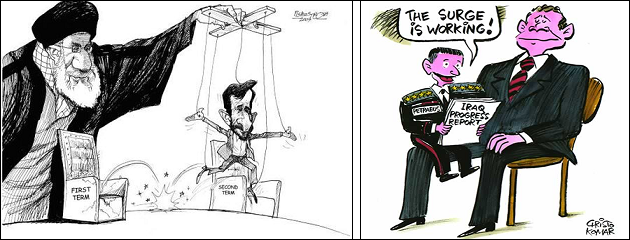
showing Khamenei pulling Ahmadinejad‘s strings and Petraeus as a puppet of GW Bush, when you come across the Netanyahu cartoon in the Guardian, you may well view it as another in a long series of political cartoons suggesting that someone is running someone else’s show behind the scenes. It’s the old idea of the eminence grise, in other words, expressed in cartoon form.

**

If, on the other hand, you’ve been exposed way too often to cartoons like these —

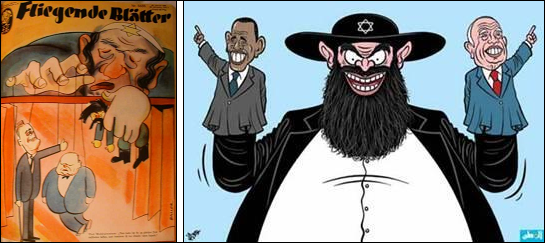
the one portraying Churchill, FDR and Stalin as Jewish puppets, taken from a 1942 issue of the Nazi paper, Fliegende Blätter, or the one depicting McCain and Obama as Israeli puppets, taken from a 2008 issue of the Saudi paper, Al-Watan… you may well see the same cartoon in a very different — and distinctly antisemitic — light.

**

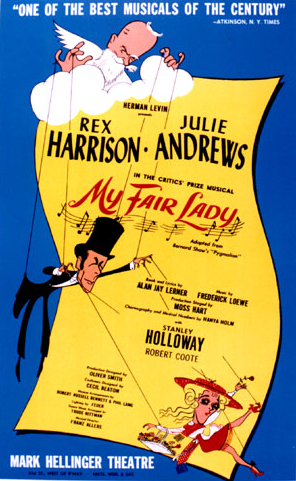
The last two graphics, at least, are extremely offensive, and I would like to offer another graphic here — one which also uses our “puppet master” theme — as a visual equivalent of offering a glass of water to cleanse the palate:

I’ll be addressing this My Fair Lady poster from a very different angle, in a later post in my “form is insight” series — this one on “dolls within dolls”, the “world stage which we have dotted with stages of our own devising” and “turtles all the way down”…

**

Having hopefully reduced the emotional freight which some of the cartoons above must surely have carried with them, I would now like to offer you some background which seems relevant to me. Characteristically, perhaps, it comes from a very different field of knowledge.

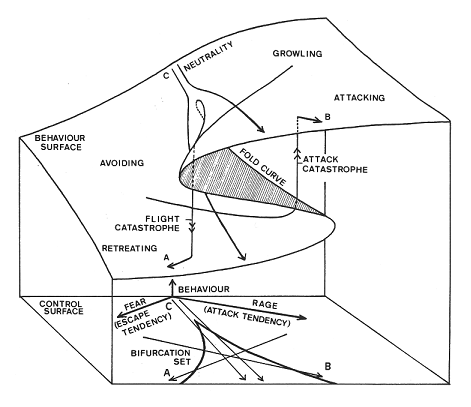
EC Zeeman‘s April 1976 article Catastrophe Theory in the Scientific American was my introduction to the mathematician Rene Thom’s remarkable body of work, an introduction which sailed mostly over my head — but one of Zeeman’s points, which he illustrated with the graphic below, made perfect sense to me.

The annotation to this illustration read in part:

If an angry dog is made more fearful, its mood follow* the trajectory ‘A’ on the control surface. The corresponding path on the behaviour surface moves to the left on the top sheet until it reaches the fold curve; the top sheet then vanishes, and the path must jump abruptly to the bottom sheet. Thus the dog abandons its attack and suddenly flees. Similarly, a frightened dog that is angered followes the trajectory ‘B’. The dog remains on the bottom sheet until that sheet disappears, then as it jumps to the top sheet it stops cowering and suddenly attacks.

My translation:

A dog that reaches the point where its ears are fully pinned back, indicating full-on fear, and its teeth are also fully bared, indicating full on rage, will behave differently depending on whether its fear level or its rage level was the first to be raised to “full”.

Just as a dog’s reaction to a full on mix of rage and fear may depend on which stimulus came first, so — I am suggesting — our own reaction to the cartoon in question — inherently antisemitic, or merely critical of a particular Israeli operation — may depend on our previous exposure to cartoons, politics, the Israeli-Palestinian conflict, or antisemitism.

**

We now have several levels of ease or difficulty in reading graphics. The Zeeman graphics are hard to read because they’re too small to be legible — but put them in the context of Zeeman’s article, and view them full size as originally published, and the only problem might be in following Zeeman’s text, itself a popularization and simplification of Rene Thom‘s work.

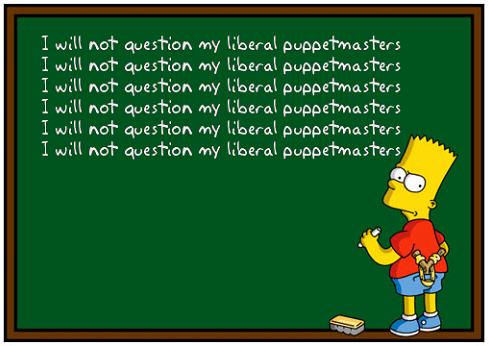
The Bart Simpson graphic is fairly straight forward, and regular viewers of the show would “read” it in line with hundreds of similar frames in which Bart writes repeated lines on a classroom chalkboard, from Season 1 episode 2’s “I will not waste chalk” to Season 23’s “There’s no proven link between raisins and boogers”.

And then there’s the disputed Netanyahu graphic… which can be “read” differently, depending on what previous “puppet master” associations the viewer beings to the task. Here, it seems to me, the task of interpretation can be viewed in one of two ways: (i) as an exploration of how it is likely to be read, which I’m suggesting will depend on previous association, and (ii) as an exploration of what “must have been” in the cartoonist’s heart.

**

Assessing the cartoon’s probable impact on segments of the public is one thing — knowing what the cartoonist intended, even though we tend to conflate the two, is quite another. Not for nothing does St Paul in I Corinthians 2.11 ask (in my own translation)

Who knows the qualities of a man but the spirit of that man within him?


Switch to our mobile site