zenpundit.com » britain

Archive for the ‘britain’ Category

The symmetry: Charlie Hebdo

Saturday, September 22nd, 2012

[ by Charles Cameron — my apologies for an earlier incomplete draft, quickly withdrawn — first of two, on loose cannonry and mirror imagery — second will deal with recent events in Benghazi ]
.


.

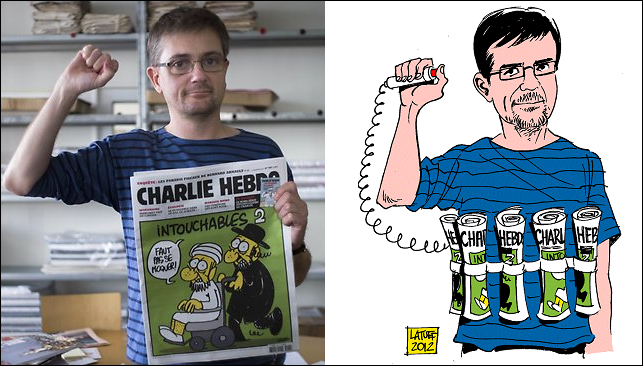
Charlie Hebdo recently published some cartoons featuring the prophet…

Okay, I’m always on about symmetry.

I posted a piece titled Messianic symmetries on ZP a while back, noting that both Ahmadinejad and Netanyahu can be viewed as exercising “leadership that makes decisions out of messianic feelings” — the quote comes from an unimpressed ex-Shin Beth director describing Bibi; Ahmadinejad makes the case for his own Mahdist leabings quite well himself.

Symmetry seems like an important analytic category to me, either because it’s there in the build of the world, or because it’s there in the build of the mind. Either way, I think we should take careful notice of symmetries.

Asymmetries I’ll talk about in my next post.

**

What about the cartoon above, right? It’s clearly based on the photo above, left, which shows Stéphane Charbonnier, the editor of Charlie Hebdo, holding his magazine with its offensive cartoons / vindication of free speech. And the suggestion is clear that he’s some kind of suicide bomber.

But who is he blowing up, exactly? Himself, and perhaps his staff and anyone else who happens to be within a few yards of his office at the time? France, Europe, the western world — the world itself? And how much irony should we read into the cartoon portrait?

They may have learned the technique from the Tamil Tigers, but these days, in the immediate wake of widespread rioting over the video clip and in the context of someone publishing cartoons that satirize the prophet, it’s clearly Islamist suicide bombers who provide the model for the cartoon of the cartoonist above.

Tit for tat? An eye for an eye? You’re just setting yourself up for a fatwa like Salman Rushdie?

**

Incendiary rhetoric on one side leads to incendiary behavior on the other, validating the incendiary rhetoric and making the escalation to incendiary behavior all the more probable.

Some of the incendiary rhetoric has its origin in holy books, which also preach peace.

There are Coptic Christians utterly blindsided by the virulence of the video, attributed to one of their number. There are Libyan Muslims utterly blindsided by the virulence of the attack on the US Embassy, attributed to some of their own.

**

I want to focus not on the specifics of the topic, but on the symmetry.

One writer, observing the partition of India and Pakistan, wrote:

The rioters brought the train to a stop. Those who belonged to the other religion were methodically picked out and slaughtered. After it was all over, those who remained were treated to a feast of milk, custard pies and fresh fruit.

Before the train moved off, the leader of the assassins made a small farewell speech: “Dear brothers and sisters, since we were not sure about the time of your train’s arrival, regretfully we were not able to offer you anything better than this most modest hospitality. We would have liked to have done more.”

Commenting on this paragraph, Ali Sethi wrote recently in the New Yorker:

That is all there is: murder—methodical and quick—followed by a feast and an ingratiating speech. Note the withholding of tags: we don’t know the location of the massacre or the religion of the killers. All we have is a spurt of base instincts.

The point here is that whenever you see a symmetry of opposites, it’s worth considering that symmetry in the abstract, as well as weighing the particular issues that drive your own side or the other.

That, I’d suggest, is one of the implications of that Paul van Riper remark I’m fond of quoting:

What we tend to do is look toward the enemy. We’re only looking one way: from us to them. But the good commanders take two other views. They mentally move forward and look back to themselves. They look from the enemy back to the friendly, and they try to imagine how the enemy might attack them. The third is to get a bird’s-eye view, a top-down view, where you take the whole scene in. The amateur looks one way; the professional looks at least three different ways.

**

I am concerned about hatred, simmering here, boiling over there. I am concerned about what sparks hatred, and what fans it. What I want to draw your attention to here, though, is the process by which one hatred fuels abother, the process of mirror imaging.

Mark Juergensmeyer, a terrific scholar of religion who has published on topics ranging from Gandhi‘s nonviolence to the violence of religionists who consider themselves sanctioned by the scriptures of various religions, makes the point in a recent Religion Dispatches post thus:

The US-based Islamophobes behind the insulting and amateurish video “The Innocence of Muslims,” and those behind the violent protests it allegedly caused around the Muslim world, are kindred hatemongers. Both are extremists with a political agenda, and both want to use this incident to discredit the legitimacy of the moderate governments in power in their respective countries. There is a symbiotic relationship between the strident protesters and the bigoted filmmakers; each needs the other.

We are in a hall of incendiary mirrors, with plenty of kindling: in my view, we should avoid playing with matches.

**

Thank God, there are also asymmetries.

In a companion post, I’ll take a look at recent, very promising events in Benghazi (h/t to Pundita for a pointer to this particular article), the not particularly unsurprising but unwelcome attitude of a Pakistani minister, and the imbalances that go along with the dangerous balances I’ve discussed in this post.

**

Oh, and let me digress…

I won the Divinity essay prize back in my schooldays at Wellington College, and received my chosen prize book, the Liber Usualis with its glorious collection of Gregorian Chants, from the then Minister of Defence, John Profumo, MP. Not long thereafter, it was discovered that he pillow talked with one Christine Keeler, a night lady of class, who also pillow talked with the Russian defence attaché. And the story was broken, week by glorious week, by the British satirical magazine, Private Eye.

Which I consequently have an affection for, after all these years. And I tell you this, because Charlie Hebdo, or Weekly Chuck as we might call it over here is, I’d suggest, a plausible latter-day French rough equivalent of Private Eye.

I don’t really like our guys posting inflammatory materials, you see, but I also have an affection for freedom of speech — and for magazines with a satirical bite, too…

So sue me, I contain multitudes.

Three dreams: the Saudi King’s, Dr. King’s and Rodney King’s

Saturday, September 1st, 2012

[ by Charles Cameron — a pub in Wiltshire, Abu Aardvark, monarchical survival in the Middle East, Kanye West, C Peter Wagner, spiritual warfare, diabolic possession, Amaterasu ]

.

Three Crowns, Brinkworth
image hommage: The endless British pub crawl

.

It looks to me as though Abu Aardvark aka Marc Lynch — associate professor of political science and international affairs at George Washington University and one of the prime go-to blogger on matters Middle Eastern — first mentioned monarchy on his FP blog in December of last year, writing:

Finally, there’s a widespread sense that the Gulf monarchies have proven more resilient than their non-monarchical Arab counterparts. The wealthy Gulf states seem relatively immune to the popular mobilizations which have challenged most of the other regimes in the region. Advocates of the Gulf exceptionalism stance point to small citizen populations, huge government employment and patronage opportunities, and monarchical legitimacy as buffers against popular outrage.

In June of this year, he picked up the thread, saying:

Explaining this variation in regime survival and which strategies and structures proved more effective in the face of popular challenge will likely be a major preoccupation of the field in the coming years.

One common answer has been particularly contentious among academics: monarchy. Is there a monarchical exception, or some reason to believe that monarchies are more resilient in the face of popular grievances? For some, the answer is obvious: none of the fallen regimes were monarchies, while non-monarchies have struggled or fallen at historic rates. As Michael Herb argues,“the regimes most seriously affected by the Arab Spring were not monarchies, with the exception of Bahrain.” But others are far more skeptical that monarchy makes the difference. After all, Gulf monarchies such as Bahrain, Kuwait, and Oman all experienced significant mobilization, as did non-oil monarchies such as Jordan and Morocco, which gives lie to any sense of their greater innate legitimacy. Other factors such as oil wealth, ethnic polarization or external support may be more important than monarchy as such. The significance of monarchy in regime stability should be a vibrant debate in academic journals in the coming years.

And then yesterday his entire post was titled Does Arab monarchy matter?, in which he says:

The advantages of monarchy have taken on the feel of “common sense” among the public and in academic debates. But I remain highly skeptical about the more ambitious arguments for a monarchical exception. Access to vast wealth and useful international allies seems a more plausible explanation for the resilience of most of the Arab monarchies.

and throws in for good measure a delightful reworking of a line from (apparently) Kanye West:

To paraphrase one of our great living philosopher kings, the Arab monarchies may be forced to choose among three dreams: the Saudi King’s, Dr. King’s and Rodney King’s.

**

I do want to suggest to Abu Aardvark that ideas like the divine right of kings [link is to James I] never quite fade away, that there is a deep thirst for the mandate of heaven [Shu Jing], that there may in short be a quasi-sacramental force to the issue.

I don’t think that this guarantees the continuation of monarchical lineages, in the Middle East, the UK, China or elsewhere — but it may favor them, other things being equal.

**

But okay. I said some months back that I hoped to tackle the issue of monarchism in a post at some point, and I’m still eager to disagree with the Christian evangelist C Peter Wagner, who can be seen on YouTube saying:

There is a spirit called a Harlot, a principality, who dominates nations, who dominates territories, who dominates people groups very, very clearly to such an extent that she has fornication with kings. And I can give you an example of how she does this: Japan, as a nation, is one of the nation’s of the world which has consciously, openly invited national demonization.

The Sun Goddess visits him in person and has sexual intercourse with the Emperor. It’s a very, very powerful thing. So the Emperor becomes one flesh with the Sun Goddess and that’s an invitation for the Sun Goddess to continue to demonize the whole nation.

Since the night that the present emperor slept with the Sun Goddess, the stock market in Japan has gone down. It’s never come up since.

I’m serious about this. I’ve been out and bought myself a copy of DC Holtom‘s The Japanese Enthronement Ceremonies — Sophia ed, 1972, what a gorgeous book! — and downloaded a number of learned papers on the topic by Felicia Bock, Carmen Blacker, and Adrian Mayer. Japanese court ceremonial is not exactly an easy study — but time permitting, I should be able to bring you something a little more subtle than Wagner’s demponically-challenged interpretation one of these days.

Pussy Riot, Holy Foolishness and Monk Punk

Sunday, August 19th, 2012

[ by Charles Cameron — mystery beyond the senses, holy of holies behind the veil, altar beyond the iconostasis, and other considerations bearing on Orthodoxy, Pussy Riot, holy folly and monastic punk ]
.

Life is full of surprises.
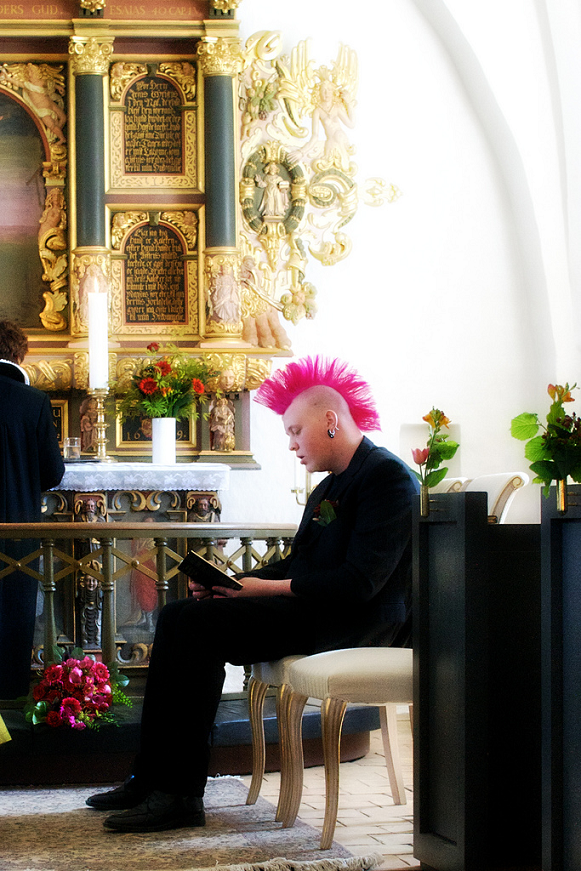
glorious photo credit: choir punk by teosartori under cc license

.

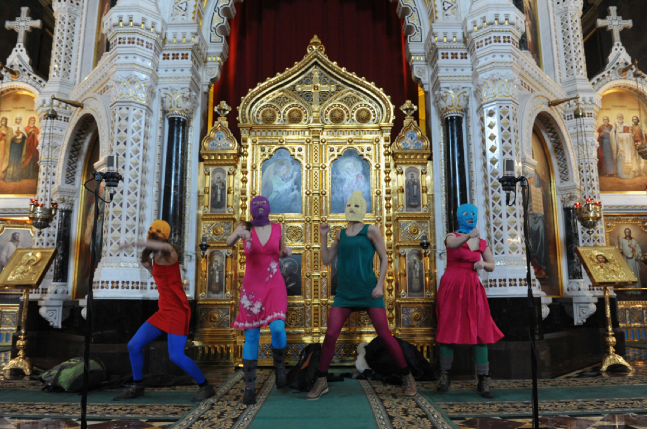
Okay, I started fishing around the web the way I do because when I first ran across the Pussy Riot story, I kept seeing press reports that said the grrls had been protesting on the altar of Christ the Savior Cathedral [Russian Orthodox] in Moscow.

**

What surprised me about this was that the altar in an Orthodox church would be behind the closed doors of the Iconostasis, because what takes place on the altar is too mysterious for us to grasp through the unaided senses.

Aside: there’s a lot of religious “clash of civs” going on in the Pussy Riot affait, so let me untangle some of the interesting threads, and then see where that leads us.

You may recall that when Christ died on the cross outside the City walls, there was a parallel incident inside Jerusalem: “the veil of the temple was rent in twain from the top to the bottom; and the earth did quake, and the rocks rent” [Matt 27.51]. This could, it seems to me, be an involuntary gesture of mourning on the part of the earth and temple — but it also opens the holy of holies..

In very broad strokes then, there are three spaces in Orthodoxy, separated by two doors, and they correspond to three ways of knowing.

    • Outside the church, there’s the realm where the senses and rational mind can be pretty much relied on for the kinds of transactions that humans mostly engage in, food, drink, shelter, exchange of goods…
    • Passing in through the church door we are in a space of devotion, the nave, in which attention is focused on the second doorway, that of the iconostasis, where the icons are presented. Here the mental activity is typically one of prayer, and the icons are available to lead the senses and mind towards that which the mind cannot comprehend.

.
.

  • And passing, as only the ordained may, through the doors of the iconostasis into the Sanctuary, we enter the space of the altar and the sacramental transformation of the Eucharist — which neither rational mind nor senses can apprehend, and which is accordingly the realm of Mystery properly defined.

The Pussy Riot grrls are clearly dancing (and singing and prostrating and crossing themselves in the video) in front of the doors of the iconostasis — not “on the altar” — a big difference, which I would suggest is comparable in kind to the difference between human prayer and divine revelation.

No, they were not “staging an anti-Kremlin protest on the altar of Moscow’s main cathedral” [Telegraph], nor “performing what they called a ‘punk prayer’ on the altar of Moscow’s Christ the Savior Cathedral” [ABC News].

**

By way of giving you some context, Eurasia Review has the religious politics:

The actions of Pussy Riot inspired indignation on the part of Church leaders and regime officials. Patriarch Kirill called their action a “mockery of a sacred place.” Sergei Lavrov, the Russian foreign minister, said it was “blasphemy.” The women were described as “satanic devils” and “prostitutes” and there were calls for them to be ripped to pieces on the ancient execution site in Red Square.

What was lost in all this was the identification of the Russian Orthodox Church with the Putin regime. Putin’s inauguration was marked by the ringing of church bells in the Kremlin. Kirill held a special prayer service for his “health” and “success in government,” in the Cathedral of the Assumption in the Kremlin. In the Novodevichy Monastery, the nuns sang psalms round the clock for Putin’s health.

And then there was that 2009 London Times article:

The Russian Orthodox Church will choose tomorrow between three alleged former KGB agents as its next spiritual leader.

More than 700 priests, monks and lay representatives will decide who should become the new Patriarch in the first Church election since the collapse of the Soviet Union.

The contest at Christ the Saviour Cathedral in Moscow pits the favourite, Metropolitan Kirill of Smolensk and Kaliningrad, against two rivals who also rose through the heirarchy at a time when the Church was under strict Communist control.

**

Here are the lyrics to the “punk-prayer” Virgin Mary, Put Putin Away that they were singing:

(choir)

Virgin Mary, Mother of God, put Putin away
?ut Putin away, put Putin away

(end chorus)


Black robe, golden epaulettes
All parishioners crawl to bow
The phantom of liberty is in heaven
Gay-pride sent to Siberia in chains

The head of the KGB, their chief saint,
Leads protesters to prison under escort
In order not to offend His Holiness
Women must give birth and love

Shit, shit, the Lord’s shit!

(Chorus)

Virgin Mary, Mother of God, become a feminist
Become a feminist, become a feminist

(end chorus)

The Church’s praise of rotten dictators
The cross-bearer procession of black limousines
A teacher-preacher will meet you at school
Go to class – bring him money!

Patriarch Gundyaev believes in Putin
Bitch, better believe in God instead
The belt of the Virgin can’t replace mass-meetings
Mary, Mother of God, is with us in protest!

(Chorus)

Virgin Mary, Mother of God, put Putin away
?ut Putin away, put Putin away

(end chorus)

Here’s a linguistic comment, which I can neither affirm nor refute, from The Economist:

“The Lord’s Shit!” is a literal translation, while the expression “Sran’ Gospodnya” found in the lyrics is an equivalent of English “holy shit”, which is a totally diferrent matter.

And then there’s this:

But prosecutors sought to downplay the political angle and highlight the blasphemy, overriding the defense’s objections with the help of Syrova’s many “question disallowed!”

“Do you believe it acceptable to say ‘Holy sh*t!’ in the church?” a prosecutor asked a father of one of the defendants in the courtroom.

The man denied it, pointing out Russia’s ancient tradition of skomorokhi – traveling actors afforded the degree of freedom of speech that apparently exceeded that allowed to Pussy Riot. Of course, the skomorokhi sometimes faced burning at the stake, but this was not mentioned at the hearing.

**

Which brings us to the entire issue of holy fools in Orthodoxy…
The holy fools are understood to “feign madness in order to provide the public with spiritual guidance” — but I wonder if that’s a rationalization of behaviors that were simply sane, direct and challenging at the time. Consider this description from the National Catholic Register:

In Russian history the greatest of the “holy fools” was Basil the Blessed, a man so revered that the famous Cathedral in Moscow’s Red Square next to the Kremlin was named in his honor. Basil walked through Moscow wearing nothing more than a long beard. He threw rocks at wealthy people’s houses and stole from dishonest traders in Red Square.

Few doubted Basil’s holiness. Tsar Ivan the Terrible feared no one but Basil. Basil was also given to eating meat on Good Friday. Once he went to Ivan’s palace in the Kremlin and forced the tsar to eat raw meat during the fast saying, “Why abstain from eating meat when you murder men?” Countless Russians died for much less but Ivan was afraid to let any harm come to the saintly Basil.

And the grrls explicitly claimed the Holy Fools inspired their mode of protest:

Nadia said. “We were searching for real sincerity and simplicity, and we found these qualities in the yurodstvo [the holy foolishness] of punk.”

Well, there are similarities, and there are differences. The canonical Holy Fools were presumably orthodox in their beliefs, which the Riot may not be — but on the other hand, they are clearly “speaking truth to power” to use the admirable Quaker phrase.

Folly is a tad under-appreciated these days.

**

On the other hand, maybe it’s demonic possession. From the examination of “altar warden Vasily Tsyganyuk, classified as a victim because he claimed to have suffered psychological trauma as a result of the performance” during the trial:

VICTIM: “Those who are possessed can exhibit different behaviors. They can scream, beat their heads against the floor, jump up and down…”

DEFENSE ATTORNEY NIKOLAI POLOZOV: “Do they dance?”

VICTIM: “Well, no.”

JUDGE: “Stop questioning him about those who are possessed. Tsyganyuk is not a medical professional and is not qualified to render a diagnosis.”

Nah, not possessed — possession would be a medical diagnosis.

**

Hey — the name Pussy Riot is a riot — and riots are not always comfortable.

Who would have imagined the name “Pussy Riot” would appear on the digital tongue of Archbishop Cranmer — who only the other day was chastised for saying that British Olympic athletes had “given the nation a veritable golden shower of success after success” when the kind of golden shower he was thinking of was presumably the kind Zeus showered on Danae.

But the good Archbishop — or at least the conservative Christian blogger who has taken that name — has in fact been vociferous in support of the Pussy Tribe, their name notwithstanding:

This is foolish. If history teaches us anything about the murky fusion of religion and politics – the spiritual with the temporal – it is that you cannot persecute the prophets of truth without multiplying the message and spreading the cult. These women had no bombs or bullets: they are not terrorists, but anarchic artists. The more inflated and preposterous the charges laid against them, the more they are elevated to martyrdom. The longer they rot in prison at the behest of a puffed-up Patriarch, the more that martyrdom becomes a cause.

Pussy Riot have nailed their 95 Theses firmly to the door of the Cathedral of Christ the Saviour. You can’t kill a movement by crucifying the radicals.

That’s theology!

But look, ecclesial nomenclature can be ambiguous in its own right. The original Archbishop Cranmer was a Puritan divine, and Richard Hooker the latitudinarian divine who wrote the classic Of the Lawes of Ecclesiastical Politie.

I think we can be safely if secretly amused that one of Cranmer’s respondents in the Pussy matter has chosen the online moniker “The Judicious Hooker”. In fact he’s the one who posted:

I realise that YG was rather plain in the chancel department (praise God for the Laudian revival!) but the ‘prisoners of conscience’ were not dancing on the altar. The Orthodox Holy Table lies behind the iconostasis screen and access is confined to sacred ministers.

The Orthodox – of all Christians – still maintain the sense of the sacred. The Cathedral’s iconostasis – where icons of our Lord and his Saints are displayed for veneration – looks rather impregnable and its doors firmly shut against profanation.

But I digress, I contain multitudes, I know.

**

One of the more interesting blogs I’ve run across discussing the Putin Pussy event has been Khanya — here’s a taste:

Is there an Orthodox culture, and does it have anything to say about this?

Yes, I believe there is an Orthodox culture, and it is well expressed in one of the hymns we sing repeatedly in the Paschal season.

Let God arise, let his enemies be scattered
Let those who hate him flee from before his face.

Does that apply to Pussy Riot?

Yes, I believe it does.

But you have to come to the end of the hymn to see how it applies.

This is the day of resurrection.
Let us be illumined by the feast.
Let us embrace each other.
Let us call “Brothers” even those that hate us, and forgive all by the resurrection, and so let us cry:
Christ is risen from the dead
Trampling down death by death
And upon those in the tombs bestowing life.

So what do we call the members of Pussy Riot?

Sisters.

And what do we do with them?

Embrace them, forgive them by the resurrection and tell them that God loves them and we love them too.

That’s Orthodox culture.

**

Another insightful blog has been Registan, where Sarah Kendzior came at things from a different angle:

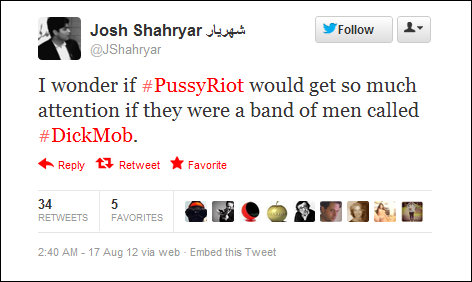
Media outlets that regularly cover Russian politics have noted how male Russian dissidents have been ignored as Pussy Riot draws world sympathy.
.
.
Removing Pussy Riot from the broader problem of political persecution in Russia is a mistake, but the case also raises specific questions about gender, media and politics.

In the same week that Pussy Riot was profiled in the New York Times style section, the Boston Review republished a 2010 interview with Hillary Clinton, in which she was asked who her favorite designer was. “Would you ever ask a man that question?” she snapped. “Probably not, probably not,” the reporter replied. The American media embraced Clinton’s riposte, reprinting it widely. But when it comes to foreign female dissidents, they promote the values Clinton rejects.

**

Meanwhile — and I mean meanwhile, since this has nothing directly to do with Pussy Riot, and a great deal to do with them in indirect ways — in my own beloved California:

In the wilderness of Northern California, Monks John and Damascene searched in hopes of finding a way to reach out to the Punk scene, which John had escaped. Seeing that the scene was full of kids that were sick of themselves and crippled by nihilism and despair, the Monks set out to give them the same hope that they found in Ancient Christianity. To do this, they decided to submit an article about Father Seraphim Rose in the popular magazine, Maximum Rock and Roll.

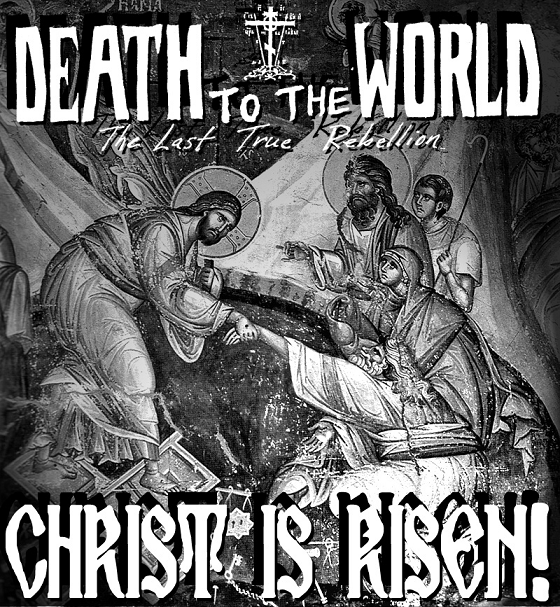
When Father Damascene read over the magazine, he knew that they would never publish something like it. Struggling to show truth to the darkened subcultures, they tried again, but this time only placing an ad for Saint Hermans Brotherhood. They got a response from the editor, saying “What the @#*% is a Brotherhood?” and the Monks were told “We only run ads for music and ‘zines*.” A light bulb went on and thus, Death to the World was born.

The first issue was printed in the December of ’94 featuring a Monk holding a skull on cover. The hand-drawn bold letters across the top read “DEATH TO THE WORLD, The Last True Rebellion” and the back cover held the caption: “they hated me without a cause.” …
.

.

The first issue, decorated with ancient icons and lives of martyrs inside, was advertised in Maximum Rock and Roll and brought letters from all around the world. People from Japan, Lithuania, and Ireland wanted to get their hands on this new radical magazine. The mailing list grew and grew and the ‘zine was distributed at punks shows and underground hangouts. It was photocopied and passed around by hundreds who wanted to read about the radical lives of the lovers of truth and the mystery of monasticism. It was estimated that at one time, there were 50,000 in circulation.

Father Paisius, who is a Monk at the monastery, said, “This subculture is raucous and deeply disturbed because of their own pain. They see life as worthless. We want to show them an ideal that is worth their life. These are marginalized youth who are wounded, and Death to the World is meant to touch with a healing hand that wound.”

Writing and putting together issues 1-12, the Monks lived in the forests of Northern California in the midst of deer, bears, mountain lions, and rattlesnakes, translating and publishing wisdom from the holy fathers and mothers of ages past. The Monks and friends of the monastery also went to rock concerts and festivals, distributing Death to the World ‘zines and t-shirts, together with icons and other books that the monastery published. The Monks did not put out any issues after issue 12, but they continued to share and hand out back orders of Death to the World.

**

That may be where the guy up there in the choir with the shocking pink mohawk comes in.
The zen of Cage II: from the A Train to Liverpool Street Station

Wednesday, August 15th, 2012

[ by Charles Cameron — two performances of Cage’s 4’33” in the New York and London Times: an interlude in my review of Where the Heart Beats, with a brief meditation on contrapuntal listening ]
.

I began to review Kay Larson‘s Where the Heart Beats in a post here last week, and am not done yet.

**

London:

photo credit: Chris Harris for the London Times

In John Cage’s sound of silence… at Liverpool Street station [London Times, subscription required], Igor Toronyi-Lalic describes performing John Cage‘s silent work 4’33” in what Cage himself — but few others — would have recognized as a concert venue, London’s Liverpool Street Station:

My rendition isn’t going down well. “This is doing my head in!” groans a drunken West Ham supporter as he watches me at the piano outside Liverpool Street station. I hear shuffling. “I can’t dance to this,” someone shouts. The restlessness is in danger of turning to anger. And I probably should have guessed it would. Presenting a performance of one of the most controversial works of music yet written in a rowdy Central London station forecourt on a Friday night on a public piano (one of several that made up the City of London Festival’s Play Me, I’m Yours artwork) was always going to be ambitious.

The work itself is hardly over before it begins — again, a paradox Cage would have enjoyed:

At my Liverpool Street Station performance, there was a symphony of rush-hour noise: commuter patter, train announcements, drunken heckling and the screeching of taxis stopping to pick up fares. Not everyone appreciated the music in this.

“When’s he going to start?” asked one lady as I finished the final movement. Others felt like they’d been had. “I thought you were going to play,” they shouted.

There’s more, and if you can get past the pay-wall you should read it all. I’ll just quote one more snippet here, though, because it leads directly into one strand of the book that I’ll be discussing in Part III of my review of Larson’s book:

“Classical musicians don’t know about Cage. They don’t perform it. We aren’t taught it in schools,” Volkov says.

But, for visual artists, Cage is a revered figure, a key part of the 1950s and 60s New York arts scene and godfather to conceptual and sound art, a connection cemented by Cage’s 40-year creative relationship with his lifelong partner, the late choreographer Merce Cunningham. “Cage worked with Rauschenberg and Cunningham and, at Black Mountain College, he mainly taught music to artists,” observes Volkov, “So, today, in art schools, they teach Cage properly. They teach his ideas.”

**

New York:

photo credit: Christian Hansen for the New York Times

From London’s Liverpool Street Station we pass to New York City’s subway system. I don’t know what it is about trains, but there you are and there you go. Or perhaps the transit is from Times to Times?

Allan Kozinn‘s John Cage Recital? Take the A Train [New York Times] starts by defining “Cage moments”:

You know about Cage moments, don’t you? We all have them, whether we think of them that way or not. They occur when happenstance kicks in, and surprising musical experiences take form, seemingly out of nowhere. They can happen anywhere at any time.

Listening. Listening as though all life is music.

Kozinn is a listener, a listener to music — but he doesn’t always listen for the music in his daily life. This time, as it happens, he did:

On the A train I wasn’t thinking about Cage at all. I had just heard an exquisitely turned, energetic performance of Schubert’s String Quintet in C at a church in Greenwich Village, and Cage could not have been further from my thoughts. Nor did the crowded subway car bring him to mind at first. But I noticed that it was unusually noisy.

**

Then something shifted:

Typically, most of the noise you hear comes from the subway itself: its din drowns out conversations, and people tend to stare at their feet, or at whatever they are reading, and listen to their portable music players. But this Tuesday evening just about all the people were talking, and working hard to drown out both the subway and the chats taking place around them.

I would normally have tuned all this out, but instead I sat back, closed my eyes and did what Cage so often recommended: I listened. I made no effort to separate the strands of conversation or to focus on what people were saying. I was simply grabbed by the sheer mass of sound, human and mechanical. It sounded intensely musical to me, noisy as it was, and once I began hearing it that way, I couldn’t stop.

Okay, this is where it get’s interesting. You remember that I pointed to the pianist Glenn Gould in my Said Symphony posts, and quoted this passage from David Rothenberg‘s Sudden Music:

Gould set himself up to hear the world in a new way. In diners he ate his lunch alone, eaves dropping closely on the voices around him. He learned to hear conversation as music, the lilting lines, the rhythms everywhere up, down, and around, what Bach does to our sense of talk. There are two part inventions in words, themes and variations in the quarrels of couples and the tales told by friends. Gould met the world on his own terms, and he was fascinated by this way of listening to human voices as if they were a musical interplay, not participating in a conversation but taking it all in, as an audience.

What Gould sets out to do — and records for Canadian Broadcasting — Kozinn finds himself doing:

Strand upon strand of the chatter was animated and midrange: there were neither basso profundos nor soaring sopranos in this choir, but after a moment the pitch levels began to sort themselves out as a kind of orchestration. Argumentative voices created driving, punchy rhythms that sailed over more smoothly floating narrative tones.

At least three languages were being spoken, each with its own melodic lilt and rhythmic character. To my left, a woman’s laughter momentarily changed the coloration of this vast choral tapestry and offset the argument to my right.

Within it all, squeaking metal yielded a high-pitched ostinato, and the ever-so-slightly-clattery rumble of the train was the high-tech equivalent of a Baroque basso continuo. As the train pulled into each station, the muted squeal of the brakes, the opening and closing of the doors and the slight shift in the balance of voices as some people left and others entered, already talking, suggested shifts between connected movements.

Again, I recommend reading the entire piece, but will close with just one more short clip:

I have heard “4’33” ” performed by pianists, percussion ensembles, oboists, cellists and orchestras, but none of those versions were as exciting as what I now think of as “4’33”: The Extended Subway Remix” by the A Train Yakkers, an ensemble so conceptual that its members had no idea they were in it.

Cage would have understood.

**

And wherever:

Listening — and listening to the world around us as music — can happen anywhere and everywhere. But as usual, I’d like to take this a step further.

As I never tire of repeating, Edward Said — pianist and music critic as much as writer on Israeli-Palestinian issues — carries the idea of listening to multiple voices a step further, when he suggests:

When you think about it, when you think about Jew and Palestinian not separately, but as part of a symphony, there is something magnificently imposing about it. A very rich, also very tragic, also in many ways desperate history of extremes — opposites in the Hegelian sense — that is yet to receive its due. So what you are faced with is a kind of sublime grandeur of a series of tragedies, of losses, of sacrifices, of pain that would take the brain of a Bach to figure out.

Said’s proposed manner of listening to the many voices of life in counterpoint involves listening to the words, their meanings, their stories, their histories, and thus to a simultaneous listening across time itself — not just to a harmonious blur, “Strand upon strand of the chatter .. a kind of orchestration .. driving, punchy rhythms that sailed over more smoothly floating narrative tones.”

It goes way deeper: my life and concerns, and yours, and yours, heard together — separate and interwoven — in polyphony, in a many-voiced music — in counterpoint.

In conflict, and in hope of resolution.

That’s one remarkable sentence

Wednesday, July 11th, 2012

[ by Charles Cameron — an expat’s nostalgia ]
.

While the eye reads the letters of a text the mind’s eye is forming images, and some of them can be startling. From today’s (UK) Metro:

Residents yesterday lost their High Court battle to prevent surface-to-air missiles being deployed on the roof of their apartment block.

**

But we don’t need to use our imaginations: the BBC has filmed the building, and the Telegraph has photographed the missiles

**

Taking a look at the BBC’s brief video of the apartments (screen-shot: upper image above) I’m reminded of the British poet John Betjeman‘s famous 1937 lines about a dreadful (from his pastoral point of view) English town whose name, “Slough”, rhymes with “plow” rather than “rough”:

Come friendly bombs and fall on Slough!
It isn’t fit for humans now,
There isn’t grass to graze a cow.

I’m sure, though, that the residents of Slough didn’t appreciate that particular poem, and the people who live in those apartments may curse them at times, but they almost certainly love them too — those apartments are their homes.

**

Tenant: But, but — an Englishman’s home is his castle!
High Court: Precisely — and we’re requisitioning the battlements for our archers.

**

Sigh. Ah well, we survived the Blitz.


Switch to our mobile site