zenpundit.com » Infinity Journal

Archive for the ‘Infinity Journal’ Category

New Issue of Infinity Journal!

Tuesday, September 13th, 2011

AE Stahl so informs me…..

Infinity Journal

Looks like an impressive line-up of authors, including Edward Luttwak, Colin Gray and friend of ZP, Frank Hoffman. I will delve in to some of these articles here later.  Registration required, but it is free.

Wilf Owen on Killing Your Way to Control

Tuesday, July 5th, 2011

Wilf Owen, noted Clausewitzian and Editor of Infinity Journal has a provocative new piece up at SWJ Blog:

 Killing Your Way to Control

The population is not the prize. The population are the spectators to armed conflict. The prize is the control the government gains when the enemy is dead and gone. Control only exists when it is being applied, and it exists via the rule of law. The population will obey whoever exercises the power of law over them. Power creates support. Support does not create power. This is the source
of great confusion.

….In general terms killing the wrong people (civilians) may undermine the political objective being sought. Whether it does or does not will be the policy context. How proportionately, precisely or discriminately lethal force is applied will be dependant on the tactics employed. Thus Rules of Engagement (ROE) are those limitations on lethal force and military activity that armed forces use to ensure that force does not undermine policy.

….All the new counter-insurgency theorists concede, some killing is required but to quote FM3-24 while necessary, especially with respect to extremists [killing] by itself cannot defeat an insurgency. Again this makes no sense, unless as part of a defence mounted to preserve the idea that you cannot kill and capture your way to success. Those who are extremists do not become apparent or may not even exist until the ranks of the enemy have been thinned by death, desertion and surrender. Until lethal force is focused on the enemy, the extremists may not be apparent, and who is and is not an extremist is irrelevant if they are clearly armed and thus a legitimate target within the ROE.

Killing and capturing are important, because lesser forms of operation aimed at disrupting or dislocating while useful, may allow the enemy to survive. Dead and captured cannot return at some later date to re-contest any issue they see fit. Warfare against irregular forces is won in a similar way to warfare against regular forces. The only major differences is that force usually has to be employed far more precisely, discriminately and proportionately. This is because lethal force will be applied close to or within a population that you are politically/legally required to protect. The other difference is that lethal force will be focussed at the individual level. This is a general distinction from that of fighting regular forces where operations would seek to defeat units and formations in part or as a whole.

The case of Algeria, during the 1990’s with the battle between Islamist rebel-terrorists and a radical Arab-socialist dictatorship provides some support for Owen’s ideas regarding killing and the separation of opponents into extremists and moderates. The government, which applied force with minimal constraints, did succeed in killing off the leadership cadres of the FIS, GIA and MIA faster than they could be properly developed, leaving leadership in the hands of either younger, more radical but less experienced men or causing the groups to accept government amnesty. 

Algeria of course enjoyed several advantages that the West lacks in places like Afghanistan – the Algerian rebels were isolated from the outside world and enjoyed minimal foreign support and the Algerian dictatorship conducted operations without regard to the laws of war in a media blackout, getting a pass from the international community because the behavior of the rebels was even worse. In Afghanistan, the center of gravity of the Taliban movement is the support of Pakistan’s ISI whch is using them as proxies to drive ISAF out of Afghanistan and the kind of punitive raiding into Pakistan to decimate Taliban manpower is forbidden by policy.

ADDENDUM:

Spencer Ackerman offers a spirited rebuttal to Wilf Owen:

Please, God, No More Stupid Anti-Counterinsurgency Arguments

…. Where to begin. Sometimes, as in nearly all counterinsurgency fights, the counterinsurgent cannot easily distinguish the insurgent from the civilian. That’s not always because of poor tactical intelligence or ignorance of a foreign culture. It’s because the guy who gives his old cellphone to his cousin so his old neighborhood friend can use it to construct IEDs for the guy paying a good going rate — quick, is he an insurgent or not? If you can’t immediately answer, Owen’s argument falls apart.

Even if you unflinchingly decide the guy’s an insurgent, killing the guy can easily inspire the whole neighborhood to rally to the insurgents’ cause. Quick: do you kill the guy so you can approach the Magic Number of dead insurgents that assures you victory? Or does not killing the guy take you further away from the Magic Number?

I know, I know. Counterinsurgency is OVER. Whatever context, wisdom or experience led people to consider it a least-bad option ought to be ignored. Its unsuitability for Afghanistan has rendered the entire enterprise inert. What, you didn’t read that National Journal piece?  

My only comment here is that Pop-centric COIN is only one brand of COIN that fits some situations better than others. I suspect much of the time in the near future, US military forces will be limiting themselves to FID, largely for budgetary reasons, and the host nation may see COIN differently than our current doctrine prescribes.

Martin van Creveld on The Lebanon War

Monday, June 27th, 2011


Eminent and controversial military historian, Martin van Creveld, analyzes the 2006 Israeli-Hezbollah War in the latest issue of Infinity Journal. Some Excerpts:

The Second Lebanon War: A Re-assessment

….Though the decision to retaliate in force was inevitable, it also meant that the Israel Defense Force (IDF) was taken by surprise and did not have time to prepare properly. Of the entire vast order of battle, only five regular brigades were immediately available. Moreover, these brigades had spent years doing little but carrying out counter-insurgency operations in the Occupied Territories. As a result, they had almost forgotten how to fight a real enemy; he who fights the weak will end up by becoming weak. Some of the burden fell on the Israeli Navy which shelled Lebanon’s coast, imposed a blockade, and cut the country off from the world. In doing so, one of its modern ships was hit by an Iranian-built surface to sea missile, suffering damage and taking some casualties. Since this was the first time in thirty-nine years anything of the kind had happened, it was a considerable propaganda victory for Hezbollah. At the same time it proved how much the crew had underestimated the enemy, since they (perhaps acting on their superiors’ orders) had not even switched on the vessel’s electronic defenses.

….”Stark raving mad” (majnun, in Arabic) was, in fact, the way many people in Lebanon and the rest of the Arab world reacted to the Israeli attack. As the statements of several of Hezbollah’s top leaders indicated, they too were surprised by the strength of the Israeli reaction. None of the organization’s original objectives were achieved. Its fighters remain in prison; the Israeli “occupation” of Shaba Farm continues; and Jerusalem, which it set itself as its ultimate objective to liberate, remains as firmly in Israeli hands as it has been during the last forty-four years. What the war did do was to show that, in case of war, neither Syria nor Iran would necessarily come to Lebanon’s rescue. The country’s infrastructure was left in ruins. Thirty thousand dwellings were destroyed or damaged, and dozens of bridges, underpasses, and gas stations demolished. Hundred of thousands of people were forced to flee, and as many as 2,000 killed.

Free registration required to read the article.

This piece is heavily IDF-centric in the analysis, perhaps reflecting van Creveld’s established authority on command and logistics and his recent work on air power, but I was surprised by the lack of space devoted to Hezbollah’s operations, given the author’s deep influence on 4GW theory and the study of postmodern irregular and asymmetric warfare. That may reflect, in part, the thrust of Infinity as a publication or the need for brevity but there’s an almost Clausewitzian subtext in the conclusion.

Good Things Come in Threes

Friday, April 29th, 2011

From our friends at Infinity Journal:

LTC Ron TiraThe Uncommitted Commitment: US Military Involvement in Libya

At the time of this writing the United States may or may not still consider itself engaged in a limited-means campaign in Libya, whose declared objective is to protect Libyan civilians and whose implicit objective is regime change. This military endeavor is, or has been, conducted in contravention of hard-learned American strategic doctrines; and it is an odd pick when contrasted with other more pressing and significant challenges to US vital interests in the Middle East.

As is the case with many lessons learned, the US has paid a high price for the insights embodied mostly in the Weinberger Doctrine and also in the Powell Doctrine. Yet, as is also often the case, it has offhandedly brushed aside that hard-earned strategic prudence.

….Yet the planners of the Libyan operation have preferred force economy and risk aversion over winning. First and foremost has been the demarcation of acceptable risks and consequently acceptable modes of military operation, while the gap between those tolerable ways and means on the one hand and the ends on the other hand remain knowingly unaddressed. The operation’s architects have only been willing to commit and risk limited assets applying standoff fire and possibly special operations, and whatever those can achieve – will be achieved. It is not the objectives and theater characteristics but economy and risk aversion that have driven the campaign’s design.   

Read the rest here ( free registration required).

From SWJ Blog where they are about to launch their subscription newsletter, where I debut as the Recommended Reading columnist with Crispin Burke of Wings Over Iraq:

SWJ Monthly E-News (Bumped – Updated)

Once a month, beginning on 1 May, we will be sending out an e-mail overview of the latest news, issues, events and more from SWJ and the broader Small Wars / Irregular Warfare community of interest and practice.

Have something you think should be included in future newsletters? Send it along to mailto:%20comment@smallwarsjournal.com. Care to advertise in future newsletters? Contact SWJ at mailto:%20advertise@smallwarsjournal.com for details.

Keep abreast of what’s happening in the far flung reaches of the SWJ Empire – sign up below for our newsletter today.

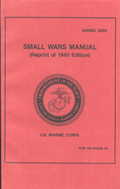
***Sign up now – One lucky SWJ E-News subscriber will win a copy of the 1987 reprint of the Small Wars Manual.*** smallwarsmanual.gif***This copy is in new condition – never been opened and has been priced as high as $101.00 on Amazon.com***The contents of SWJ E-News No. 1 will include:

* SWJ News – Journal articles and blog entries, Council debates and discussions, This Week at War and a sneak preview of our SWJ challenge coin,
*
Doctrine Man @ SWJ – DM’s exclusive for Small Wars Journal cartoon commentary,
* Professional Reading – Snapshots and links to articles of interest from a wide array of professional journals,
* SWJ Interviews – A recap with links covering our SWJ interview series,
*
Starbuck and Zenpundit – Recommended reading,
* Book Review – Bing West’s The Wrong War,
* Upcoming Events – Small Wars-related workshops, conferences, seminars and webcasts,
* More…

Signup for our Monthly E-News

* indicates required


Finally, Wikistrat has released the latest Core-Gap Bulletin:

CoreGap 11.11 Released – What to Do With Despots Who Fight to the Bitter End?

Wikistrat has released edition 11.11 of the CoreGap Bulletin.

This CoreGap edition features, among others:

  • Terra Incognita – What to Do With Despots Who Fight to the Bitter End?
  • Bahrain Repression Indicates Just How Scared of Iran the Saudis Truly Are
  • IMF and Standard & Poors Both Issue Warnings on Unprecedented US Debt
  • As Libyan Stalemate Looms, NATO Increases Involvement
  • South Africa Formally Joins BRIC Group, Signaling China’s Dominance

And much more…

The entire bulletin is available for subscribers. Over the upcoming week we will release analysis from the bulletin to our free Geopolitical Analysis section of the Wikistrat website, first being “Terra Incognita – What to Do With Despots Who Fight to the Bitter End?”

Read the full piece here

Porter at Infinity Journal

Friday, April 8th, 2011

Infinity Journal has added a more “blog-like” or “column-like” section to cover events within a contemporaneous frame in addition to their peer-review articles which come out quarterly (or perhaps bimonthly) more contemporaneous peer reviewed articles, oriented toward current events, in addition to their quarterly publication of the journal . Dr. Patrick Porter of Offshore Balancer ( and King’s College) has the maiden post with a provocative piece:

Exclusive: Lost in Libya: The UK does not understand strategy

The limited war of 2011 would refuse to be quarantined. After all other options were exhausted, it could culminate in a land war against Tripoli. Distressingly, we would shoulder the burden of invading, pacifying and administering this country. Occupation would probably lead to resistance – and Libya propelled more foreign-born jihadi volunteers into Iraq than any other nation. A new front in the War on Terror would open up. Idealists now calling for humanitarian rescue would discover that all along they opposed Western imperial hubris….

Free registration required. 

Admittedly, I stole the excerpt above from SWJ Blog – the online format of IJ makes it difficult for bloggers to quote sections of articles by copying and pasting into blog posts. This probably cuts down on the velocity and extent of IJ articles circulating in the .mil/strategy/foreign policy online world (blogosphere, twitter, listservs). OTOH the editors may not care as it probably reduces the amount of inane vs. informed criticism as well 🙂

In any event. Dr. Porter’s article is worth reading.


Switch to our mobile site