zenpundit.com » Apocalyptic

Archive for the ‘Apocalyptic’ Category

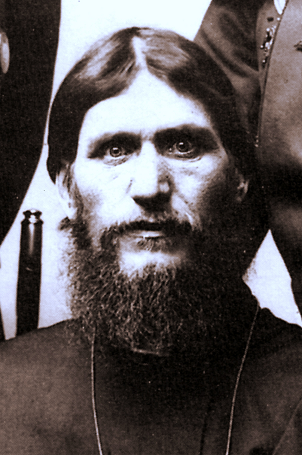
Rasputin’s Apocalypse

Friday, August 23rd, 2013

[ by Charles Cameron — most likely a “foolish virgin” (Matthew 25) — I had no idea today was the day until today ]
.

.

According to Pravda, which I believe means Truth:

August 23, 2013 is the day, for which the infamous Grigory Rasputin predicted the end of the world in the beginning of the last century. Rasputin predicted a “terrible storm” in which fire would swallow all life on land, and then life would die on the whole planet. He also said that Jesus Christ would come down to Earth to comfort people in distress.

I would be remiss if I did not attempt to warn you…

Elkus interviews Charles Cameron at Abu Muqawama

Wednesday, July 31st, 2013

[ by Mark Safranski a.k.a “zen“]

Longtime friend of ZP,  Adam Elkus interviews our own Charles Cameron at the highly regarded Abu Muqawama blog:

Interview Charles Cameron 

[….]  AE: How has the study of apocalyptic tropes and culture changed (if it has at all) since 9/11 focused attention on radical Islamist movements?

CC: USC’s Stephen O’Leary was the first to study apocalyptic as rhetoric in his 1994 Arguing the Apocalypse, and joined BU’s Richard Landes in forming the (late, lamented) Center for Millennial Studies, which gave millennial scholars a platform to engage with one another. David Cook opened my eyes to Islamist messianism at CMS around 1998, and the publication of his two books (Studies in Muslim ApocalypticContemporary Muslim Apocalyptic Literature), Tim Furnish’s Holiest Wars and J-P Filiu’s Apocalypse in Islam brought it to wider scholarly attention — while Landes’ own encyclopedic Heaven on Earth: The Varieties of the Millennial Experience gives a wide-angle view of the field in extraordinary detail.

I’d say we’ve gone from brushing off apocalyptic as a superstitious irrelevance to an awareness that apocalyptic features strongly in Islamist narratives, both Shia and Sunni, over the past decade, but still tend to underestimate its significance within contemporary movements within American Christianity. When Harold Camping proclaimed the end of the world in 2011, he spent circa $100 million worldwide on warning ads, and reports suggest that hundreds of Hmong tribespeople in Vietnam lost their lives in clashes with the police after moving en masse to a mountain to await the rapture. Apocalyptic movements can have significant impact — cf. the Taiping Rebellion in China, which left 20 million or so dead in its wake.

Read the rest here.

Apocalyptic Fire in Azan #2

Wednesday, June 5th, 2013

[ by Charles Cameron — on end-times rhetoric and having no need of sun or moon ]
.

Detail from a Commentary on the Apocalypse by Beatus of Liebana

**

On the whole, the “signs of the end times” described in the installment of Maulana Asim Umar‘s Third World War and Dajjal, pp. 23-31, and now posted in the second issue of Azan on pp 83-89 are standard fare of the “wars and rumors of wars” type that could fit pretty much any time n history, including our own — “When the most despicable person of a nation would be its leader” would fit an astounding number of rulers across recorded history, depending on your point of view, including Nero and Diocletian, George III and Abe Lincoln, and a slew of Saddams, Mubaraks and Assads

There was one section, however, that struck me as a powerful piece of visionary apocalyptic, and I wanted to bring it to the attention of those interested in such things.

The Maulana writes [I’ve omitted the Arabic honorifics since I lack Arabic, and corrected one typo in Enlish]:

“Hazrat Abu Hurayrah narrates that the Prophet of Allah said that the Day of Judgment would not occur before a fire erupts from Hijaz and lights up the necks of the camels of Basra.” [Bukhari, Muslim]

The incident mentioned in this Hadith has already occurred according to Hafiz Ibn Kathir (RA) and other historians. This fire appeared in 650 H on the Day of Jumu’ah in some valleys of Madinah Munawwarah and remained for about a month. The narrators have said that the fire suddenly erupted from the direction of Hijaz. The scene looked like a whole city of fire – containing a whole castle, tower or battlement etc. Its height was 4 “farsakh” (around 12 miles) and its width was 4 miles. The fire would melt any mountain it reached as if the mountain was made out of wax or glass. Its flames had the sound of thunder and the energy of river waves. Blue and red-colored rivers looked to be coming out of the fire. In such a (horrible) state, the fire reached Madinah Munawwarah. But the curious thing was that the wind that was emanating from the direction of the flames felt cool in Madinah. The scholars have written that the fire had encompassed all the jungles of Madinah such that in the Haram-e-Nabwi and in Madinah, all the houses were lit up as if from the sun. The people would do all their work in the night from the light (of the fire); in fact, the light of the sun and the moon would became faded because of the light of the fire.

Some people of Makkah (at the time of the fire) bore witness that they saw the fire while they were in Yamama and Basra.

A strange quality of the fire was that it used to burn the stones to coal but it would not have any effect on the trees. It is said that there was a large stone in a jungle – half of it was in the limits of Haram-e-Madina and half of it was outside the limits. The fire burnt to coal the half of the stone that was outside the limits of the Haram-e-Madina. However, it cooled when it reached to the other half and hence, this half remained safe.

The people of Basrah bore witness that they saw the necks of camels light up from the light of the fire…

[The Beginning and the End: Ibn Kathir (RA)]

**

You know my interest in semblances and parallelisms. Compare:

in fact, the light of the sun and the moon would became faded because of the light of the fire

in that narrative with:

the city had no need of the sun, neither of the moon to shine in it, for the glory of God did lighten it

in Revelation 21:23.

I am not arguing that there is an echo between the two accounts, nor that they describe the same phenomenon — simply that the rhetoric of each has a similar poetic intensity. This just happens to be one of those occasions when there are more things in heaven than are dreamed of in your natural sciences.

It’s a weird, wild world

Sunday, May 26th, 2013

[ by Charles Cameron — Omar Bakri Muhammad, al-Muhajiroun, Tom Jones and The Hour — also: hot-wiring the apocalypse, I think not ]
.

As we all know by now, it turns out that the primary Woolwich suspects were associated with al-Muhajiroun. Accordingly, a couple of days ago I watched John Ronson‘s recently reposted documentary about their sheikh, Omar Bakri Muhammad, titled Tottenham Ayatollah Revisited. Bakri is about as far from an ayatollah as two peas can get inside a single pod, but never mind, here’s the video:

At the 13.56 mark, Bakri is preparing to negotiate arrangements for a rally he hopes to hold in a venue that hosts a variety of events, and what I’d say is a majorly weird exchange between the director and Bakri is captured on film:

The rally is scheduled between a Tom Jones concert and a show called The wonderful World of Horses. Omar has never heard of Tom Jones, and he is shocked to discover that women throw their underwear onstage.

“Oh my God, is that a sign of the Hour, a sign of the Hour?”

Is it?

“Of course, people start take off their, you know, their own knickers and their underwear, that is sign of the Hours.”

Now, I happen to think Bakri is joshing about not knowing Tom Jones, but the form his joshing takes is interesting.

The Hour in question would be the Hour mentioned in the Quran:

They will question thee concerning the Hour, when it shall berth. What art thou about, to mention it? Unto thy Lord is the final end of it. Thou art only the warner of him who fears it. It shall be as if; on the day they see it, they have but tarried for an evening, or its forenoon. [Q 79.42-46]

and:

They will question thee concerning the Hour, when it shall berth. Say: ‘The knowledge of it is only with my Lord; none shall reveal it at its proper time, but He. Heavy is it in the heavens and the earth; it will not come on you but suddenly!’ They will question thee, as though thou art well-informed of it. Say: ‘The knowledge of it is only with God, but most men know not.’ [Q 7.187]

and — perhaps most interestingly:

Those that believe not therein seek to hasten it; but those who believe in it go in fear of it, knowing that it is the truth. Why, surely those who are in doubt concerning the Hour are indeed in far error. [Q 42.18]

**

Hey. we’re in apocalyptic time again… Here’s my question:

We read quite often of the possibility that the Iranians — or Al-Qaida — might wish to “hot-wire the apocalypse” or “hasten the coming of the Mahdi”. I’d read that last verse as strongly suggestive that “hastening” might put one in the category of disbelief.

Is that an argument that has been offered against the idea, in either Sunni or Shi’a circles?

Hezbollah and related graphics

Sunday, May 26th, 2013

[ by Charles Cameron — insights into symbolism on both sides of the Syrian conflict, including Nasrallah as Dajjal and Pinocchio, Star Trek darkness, more ]
.

I thought it might be instructive to compare the Hezbollah flag:

with a couple of variants seen recently:

The version on the left is captioned Syrian opposition activists re-imagining Hezbollah’s logo after absorbing heavy losses in Qusayr. The one on the right is from another image mocking Hezbollah, this one picturing Nasrollah as the Dajjal.

Note that in the second image, the gun is pointing down — in a sort of “shoot your own foot” gesture, perhaps?

**

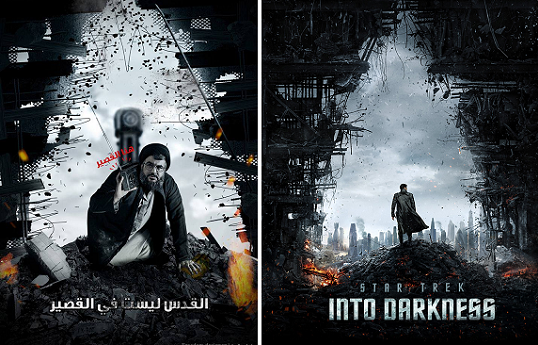
That second image, with the gun reversed, comes from a portrayal of Nasrallah as the Dajjal (below, left) — the one-eyed figure in Muslim apocalyptic serving roughly the same function as the Antichrist in Christian eschatology (depicted in a popular book cover,found by J-P Filiu, below, right):
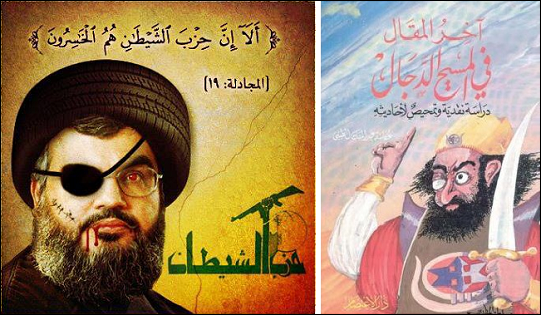
Not also the tire substituting for Nasrallah’s black turban.

This image of Nasrallah is itself a variant on this one, also portraying him as the Dajjal:

but without the vampiric attributes and tire-turban of the other version.

**

These guys are quick, incidentally — see how fast Nasrallah appeared in StarTrek guise

**

Here are a couple more variants on the Hezbollah flag:

I’m intrigued by the Pinocchio image, which — if I’m not mistaken — features the tire-turban once again:
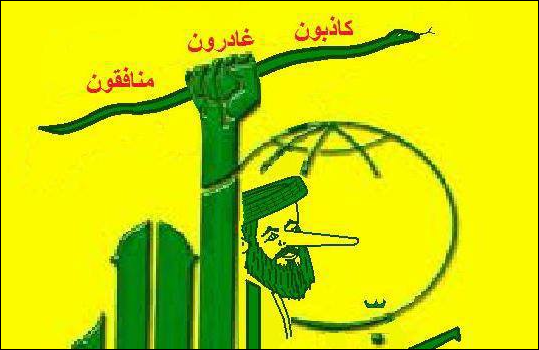
It was lying that made Pinocchio’s nose extend itself, and just as the Devil in Christianity is “the Father of Lies” (John 8.44), so in Islam the term al-Dajjal means “the Deceiver”. And see how the gun has turned into a Serpent, complete with forked tongue?

**

Finally, Phillip Smyth has been posting a series titled Hizballah Cavalcade at Aaron Zelin‘s Jihadology blog, and a couple of details caught my eye in what Smyth terms the “official Hizballah martyrdom posters” for Ashraf Hasan ‘Ayyad and Musen Samir Birro.
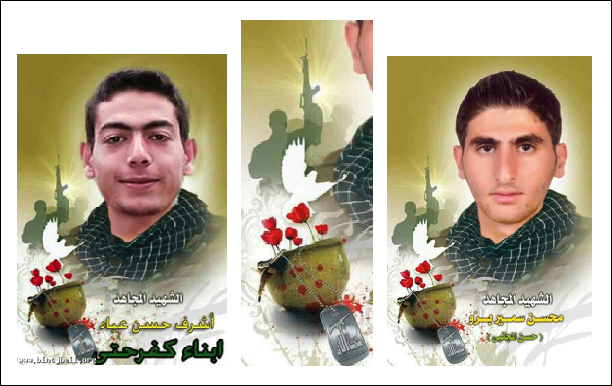
As you can see, each of these posters features the Hezbollah emblem on dog-tags, a soldier’s helmet with poppies growing from it, the outline of a white dove, silhouette of a soldier with rifle raised, and the glint of the sun behind it.

If anyone has a detailed exegesis of this cluster of images to offer, I’d be most interested.

**

Hat tips to Mr Orange for pointing me to the Nasrallah Dajjal graphics, and to Aaron Zelin for Jihadology…


Switch to our mobile site