zenpundit.com » Apocalyptic

Archive for the ‘Apocalyptic’ Category

Chavez and the Second Coming?

Sunday, March 10th, 2013

[ by Charles Cameron — the final, astounding, Messianic-Mahdist word goes to Hugo Chavez! caught on video! ]
.


.

We now know, thanks to VOA and the Atlantic, this much:

The death of Venezuelan leader Hugo Chavez has prompted eulogies from around the world, but few of the messages have been as eccentric as the second-coming predicted by Iran’s president.

And as if returning to Earth alone was not enough, President Mahmud Ahmadinejad says Chavez will do so alongside some esteemed company.

“I have no doubt that he [Chavez] will return alongside Jesus Christ and the Mahdi [the Hidden Imam] to establish peace and justice in the world,” Ahmadinejad wrote in an emotional condolence message posted on his personal website. The Mahdi is a revered figure among Shi’ite Muslims, many of whom believe he will return to save humanity.

Not surprisingly, as reported by Reuters, these remarks drew rebukes from some senior Iranian clergy:

“The terms Mr Ahmadinejad used to describe the Venezuelan president are not appropriate for us,” the semi-official Mehr news agency quoted Ghorbanali Dorri Najafabadi, a cleric and a senior member of the Assembly of Experts, as saying.

“One can naturally send a diplomatic letter without getting into religious discussions,” hardline Friday prayer leader Ahmad Khatami was quoted as saying by Iranian media, adding that he believed Ahmadinejad’s decision to do so was wrong.

According to the parliamentary news agency ICANA, lawmaker Mohammad Taqi Rahbar said on Thursday Ahmadinejad’s comments were “certainly wrong and exaggerated”.

**

Dr Timothy Furnish attributes this sort of blurring of theological categories to what he terms “ecumenical messianism” — for some quick context see his comments on the Lutheran Witness site. I’d suggest that is not just a fleeting idea but an area we should look into in some depth, if only because I myself was struck by an earlier incarnation of much the same idea, as expressed by the late Ayatollah Muhammad Baqir al-Sadr, who is quoted as having said:

The Mahdi is not an embodiment of the Islamic belief but he is also the symbol of an aspiration cherished by mankind irrespective of its divergent religious doctrines. He is also the crystallization of an instructive inspiration through which all people, regardless of their religious affiliations, have learnt to await a day when heavenly missions, with all their implications, will achieve their final goal and the tiring march of humanity across history will culminate satisfactory in peace and tranquility. This consciousness of the expected future has not been confined to those who believe in the supernatural phenomenon but has also been reflected in the ideologies and cult which totally deny the existence of what is imperceptible. For example, the dialectical materialism which interprets history on the basis of contradiction believes that a day will come when all contradictions will disappear and complete peace and tranquility will prevail.

In light of that quote, Ahmadinejad‘s interest in Hugo Chavez seems a little less far-fetched.

**

Okay, I’m no expert, but I do try to keep more or less on top of the swirling currents of contemporary Mahdism, which is from my POV understudied — and when studied in haste, often misunderstood — but I swear I never saw this one coming.

A further hat tip to Tim Furnish, then, for pointing us to this Iranian news report of a speech by Hugo Chavez himself in Masshad… the holy city in Iran where Imam Reza was martyred, indeed whose very name, mah-shahd, means “place of martyrdom”.. way back in 2009.

The Messiah [Jesus] and the Mahdi are not dead, they are alive and well and will soon return to spread justice over all the world. This afternoon Imam Khameini told us that as long as we two Presidents are united in our hearts and minds, as long as we pursue the same humanistic deeds together, and as long as we continue seeking justice, the Mahdi and the Messiah will emerge very soon. Therefore, we must struggle so that his holiness the Mahdi and the Messiah emerge to spread justice all over the world.

Dr Furnish’s Iranian source is Mehr News. I wonder if the Venezuelan press thrashed about it much, or whether they thought it was just diplo small talk?

I poked around the web a bit, and this looks to be a tape of a similar interview:

Whoah!

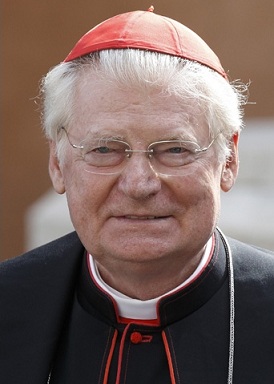
The papabili — and Angelo Cardinal Scola among them

Sunday, March 3rd, 2013

[ by Charles Cameron — thinking today of the Church in terms of its “foreign policy” and the “Islamic world” ]
.

It’s worth looking at John Allen‘s list of papabili from the most recent conclave, the 2005 conclave that elected Joseph Ratzinger to the papacy, before reading the twelve names he offered CNN for the upcoming election — if only to note that Ratzinger’s own name is conspicuously absent from the list of likely candidates…

It is also worth remembering the response then-Cardinal Ratzinger gave to a reporter in a 1997 interview:

INTERVIEWER: “Your Eminence, you are very familiar with church history and know well what has happened in papal elections. . . . Do you really believe that the Holy Spirit plays a role in the election of the pope?”

RATZINGER: “I would not say so in the sense that the Holy Spirit picks out the pope, because there are too many contrary instances of popes the Holy Spirit would obviously not have picked. I would say that the Spirit does not exactly take control of the affair, but rather like a good educator, as it were, leaves us much space, much freedom, without entirely abandoning us. Thus the Spirit’s role should be understood in a much more elastic sense, not that he dictates the candidate for whom one must vote. Probably the only assurance he offers is that the thing cannot be totally ruined.”

**

Bearing that in mind, and given the current world context in which the issue of reform within the church is receiving the most fervent press attention, I’d like to pause for a moment to consider “foreign affairs” — and more specifically the Church’s relations with the Islamic world, since the next pope has the opportunity here to be a bridge builder, a literal pontifex, a peacemaker if he so chooses — or a divider, an antagonist.

I am therefore particularly interested in the possibility that Angelo Card. Scola might be elected to the papacy, since he has been involved for some time in Catholic-Islamic dialog through his Oasis project:

The ‘mestizaje of civilisations and cultures’. This refers to the ongoing, novel historical process of mixing of peoples and cultures. Hybridization is neither a theory about cultural integration, nor a general notion explaining realty. It is simply an acknowledgment of a situation that we must all face, whether we like or not, individually or collectively, that requires that each one of us to try to influence it for the better. On the basis of this notion the Oasis Centre aims at transcending certain frames of reference and concepts like multiculturalism, integration and reciprocity that are proving increasingly inadequate to explain the increasing interaction of peoples. It is clear that reflecting upon it cannot be done without taking into consideration the contribution of various religions and the way they themselves interact. In particular the Centre’s focus is on the relationship between Christians and Muslims.

Scola is currently the archbishop of Milan, and was previously patriarch of Venice. For a closer look at his work with what he accurately terms “the Islams” see his 2008 op-ed, The Freedom to Convert and interview with John Allen on “popular Islam”.

**

For myself, I was particularly interested in his response to a question from Allen in a 2009 interview on Shi’ite messianism:

ALLEN: What are you hearing from your contacts in Iran these days? Looking down the line, it seems that Shi’a Muslims and Catholics share certain traits: A strong clerical hierarchy, a theology of sacrifice, and deep currents of popular devotion. Does this suggest that Catholicism can play an important role in a dialogue with Iran, where Shi’a Islam is dominant?

SCOLA: Three accents strike me in the Shi’a tradition: the necessity of a continual actualization of revelation in certain physical persons, to the point of overcoming a too-rigid conception of divine transcendence; the lively expectation of eschatological fulfillment; and the reflection on the problem of evil. I have the impression that we’re not well informed on these points, despite the enormous work of study and analysis that’s been done by specialists in recent years. We know Shi’ites better than we know Shi’ism!

The Oasis network really hasn’t arrived yet in Iran, so what I know about what’s happening is what I see and read in the mass media. I don’t doubt, however, that many people in Iran want better relations with the West. We must not forget that Persian culture has shown itself to be extraordinarily fertile and receptive.

The principal problem, if I can put it slightly audaciously, is that Shi’ite messianism, almost unable to bear the weight of the expectations with which it is structurally bound up, has been converted over the centuries, at least in some circles, into a political ideology. We’re talking about a long process that’s not linear, which experience a brusque acceleration with the 1979 revolution. As Westerners, we were caught off guard. We had forgotten that history is also sometimes forged by ‘theological options.’

In any event, all this is reversible.

A comparison of the Shi’ite Ta’zieh “passion plays” mourning the martyrdom of Husayn at Kerbala with the equivalent Catholic play at Oberammergau memorializing the passion of Christ confirms the resemblance Allen suggests between the “theology of sacrifice, and deep currents of popular devotion” in Shi’a Islam and Catholicism respectively.

As for our lack of awareness of the contemporary pull of Islamic eschatology, Scola’s words mirror one of my own concerns to a T:

As Westerners, we were caught off guard. We had forgotten that history is also sometimes forged by ‘theological options.’

Miscik 2004, Gerecht 2013

Thursday, February 21st, 2013

[ by Charles Cameron — on the exclusion of worldviews not consonant with grey suits and security clearances ]
.

These two persons are likely being polite.

**

I’m wondering how any people at State or in the Agency or wherever know what it feels like to be one of the flagellants in Iran during Muharram, in Qom or Masshad perhaps… or at the Jamkaran mosque, and to believe the Mahdi is waiting close by in the wings… or to be in Afghanistan, Sunni, and expecting his army with black banners will sweep down on Jerusalem from Khorasan in accordance with hadith… or in Palestine, reliant on the hadith of the rocks and the trees, certain that Israel will soon fall… in Pakistan, listening to Syed Zaid Zaman Hamid and mentally preparing for the Ghazwa-e-Hind?

**

I suppose I’ve been struggling to say this for years:

The sanction for extremist violence, even to the point of death, is that the cause is just and right. The sanction for messianic violence is that the cause is not only humanly just and right but divinely so — and final, for the entirety of the cosmos, for all Creation.

**

Sources:

Jami Miscik, tesimony, House Intelligence Cttee
Reuel Marc Gerecht, Spooky Sex

h/t Nada Bakos

Further readings on messianisms:

Mahdi in the wings, Iran
Khorasan, army with black banners, Afghanistan
Hadith of the rocks and the trees, Palestine
Ghazwa-e-Hind, Pakistan

David Cook, Contemporary Islamic Apocalyptic Literature
David Cook, Studies in Islamic Apocalyptic
Timothy Furnish, Holiest Wars
Gershom Gorenberg, The End of Days
Anne-Marie Oliver & Paul Steinberg, The Road to Martyr’s Square
Jean-Pierre Filiu, Apocalypse in Islam
Syed Saleem Shahzad, Inside al-Qaeda and the Taliban
Ali Soufan, The Black Banners
Richard Landes, Heaven on Earth

Rabbis, Islam & End of Days II, also 2013 Mahdism Update, II

Tuesday, January 22nd, 2013

[ by Charles Cameron — continuing my updating of Mahdist issues, also surprising parallels and oppositions ]
.

By the time you’ve learned the various signs of the times — pre-, mid- and post-trib rapture dispensationalist, preterist, Mormon, I dunno, ecological, Sunni, Shiite — the list, like Tolkien‘s Road, goes ever on — who’s on which side, and who might be somebody else’s something — you may feel as confused as I do.

**

The very first sentence of Tim Furnish‘s book, Holiest Wars: Islamic Mahdis, their Jihads and Osama bin Laden — which I may never tire of quoting — reads:

One man’s messiah is another man’s heretic.

I was rereading the amazing section on the Gharqad tree in Anne Marie Oliver and Paul Steinberg‘s book, The Road to Martyrs Square, the other day, and noticed on p. 21 yet another intriguing variant on Furnish’s point:

Even before the intifada, the figure of the Dajjal was equated by many Islamists with the Jewish Moshiach, the Messiah, as when the highly influential Pakistani Islamist Malauna Maududi claimed in the 1960s that “the stage has been set for the emergence of the Dajjal who, as was foretold by the Holy Prophet (PBUH), will rise as a ‘Promised Messiah’ of the Jews.” By the late intifada, the equation was commonplace in the West Bank and Gaza. When the Lubavitcher Hasidim in the early 1990s began to refer to Rabbi Menachem Mendel Schneerson as the Messiah, the claim had considerable effect on Palestinian Islamists. Some actually began to include Schneerson on their list of False Prophets, referring to him as “the Antichrist Liar.”

**

Compare this, however, with the Muslim Harun Yahya‘s willingness to declare his expectation of the King Messiah / Moshiach in the screen-cap below. Yahya is presumably referring to the same salvific end-times figure he elsewhere refers to as the Mahdi.

Here we have the reverse possibility to the one Furnish points to — it certainly looks as though here, one man’s Messiah is another man’s Mahdi. On one of his websites, King-Messiah.com, Yahya makes the identification of these figures from two traditions explicit:

And “King Messiah” is a particularly interesting phrase for Yahya to use — among other things, it’s the term some followers of the late Lubavitcher Rebbe Schneerson use to describe their rebbe.

**

As I pointed out two days ago in Expecting the unexpected: Rabbis, Islam, and the End of Days, there’s a whole lot going on here, and it takes patience to tease all the strands out…

One of these days I’ll have to put together an extended list of messiah / mahdi correspondences — and prophet / false prophet and christ / antichrist correspondences between competing eschatologies, too, both within specific religions and across them.

I suspect Ayatollah Muhammad Baqir al-Sadr was thinking along similar lines to Yahya when he wrote the paragraph I quoted towards the end of The Messianic Mahdist Moebius strip — or maybe Maze?:

The Mahdi is not an embodiment of the Islamic belief but he is also the symbol of an aspiration cherished by mankind irrespective of its divergent religious doctrines. He is also the crystallization of an instructive inspiration through which all people, regardless of their religious affiliations, have learnt to await a day when heavenly missions, with all their implications, will achieve their final goal and the tiring march of humanity across history will culminate satisfactory in peace and tranquility. This consciousness of the expected future has not been confined to those who believe in the supernatural phenomenon but has also been reflected in the ideologies and cult which totally deny the existence of what is imperceptible. For example, the dialectical materialism which interprets history on the basis of contradiction believes that a day will come when all contradictions will disappear and complete peace and tranquility will prevail.

The Iranian scholar Muhammad Ali Shumali, whom I also quoted, said much the same:

Imam Mahdi is not a saviour for [just] the Shias. Imam Mahdi is a saviour for all mankind…

**

Parallels and oppositions…

My language here will probably not be precise enough for mathematicians or logicians — but isn’t the thing that most closely resembles another thing its exact opposite?

And to give this already twisty rope yet another twirl… not in terms of apocalyptic, but of Jewish / Muslim relations more generally…

Here’s Pastor John Hagee — the preacher who was so far right that Sen. John McCain rejected his endorsement in the 2008 presidential campaign — talking with Rabbi Daniel Lapin about Muslims being blessed, and how their five-times-daily prayers are particularly listened to by God:

These unpredictable “outlier” nuances and their attendant shocks and surprises are ongoing…

**

The “signs” graphic at the head of this post is from a post titled Preparing for the Second Coming on LDS Why? — you can download their answers for teens in Chapter 12 of the book The Big Picture. It begins:

Imagine it’s a bright and sunny afternoon, and as you drive down the road with your parents you look up and notice that the sky looks different than normal. The clouds are luminescent, bright, and heavenly. Suddenly, without warning, the sky seemingly bursts open and the veil between heaven and earth is split. Trumpets start sounding from the sky, and you see above you the most glorious being your mind could ever conceive of descending out of heaven and touching down on earth — Jesus Christ in all His glory…

That’s a sign that might be hard to miss…

Expecting the unexpected: Rabbis, Islam, and the End of Days

Sunday, January 20th, 2013

[ by Charles Cameron — strange intersections between Islamic, Judaic and Christian teachers around the end times, also Yehuda Etzion of the Jewish Underground, and Habayit Hayehudi’s Jeremy Gimpel ]
.

My guess is that at least one aspect of this screen-grab will surprise you — but it’s hard to say which!


.

One possible surprise is a 2013 end times prediction from an Islamic source — but there are enough other surprises here to go around, I think…

Okay, here it is. I ran across two videos of rabbis on two sites connected with Islamic end times expectations today, and they’re causing a bit of a re-set in my thinking about the various alignments possible in the complex world of competing contemporary eschatologies.

**

I imagine the rabbi in the first of the two videos is from Neturei Karta or Satmar, because at one point he says:

this country (Israel) does not have the right to exist

and refers to the State of Israel as “the origin of evil”.

There is obviously much more going on here, and I’m none too confident of the accuracy of the subtitles, so I’d appreciate any comments from those who know more about either the rabbi’s Jewish context or the Muslim eschatological site‘s place within the Mahdist spectrum.

2013? C’mon!

**

The second video comes from Adnan Oktar / Harun Yahya. What’s most intriguing to me here is the rabbi’s assertion that “Islam is the religion of Adam himself” — the Noahide or universal faith into which we are all born according to Judaism. And once again, I’d appreciate any commentary on the participants and their respective contexts:

He’s definitely an interesting fellow, this Harun Yahya — his teachings on Mahdism feature a peaceable Mahdi, he has reached out in dialogue to Joel Richardson, the author of Mideast Beast: The Scriptural Case for an Islamic Antichrist, and his Jewish contacts include Adin Steinsaltz, Talmudic scholar par excellence and president of the revived Sanhedrin.

**

By way of abrupt contrast, consider the inflammatory words of this current candidate for the Knesset, Jeremy Gimpel, drawn from a speech he gave in a Florida church in 2011:

Imagine if the Golden Dome – I’m being recorded so I can’t say ‘blown up’ – but let’s say the Dome was blown up, right? And we laid the cornerstone of the Temple in Jerusalem. Can you imagine? None of you would be here – all of you would be like, “I’m going to Israel, right?” No one would be here, it would be incredible!”

Alongside these of Harun Yahya, from his conversation with the rabbinic delegation from the Sanhedrin:

Out of a sense of collective responsibility for world peace and for all humanity we have found it timely to call to the World and exclaim that there is a way out for all peoples. It is etched in a call to all humanity: We are all the sons of one father, the descendants of Adam, and all humanity is but a single family. Peace among Nations will be achieved through building the House of G-d, where all peoples will serve as foreseen by King Solomon in his prayers at the dedication of the First Holy Temple. Come let us love and respect one another, and love and honor and hold our heavenly Father in awe. Let us establish a house of prayer in His name in order to worship and serve Him together, for the sake of His great compassion. He surely does not want the blood of His creations spilled, but prefers love and peace among all mankind. We pray to the Almighty Creator, that you harken to our Call. Together – each according to his or her ability – we shall work towards the building of the House of Prayer for All Nations on the Temple Mount in peace and mutual understanding.

**

Further reading:

  • Hachrazah 5769 Tamuz 9 from the revived Sanhedrin site, a fascinating overview.
  • Joel Richardson, Muslim Leader wants Temple Rebuilt, WND
  • Haaretz, Is it the End of Days for Jeremy Gimpel?, also with fascinating detail
  • Note particularly, in Joel Richardson’s piece, this quote attributed to Rabbi Hollander:

    It is said that the structure of the Dome in Haram E-Sharrif (the Temple Mount) was originally meant by (Caliph) Omar to be a House of Prayer for Jews, and the Al-Aqsa for Muslims.

    When considering Gimpel’s remark, bear in mind also that Yehuda Etzion was imprisoned in the early 1980s for his part in a conspiracy to blow up the Dome of the Rock –a four year effort which included the recruitment of an air force pilot, the theft of military explosives, and the making of 28 bombs — oy — which was only called off when no rabbi could be found to give it his official blessing, and which resulted in a trial at which the judge praised the defendants for their “pioneering ethos”.

    On this, see, eg:

  • David New, Holy War: The Rise of Militant Christian, Jewish and Islamic Fundamentalism, pp 154-56.

  • Switch to our mobile site