zenpundit.com » Apocalyptic

Archive for the ‘Apocalyptic’ Category

A Bigger Bang for the Book?

Friday, August 10th, 2012

[ by Charles Cameron — apocalypse out-movied, science fiction overwhelmed, what in the world is the world coming to? and whither SF? ]
.

I could hardly be expected not to share with you my delight in this, from the Onion [turn down your volume control before you click, it’s preset to wake the dead]:

**

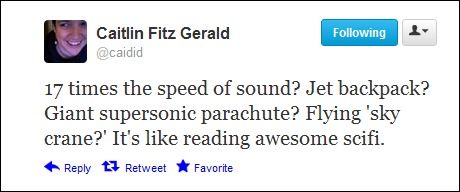
But I don’t think the Book (of the Revelation of St John on Patmos) is the only thing that’s getting out-gunned these days. Consider this tweet from Caitlin Fitz Gerald aka @caidid:

The thing is — aside from terraforming Mars [Frederick Turner, Kim Stanley Robinson] or visiting spaces deeper out, we’ve accomplished or are accomplishing much of what “hard” (ie science-based) science fiction imagined for us. And to my mind, that suggests the possibility that writing hard SF will be getting a whole lot more difficult, and that character and culture will increasingly be what divides the best from the bland.

Still plenty of room for the likes of Jack Vance and his brilliant and beautiful Moon Moth, though.

**

So, will the End Bang be bigger than the Big Bang? Or is there a principle of symmetry that makes them exquisitely equal and opposite?

Who among us can comprehend religion? — Mahdi & Second Coming

Wednesday, August 8th, 2012

[ by Charles Cameron — the Second Coming in Mahdist eschatology, Abu Musab al-Suri: a first addendum to my post responding to Scott Atran ]
.

I quietly asked “who among us can comprehend religion?” in the header to my most recent post responding to Atran on FP, and here and in the post that follows this one, I want to stir some thoughts on the topic.

**

First, here’s a snippet of today’s twitterfeed that caught my attention:

Bright folks, each one of them — and Vatyma is right, Lebovich nails it tecommending Filiu‘s book.

**

Okay, larger than life with my in-house advantage, here’s my response:

**

And here’s Jean-Pierre Filiu, talking specifically about Abu Musab al-Suri‘s attention to the Second Coming — understood as an accompaniment to the coming of the Mahdi and defeat of the Antichrist / Dajjal — in his Apocalypse in Islam, p. 191:

Abu Musab al-Suri endorses all the accepted traditions concerning Jesus and the Antichrist, notably among them the homicidal hadith about the stones and trees that denounce the Jews hiding behind them. But he innovates in supplementing it with a related saying, according to which the concealed presence of “impure Christians” will also be betrayed in the same fashion.

BTW, that’s the gharqad tree hadith, on which see (a) the Charter of Hamas, article 7, and (b) Anne Marie Oliver & Paul Steinberg, The Road to Martyr’s Square, pp 19-24.

Here’s Filiu again, a little later on the same page, still expounding Abu Musab:

The Antichrist, harassed by two angels who denounce his lies, will attempt to follow [the Muslims into Jerusalem], but at this juncture Jesus will return from heaven and strike him down.

**

Abu Musab dedicates the last hundred pages of his 1,600-page Call for Global Islamic Resistance to his eschatological views — and as Filiu notes, and as I have quoted before:

There is nothing in the least theoretical about this exercise in apocalyptic exegesis. It is meant instead as a guide for action. …

So there you have it: in the view of the man Brynjar Lia calls the Architect of Global Jihad, popular Sunni eschatology — including the return of Jesus — has detailed implications for prophetically informed strategic jihadist planning.

Religion: why it is indeed imperative, as Scott Atran suggests, for us to understand it.

The most contested piece of real-estate on earth

Friday, July 27th, 2012

[ by Charles Cameron — Jerusalem and apocalyptic sentiment, not at the emergency crash warning level, but still something to keep an eye out for ]
.


.

If you’re interested, as I am, in the ways that end-times theology impacts geopolitics, whether in its Christian, Judaic or Islamic (Sunni or Shi’ite) formulations, then two recent articles in Ha’aretz deserve your attention.

**

The first, published July 27, has Ari Shavit interviewing Gov. Mitt Romney on behalf of Ha’aretz, and asking the following question:

Governor Romney, you’ll be arriving in Jerusalem on Saturday night, on the eve of the day on which we commemorate the destruction of the First and Second Temples. Many Israelis feel that the fate of the ‘Third Temple’ relies on its strong bond with a strong America. Can you assure them that should you be president, you will reverse the trend of American decline? Can you guarantee that both America, and Israel’s bond with America, will be strong once again?

Gov. Romney does not speak to the Third Temple issue in his response, though the rest of the interview will no doubt interest those with a focus on foreign policy – and policy with regard to a nuclear Iran in particular.

**

The second Ha’aretz piece, posted almost a month earlier, gives some context on why the issue of the Third Temple is important – it is part and parcel of Jewish messianic prophecy. The problem here is that the rebuilding of the Temple would presumably take place on the site that’s currently considered the third holiest in Islam – the plateau that Muslims term the Noble Sanctuary and Jews the Temple Mount.

And that could mean trouble:

In 1990, after Muslims became concerned that the Temple Mount Faithful would come to lay the cornerstone for the Third Temple – as they had several times in the past – the muezzin of the Al-Aqsa Mosque on the mount called on the thousands of worshippers there to defend the site against such a move. This led to what became known as the Temple Mount riots, in which 17 Palestinians were killed and several Jewish worshippers at the Western Wall were injured. The riots led to a serious toughening of the police stance regarding the Temple Mount, but it did not stop attempts by the various right-wing organizations to restore a full Jewish presence there.

**

As the navel is set in the centre of the human body,
so is the land of Israel the navel of the world…
situated in the centre of the world,
and Jerusalem in the centre of the land of Israel,
and the sanctuary in the centre of Jerusalem,
and the holy place in the centre of the sanctuary,
and the ark in the centre of the holy place,
and the foundation stone before the holy place,
because from it the world was founded.

— Midrash Tanchuma, Qedoshim.

Tisha B’Av, the day on which Jews mourn the destruction of the First and Second Temples, begins in the evening of Saturday, July 28 this year, and ends in the evening of Sunday, July 29.

**

Gershom Gorenberg calls the plateau “the most contested piece of real-estate on earth” — and his book The End of Days is the definitive text exploring the different apocalyptic expectations asspociated with it in the three Abrahamic religions.

In it, he notes that according to one Jewish source, the fight between Cain and Abel arose over a dispute as to which of them had the better claim to the Temple Mount.

The Twilight War—a review

Monday, July 23rd, 2012

[by J. Scott Shipman]
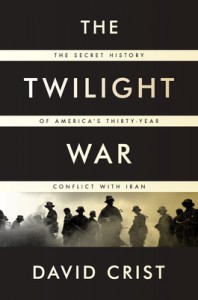
The Twilight War, The Secret History of America’s Thirty-year Conflict with Iran, by David Crist

When President Obama made a heartfelt opening, a smug Iranian leadership viewed it as a ruse or the gesture of a weak leader. Iran spurned him. Obama fell back on sanctions and CENTCOM; Iran fell back into its comfortable bed of terrorism and warmongering. Soon it may no longer be twilight; the light is dimming, and night may well be approaching at long last. [emphasis added]

Thus concludes senior government historian David Crist’s The Twilight War, and be assured Crist’s language is not hyperbole. Crist masterfully details the tumult of U.S.-Iranian relations from the Carter administration to present day. Using recently released and unclassified archived data from principals directly involved in shaping and making American foreign policy, Crist provides the reader an up-front view of “how the sausage is made;” and, as with sausage, the view often isn’t pretty for either side. Crist’s access wasn’t limited to U.S. policy makers, as he conducted interviews with principles on the other side as well, for instance, he had secret meetings/interviews with pro-Iranian Lebanese officials in south Beirut. In all, Crist estimated he interviewed over “four hundred individuals in the United States and overseas.”

Crist begins his story with the Shah of Iran in the last days of his leadership, as popular sentiment was turning against both his regime, as well as his American enablers. He reveals the Carter administration’s fleeting notion of military intervention following the fall of the Shah, and includes details how the clerics reigned in professional Iranian military members, purging the “unreconstructed royalists.” From the start, the U.S. learned how difficult, if indeed impossible, relations were going to be with the new Iranian leadership. One State Department report summed up the situation:

It is clear that we are dealing with an outlook that differs fundamentally from our own, and a chaotic internal situation. Our character, our society are based on optimism—a long history of strength and success, the possibility of equality, the protection of institutions, enshrined in a constitution, the belief in our ability to control our own destiny. Iran, on the other hand has a long and painful history of foreign invasions, occupations, and domination. Their outlook is a function of this history and the solace most Iranians have found in Shi’a Islam. They place a premium on survival. They are manipulative, fatalistic, suspicious, and xenophobic.

While I am certain the writer of this report was not intending to be prophetic, as it turns out this paragraph captures the essence of our conflict. Each American president has thought himself equal to the challenge and each has thus far failed.

The Twilight War includes the birth of Hezbollah, accounts of the Marine barracks bombing in 1983 (from the men who were there), and the details of the Kuwaiti request for American protection of their tanker fleet from the Iranians. From this decision, the U.S. committed military force to protect Middle East oil—a difficult and at times, contentious decision. This decision resulted in continued sporadic confrontations between the U.S. and Iranian forces in the Persian Gulf.

Crist’s book is an illustration writ-large of a book previously reviewed here at Zenpundit.com; Derek Leebaert’s Magic and Mayhem, The Delusions of American Foreign Policy—as both “magic” and “mayhem” figure large in our on-going relationship with Iran. Most U.S. administrations when dealing with Iran came to rely on the “magic, ” and often divorced, or worse, ignored the realities.

At 572 pages, the fast paced narrative is a must read for anyone wanting insight into the origins and issues that remain in the ongoing U.S.-Iran conflict. The Twilight War is exhaustively sourced.  Crist says in the Notes his book was twenty-years in the making and it shows. Further, this book comes with excellent maps, so keeping up with the geography is made easier.

Tom Ricks said, “this is the foreign policy book of the year, perhaps many years,” and Ricks may be right. The Twilight War is an important and timely book on a vital topic, and comes with my strongest recommendation.

Postscript:

A copy of The Twilight War was provided to this reviewer by the publisher.
A digital Mahdi? No way…

Tuesday, July 17th, 2012

[ by Charles Cameron — a computer virus with mild Mahdist implications ]
.

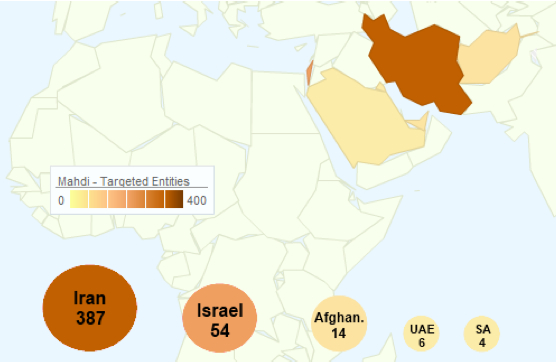
Mahdi: targeted entities, credit: Seculert via Wired

.

Ah. From a religious studies standpoint, the targeting here is curious.

Iran is the country of the Mahdaviat, the nation whose President, wreathed in light, prays at the United Nationsfor the soon coming of the Promised One, that perfect and pure human being, the one that will fill this world with justice and peace, the Mahdi.

**

My own concern is not with the virus, but with the religious connotations of the name that has been given to it.

For those whose concern is with the virus itself, I’d suggest the Wired article, although if blog-friends involved in computer security would like to offer further pointers, I’m sure our readers would welcome them.

**

In case you were wondering, here are the key paras regarding the implications as I see them, from the Jerusalem Post:

Seculert and Kaspersky dubbed the campaign Mahdi, a term referring to the prophesied redeemer of Islam, because evidence suggests the attackers used a folder with that name as they developed the software to run the project.

They also included a text file named mahdi.txt in the malicious software that infected target computers.

and from the Wired coverage:

The infections in Iran and Israel, along with the Farsi strings, suggest the malware may be the product of Iran, used to spy primarily on domestic targets but also on targets in Israel and a handful of surrounding countries. But the malware could also be a product of Israel or another country that’s simply been salted with Farsi strings in order to point the finger at Tehran.

**

So we really can’t tell if it’s the Mahdi (Islam’s awaited one) or the Dajjal (Islam’s antichrist figure)?

**

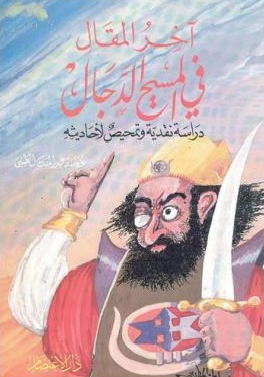
Here, for your edification, is the potrait of the Dajjal from the cover of Okasha Abdelmannan al-Tibi’s The Whole Truth about the Antichrist (courtesy of JP Filiu):

image credit: J-P Filiu, Apocalypse in Islam

According to the tradition as narrated by ‘Abdullah bin ‘Umar, the Prophet said:

I turned my face to see another man with a huge body, red complexion and curly hair and blind in one eye. His eye looked like a protruding out grape. They said (to me), He is Ad-Dajjal.

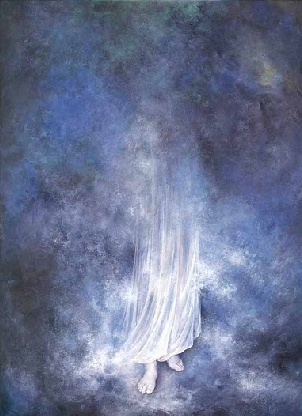
And here is a portrait of the Mahdi, the “Birth of Hope” — insofar as the artist Mahmoud Farshchian feels able to depict him:

image credit: Mahmoud Farshchian

**

While it’s pretty clear that neither Mahdi or Dajjal could be a computer virus, it also seems likely that the virus is associated, either mockingly or sympathetically, with the Mahdi — an indicator, if nothing else, that this end-times figure once little known outside Shi’ite Islam has by now become part of a wider “universe of discourse” and general conversation.

Mahdi has arrived among the geeks.


Switch to our mobile site