zenpundit.com » Apocalyptic

Archive for the ‘Apocalyptic’ Category

Quantity and Quality: angelic hosts at Badr and / or Armageddon

Monday, March 26th, 2012

[ by Charles Cameron — on a mostly overlooked possible asymmetry ]

Michael Peck posted a piece at the game site Kotaku yesterday, titled The Immense Pleasure of Huge War Games, and his opening quote startled me – it’s not one I’d heard before. Here’s Peck’s first para:

“Quantity has a quality all its own,” said Josef Stalin, as he relentlessly flung waves of Soviet tanks and troops against Hitler’s elite but outnumbered panzers. Comrade Stalin might not have believed in a deity, but even a Communist warlord would surely have agreed with Napoleon’s dictum that God is on the side of the bigger battalions.

That interests me deeply, because I regard the relationship between quantity and quality as one phrasing of the knot at the heart of consciousness — the “hard problem” as science terms it — equivalent to the question of how our subjectivity and objective reality mutually arise.

*

And so to Napoleon’s dictum that God is on the side of the bigger battalions — I imagine he means real, flesh and blood battalions — which “even a Communist warlord would surely have agreed with”.

Not so the Qur’an, which reminded the Prophet of the battle of Badr (Quran 8.9-10):

Remember ye implored the assistance of your Lord, and He answered you: “I will assist you with a thousand of the angels, ranks on ranks.” Allah made it but a message of hope, and an assurance to your hearts: (in any case) there is no help except from Allah: and Allah is Exalted in Power, Wise.

Durer‘s angels of the Apocalypse, likewise, are militant angels, though like ourselves (Ephesians 6.12) they:

wrestle not against flesh and blood, but against principalities, against powers, against the rulers of the darkness of this world, against spiritual wickedness in high (celestial) places.

*

And so I would ask you: is there even the possibility of a higher asymmetry at work here — or are we speaking only of a matter of brute force versus high morale?

Should I whisper, should I scream? – Abu Musab al-Suri redux, Pt 2

Thursday, March 1st, 2012

[ by Charles Cameron — typology of intelligence failures, analytic blind spot, millennial movements, prophecy as strategy, abu Musab’s end times chronology ]
.

To tie in with the first part of this double-post, let me quote Aaron Zelin again:

I’ll back that up with Jean-Pierre Filiu‘s observation that in Abu-Musab al-Suri’s reading of jihadist history, “events lead on from one another toward the appearance of the Mahdi” — and that in Abu-Musab’s own words, “We shall be alive, then, when Allah’s order comes.”

I’ll give a brief account of the chronology below. Let’s get on with this.

1.

I don’t believe that Richard Landes, my mentor at the Center for Millennial Studies, mentions Abu Musab al-Suri in his Heaven on Earth: The Varieties of the Millennial Experiences (again as with Furnish, I could be wrong) — but if there’s a single book that will convince you of the enormity of our blind spot when it comes to taking millennial movements seriously, it’s this masterwork — simply stunning.

The thrust of his book is that millennial movements have been quite deliberately overlooked twice by the grand narratives of western civilization — first by religious writers who were embarrassed by the repeated cycle of enthusiasm followed by failure of end times prophecies and retroactively marginalized the topic, and more recently by…

secular historians, determined to push religion into the background of their story, [who] were hardly interested in highlighting religious phenomena that even the ecclesiastical historians considered ridiculous.

It is to undo the damage that this two-fold blindedness has caused us that Landes writes his remarkable book, covering in extraordinarily wide-ranging scholarly detail and with insight and wit, that current in human fear and hope he terms “the most protean belief in human history: millennialism.”

2.

In other words, the “the most protean belief in human history” has been consistently disregarded for way too long by academics, pundits and experts.

Put that in the context of this trenchant paragraph from Richards Heuer‘s Psychology of Intelligence Analysis, just recently quoted and indeed highlighted by Clint Watts and John E. Brennan in their paper Capturing the Potential of Outlier Ideas in the Intelligence Community:

Major intelligence failures are usually caused by failures of analysis, not failures of collection. Relevant information is discounted, misinterpreted, ignored, rejected, or overlooked because it fails to fit a prevailing mental model or mind-set.

3.

Rejected and overlooked?

Even the Psalmist (118.22) knows the importance of what’s rejected:

The stone which the builders rejected has become the chief cornerstone.

And just in passing, I’d argue that two of the seven “outlandish, unthinkable, and wholly anomalous” outliers that Watts & Brennan offer as bulleted examples in their paper — the Khomeini and bin Laden events — would have shown up rather more prominently had a subset of analysts been tasked to keep an eye on millenialist and / or specifically mahdist movements.

4.

Very quickly, then, here are some of the recent reports regarding al-Suri from well-informed analysts which seem to pay little mind to the Mahdist strand in his strategic thinking:

  • Raff Pantucci‘s January 26, 2012 post Whither al Suri? focuses on the implications of al-Suri’s release and quotes Brynjar Lia — insightful, but no mention of Mahdism.
  • Aaron Zelin‘s February 3 Foreign Policy post on al-Suri’s release comes closest to mentioning an apocalyptic angle when he writes:

    Additionally, his lore will grow in light of an alleged vision he had this past August, which was relayed by online jihadist Jundi Dawlat al-Islam (“Soldier of the Islamic State”), a member of the important Shamukh al-Islam Arabic Forum. “I have been informed that the Shaykh [Suri] saw in the past days a vision that he will have an important role in Bilad al-Sham (Syria), we ask Allah that it becomes true,” the jihadist wrote. Suri’s release will be seen as a vindication of that vision by his supporters, and no doubt boost his influence.

    The significant role of Shams — “the apocalyptic theater par excellence” — in al-Suri’s narrative is something J-P Filiu emphasized (p. 189).

  • Bill Roggio‘s February 5 piece for Long War Journal is an excellent backgrounder as befits LWJ — but no mention of eschatological strategy there, either.
  • Jarret Brachman‘s February 6 Abu Musab al-Suri Still Matters Online at Chronus Global is a brief note, just a tip-off that al-Suri is still influential…
  • MEMRI‘s February 8, 2012 The Release of Top Al-Qaeda Military Strategist/Ideologue Abu Mus’ab Al-Suri from Syrian Prison – A Looming Threat makes no mention of al-Suri’s eschatological thinking, and neither does their more extensive report on al-Suri, Al-Qaeda Military Strategist Abu Mus’ab Al-Suri’s Teachings on Fourth-Generation Warfare (4GW), Individual Jihad and the Future of Al-Qaeda, to which their February 2012 post links.
  • And the Jamestown Foundation‘s Feb 10 piece by Murad Batal al-Shishani, Syria’s Surprising Release of Jihadi Strategist Abu Mus’ab al-Suri, in their Terrorism Monitor v 10 # 3 doesn’t mention the apocalyptic angle — and Jamestown is where I heard Ali A Allawi speak on Millenarianism, Mahdism and Terrorism: The Case of Iraq back in 2007!

    Curious…

  • Ah well, there’s always Zenpundit [vbg].

    5.

    Okay, it looks to me as though we’re still so focused on the “nizam la tanzim / system not organization” and “lone wolf / leaderless resistance” aspects of al-Suri’s work, significant as they are, that it’s easy to overlook that damned ridiculous “end times” stuff the fellow also considers important, strategically speaking.

    So for the record, here’s the chronology of future events as J-P Filiu recounts it:

    Events will unfold in the following manner: “The Arabian Peninsula will be preserved [from harm] until the destruction of Armenia, Egypt will be preserved until the destruction of the [Arabian] peninsula, Kufa will be preserved until the destruction of Egypt, the city of impiety [mad?nat al-kufr] will be conquered only after the great wars, and the Antichrist will appear only after this conquest.” The concentrically expanding path of apocalyptic devastation will then close in upon Palestine, the sanctuary of Judeo- Crusader “impiety,” where the ultimate confrontation with the Byzantines will take place in and around the city of Acre.

    Well, that’s part of it, but you should read Filiu’s pp 186-191 for a fuller account — and somebody, please send me a reliable translation of those last 100 pages of abu Musab’s Call if you have one!

    Sadly, I don’t read or speak Arabic.

    6.

    Okay, that’s it, I’ve shouted, or whispered or whatever.

    The books at the top of this post are:

    David Cook, Contemporary Muslim Apocalyptic Literature
    Timothy Furnish, Holiest Wars: Islamic Mahdis, Their Jihads, and Osama bin Laden
    Jean-Pierre Filiu, Apocalypse in Islam
    Richard Landes, Heaven on Earth: The Varieties of the Millennial Experience

    All four are worthy of your consideration.

    Should I whisper, should I scream? – Abu Musab al-Suri redux, Pt 1

    Wednesday, February 29th, 2012

    [ by Charles Cameron — abu Musab al-Suri, analytic blind spot, prophecy as strategy, redux redux redux ]
    .

    Abu Mus’ab al-Suri appears to have been released from prison recently. Speaking of which, we seem to have a blind spot.

    1.

    Here’s how an Egyptian activist who was in prison with Abu Musab in 2005 described their conversations, as reported three days ago in The Arab Digest:

    Abu Musab’s Philosophy in prison was about spreading hope, and what we have to do now to strengthen our connection to Allah; it is the strong power to restore trust in that we will prevail, and that the nation’s projects will not stop at the tyrants’ plans, and the occupation of Afghanistan. The prophet’s prophecies assures the return of Afghanistan and the rise of the black flags army from Khurasan. We will win and continue our role together till victory – May Allah relieve you Abu Musab – these words had a profound effect on our morale, they ended all of our pains in a moment when we foresee a future and our duties.

    As my analyst friend Aaron Zelin, who kindly pointed me to this extract and has himself written on al-Suri for Foreign Policy said:

    Yes indeed — Aaron is exactly right. And just to be clear on this, let me repeat myself:

    Abu Musab al-Suri is the man who “wrote the book” – the 1,500-page book – on jihad. And as you may remember, his book builds to what Jean-Pierre Filiu calls “a hundred-page apocalyptic tract” while also commenting that there is “nothing in the least rhetorical about this exercise in apocalyptic exegesis. It is meant instead as a guide for action.”

    And that black flags army from Khurasan? Those are not just any old black flags, they’re the banners of the “end times army” of the Mahdi.

    2.

    If you wrote a 1500 page book about jihad and devoted the last 100 pages to describing a set of “end times” prophecies that predicted where and in what order various battles would take place, would you have added those last hundred pages in because you had paper to spare and time to kill?

    Or would you have climaxed your book with those hundred pages because those end times prophecies were what the whole business was all about?

    And if, on the other hand, you were in the business of analyzing jihadist strategic literature with a view to understanding the jihadist enemy, would you more or less skip those last hundred pages because they’re just “repetitive theological justification” — because, let’s face it, it’s weird religious stuff?

    3.

    Abu Musab al-Suri is the man who introduced Peter Bergen to bin Laden, and of whom Bergen later wrote:

    He was tough and really smart. He seemed like a real intellectual, very conversant with history, and he had an intense seriousness of purpose. He certainly impressed me more than bin Laden.

    While he was at large prior to his capture in 2005, the FBI offered a $5 million bounty for information as to his whereabouts.

    And Abu Musab al-Suri’s 1,500 page Call to Global Islamic Resistance has been described by counter-terrorist researcher Brynjar Lia as “the most significant written source in the strategic studies literature on al-Qa’ida”.

    A source which has has a 100-page closing section which discusses “end times” hadith…

    WTF? you might well ask — WTF?

    4.

    Here’s one answer to WTT? It comes from Tim Furnish, who (unless I’ve missed it, always a possibility) doesn’t mention al-Suri in his book Holiest Wars: Islamic Mahdis, Their Jihads, and Osama bin Laden, which as you can tell from the subtitle is precisely and exactly about Mahdist warfare — but he does let us know, right in the first paragraph, why Mahdist warfare is important, telling us:

    Muslim messianic movements are to fundamentalist uprisings what nuclear weapons are to conventional ones…”

    Okay, perhaps you think Furnish is screaming — here’s something more like a whisper from J-P Filiu as to what a Mahdist movement might portend:

    An appeal to the imminence of apocalypse would provide it with an instrument of recruitment, a framework for interpreting future developments, and a way of refashioning and consolidating its own identity. In combination, these things could have far-reaching and deadly consequences.

    So. Should I shout, or should I whisper?

    5, 6, 7…

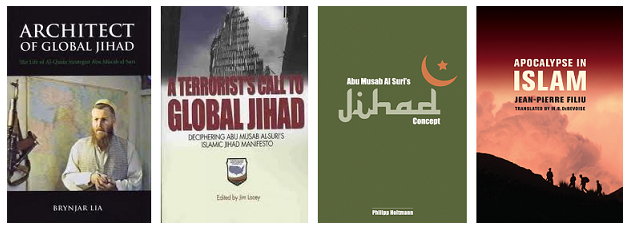
    This is getting too long, I have too much more to say, I want to tie this in with Richards Heuer and Clint Watts and the Psalms of David, so I’ll just list the books illustrated at the head of this post for your convenience now —

    Brynjar Lia, Architect of Global Jihad: The Life of Al Qaeda Strategist Abu Mus’ab al-Suri
    Jim Lacey, A Terrorist’s Call to Global Jihad: Deciphering Abu Musab al-Suri’s Islamic Jihad Manifesto
    Philipp Holltmann, Abu Musab Al-Suri’s Jihad Concept
    J-P Filiu, Apocalypse in Islam

    — and I’ll be back with a follow-up post tomorrow.

    The End

    Tuesday, January 24th, 2012

    The End by Ian Kershaw

    I have a deadline to meet this week for a publisher, so my posts are going to be short and to the point.

    Just received the above title as a gift from my father-in-law. Having read Kershaw’s 2 volume bio of Hitler, as a historian, he merits the accolade “critically acclaimed” and is one of number that I direct students to read who express an interest in WWII or the history of the Third Reich. Here Kershaw explores the Nazi Gotterdammerung of 1944-45; a worthwhile lesson for those who hold supreme confidence in the ultimate rationality of states in existential matters of war and peace.

    That Hitler had been unfathomable to the blinkered and idealistic Neville  Chamberlain seems all too comprehensible, but that the Fuhrer also took in the wily, Georgian monster who ruled of the USSR is less so – until you grasp Hitler’s obsession with triumph or death.  In matters of war the difference between the 20th century’s greatest dictators was that Josef Stalin miscalculated on small stakes while Adolf Hitler gambled for the pot.

    Recklessly.

    MLK’s eschatology and the civil rights movement

    Tuesday, January 17th, 2012

    [ by Charles Cameron — early seeds of MLK’s social orientation in a paper he wrote on eschatology ]
    .

    .
    As on many other days, I was thinking about eschatology yesterday. Also yesterday, I was thinking a bit about Martin Luther King. So it occurred to me to see what I could find out about King’s eschatology. It’s not something I’ve really looked into before, I don’t have access to the intriguing-looking dissertation whose cover is illustrated above — and what I was able to discover via the web somewhat surprised me…

    *

    The main documentary evidence available to me was King’s own very early essay, The Christian Pertinence of Eschatological Hope. In this essay, King makes it clear that he does not question the modern scientific worldview with respect to scientific fact, and thus finds that Christian beliefs from two millennia ago must be reinterpreted in light of recent discoveries and understandings. Specifically, this leads him to reconsider eschatology:

    Among the beliefs which many modern Christians find difficult to accept are those dealing with eschatological hopes, particularly the second coming of Christ, the day of judgment, and the resurrection of the body.

    He regrets that the clash between scientific and scriptural narratives regarding (eg) heaven and hell has had the effect of distancing many of his contemporaries from religion:

    In an attempt to solve this difficult problem many modern Christians have jettisoned these beliefs altogether, failing to see that there is a profundity of spiritual meaning in these beliefs which goes beyond the shackles of literalism.

    and formulates his view of scriptural inspiration which could accommodate both scientific and scriptural modes of knowledge:

    Inspiration did not magically remove the limitations of the writers. It heightened their power, but did not remove their distortions. Therefore it is our job as Christians to seek the spiritual pertinence of these beliefs, which taken literally are quite absurd.

    This is not exactly a novel position, but King expresses it pretty forcefully, dealing in turn with the four great doctrines of the end times — in each case viewing the present moment as our aperture on eternity, and eventually doing so in a way which confers immediacy on the need for social justice.

    He does this under four heads:

    1. The Second Coming of Christ

    It is obvious that most twentieth century Christians must frankly and flatly reject any view of a physical return of Christ. To hold such a view would mean denying a Copernican universe, for there can be no physical return unless there is a physical place from which to return.

    At this point, he quotes George Hedley, The Symbol of the Faith:

    The second coming of the Christ is not an event in space-time, but an experience which transcends all physical categories. It belongs not to the sky, but to the human heart; not to the future, but to whatever present we are willing to assign to it.

    King continues, here making our choices at each moment the criteria for Christ’s presence in our lives:

    Actually we are celebrating the Second Advent every time we open our hearts to Jesus, every time we turn our backs to the low road and accept the high road, every time we say no to self that we may say yes to Jesus Christ, every time a man or women turns from ugliness to beauty and is able to forgive even their enemies. Jesus stands at the door of our hearts if we are willing to admit him. He is far away if with ugliness and evil we crowd him out. The final doctrine of the second coming is that whenever we turn our lives to the highest and best there for us is the Christ. This is what the early Christians were trying to say.

    2. The Day of Judgment

    If our choices at each moment determine whether we “admit” Christ to our hearts or “crowd him out”, King suggests, it follows that each moment is “the judgment”.

    When we set aside the spectacular paraphernalia of the judgment scene and the literal throne we come to the real meaning of the doctrine. The highest court of justice is in the heart of man after the light of Christ has illumined his motive and all his inner life. … In this sense Christ has already come to judge the world. Already and here he is judging every one of us. This is the ultimate meaning of the Christian doctrine. Dare we judge ourselves by the Christ?

    3. Immortality

    King’s view on immortality here is quite surprising: he argues that “God is a conserver of values” — that’s an idea I’d like to investigate — and then makes what is essentially an apophatic case for our inability to envision what immortal life entails:

    For us immortality will mean a spiritual existence. All of the details of what this existence will be like are somewhat beyond our intelligence. But with faith in God we may rest assure that death will not be a period that will end this great sentence of life, but it will be a comma punctuating it to more loftier significance.

    Compare, for example, St Cyril of Jerusalem: “For we explain not what God is but candidly confess that we have not exact knowledge concerning Him. For in what concerns God to confess our ignorance is the best knowledge”

    4. The Kingdom of God

    If the meaning of “spiritual existence” beyond death is ineffable and necessarily unclear to us, King can turn at last to locate “the Kingdom” in the here and now, perceived in terms of social imperative:

    The eschatological thinking of the Christian religion is not without its social emphasis. Throughout nineteen hundred years Christian thinking has centered on the kingdom of God. Some have seen this kingdom in political terms in which there would be established a theocratic kingdom on earth which would triumph over all rival and satanically inspired regimes. Others have seen the kingdom of God coming to realization by means of the increasing influence of the church ultimately destined to dominate the world. Others have seen it as the day when Jesus shall return on the clouds bringing about a cataclysmic end of history and establishing God’s eternal purpose. … Whether it come soon or late, by sudden crisis of through slow development, the kingdom of God will be a society in which all men and women will be controlled by the eternal love of God. When we see social relationships controlled everywhere by the principles which Jesus illustrated in his life–trust, love, mercy, and altruism–then we shall know that the kingdom of God is here. To say what this society will be like in exact detail is quite hard for us to picture, for it runs so counter to the practices of our present social life. But we can rest assure that it will be a society governed by the law of love.

    And there we have the kernel of the quest for social justice, in the name of Christ and of the God who is love, that was to be King’s mission in life.

    As Robert James “Be” Scofield put it in a recent article in Tikkun:

    The purpose of the church for King is not to create dogma, theology, or creeds but rather “to produce living witnesses and testimonies to the power of God in human experience,” and to commit to action.

    *

    I’d love to know more about how King’s eschatology matured and developed across the years, and would appreciate any pointers others may have — particularly and personally because my own mentor, Father Trevor Huddleston [link goes to video], was similarly faced with the issue of a Christian response to racism [link to key quote in a previous ZP post] during his time in S. Africa.

    It is to be regretted that Scott Savaiano‘s interesting-looking dissertation, King among the Eschatologists: The political eschatologies of Martin Luther King, Jr. and Mahatma Gandhi, security state violence and the Civil Rights movement — cover illustrated at the top of this post — should be priced clear out of the reach of interested students of civil rights, non-violence and matters of security and the state.

    Not to mention students of eschatology : )


    Switch to our mobile site